Who Has the Best Home Internet Service in 2026: 8 Providers Compared

How we put this together: we compare official feature and pricing pages, app store listings, privacy policies and public user reviews. Prices change, so check the provider's site before you pay.
Key takeaways
- AT&T Fiber is our pick where it is available, thanks to symmetrical speeds and no annual contract on fiber plans.
- Xfinity and Spectrum offer the widest cable coverage for homes without fiber.
- Verizon Fios and Google Fiber are strong fiber alternatives where their networks reach your street.
- T-Mobile Home Internet and Starlink suit homes without good wired options, with different trade offs on speed and latency.
Quick comparison
| Name | Who it suits | Starting price | Free option | |
|---|---|---|---|---|
 AT&T Fiber | Best fiber where available | See website | No | Visit |
 Xfinity | Widest cable coverage and bundles | See website | No | Visit |
 Spectrum | Cable with wide availability | See website | No | Visit |
 Verizon Fios | Symmetrical fiber speeds | See website | No | Visit |
 Google Fiber | Simple fast fiber plans | See website | No | Visit |
 Optimum | Cable and fiber value | See website | No | Visit |
 T-Mobile Home Internet | 5G home internet without wires | See website | No | Visit |
 Starlink | Rural and remote satellite internet | See website | No | Visit |
The best home internet service providers
The honest answer to who has the best home internet service is that it depends on your address. Fiber is usually best where it exists, cable is best where fiber does not, and 5G or satellite fills gaps where wired service is weak. We compared official plan pages and coverage information for the providers below, and we focused on speed, upload speed, price structure, data terms, and availability. Prices are promotional in many cases and vary by address, so we show See website for starting price and advise checking the price for your exact address, including after any promo period ends.
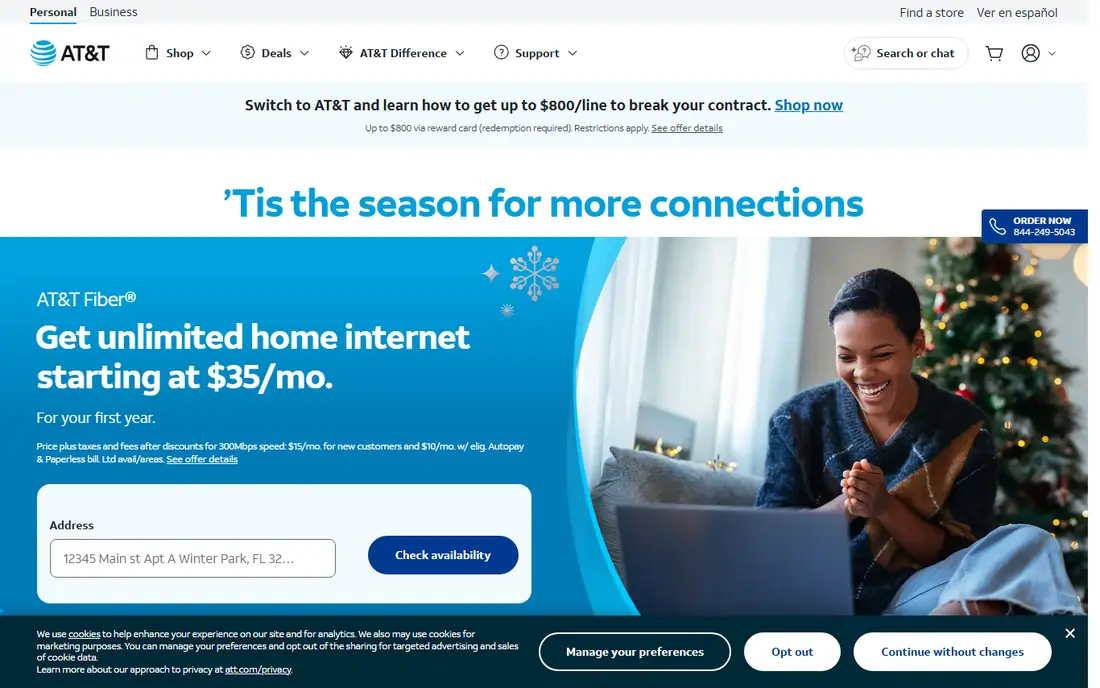
AT&T Fiber is our top pick where it is available, because fiber gives the same speed up and down, which helps video calls, cloud backups, and uploading large files. Fiber plans offer unlimited data and no annual contract in many areas, and equipment is often included in the plan price. That combination makes the monthly cost easier to predict than a cable plan with a promo that jumps after a year.
The limit is availability. AT&T Fiber does not reach every home, even in cities where AT&T offers other internet service. Slower AT&T Internet plans based on older technology are not the same as fiber, so confirm that fiber is available at your address before you compare speeds. If fiber reaches your home, AT&T Fiber should be your first check.
- Symmetrical upload and download speeds
- Unlimited data on fiber plans
- No annual contract on fiber
- Fiber availability is limited by street
- Slower AT&T Internet plans are not fiber
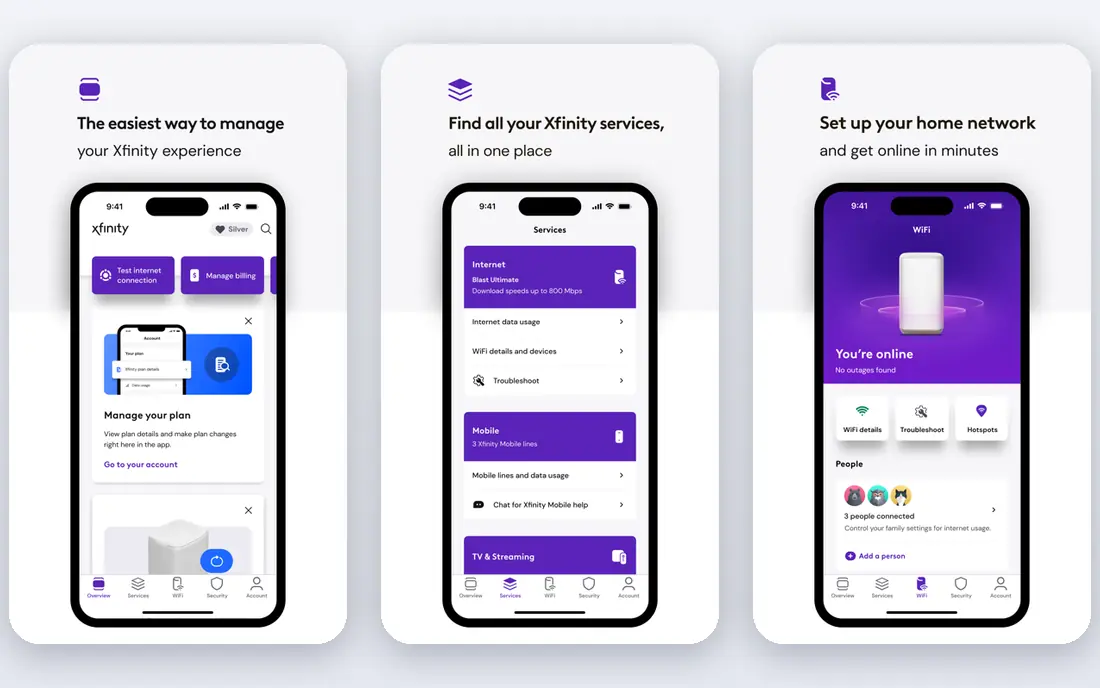
Xfinity, from Comcast, has one of the largest cable footprints in the United States, covering homes in 39 states in many counts. That reach makes it the default option for many homes without fiber. Speed tiers range from basic plans for browsing and streaming to gigabit plans for large households, and bundles with TV and mobile can lower the combined bill.
The main drawback is upload speed, which is lower than download speed on cable, and promo pricing that rises after 12 months in many cases. Data terms and equipment fees also vary by plan and region, so check the full monthly cost for your address. For a home without fiber that wants wide availability and bundle choice, Xfinity is a strong option.
- Very wide cable footprint
- Many speed tiers
- Bundle options with TV and mobile
- Upload speeds are lower than fiber
- Promo prices rise after the promo period
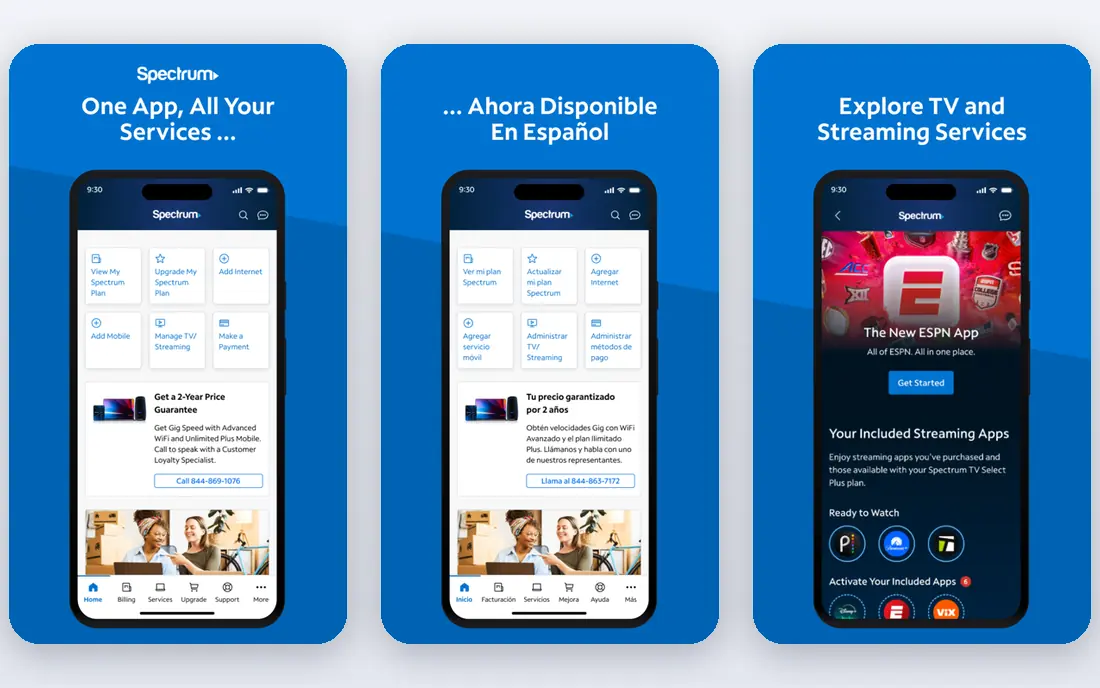
Spectrum, from Charter, offers cable internet across 41 states, making it another strong choice where fiber is not available. Plans are structured simply, with no annual contract in many cases, and speeds cover basic browsing through gigabit service for large households. That simplicity helps when you want internet without a bundle or a long commitment.
Spectrum shares the cable trade off of slower uploads than fiber, and promo prices can rise after the first year. Equipment and activation terms also vary, so confirm the full price before signing. For a home that needs reliable cable service with wide availability, Spectrum is a solid pick, especially where it is the main wired provider.
- Wide cable coverage across 41 states
- No annual contract in many plans
- Simple plan structure
- Upload speeds lag fiber
- Prices can rise after promo periods
Verizon Fios is a fiber service with symmetrical upload and download speeds, similar to AT&T Fiber, and it is known for reliable performance in the areas it serves. Plans cover a range from basic fiber for small households to multi gigabit service for large homes, and many plans have no annual contract. If Fios reaches your street, it is often the best choice in that area.
Availability is the main limit. Fios serves parts of the Northeast and Mid Atlantic, not most of the country, so many readers cannot get it at all. Check availability by address on the Verizon site, and do not assume Fios is an option based on state alone. Where it is available, Fios competes directly with AT&T Fiber for the top spot.
- Fiber with symmetrical speeds
- Strong reliability in served areas
- No annual contract on many plans
- Availability limited to parts of the Northeast and Mid Atlantic
- Not available in most of the country
Google Fiber offers fast fiber internet with a simple plan structure and symmetrical speeds, which appeals to households that want a fast connection without complex tiers. Plans typically include high speeds with no data caps on fiber service, and the service is known for straightforward pricing in the cities it serves.
Google Fiber is available in a limited set of cities, so most homes cannot get it. Installation timing also varies, especially in newly served areas. If Google Fiber is available at your address, it is worth comparing directly with any other fiber provider there, since both will beat cable on uploads. If it is not available, move to the next provider on this list.
- Fast symmetrical fiber
- Simple plan choices
- No data caps on fiber plans in many areas
- Limited city availability
- Installation may take time in new areas
Optimum offers cable and fiber internet across 21 states, with a mix of speed tiers for small and large households. Entry prices are competitive in served areas, and bundles with TV and mobile can help households that want one bill. Fiber plans, where available, offer better uploads than cable plans from the same provider.
Optimum is not a national provider, so availability is limited by state and street. Upload speeds also depend on whether your plan uses fiber or cable, so confirm the technology at your address, not just the headline download speed. For homes in Optimum areas, it is a good value option to compare with Xfinity or Spectrum where both are present.
- Cable and fiber options in served states
- Competitive entry prices
- Bundle options
- Availability limited to 21 states in many counts
- Upload speeds vary by technology
T-Mobile Home Internet uses 5G fixed wireless to bring internet into a home without a cable or fiber line. You place a gateway near a window, connect to the 5G network, and use it like a normal home router. That simplicity suits renters, homes without wired options, and households that want to avoid installation appointments.
Speeds vary by signal strength, tower congestion, and time of day, so performance is less predictable than fiber or cable. Upload speeds and latency may also be weaker for competitive gaming or heavy video uploads. Check T-Mobile availability by address and, if possible, test during peak evening hours. For a home without good wired service, T-Mobile is a practical, low hassle option.
- No wired installation needed
- Simple pricing
- Wide 5G footprint
- Speeds vary by signal and congestion
- Not ideal for heavy upload or competitive gaming in all areas
Starlink, from SpaceX, uses low orbit satellites to serve homes that wired providers do not reach. That makes it a real option for rural, remote, and farm homes where cable and fiber are absent and 5G signal is weak. Latency is lower than older geostationary satellite service, which helps video calls and browsing feel more normal.
Starlink costs more per month than most wired plans, and equipment must be bought up front. Speeds vary with weather, satellite load, and obstructions, and the dish needs a clear view of the sky. For a rural home with no good wired option, Starlink is often the best available service. For a city home with fiber or cable, a wired plan will be cheaper and more stable.
- Available in rural and remote areas
- Low orbit satellites give lower latency than older satellite
- No wired line needed
- Higher monthly cost and equipment cost
- Speeds vary by weather and congestion
- Needs clear sky view
How we picked these
We compared official plan and coverage pages for home internet providers available in October 2026, and we checked that each official homepage matches the provider named. We favored providers with wide coverage, clear speed tiers, and a mix of fiber, cable, 5G, and satellite technologies, so readers in different areas can find a relevant option. Because prices and speeds vary by address and promo, we show See website for starting price and advise checking the exact price for your address.
How to choose for your address
Check availability first, before comparing speeds. Use each provider's address checker, and also check the Federal Communications Commission broadband map for what is reported at your address. A provider that does not serve your street cannot be your best choice, no matter how good its national plans look.
Next, match speed to household use. A small household that streams and browses can manage on 100 to 300 Mbps, while a large household with several workers, gamers, and streamers may need 500 Mbps or more. Upload speed matters if you work from home on video calls, upload large files, or stream. Finally, read the full price: promo length, price after promo, equipment fees, installation fees, data terms, and contract length. A low promo price that doubles in year two is not the same as a stable price.
Questions to ask before you sign
Ask whether the price includes equipment and taxes, how long the promo lasts, what the price becomes after the promo, and whether there is a data cap or throttling policy. Ask about installation, contract length, and early termination fees. Ask how to test speeds and what support is available if speeds fall far below the advertised tier.
Frequently asked questions
Who has the best home internet service?
AT&T Fiber and Verizon Fios are the best where fiber is available, thanks to symmetrical speeds and reliability. Xfinity and Spectrum are the best cable options where fiber is not available, while T-Mobile and Starlink suit homes without good wired service.
What internet company is the best for fiber?
AT&T Fiber, Verizon Fios, and Google Fiber are the strongest fiber providers in this list, each limited to the areas its network serves. Check all three by address if you live in an area where more than one fiber network is present, and compare upload speed and price after promo.
What are the best home internet companies for rural areas?
Starlink suits rural and remote homes without wired service, while T-Mobile Home Internet suits rural homes with good 5G signal. Fixed wireless and satellite speeds vary by location, so test signal and check for data terms before committing.
Is fiber better than cable internet?
Fiber usually offers faster uploads, more stable speeds, and lower latency than cable, which helps video calls, cloud backups, and gaming. Cable is still good for most streaming and browsing, and it is available in far more homes than fiber.
How much internet speed do I need at home?
A small household can manage on 100 to 300 Mbps for streaming and browsing. A larger household with remote work, gaming, and several streams at once may need 500 Mbps or more. Upload speed matters more than download speed for video calls and large file uploads.
Do home internet prices go up after a promo?
Often yes. Many cable and fiber plans offer a promo price for 12 months, then move to a standard rate. Check the promo length, the standard rate, equipment fees, and contract terms on the provider site for your address before you sign.
Sources we checked (8)

Online Jobs is an independent blog about careers, online work, learning new skills and the tools that help people earn. More about us.
Keep reading
All posts
iPhone Alternatives
Looking for iPhone alternatives in 2026? Compare 9 Android phones from Samsung, Google, OnePlus, and more, with cameras, battery life, and honest trade-offs.

Best Robotics Companies
Compare the best robotics companies in 2026, from humanoids to factory robots, with focus areas, deployments, and honest limits for buyers and pilots.

Best Phone Company to Switch To
Compare the best phone company to switch to, from low-cost Visible and Mint Mobile to full-service T-Mobile, Verizon and AT&T, with prices and trade-offs.