Top 10 Logistics Software in 2026: 10 Platforms Compared


Global transport for enterprises · Starting price: See website
How we put this together: we compare official feature and pricing pages, app store listings, privacy policies and public user reviews. Prices change, so check the provider's site before you pay.
Key takeaways
- Oracle Transportation Management and SAP Extended Warehouse Management suit large enterprises with global, complex logistics networks.
- ShipStation and ShipBob suit e-commerce sellers who need shipping, fulfilment, or both without enterprise complexity.
- Blue Yonder, Manhattan Associates, and Descartes suit supply chain planning, warehouse, and transport specialists.
- Pricing ranges from $14.99 per month for small shipping tools to quote-based enterprise contracts, so match the tool to your shipment volume.
Quick comparison
| Name | Who it suits | Starting price | Free option | |
|---|---|---|---|---|
| Oracle Transportation Management | Global transport for enterprises | See website | No | Visit |
 SAP Extended Warehouse Management | Warehouse control inside SAP | See website | No | Visit |
 ShipStation | Shipping for e-commerce sellers | $14.99 per month | Free trial | Visit |
 ShipBob | Outsourced fulfilment for sellers | See website | No | Visit |
 Blue Yonder | Supply chain planning and execution | See website | No | Visit |
 Manhattan Associates | Warehouse and supply chain at scale | See website | No | Visit |
 Descartes | Transport, routing, and customs | See website | No | Visit |
 NetSuite | ERP plus logistics for growing firms | See website | No | Visit |
 Shipwell | Transport management for shippers | See website | No | Visit |
 Logiwa | Warehouse management for e-commerce | See website | No | Visit |
The best logistics software
Logistics software covers transport, warehousing, shipping, and fulfilment, and no single tool does all of it equally well. Some platforms manage global freight, others run a warehouse, and others print shipping labels for an online store. We compared official product pages and published pricing, and we focused on platforms that are actively used for real logistics work in 2026.
Oracle Transportation Management
Who it suits: Global transport for enterprises
Oracle Transportation Management, or OTM, is a deep global transport platform for shippers with high volumes and complex networks. It handles planning, execution, freight settlement, and trade compliance across modes, with ETA prediction and load configuration tools. For Oracle ERP users, integration is a major advantage, since order, warehouse, and transport data flow together.
Complexity is the drawback. Published comparisons have described monthly pricing starting around $450 for some configurations, but enterprise deployments are usually quote-based and implementation can be long. OTM fits large shippers that need global transport control. Smaller sellers should look at ShipStation or Shipwell first.
- Covers air, ocean, rail, parcel, and truckload in one platform
- Strong Oracle ERP integration
- Machine learning ETA prediction
- Enterprise pricing and complexity
- Implementation takes real commitment, especially outside Oracle systems
SAP Extended Warehouse Management
Who it suits: Warehouse control inside SAP
SAP Extended Warehouse Management, or SAP EWM, controls complex warehouse operations: receiving, putaway, picking, packing, labour management, and yard operations, inside the SAP ecosystem. Large manufacturers, retailers, and distributors use it where warehouse accuracy and throughput directly affect service levels.
Outside SAP, much of the value is lost, and implementation needs SAP skills and time. Smaller warehouses will find a standalone warehouse system faster and cheaper. For SAP shops with complex warehouses, EWM is the natural, deeply integrated choice.
- Deep warehouse control inside SAP
- Labour, slotting, and yard management
- Strong for complex warehouses
- SAP-only value is highest
- Enterprise pricing and implementation
- Needs SAP expertise
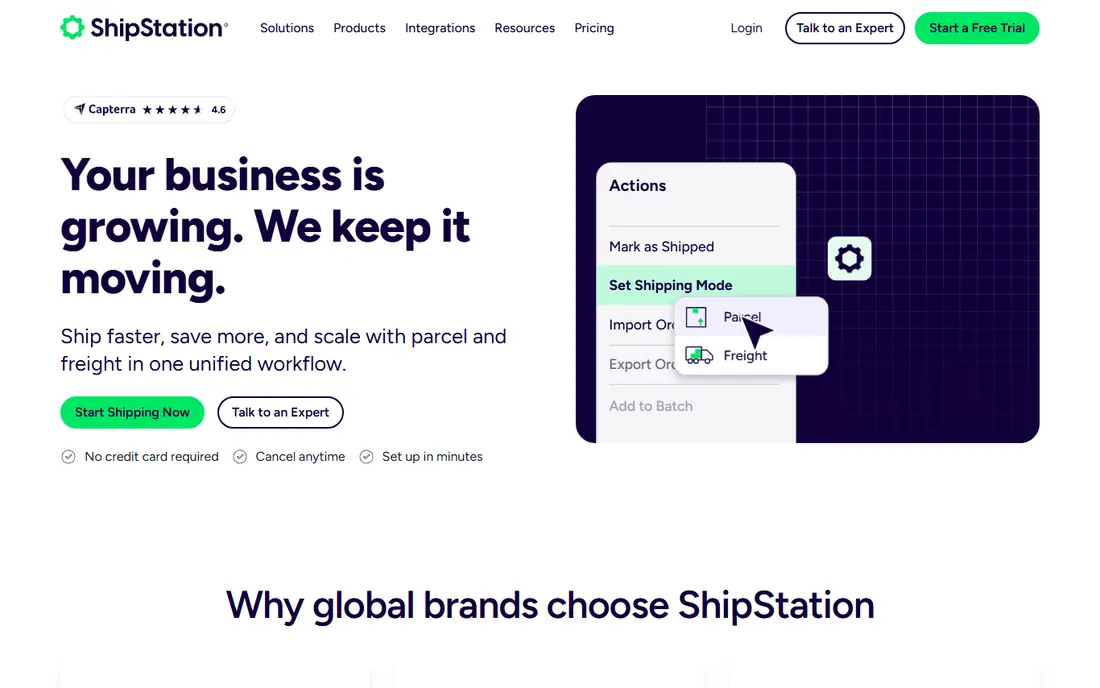
ShipStation is the most practical shipping tool for small and mid-sized e-commerce sellers. It imports orders from many sales channels, applies automation rules for carriers and services, prints labels in bulk, and sends tracking updates. Published vendor pricing starts at $14.99 per month for 50 shipments, with higher tiers by shipment volume and a 30-day free trial.
Subscription cost is predictable, but carrier shipping costs sit on top, so total cost depends on volume and weight. Advanced inventory and warehouse features need higher plans. For sellers who ship parcels themselves, ShipStation is a strong, affordable starting point.
- Multi-channel order import
- Automation rules for labels and tracking
- Transparent monthly pricing
- Shipping costs are separate from subscription
- Support response can vary
- Advanced warehouse features need higher plans
ShipBob is a fulfilment provider, not just software. Sellers send inventory to ShipBob warehouses, and ShipBob picks, packs, ships, and handles returns, with a dashboard for orders, inventory, and tracking. That model suits growing brands that do not want to lease warehouse space or hire fulfilment staff.
Costs are usage-based, covering receiving, storage, picking, packing, shipping, and returns, so a sample invoice for your typical month is essential before comparing with self-fulfilment. Control is also lower than running your own warehouse. ShipBob fits when outsourced labour and space justify the fees.
- Outsourced warehousing, picking, packing, and shipping
- Fulfilment network across regions
- Returns handling
- Usage-based costs for receiving, storage, and fulfilment
- Less control than running your own warehouse
Blue Yonder covers supply chain planning, warehouse management, and transport execution in one suite, with a focus on forecasting, replenishment, and execution for retailers and manufacturers. Its planning tools help teams balance inventory, service, and cost across a network, rather than optimising one warehouse in isolation.
Enterprise scope brings enterprise cost and implementation effort. Smaller operations will find it heavy. Large supply chains that need planning plus execution, and that can support a major rollout, are the natural audience for Blue Yonder.
- Broad supply chain planning, warehouse, and transport coverage
- Strong for retail and manufacturing
- AI-assisted planning tools
- Enterprise pricing and complexity
- Implementation needs specialist partners in many cases
Manhattan Associates is a long-standing leader in warehouse and supply chain software for high-volume retail, distribution, and manufacturing. Its warehouse management system handles complex picking, automation, labour, and slotting, while order management coordinates fulfilment across stores and warehouses. Performance at scale is the core strength.
Cost and implementation place it firmly in the enterprise category. Small warehouses should choose a simpler system such as Logiwa. Large operations with automation, high throughput, and complex fulfilment networks will find Manhattan hard to beat.
- Leading warehouse management at scale
- Strong order management
- Proven in high-volume retail and distribution
- Enterprise pricing
- Implementation is a major project
- Overkill for small warehouses
Descartes offers a broad logistics network covering routing and fleet management, transport management, customs declarations, and trade compliance. That combination suits shippers, carriers, and brokers who move goods across borders and need compliance handled alongside transport planning. Its global network connects many logistics partners.
Pricing is modular, so costs depend on which modules you use, and single-module buyers may get less value. Descartes fits best for cross-border and multi-party logistics, where compliance and network connectivity matter as much as routing.
- Routing, fleet, and transport management
- Customs and trade compliance tools
- Global logistics network
- Modular pricing can be complex
- Best value when several Descartes modules are used together
NetSuite, from Oracle, combines ERP with inventory, order management, and warehouse features, which suits growing firms that want logistics inside their main business system rather than in separate tools. Orders, inventory, purchasing, and fulfilment share one dataset, reducing reconciliation work as a company scales.
Specialist warehouse or transport needs may still need a dedicated tool, and ERP implementation is a project, not a quick install. NetSuite fits firms that need a coherent business system first, with solid logistics inside it, rather than a best-of-breed transport or warehouse platform alone.
- ERP, inventory, order, and warehouse management in one system
- Good for growing firms outgrowing spreadsheets
- Cloud-based
- ERP implementation takes time
- Logistics depth trails specialist warehouse and transport tools
Shipwell is a transport management system for shippers that want better visibility, carrier management, and shipment tracking without an enterprise TMS rollout. It helps teams tender loads, track shipments, manage exceptions, and analyse freight spend in one platform. Mid-sized shippers often find it a practical step up from spreadsheets and email.
Global, multi-modal complexity and deep trade compliance are thinner than in Oracle or Descartes. Pricing is quote-based, so get a quote for your lane volume. Shipwell fits shippers that need modern TMS visibility at a mid-market level of effort.
- Transport management with shipment tracking and carrier tools
- Easier to adopt than enterprise TMS platforms
- Good visibility
- Less depth than Oracle or Blue Yonder for global complexity
- Pricing is by quote
Logiwa is a warehouse management system built for e-commerce and third-party logistics providers, covering receiving, inventory, picking, packing, and shipping for online orders. It integrates with sales channels and shipping carriers, which helps warehouses that fulfil many small orders quickly. That e-commerce focus makes setup more relevant than a generic warehouse tool.
Manufacturing or heavy industrial warehouses may need different features, and pricing is quote-based. For e-commerce warehouses and 3PLs that need a modern, cloud-based WMS, Logiwa is a strong, focused option.
- Warehouse management built for e-commerce
- Order, inventory, and fulfilment workflows
- Integrations with sales channels
- E-commerce focus means less fit for manufacturing warehouses
- Pricing is by quote
How we picked these
We compared official product pages, pricing pages, and published logistics comparisons, covering transport, warehouse, shipping, and fulfilment rather than only one niche. We included enterprise and small-business tools, and we wrote See website where pricing was quote-based, while publishing the verified ShipStation starting price. A tool was included only if it is actively used for logistics work, not merely marketed as a logistics tool.
What to check before you choose
Start with your logistics job. A seller shipping parcels needs ShipStation or ShipBob. A warehouse needs a WMS such as Manhattan, SAP EWM, or Logiwa. A shipper moving freight needs a TMS such as Oracle, Shipwell, or Descartes. Buying a suite that covers everything can waste money if you only need one part.
Volume, integrations, and rollout
Model your real volume: orders, shipments, warehouse transactions, and freight spend, since pricing often scales with volume. Check integrations with your ERP, sales channels, carriers, and warehouse hardware before signing. Pilot on one warehouse, lane, or channel, measure accuracy and on-time performance, and only then expand. Logistics rollouts fail more often from poor data and training than from missing features.
Frequently asked questions
What is the best software for logistics?
ShipStation is best for small e-commerce shipping, Oracle Transportation Management is best for global enterprise transport, and Manhattan Associates is best for large-scale warehousing. The best logistics software depends on whether your main job is shipping, warehousing, or transport.
What is the top logistics software for small businesses?
ShipStation suits sellers who ship themselves, ShipBob suits sellers who want fulfilment outsourced, and NetSuite suits growing firms that want logistics inside an ERP. All three are easier to adopt than enterprise suites.
How much does logistics software cost?
Small shipping tools start around $14.99 per month, mid-market warehouse and transport tools are usually quote-based, and enterprise suites run into large annual contracts plus implementation. Always compare total cost, including shipping, storage, and implementation, not just the subscription.
What is the difference between a TMS and a WMS?
A transport management system, or TMS, plans and manages freight and shipments between locations. A warehouse management system, or WMS, manages inventory and operations inside a warehouse, such as receiving, picking, and packing.
Do I need a full logistics suite or one tool?
Most businesses need one tool first, for their biggest pain point, such as shipping, warehousing, or transport. Add other tools as volume grows, and choose systems with open integrations so data can flow between them.
Sources we checked (10)

Online Jobs is an independent blog about careers, online work, learning new skills and the tools that help people earn. More about us.
Keep reading
All posts
n8n Alternatives
n8n alternatives compared for 2026, with Zapier, Make, Activepieces, and more, covering visual builders, code steps, self-hosting, and pricing models.

ZoomInfo Alternatives
The best ZoomInfo alternatives in 2026, compared on price, free plans, data coverage, and which tool fits small teams or large sales teams best in detail.

Zoom Alternatives for Webinars
Compare Zoom alternatives for webinars in 2026, from browser-based rooms to enterprise events, with prices, attendee limits, features and honest trade-offs.