Substack Alternatives in 2026: 8 Platforms Compared

How we put this together: we compare official feature and pricing pages, app store listings, privacy policies and public user reviews. Prices change, so check the provider's site before you pay.
Key takeaways
- Beehiiv is the closest direct replacement for Substack, with growth tools and no revenue share on paid subscriptions.
- Ghost suits creators who want full ownership and design control, including a self-hosted option.
- Kit suits creators who sell products through email automation, while MailerLite suits budget-conscious senders.
- The reason you leave Substack matters more than the feature list, because revenue share, ownership and discovery pull in different directions.
Quick comparison
| Name | Who it suits | Starting price | Free option | |
|---|---|---|---|---|
 Beehiiv | Newsletter growth | $49 per month | Yes | Visit |
 Ghost | Full ownership | $9 per month | Free trial | Visit |
 Kit | Creator automation | $29 per month | No | Visit |
 MailerLite | Budget email | $9 per month | Yes | Visit |
 Mailchimp | Marketing email | See website | Yes | Visit |
 WordPress.com | Website plus newsletter | See website | Yes | Visit |
 Buttondown | Simple newsletters | See website | Yes | Visit |
 Patreon | Tiered memberships | See website | Yes | Visit |
The best Substack alternatives
Substack is easy to start and strong for discovery, but its 10 percent cut of paid subscription revenue and its limited design control push many creators to look elsewhere. The alternatives below solve different parts of that problem. Some give you full ownership, some give you better growth tools, and some give you stronger automation for selling products. We compared official pricing pages and feature pages to sort them by the job they do best.
Beehiiv is the cleanest direct replacement for Substack for most newsletter creators. It offers a website, email sending, paid subscriptions and growth tools such as referral programs and recommendations, without taking a share of your paid subscription revenue beyond payment processing. The free plan up to 2,500 subscribers lets new creators test the platform before paying, and the editor is built for newsletters rather than general marketing email.
The main loss compared with Substack is discovery. Substack recommendations and its reader network can bring new subscribers without extra work, while Beehiiv expects you to drive more growth yourself. Paid plans also rise with subscriber count, so check the price at your next growth stage, not just today. Beehiiv suits creators who want ownership and growth tools and who are ready to handle their own promotion.
- Free up to 2,500 subscribers in many plans
- Growth tools and referral programs
- No revenue share on paid subscriptions
- Discovery is weaker than Substack network
- Paid plans cost more as list grows
- Design is newsletter-first
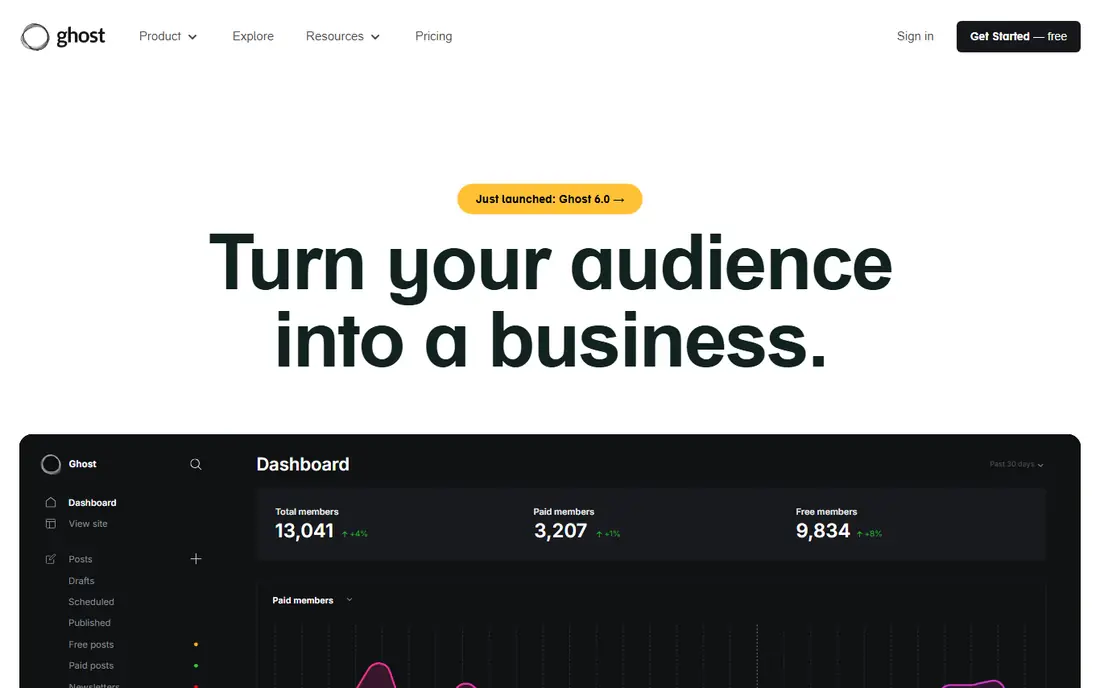
Ghost is an open-source publishing platform for newsletters and membership sites, with full control over design, data and content. You can self-host it for free apart from server and email costs, or use Ghost Pro, the hosted service, from the monthly price shown here. Paid memberships run through Stripe, and Ghost does not take a share of that revenue, which makes the long-term economics clearer than Substack for larger paid lists.
Growth is the trade-off. Ghost has no equivalent to Substack discovery or Beehiiv referral boosts, so you need your own audience source. Self-hosting also needs technical confidence, while hosted pricing rises with member count. Ghost suits established creators who value ownership and design, and who already have an audience to bring with them.
- Open-source platform
- Full design control
- Paid memberships with no Ghost revenue share
- Growth tools are limited
- Self-hosting needs technical skill
- Hosted pricing rises with members
Kit, formerly ConvertKit, is built for creators who sell through email. Its visual automation builder lets you set up welcome sequences, tag subscribers by interest, and move people between sequences based on clicks or purchases. Landing pages and digital product sales sit in the same account, which helps coaches, course sellers and authors who use email as a sales channel rather than only as a publication.
The cost structure is the catch. Recent reports note that Kit ended its free plan for new accounts, with paid plans starting at the monthly price shown here, and costs rise as your list grows. Newsletter design is also simpler than Ghost, and discovery tools are limited. Kit suits creators whose main goal is automation and sales, not just publishing a newsletter.
- Strong visual automation
- Landing pages and product sales
- Tag-based subscriber management
- No lasting free plan in recent reports
- Cost rises with list size
- Newsletter design is simpler than Ghost
MailerLite is a budget-friendly email platform that works well for creators who want simple newsletters without a large bill. It offers automation, landing pages, forms and basic segmentation at a low starting price, with a free plan for small lists. The interface is clear, which helps solo creators who send regularly but do not need complex sales funnels.
Paid memberships are not its strength. If your main income is paid subscriptions with gated posts, Ghost or Beehiiv will fit better. MailerLite also offers fewer growth tools than Beehiiv. It suits creators who send free or low-cost newsletters, who want reliable delivery at a low price, and who do not need a full membership site.
- Low starting price
- Simple automation
- Landing pages and forms included
- Paid membership features are limited
- Design options are simpler
- Free plan limits subscribers
Mailchimp is a general marketing email platform with wide integrations, automation and reporting. It suits small businesses and creators who also need marketing campaigns, audience segments and connected tools such as shops or booking systems. The free plan covers small lists, and the template and automation tools are familiar to many marketers.
For pure newsletter creators, Mailchimp can feel business-first. Pricing rises with contact count, and paid membership features are less central than on Ghost or Beehiiv. The interface also packs many marketing tools into one dashboard, which can feel busy if you only send a weekly issue. Mailchimp suits creators who already use it for marketing and who want newsletters in the same account.
- Wide integrations
- Marketing automation and analytics
- Free plan for small lists
- Pricing rises with contacts
- Paid newsletter features can feel business-first
- Interface can feel busy
WordPress.com gives you a full website with newsletter tools, which suits creators who want articles, pages and email in one place. You can publish long-form posts, build a site structure, and send newsletters to subscribers, with themes and plugins that go far beyond a newsletter-only platform. That breadth helps creators whose work is not only email, but also search, portfolio or course content.
Setup takes more time than Beehiiv or Substack, and newsletter features vary by plan, so check what is included before you commit. Paid plans are needed for fuller tools, custom domains and some monetisation features. WordPress.com suits creators who want a website first and a newsletter second, and who are comfortable managing a site.
- Full website plus newsletter tools
- Wide theme and plugin options
- Ownership of your site content
- Newsletter features vary by plan
- Setup takes more time
- Paid plans needed for fuller tools
Buttondown is a deliberately simple newsletter tool. It focuses on writing, sending and managing subscribers, with a clean interface and support for Markdown and an API for developers. That simplicity appeals to writers who want to send an email without learning a marketing platform, and who value a calm writing experience over growth dashboards.
Design and growth tools are limited compared with Beehiiv or Ghost. There is no large recommendation network, and paid membership features are simpler. Buttondown suits writers with a small or growing list who want a low-friction newsletter tool, and who will handle growth through their own channels.
- Very simple newsletter workflow
- Clean writing interface
- API and Markdown support
- Design options are limited
- Growth tools are minimal
- Paid features are simpler than rivals
Patreon is a membership platform rather than a newsletter-only tool, and it fits creators who sell tiered access. You can offer several membership levels, each with different perks, posts and community access, and Patreon handles payments and member management. That structure suits podcasters, video creators, writers and artists who want supporters to pay for ongoing work.
The platform fee on earnings is the main cost, and free newsletters are not its strength. Discovery also depends largely on your own audience, because Patreon does not bring readers the way Substack recommendations can. Patreon suits creators who already have fans and who want tiered memberships, while Beehiiv or Ghost suit creators whose main product is the newsletter itself.
- Tiered memberships and perks
- Built-in payment handling
- Community tools for supporters
- Platform fee on earnings
- Less suited to free newsletters
- Discovery depends on your own audience
How we picked these
We compared official pricing pages and feature pages, and we kept only platforms that are still available and truly support newsletters, paid memberships or creator email in 2026. We favoured platforms with a distinct reason to leave Substack, whether ownership, growth, automation or price, rather than listing many similar email tools. Revenue share, free plan limits, design control and discovery all shaped the shortlist.
We did not claim hands-on migration testing, and we did not invent subscriber counts or revenue figures. Where pricing varied by subscriber or member count, we used the entry figure shown on the vendor page and marked prices as See website when no single figure applied. Prices change, so check the vendor page at your list size before you move.
How to choose based on why you are leaving Substack
Start with the reason, not the feature list. If the 10 percent revenue share is the problem, any platform with no revenue share fixes it, but the right one still depends on your list size and growth plan. If ownership is the problem, only a platform where you control data, design and domain truly fixes it. If discovery is the problem, no alternative fully replaces Substack network effects, so you need a growth plan of your own.
Plan the move before you export
Export your subscriber list, check which subscribers are paid and which are free, and test the new platform with a small send first. Tell readers where you are moving and why, and keep your Substack archive accessible during the transition. A careful move protects deliverability and avoids losing subscribers who miss the announcement.
Compare total cost at your next size
Price the platform at your current list size and at double that size, because newsletter costs rise with subscribers. Add payment processing fees, which apply on most platforms, and check whether paid plans include the growth or automation features you need. A cheap entry price can become expensive if key features sit on a higher tier.
Frequently asked questions
What are the best Substack alternatives for paid newsletters?
Beehiiv and Ghost are the strongest paid newsletter options, because neither takes a share of paid subscription revenue beyond processing fees. Beehiiv adds growth tools, while Ghost adds design control and ownership. Kit also supports paid newsletters, but its strength is automation and product sales rather than publishing alone.
Are there free alternatives to Substack?
Yes, Beehiiv offers a free plan up to 2,500 subscribers, MailerLite and Mailchimp offer free plans for small lists, and Ghost can be self-hosted for free apart from server and email costs. Free plans limit subscribers, features or sends, so check the limits at your list size. Substack itself is free to publish until you charge readers.
What is the best alternative to Substack for writers?
For writers who want a simple newsletter, Beehiiv or Buttondown are strong choices, while Ghost suits writers who want a full publication site. The best choice depends on whether you need growth tools, design control or simplicity. Try the free plan or trial with a real issue before you move your full list.
Can I move my subscribers from Substack to another platform?
Yes, most platforms support CSV import of subscribers, and some offer direct migration help. Paid subscribers need extra care, because payment details do not move in the same way as email addresses, so check the new platform migration guide. Tell readers about the move, test a send, and keep your old archive live during the transition.
Do Substack alternatives help you grow faster?
Some help, but none fully replace Substack discovery. Beehiiv offers referral programs and recommendations, while other platforms rely more on your own promotion, search and social channels. Growth still depends on your content, your promotion and your existing audience, whatever platform you choose.
Sources we checked (8)

Online Jobs is an independent blog about careers, online work, learning new skills and the tools that help people earn. More about us.
Keep reading
All posts
n8n Alternatives
n8n alternatives compared for 2026, with Zapier, Make, Activepieces, and more, covering visual builders, code steps, self-hosting, and pricing models.

ZoomInfo Alternatives
The best ZoomInfo alternatives in 2026, compared on price, free plans, data coverage, and which tool fits small teams or large sales teams best in detail.

Workday Alternatives
We compared the best workday alternatives for HR, payroll, and global hiring, from BambooHR and Gusto to Rippling, Deel, and HiBob for growing teams in 2026.