Best Splunk Alternatives in 2026: 8 Tools Compared

How we put this together: we compare official feature and pricing pages, app store listings, privacy policies and public user reviews. Prices change, so check the provider's site before you pay.
Key takeaways
- Datadog and Elastic are the closest Splunk alternatives for teams that need logs, metrics, and search in one place.
- Sumo Logic and Graylog suit teams that want log management without Splunk licence costs, with different trade-offs in hosting and scale.
- Dynatrace and New Relic are better when application performance matters more than raw log search.
- Microsoft Sentinel and ManageEngine Log360 suit teams that need security monitoring and compliance reporting on top of log collection.
Quick comparison
| Name | Who it suits | Starting price | Free option | |
|---|---|---|---|---|
 Datadog | Logs, metrics, and traces together | See website | Free trial | Visit |
 Elastic | Search-first log analysis | See website | Free trial | Visit |
 Sumo Logic | Cloud log analytics at scale | See website | Free trial | Visit |
 Graylog | Self-hosted log management | Free | Yes | Visit |
 Dynatrace | Application and infrastructure observability | See website | Free trial | Visit |
 New Relic | Application monitoring with logs | See website | Yes | Visit |
 Microsoft Sentinel | Cloud SIEM for Microsoft shops | See website | Free trial | Visit |
 ManageEngine Log360 | SIEM and compliance for mid-size firms | See website | Free trial | Visit |
The best Splunk alternatives
Splunk is known for collecting, searching, and analysing machine data, but its licence costs rise with data volume, which pushes many teams to look elsewhere. The alternatives below cover the same ground in different ways, from cloud log platforms to self-hosted tools and security-focused SIEM products. We compared official documentation, pricing pages, and feature pages for tools maintained in 2026.
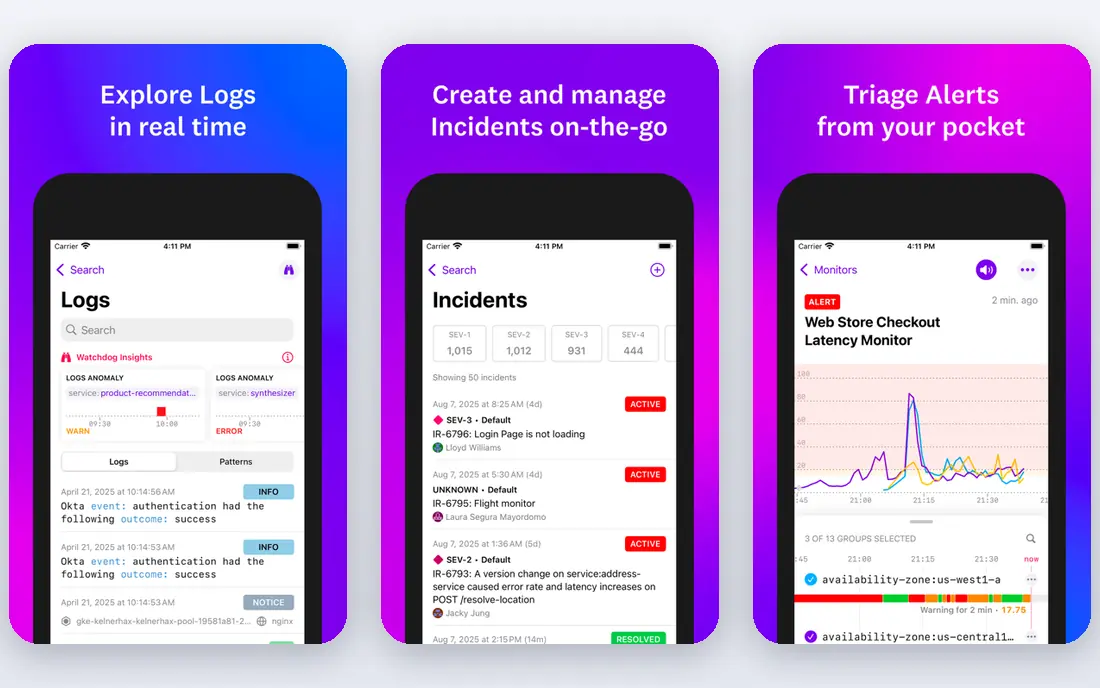
Datadog is a strong Splunk alternative when you want logs connected to the rest of observability. A log line can lead straight to a metric chart or a trace, which shortens incident work compared with searching logs in isolation. Its dashboards, monitors, and notebooks give teams one place to investigate, rather than three separate tools.
The cost warning matters most here. Datadog charges for log ingestion and retention, so an unfiltered log stream can become expensive. Set indexes, exclusions, and retention tiers early, and model a month of real volume during the trial before you move a large Splunk workload over.
- Logs linked to metrics and traces
- Strong dashboards and alerts
- Large integration library
- Usage-based pricing can grow fast
- Log volume needs careful control
- Smaller teams may find it complex

Elastic, built around Elasticsearch and Kibana, is the closest open-core alternative to Splunk for pure log search. You can ingest logs from many sources, search them fast, build dashboards, and set alerts, all on a platform that many teams already know. For security and operations teams that live in search queries, that speed is the main draw.
The trade-off is operations. Running Elasticsearch at scale needs attention to cluster size, index design, and retention, and a poorly tuned cluster can become slow or costly. Hosted Elastic removes some of that work but adds a usage bill. If your team has Elastic skills, it is a strong pick. If not, budget for that learning curve.
- Very strong search
- Kibana dashboards included
- Flexible deployment options
- Scaling a cluster takes skill
- Hosted costs vary with data
- Query learning curve for beginners

Sumo Logic is a cloud platform for log management, security analytics, and observability. It ingests logs from cloud services, servers, and apps, then lets teams search, dashboard, and alert on them without running their own cluster. That cloud model suits teams that want to drop Splunk hosting work entirely.
Pricing is the main question. Sumo Logic quotes based on data volume and features, so you should model your daily log volume and retention before you sign. Its query language also takes time to learn, although its dashboards and scheduled searches cover many common cases without deep query work.
- Cloud-native log analytics
- Good for security and compliance
- Scalable without self-hosting
- Pricing is usage based and quoted
- Query language takes learning
- Costs need volume control
Graylog is a practical self-hosted Splunk alternative for teams that want central log management without a large licence bill. It collects logs from servers, apps, and network devices, lets you search and dashboard them, and sends alerts on patterns you define. The open source core covers the main log workflow well.
The honest catch is hosting. You run the server, the database, and storage, and you handle upgrades and scaling as volume grows. Enterprise features such as advanced archiving and some security tools sit on paid plans. For a team comfortable with self-hosting, Graylog offers a lot for no licence fee. For a team that wants no hosting, a cloud platform is a better fit.
- Free open source core
- Central log collection
- Alerts and dashboards included
- Self-hosting and scaling take work
- Enterprise features are paid
- Smaller ecosystem than Elastic
Dynatrace is less of a pure log search tool and more of a full observability platform. It discovers services automatically, maps dependencies, and links logs to application traces and infrastructure metrics. That context helps when a log error is really an application or database problem, not just a text pattern to search.
The downside is price and scope. Dynatrace is priced for enterprises, and teams that only need log search may find it more than they need. Use the trial on a real service and check whether its automatic detection matches your stack, because that automation is the main reason to pay its premium over a log-only tool.
- Automatic service discovery
- Problem detection across stack
- Logs linked to app context
- Enterprise pricing
- Heavier than a pure log tool
- Trial needed to judge cost
New Relic suits teams whose main question is application health, with logs as supporting evidence. You can see slow transactions, errors, and infrastructure metrics, then open the related logs without switching tools. Its free tier gives smaller teams a real starting point, with a monthly data allowance.
The limit is volume. Once you pass the free allowance, costs depend on data ingested, so noisy logs can push you into a paid plan. Trim debug logs and set retention carefully, and use the free tier to learn which logs you actually open during incidents before you commit to a larger plan.
- Free tier for smaller use
- Logs in context with app performance
- Ready dashboards
- Free data allowance is limited
- Paid tiers are usage based
- Log retention varies by plan
Microsoft Sentinel is a cloud SIEM that collects security logs from Microsoft services and many third-party sources, then helps teams detect threats, investigate incidents, and automate responses. For a firm already using Microsoft 365 and Azure, its built-in connectors and data model are a major advantage over a generic log tool.
The catch is fit outside Microsoft. It works with other sources, but its strengths show most inside a Microsoft environment, and its Kusto query language takes time to learn. Costs are pay-as-you-go based on data ingested, so set data collection rules and retention before you forward every log source.
- Strong for Microsoft 365 and Azure data
- SIEM and automation built in
- Pay-as-you-go model
- Best inside Microsoft cloud
- Query language takes learning
- Costs vary with data volume
ManageEngine Log360 combines log management, SIEM, and compliance reporting in one product aimed at mid-size firms. It audits Active Directory changes, tracks user activity, and produces reports for common compliance frameworks, which helps IT teams that need both security monitoring and audit evidence. An on-premises option suits firms that prefer to keep logs inside their own network.
The trade-off is style and scope. The interface is practical rather than polished, and its strengths show most in Windows-centred environments. Pricing is quoted, so ask for a quote based on log volume and device count. For a mid-size firm that needs compliance reports without an enterprise SIEM budget, it is a sensible shortlist candidate.
- SIEM, log management, and compliance reports together
- Active Directory auditing
- On-premises option
- Interface is functional rather than modern
- Pricing is quoted
- Best for Windows-centred environments
How we picked these
We compared official documentation, pricing pages, and release status for tools that are maintained in 2026 and that cover log collection, search, observability, or SIEM use. We kept a mix of cloud platforms, open source tools, and security-focused products, and we noted where pricing is usage based or quoted. We did not claim hands-on testing, and we did not invent prices or limits. Where a vendor does not publish a simple starting price, we wrote See website.
How to choose a Splunk alternative
Start with your main use case, not your current Splunk bill. Log search, application observability, and security monitoring are different jobs, and the best tool for one is not always best for another. A team that mainly searches logs should shortlist Elastic, Sumo Logic, or Graylog. A team that mainly chases app incidents should shortlist Datadog, Dynatrace, or New Relic.
Model cost on your real log volume
Splunk alternatives often charge by data ingested, retained, or searched, so a small demo can mislead. Measure your daily log volume, decide how long you need to keep each source, and ask each vendor to price that exact profile. Cut noisy debug logs before you migrate, because you will pay for every gigabyte you forward.
Plan the migration, not just the tool
Moving dashboards, alerts, and saved searches takes time, and query languages differ between platforms. Pick one high-value use case, rebuild it on the new tool, and run both systems in parallel for a short period. That parallel run catches missing data and broken alerts before you switch off Splunk.
Frequently asked questions
What are the best Splunk alternatives for observability?
Datadog and Elastic are the best Splunk alternatives for observability in most cases, with Dynatrace and New Relic strong when application performance matters most. Sumo Logic and Graylog are better picks when log analytics is the main job.
Are there free Splunk alternatives?
Yes. Graylog has a free open source core, and New Relic offers a free tier with a data allowance. Elastic also offers a free tier for smaller use, although larger deployments need a paid plan or self-hosting effort.
Is Elastic a good replacement for Splunk?
Elastic is a good replacement for teams that prioritise log search and already have, or are willing to build, Elasticsearch skills. It is less of a drop-in replacement for teams that want a fully managed platform with no cluster work.
Which Splunk alternative is best for security monitoring?
Microsoft Sentinel is best for Microsoft-centred firms, while ManageEngine Log360 suits mid-size firms that need SIEM and compliance reports. Sumo Logic and Elastic also offer security analytics, but a SIEM-focused tool gives stronger incident and compliance workflows.
Why do teams leave Splunk?
The most common reason is cost tied to data volume, followed by a wish for a single platform that links logs to metrics and traces. Some teams also leave because they want a cloud service with no cluster to run, or a simpler tool for a smaller log volume.
Sources we checked (8)

Online Jobs is an independent blog about careers, online work, learning new skills and the tools that help people earn. More about us.
Keep reading
All posts
n8n Alternatives
n8n alternatives compared for 2026, with Zapier, Make, Activepieces, and more, covering visual builders, code steps, self-hosting, and pricing models.

ZoomInfo Alternatives
The best ZoomInfo alternatives in 2026, compared on price, free plans, data coverage, and which tool fits small teams or large sales teams best in detail.

Zoom Alternatives for Webinars
Compare Zoom alternatives for webinars in 2026, from browser-based rooms to enterprise events, with prices, attendee limits, features and honest trade-offs.