Best Semrush API Alternatives in 2026: 8 APIs Compared

How we put this together: we compare official feature and pricing pages, app store listings, privacy policies and public user reviews. Prices change, so check the provider's site before you pay.
Key takeaways
- DataForSEO and SE Ranking suit builders who want pay-as-you-go data without a large monthly suite plan.
- Ahrefs API suits teams that need backlink depth, but its unit pricing means small requests still cost units.
- SerpApi and Bright Data suit live SERP work, while Google Search Console API covers your own site data for free.
- API units, credits, and searches are not the same thing, so compare cost per report you actually run, not headline price alone.
- Most of these APIs offer a trial, free tier, or small deposit, so test output format and coverage before you commit.
Quick comparison
| Name | Who it suits | Starting price | Free option | |
|---|---|---|---|---|
 DataForSEO | Pay-as-you-go SEO data at scale | $50 deposit | Free trial | Visit |
 SE Ranking API | Agencies that want dashboard plus API | $50 deposit | Free trial | Visit |
 Ahrefs API | Backlink and keyword research depth | $129 per month | No | Visit |
 SerpApi | Live results from many search engines | $25 per month | Yes | Visit |
 Bright Data SERP API | Large scale SERP collection | See website | Free trial | Visit |
 Serpstat API | Budget all-round SEO data | See website | No | Visit |
 Moz Links API | Link metrics and domain authority | $20 per month | Yes | Visit |
 Google Search Console API | Free data for your own sites | Free | Yes | Visit |
The best Semrush API alternatives
Semrush API access is tied to a large plan and unit limits, which makes it a poor fit when you only need raw data for a tool, report, or internal dashboard. The options below cover the same core jobs in different ways, from full keyword and backlink APIs to simple live SERP feeds.
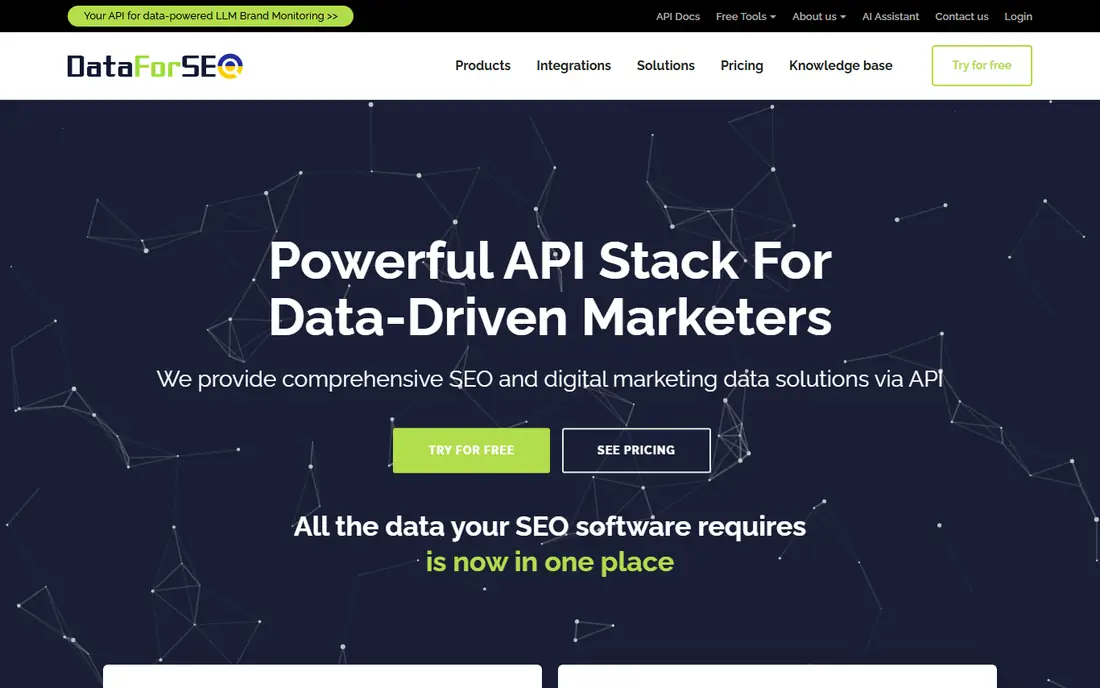
DataForSEO is our pick for most builders who want Semrush-style data without paying for a full marketing suite. It covers SERP results, keyword data, backlinks, on-page checks, and domain data through one API, and you top up a balance instead of buying a fixed monthly bundle. That model suits uneven workloads, since a quiet month costs little beyond what you actually request.
The catch is that you get data, not finished reports. You will need to build charts, filters, and summaries yourself, or plug the output into your own product. Endpoint prices also differ, so a keyword volume call and a full SERP pull do not cost the same. Test with the trial credit first and price your three most common calls before you scale up.
- Broad endpoint coverage
- Pay-per-request billing
- No large monthly plan required
- Raw data needs your own analysis layer
- Costs vary by endpoint
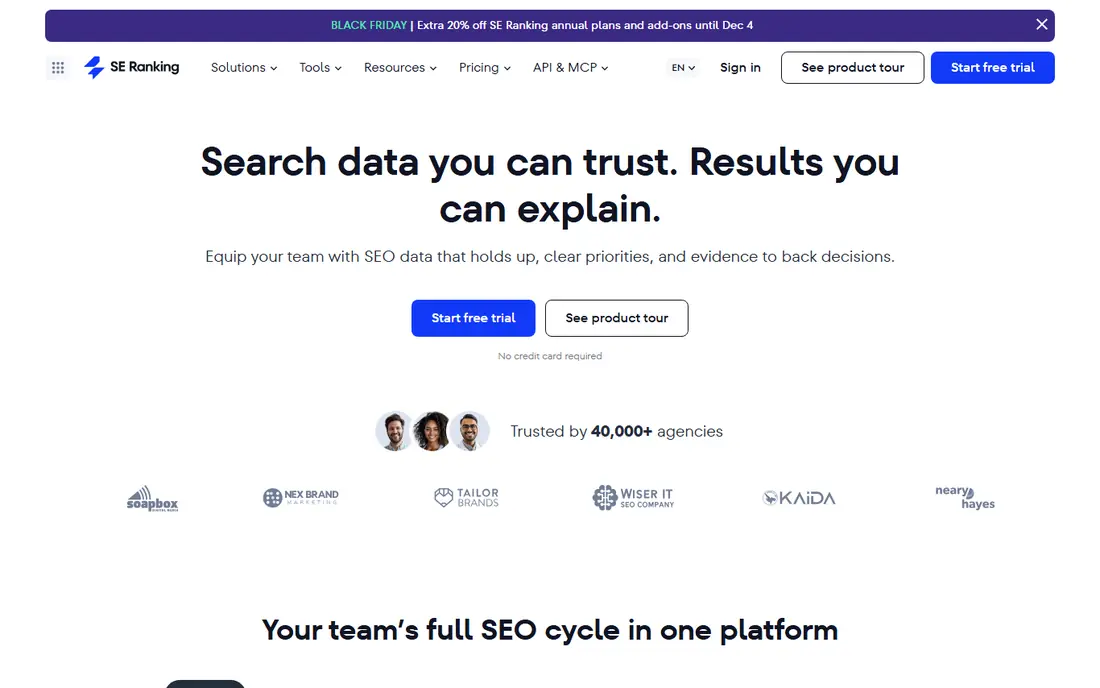
SE Ranking works well when your team still wants human-readable reports alongside programmatic access. The API covers rankings, keywords, backlinks, site audits, and domain data, and the same account gives staff a dashboard to check work without writing code. Recent additions around AI search visibility also help teams tracking mentions in chat-based answers.
The trade-off is scope. If you never open the dashboard, you are paying for a product layer you do not use, and DataForSEO may be cheaper for pure data pulls. Still, for agencies that serve clients, the mix of API output and shareable reports is a practical advantage, and the trial lets you check both sides before paying.
- API plus a full dashboard in one account
- AI search visibility endpoints
- Clear credit model
- Dashboard features may be surplus if you only need data
- Higher tiers cost more for large volumes
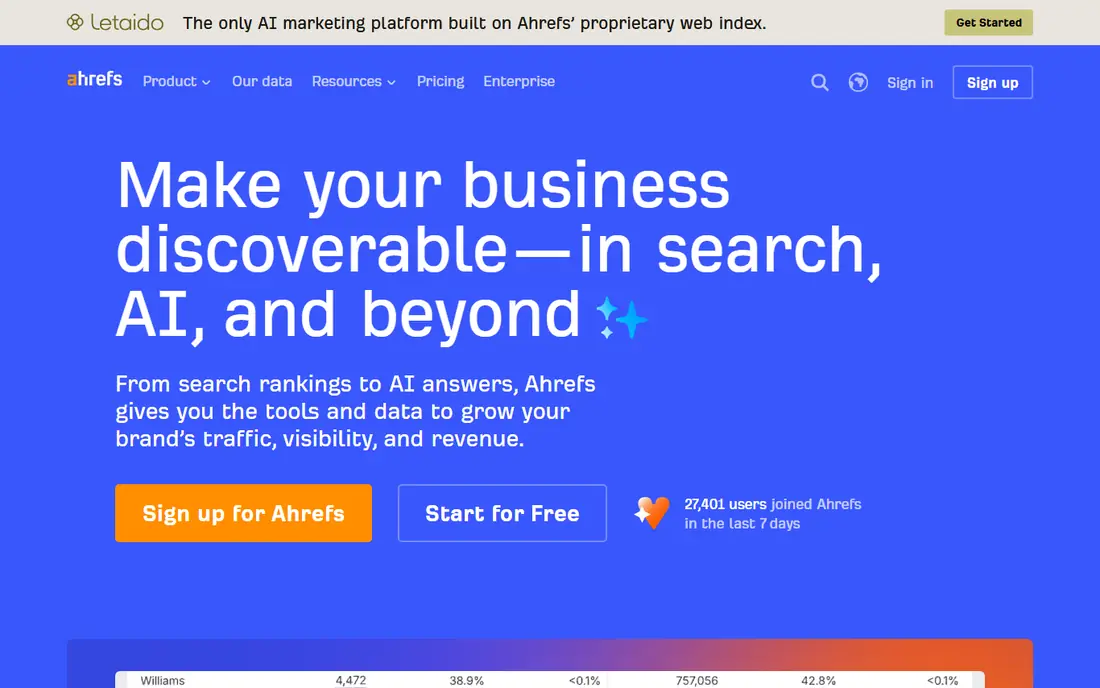
Ahrefs is the closest match when backlinks are the main reason you wanted the Semrush API. Its link index, referring domain data, and keyword metrics are widely used by SEO teams, and the newer API version adds rank tracking and site audit endpoints. If link quality drives your product or client reports, this depth is hard to replace with a SERP-only tool.
Cost control needs care here. Requests carry a minimum unit charge, so many tiny calls can burn through a monthly unit allowance faster than expected. Batch your requests, cache results where the terms allow, and check the unit cost of your exact endpoints. Teams that only need occasional link checks may find a cheaper API plus manual checks in the dashboard enough.
- Deep backlink index
- Strong keyword and rank data
- Well documented endpoints
- Minimum unit charge per request
- Entry plan is a full subscription, not a small top-up
SerpApi answers a narrower question than Semrush, and it answers it well. It returns live search results, including AI overviews and local results where supported, from Google and many other engines. Developers building rank checkers, price monitors, or research tools get clean JSON without managing proxies or parsers.
Do not buy it expecting keyword volumes or backlink history, because that is not what it sells. It is a SERP feed, so pair it with a keyword API if you need search volume or difficulty scores. The free tier of 250 searches a month is enough to test parsing and result quality, and the starter plan suits small tools with steady but modest volume.
- Live SERP data from many engines
- Simple JSON output
- Permanent free tier for testing
- SERP only, no keyword volume or backlink database
- Costs rise with search volume
Bright Data fits teams collecting SERP data at industrial scale, across countries, languages, and device types. Its proxy network and SERP endpoints handle sites and search engines that block simple scrapers, and success-based pricing means you pay for results that come back. For large research, monitoring, or data products, that reliability matters more than the lowest per-search sticker price.
Smaller teams should weigh complexity against need. The platform has many products beyond SERP data, and picking the right one takes time. Start with a small paid test, measure successful requests against failures, and confirm the total cost for your target volume before moving a production workload over.
- Built for high volume collection
- Proxy infrastructure included
- Many engines and locales
- Pricing is usage based and can climb fast
- Setup takes more care than a simple SERP API
Serpstat is a sensible middle ground for teams that want broad SEO data but cannot justify top-tier suite pricing. Its API covers keyword research, competitor domains, backlinks, rank tracking, and site audits, which covers most reporting needs for agencies and in-house teams. Credit-based billing keeps costs tied to use rather than seat count.
The honest limit is coverage depth in some markets and for very large backlink pulls, where larger indexes may return more rows. Check your own target domains and keywords during a trial, and compare row counts against a second source. If the numbers match for your niche, Serpstat can replace a large share of Semrush API use at a lower monthly cost.
- Keyword, domain, backlink, and audit data in one API
- Credit based plans
- Lower entry cost than suite APIs
- Coverage varies by market
- API credits differ by plan tier
Moz Links API is best when your real need is link metrics rather than a full SEO database. Domain authority, page authority, and linking domain counts appear in countless client reports and outreach tools, so matching that metric set can matter more than raw index size. The low entry price and small free allowance make it easy to test.
Treat it as a specialist tool. It will not return SERP pages, keyword volumes, or audit issues, so you will still need another source for those jobs. Rate limits on the cheapest tier also mean it suits batch enrichment and reporting, not high-frequency live lookups. For that focused job, though, it is simple and affordable.
- Domain authority and link metrics many teams already cite
- Low entry price
- Free rows for testing
- Link data only, not full keyword or SERP coverage
- Rate limits are strict on low tiers
Google Search Console API
Who it suits: Free data for your own sites
Google Search Console API is the free option every site owner should use before paying for anything else. It returns the actual queries that brought people to your site, plus clicks, impressions, and position data, straight from Google. For reporting on your own performance, fixing pages, and finding query gaps, no third-party estimate beats first-party data.
The limit is clear and absolute. You only get data for properties you have verified, so competitor research and market keyword volumes still need a paid API. Use Search Console as the foundation for your own sites, then add one paid API from this list for competitor and market data. That pairing often costs less than a single large suite plan.
- Free first-party search data
- Real queries, clicks, and impressions for verified sites
- No unit billing
- Only your own verified properties
- No competitor keywords or backlinks
How we picked these
We compared official feature pages, pricing pages, and app documentation for APIs that cover keyword, backlink, SERP, or site data, and we checked that each vendor homepage loads and matches the product named. We favored APIs that are still sold and documented in 2026, that cover at least one core Semrush API job, and that offer a trial, free tier, or small deposit so readers can test before committing. Where a vendor does not publish a simple starting price, we wrote See website rather than guessing a figure.
What to check before you switch APIs
Start with the exact calls you run today. List your top five endpoints, how often each runs, and how many rows each returns, then price that same workload on two or three candidates. Unit, credit, and search pricing models hide very different totals, and a cheap headline price can turn costly on large backlink pulls.
Match the data type to the job
SERP APIs return live result pages. Keyword APIs return volumes and difficulty estimates. Backlink APIs return link graphs. A tool that excels at one rarely excels at all three, so split the work if needed. A SERP API plus a link API often beats one expensive suite API that does both poorly for your volume.
Test coverage on your own domains
Indexes differ by country, language, and niche. Run the same ten domains and fifty keywords through each candidate and compare row counts, freshness dates, and missing results. A vendor that looks strong in general roundups may be thin in your market, and only your own test shows that gap.
Plan for rate limits and caching
Check requests per second, monthly unit caps, and overage charges before you build. Cache stable data such as backlink counts for a sensible period, batch small requests, and set alerts before you hit a cap. A short trial that only tests one call will not reveal limit problems that appear at production volume.
Frequently asked questions
What is the best Semrush API alternative?
It depends on the job. DataForSEO and SE Ranking suit broad data needs, Ahrefs suits backlink depth, and SerpApi suits live SERP work. Pick by the endpoints you run most, then confirm cost on your real volume.
Are there free Semrush API alternatives?
Yes, with limits. Google Search Console API is free for your own verified sites, SerpApi has a small free tier, and Moz offers free rows for testing. Full competitor keyword and backlink data still needs a paid plan.
How much does a Semrush API alternative cost?
Entry points in this list run from free to around $129 per month, plus usage charges on some plans. Pay-as-you-go options start with a $50 deposit on DataForSEO and SE Ranking. Always price your actual calls, since unit and credit models differ.
Can I replace Semrush fully with an API?
You can replace the data layer, but you lose the finished reports and dashboards unless you build them. Teams that want reports as well as data should pick SE Ranking or pair a raw API with their own reporting tool.
Do these APIs include AI search data?
Some do. SE Ranking and SerpApi list AI overview and AI search endpoints, while older link-only APIs do not. Check the current endpoint list for the AI engines you need to track.
Which alternative is best for agencies?
SE Ranking suits agencies that need client reports plus API access, while DataForSEO suits agencies building custom dashboards. Ahrefs suits agencies where link reporting is the core deliverable.
Sources we checked (8)

Online Jobs is an independent blog about careers, online work, learning new skills and the tools that help people earn. More about us.
Keep reading
All posts
n8n Alternatives
n8n alternatives compared for 2026, with Zapier, Make, Activepieces, and more, covering visual builders, code steps, self-hosting, and pricing models.

ZoomInfo Alternatives
The best ZoomInfo alternatives in 2026, compared on price, free plans, data coverage, and which tool fits small teams or large sales teams best in detail.

Zoom Alternatives for Webinars
Compare Zoom alternatives for webinars in 2026, from browser-based rooms to enterprise events, with prices, attendee limits, features and honest trade-offs.