React Alternatives in 2026: 8 Frameworks Compared

How we put this together: we compare official feature and pricing pages, app store listings, privacy policies and public user reviews. Prices change, so check the provider's site before you pay.
Key takeaways
- Vue is the safest general React alternative, with gentle onboarding, clear docs, and the Nuxt meta-framework for full-stack apps.
- Svelte and SolidJS lead for performance and small bundles, with Svelte shifting work to compile time and SolidJS using fine-grained reactivity.
- Angular is the best React alternative for large enterprise teams that want a complete, opinionated framework with TypeScript built in.
- Preact is the closest drop-in option for teams that want React patterns with a much smaller bundle, using a compatibility layer.
- Qwik, Lit, and Ember suit narrower jobs: instant startup, framework-agnostic components, and long-lived convention-led products.
Quick comparison
| Name | Who it suits | Starting price | Free option | |
|---|---|---|---|---|
 Vue | Gentle onboarding and general apps | Free | Yes | Visit |
 Angular | Large enterprise applications | Free | Yes | Visit |
 Svelte | Small bundles and fast apps | Free | Yes | Visit |
 SolidJS | Fine-grained reactive interfaces | Free | Yes | Visit |
 Preact | Small React-compatible bundles | Free | Yes | Visit |
 Qwik | Instant startup for public sites | Free | Yes | Visit |
 Lit | Framework-agnostic web components | Free | Yes | Visit |
 Ember | Long-lived convention-led products | Free | Yes | Visit |
The best React alternatives
React remains the default UI library for many teams, but it is not the only good choice. Some alternatives are easier to learn, some ship less JavaScript, some give more structure, and some load faster on slow networks. The frameworks below are all open source and free to use, so the real cost is learning time, hiring, and ecosystem fit, not licence fees.
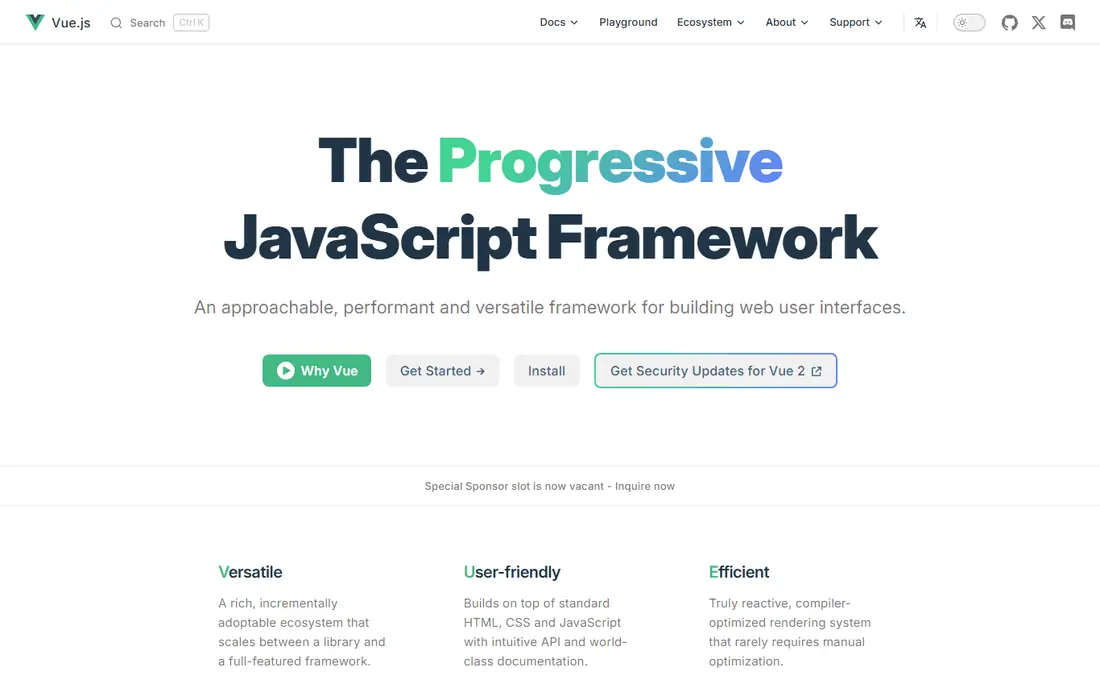
Vue is the React alternative we recommend first to most teams. Its template syntax reads clearly, its docs are widely praised, and it can be adopted gradually: start with a widget on an existing page, then grow to a full single-page app, then add Nuxt for server rendering and full-stack features. Official libraries for routing and state, Vue Router and Pinia, keep the core ecosystem coherent.
Vue is not as opinionated as Angular, so large teams need their own conventions for file structure, state, and testing, or a large codebase can drift. Hiring is also easier for React in some markets, though Vue hiring is strong in Europe and Asia. For product teams, agencies, and startups that want a productive, approachable framework, Vue is the safest switch from React.
- Clear docs and gentle learning curve
- Progressive adoption from a widget to a full app
- Nuxt for full-stack apps
- Smaller hiring pool than React in some markets
- Needs discipline on conventions at large scale
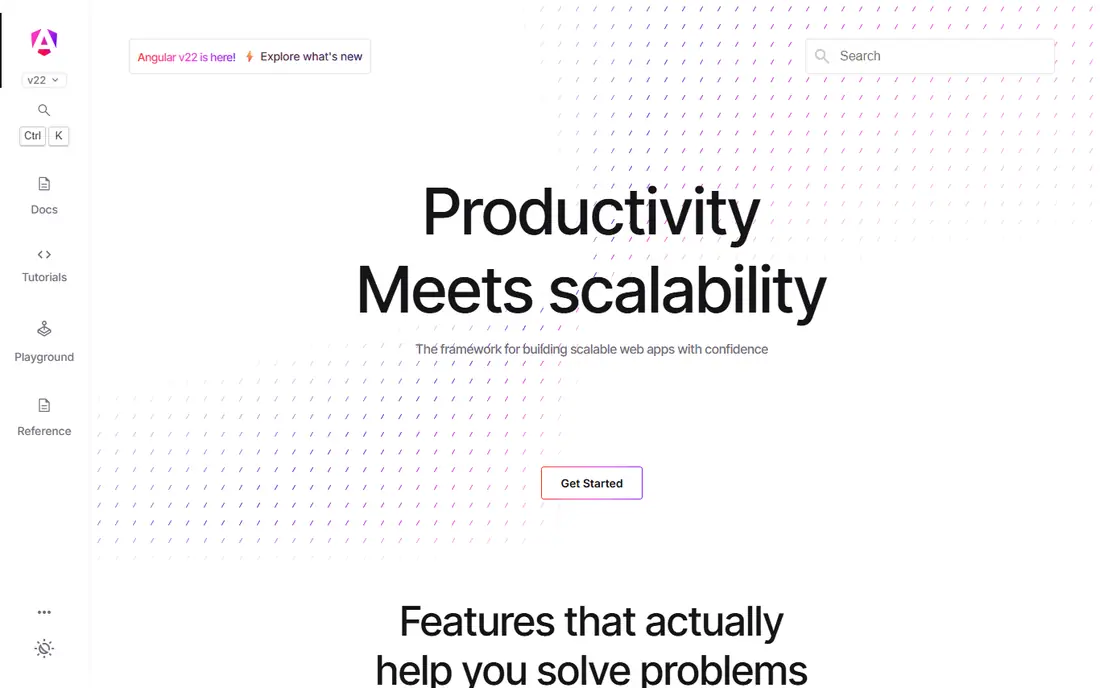
Angular is the React alternative for teams that want decisions made for them. Routing, forms, HTTP, dependency injection, and testing tools ship as part of the framework, with a command-line tool that scaffolds and updates projects. TypeScript is first-class, which helps large teams catch errors early and maintain a codebase across many developers and years.
That completeness comes with ceremony. Angular apps need more setup, more concepts, and more training than Vue or Svelte, and small apps can feel heavy. For enterprise systems, internal platforms, and long-lived products where consistency matters more than speed to a first demo, Angular structure pays off. For a small marketing site or a quick prototype, it is usually too much.
- Complete framework with routing, forms, and HTTP built in
- TypeScript first
- Long-term support and tooling
- Steepest learning curve here
- Larger bundles and more ceremony for small apps
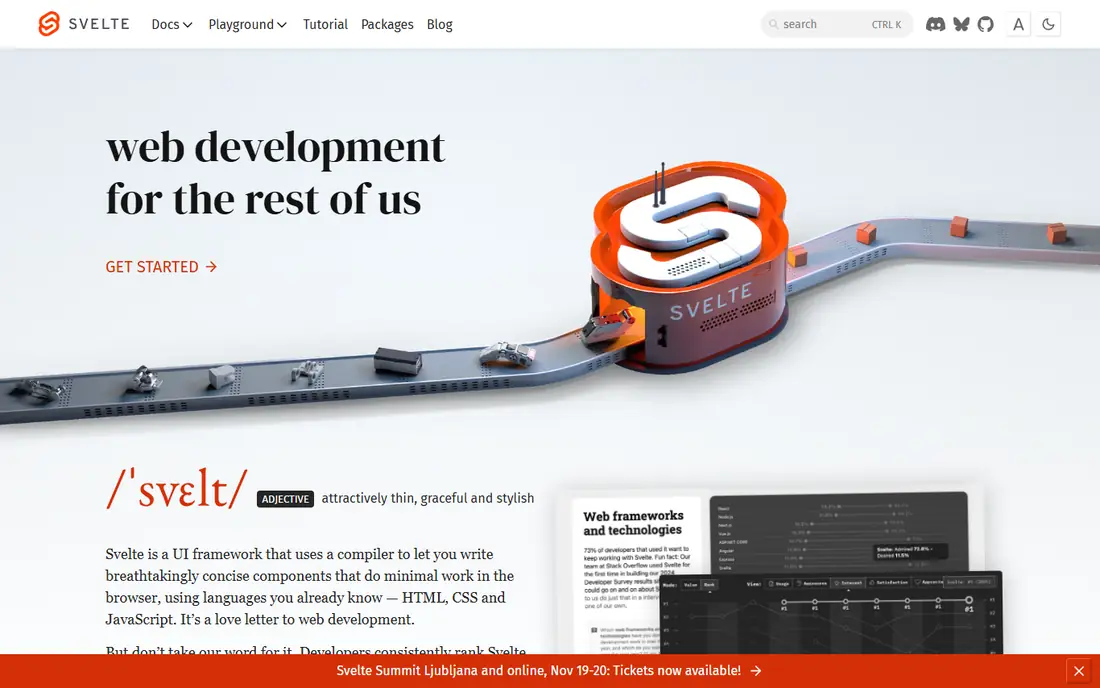
Svelte takes a different path from React: instead of shipping a runtime that updates the page in the browser, Svelte compiles components into efficient JavaScript at build time. The result is small bundles and fast updates, with component code that reads more concisely than equivalent React code. SvelteKit adds routing, server rendering, and full-stack features for larger apps.
The ecosystem is smaller than React or Vue, so some niche libraries need extra work or alternatives. Teams moving from Svelte 4 to Svelte 5 also face new reactivity concepts to learn. For performance-sensitive apps, widgets, and product front ends where every kilobyte matters, Svelte is one of the strongest React alternatives available.
- Compiler model means little runtime code
- Concise components
- SvelteKit for full-stack apps
- Smaller ecosystem than React or Vue
- Svelte 5 changes need learning for older Svelte users
SolidJS looks familiar to React developers, because it uses JSX and a component model, but it drops the virtual DOM in favour of fine-grained reactivity. Only the parts of the page that depend on changed data update, which gives very fast performance for data-heavy dashboards and interactive interfaces. Solid Start adds routing and server features for full apps.
SolidJS is newer and smaller than Vue or Angular, so hiring is harder and some React ecosystem libraries need adapters or replacements. Teams with React experience can learn SolidJS quickly, and the performance gains are real for interactive UIs. It suits performance-focused teams that like JSX but want a faster rendering model.
- React-like JSX with fine-grained reactivity
- Very fast updates
- Small runtime
- Smaller ecosystem and hiring pool
- Some React libraries need adapters
Preact is the React alternative for teams that do not want to rewrite their app. Its compatibility layer lets much React code run on Preact with a small core, around 3 kilobytes, compared with a much larger React bundle. That size saving matters for embeds, widgets, extensions, and mobile pages where parse and load time affect user experience.
Compatibility is not perfect. Some React-specific libraries and newer React features need checks or workarounds, so test your dependencies before committing to a switch. For existing React apps with bundle pressure, Preact is the lowest-risk alternative: try it on a widget or a single route first, measure the saving, and expand only if tests pass.
- Near drop-in React replacement via compatibility layer
- Tiny core around 3 kilobytes
- Fast parse and load
- Compatibility edge cases with some React libraries
- No full meta-framework of its own
Qwik is built for instant startup. Instead of downloading and running a large JavaScript bundle before a page becomes interactive, Qwik resumes server-rendered HTML and loads code lazily as the user interacts. That makes it strong for marketing pages, ecommerce landers, and content sites where Core Web Vitals and time to interactive matter.
Qwik mental model is different from React, with resumability and serialization rules that take time to learn, and its ecosystem is smaller than Vue or Svelte. It is not the best pick for a highly interactive app with complex shared state, where Svelte or SolidJS may fit better. For public pages where speed on first load is the priority, Qwik deserves a prototype.
- Resumability means minimal JavaScript on load
- Fast startup for marketing and ecommerce pages
- Qwik City for apps
- Newer model with serialization constraints
- Smaller ecosystem and fewer production examples
Lit is not a full app framework like Angular or Vue. It is a library for building web components using web standards, which means a Lit component can run inside a React, Vue, Angular, or plain HTML page without a rewrite. That makes Lit the best React alternative for design systems and shared component libraries that must serve several frameworks at once.
For a full app, Lit needs extra choices for routing, state, and data fetching, which other frameworks include or guide more clearly. Teams that need a complete app framework should pick Vue, Svelte, or Angular instead. Teams that need reusable components across frameworks should start with Lit and keep app logic in the host framework.
- Builds standard web components that work in any framework
- Small runtime
- Good for design systems
- Lower-level than Vue or Angular
- Needs extra tooling for routing and state in full apps
Ember is the convention-led React alternative for products that will live for many years. It provides routing, data handling, templating, and testing with clear conventions, so new team members know where code lives and how upgrades work. Ember upgrade paths are famously careful, which helps teams maintain a product across years without painful rewrites.
Ember community is smaller than React or Vue, and its conventions take time to learn for developers used to looser frameworks. New greenfield startups often pick Vue or Svelte for speed, while Ember suits established products, internal tools, and teams that value stability and shared conventions over the latest ecosystem trend.
- Strong conventions and upgrade paths
- Built-in routing, data, and testing
- Stable for long-lived products
- Smaller community than React or Vue
- Learning curve for its conventions and build tooling
How we picked these
We compared official framework docs, ecosystem size, rendering models, bundle characteristics, and meta-framework options for libraries and frameworks that replace React for building user interfaces. We favoured actively maintained projects with published docs, a real production track record, and a distinct reason to switch, whether learning curve, bundle size, structure, or startup speed. We did not claim hands-on testing of every framework; our comparison rests on official docs and public ecosystem evidence. All frameworks here are free and open source, so starting price and free plan reflect licence cost, not hosting or hiring costs.
How to choose a React alternative
Start with team skills and hiring, not just benchmarks. A framework your team already knows will ship faster than a theoretically faster one they must learn, and hiring depth matters for a product that will grow. Prototype the same small feature, such as a data table with filters and a form, in your top two choices, and compare code size, build output, and how pleasant the code feels to change.
Next, check ecosystem fit for your specific needs: routing, forms, state, testing, UI libraries, and server rendering. A framework with a strong meta-framework, such as Nuxt for Vue, SvelteKit for Svelte, or Qwik City for Qwik, saves weeks on a full-stack app. Also check long-term maintenance: release cadence, upgrade guides, and whether the project is backed by a company, a foundation, or a broad community. A framework that is easy to start and hard to maintain is a poor trade.
Migrating from React without a rewrite
You do not have to rewrite everything at once. Preact offers the gentlest path, with a compatibility layer for existing React code. Lit lets you build new components that work inside a React app. For a full switch, start with a new feature or a single route in the new framework, run it alongside React, and expand only when the team is confident. Keep shared design tokens, API clients, and tests framework-agnostic where possible, so a future move costs less.
Frequently asked questions
What are the best alternatives to React?
Vue is the best general alternative, Angular is best for enterprise, Svelte and SolidJS are best for performance, and Preact is best for a low-risk switch from existing React code. Qwik suits fast public pages, Lit suits design systems, and Ember suits long-lived products. The best pick depends on team skills and app type.
What is the best alternative to Create React App?
Create React App is no longer the recommended starting point for React itself, and its alternatives vary by framework: Vite with Vue, SvelteKit for Svelte, Angular CLI for Angular, and Qwik City for Qwik all provide modern scaffolding. For new React projects, Vite or Next.js are the common starting points, while a full framework switch should start with its own official CLI.
Is Vue better than React?
Vue is easier to learn and more approachable for many teams, with clear docs and progressive adoption, while React has a larger ecosystem and hiring pool. Neither is better in every case. Vue suits product teams that value onboarding speed and template clarity, while React suits teams that need the widest library choice and hiring depth.
Is Svelte faster than React?
Svelte often produces smaller bundles and faster updates than React for comparable apps, because it compiles components instead of shipping a virtual DOM runtime. Real-world speed also depends on app structure, data patterns, and server rendering, so prototype your actual feature before deciding on performance alone.
Should I learn Angular or Vue after React?
Learn Vue if you want a gentle, productive alternative for general product work, and learn Angular if you target enterprise jobs or large, structured codebases. Both build on JavaScript and TypeScript skills from React, and both are easier to learn second than first. Check job listings in your market for which skill is in higher demand locally.
Sources we checked (8)

Online Jobs is an independent blog about careers, online work, learning new skills and the tools that help people earn. More about us.
Keep reading
All posts
n8n Alternatives
n8n alternatives compared for 2026, with Zapier, Make, Activepieces, and more, covering visual builders, code steps, self-hosting, and pricing models.

ZoomInfo Alternatives
The best ZoomInfo alternatives in 2026, compared on price, free plans, data coverage, and which tool fits small teams or large sales teams best in detail.

Workday Alternatives
We compared the best workday alternatives for HR, payroll, and global hiring, from BambooHR and Gusto to Rippling, Deel, and HiBob for growing teams in 2026.