Node.js and Go Alternatives for Pandas and NumPy in 2026: 8 Tools Compared

How we put this together: we compare official feature and pricing pages, app store listings, privacy policies and public user reviews. Prices change, so check the provider's site before you pay.
Key takeaways
- Danfo.js is the closest JavaScript match to pandas, with DataFrames, Series, groupby, merging and plotting in Node.js and the browser.
- For NumPy-style maths in JavaScript, math.js and TensorFlow.js cover different needs: math.js for general maths, TensorFlow.js for tensors and machine learning.
- In Go, Gonum covers numerical computing and statistics, Gorgonia covers machine learning graphs, and DataFrame-go covers tabular data.
- No single JavaScript or Go library matches the full pandas and NumPy ecosystem, so most teams combine a DataFrame library with a maths library.
Quick comparison
| Name | Who it suits | Starting price | Free option | |
|---|---|---|---|---|
 Danfo.js | Pandas-style DataFrames in JavaScript | Free | Yes | Visit |
 TensorFlow.js | Tensors and machine learning in JavaScript | Free | Yes | Visit |
 math.js | General maths in JavaScript | Free | Yes | Visit |
 Arquero | Fast table transforms in JavaScript | Free | Yes | Visit |
 Data-Forge | Data wrangling in JavaScript | Free | Yes | Visit |
 Gonum | Numerical computing in Go | Free | Yes | Visit |
 Gorgonia | Machine learning graphs in Go | Free | Yes | Visit |
 DataFrame-go | DataFrames in Go | Free | Yes | Visit |
The best Node.js and Go alternatives for pandas and NumPy
Pandas gives Python developers labelled tables, with filtering, grouping, joining and time series tools, while NumPy gives fast arrays and maths. JavaScript and Go do not have one library that copies both exactly, but they do have strong tools for each part of the job. The libraries below are open source, actively documented and used for real data work in Node.js, browsers or Go services. We compared official docs, project pages and public examples, and we focused on DataFrame features, numerical features, maturity and ease of use for a pandas or NumPy user.
Danfo.js is the first library to try if you want pandas in JavaScript. You can load data from arrays, JSON, CSV or tensors, create a DataFrame, filter rows, add columns, handle missing values, group and aggregate, merge tables and plot results. The API deliberately mirrors pandas, so a Python user can often guess method names and get productive quickly.
It is built on TensorFlow.js for low-level maths, which also means you can convert a DataFrame to a tensor for machine learning. The limits are ecosystem and scale: Danfo.js does not have the huge library of Python data tools around pandas, and very large tables may need chunking or a server-side approach. For web apps, dashboards and Node.js services that need pandas-style tables without Python, Danfo.js is the closest fit.
- DataFrame and Series APIs close to pandas
- Groupby, merging, joining and plotting
- Works in Node.js and browsers, built on TensorFlow.js
- Smaller ecosystem than pandas
- Some pandas features are missing or behave differently
- Large data can be slower than Python with NumPy
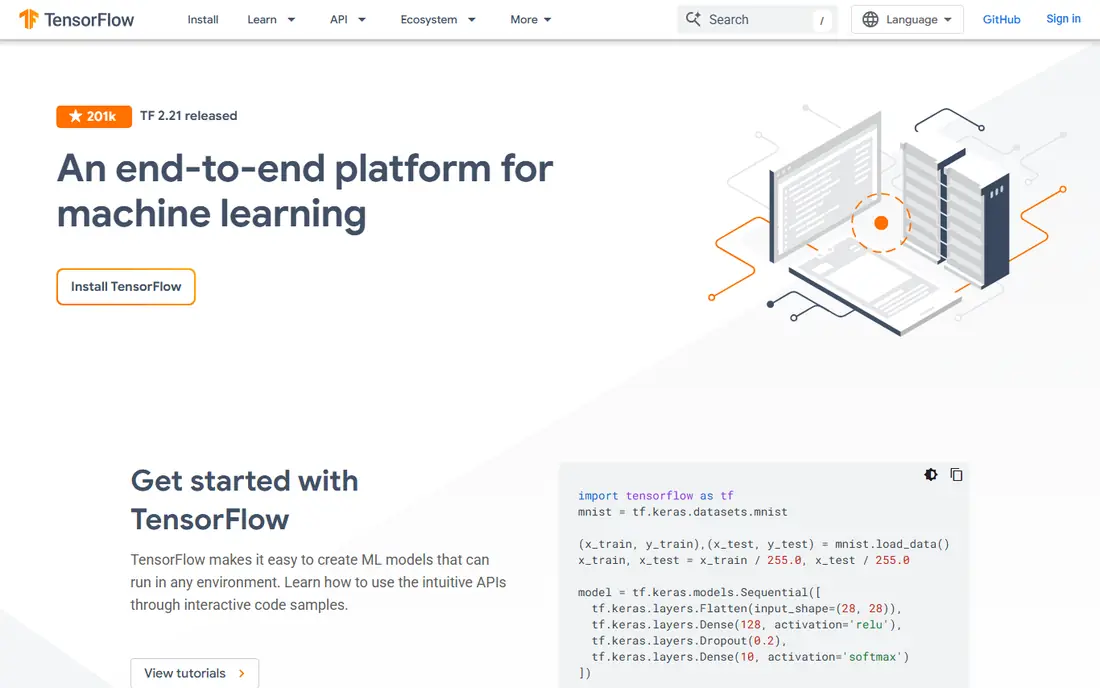
TensorFlow.js is the NumPy-adjacent library for JavaScript machine learning. It provides tensors, array maths, automatic differentiation and model training and inference, in the browser and in Node.js. If your pandas and NumPy work ends in a model, TensorFlow.js lets you keep that whole pipeline in JavaScript, including running a trained model in a web app without a Python server.
It does not provide pandas-style labelled tables, so pair it with Danfo.js for data preparation. A NumPy user will recognise many tensor concepts, but method names and memory management differ, and you need to dispose tensors carefully in long-running apps. For JavaScript teams that need numerical arrays and machine learning, TensorFlow.js is the standard choice.
- Tensors, maths ops and models in JavaScript
- Runs in browsers and Node.js, with GPU support where available
- Large docs and community
- Not a DataFrame library
- Tensor API takes time to learn for a NumPy user
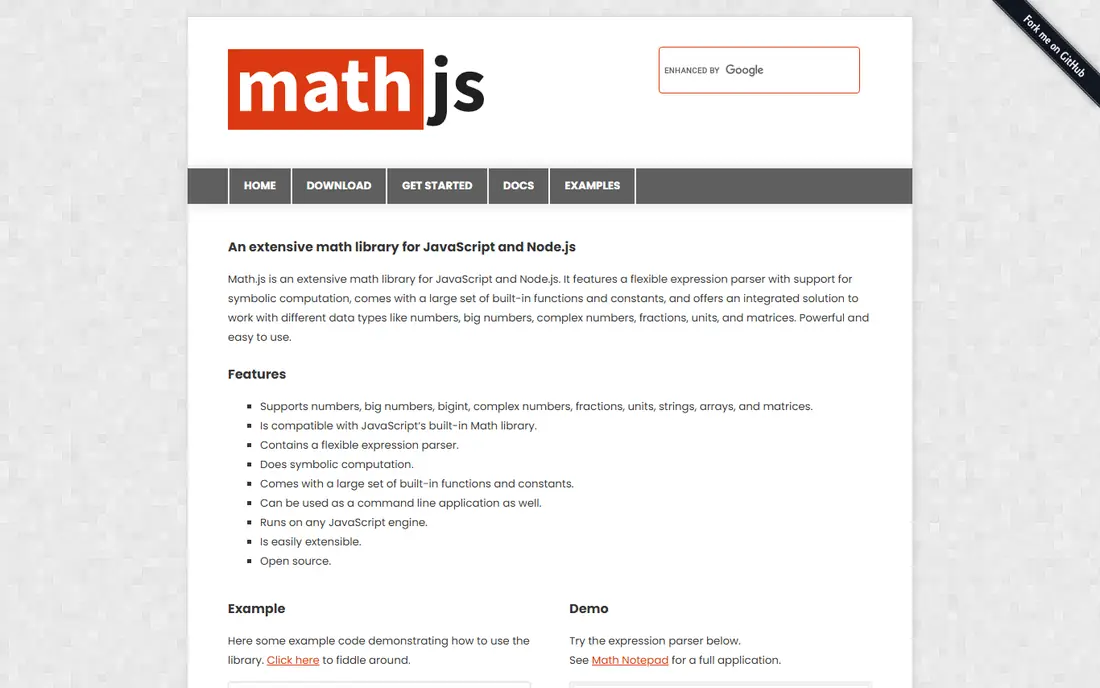
math.js is a general maths library for JavaScript, covering numbers, big numbers, complex numbers, fractions, units, matrices and an expression parser. If your NumPy use is mainly matrix maths, statistics and calculations in a web app, math.js gives you a clear, well-documented API without the weight of a machine learning framework. It also handles units, which helps in science and engineering apps.
It is not a replacement for pandas, and it is not optimised for very large arrays in the way NumPy is. Use math.js for calculations, formulas and smaller matrices, and use Danfo.js or TensorFlow.js when you need tables or tensors at scale. For many JavaScript apps, math.js plus Danfo.js covers the practical ground that pandas and NumPy cover in Python.
- Matrices, complex numbers, units and expression parsing
- Works in browsers and Node.js
- Easy to use for everyday maths
- Not built for large-scale array computing
- No DataFrame or plotting as a core feature
Arquero, from the University of Washington Interactive Data Lab, is a JavaScript library for query processing and transformation of array-backed tables. It offers verbs for selecting, filtering, deriving, grouping, joining and rolling up data, with a design influenced by dplyr and SQL as much as pandas. It is fast for in-browser data work and pairs well with Arrow-based data formats.
A pandas user will need to learn Arquero verbs, because method names and chaining differ from pandas. That learning pays off in data-heavy web apps, where Arquero handles large tables smoothly and composes well with visualisation tools. If you want a pandas-like API above all, Danfo.js fits better. If you want fast, expressive table transforms in a JavaScript app, Arquero is a strong alternative.
- Fast, expressive table verbs for filter, group, join and rollup
- Works well with Apache Arrow data
- Good for data apps and notebooks
- API differs from pandas, so it takes learning
- Less plotting and machine learning integration than Danfo.js
Data-Forge is a JavaScript and TypeScript library for working with tabular and time-series data. It provides DataFrame and Series types, with methods for parsing, filtering, transforming, grouping and aggregating data, plus tools for working with dates and series. TypeScript users will appreciate its typed API, which catches errors earlier than plain JavaScript.
Its community is smaller than Danfo.js, and development has been slower, so check the current release and docs before building a new project on it. For a TypeScript team that wants a clear, LINQ-style data wrangling API and does not need machine learning integration, Data-Forge remains a usable pandas alternative. For a new project in 2026, Danfo.js is usually the safer first choice.
- DataFrame and Series for JavaScript and TypeScript
- Clear wrangling, grouping and aggregation tools
- Good TypeScript support
- Less active development than Danfo.js in recent years
- Smaller community and fewer examples
Gonum is the closest Go equivalent to NumPy for numerical work. It provides packages for matrices, linear algebra, statistics, optimisation, spatial data and more, designed for Go developers who need reliable numerical code in a service or tool. If you are building a Go backend that does calculations, simulations or data analysis, Gonum gives you the building blocks NumPy gives Python developers.
Gonum does not include a pandas-style DataFrame, so pair it with DataFrame-go for tabular work, or use plain Go slices and maps for simple cases. Go code will be more verbose than NumPy for array operations, because Go lacks NumPy broadcasting and vectorised syntax. That verbosity buys you compiled speed, static typing and easy deployment as a single binary, which suits many production services.
- Matrices, linear algebra, statistics and optimisation in Go
- Well-structured packages for scientific computing
- Good for services that need maths
- No pandas-style DataFrame as a core package
- Go maths code is more verbose than NumPy
Gorgonia is a Go library for building machine learning models as expression graphs, with automatic differentiation similar to early TensorFlow. It lets Go developers define a computation graph, run it and train models, without calling out to Python. That matters for teams that want a single-language Go service, from data ingestion to model inference, with no Python runtime to manage.
The learning curve is steeper than a high-level framework, because you work at the graph level rather than calling a ready-made model class. The ecosystem is also smaller than Python machine learning, so you will write more code for data loading and evaluation. For Go teams doing custom models or research, Gorgonia is the most direct NumPy and TensorFlow-style option in Go.
- Expression graphs and automatic differentiation in Go
- Useful for machine learning research and custom models
- Runs without Python
- Steeper learning curve than TensorFlow.js for beginners
- Smaller ecosystem than Python machine learning tools
DataFrame-go provides a DataFrame type for Go, aimed at statistics, machine learning and data manipulation. You can load data, select columns, filter rows, group and aggregate, and join tables, in a style familiar to pandas users. That makes it a natural partner to Gonum: DataFrame-go handles the table, Gonum handles the maths.
Its feature set is smaller than pandas, and its maintenance pace is slower than larger Go projects, so check the repository, issues and latest release before you depend on it. For a Go service that needs modest tabular work, DataFrame-go saves a lot of manual slice and map code. For heavy data analysis, a Python service or a JavaScript Danfo.js workflow may still be more productive.
- DataFrame type for Go, with filtering, grouping and aggregation
- Useful for statistics, machine learning prep and data exploration in Go
- Smaller feature set than pandas
- Project activity should be checked before a new project
How we picked these
We compared official docs, project pages and public examples, and we checked that each project homepage or repository loads and belongs to the library named. We included only libraries that are open source, documented and usable in 2026 for DataFrame work, numerical maths or machine learning in JavaScript or Go. We also noted where a library covers only part of the pandas and NumPy job, because no single JavaScript or Go library matches the full Python pair.
How to choose a pandas and NumPy alternative
Start with your language and your deployment. If you build a web app or a Node.js service, Danfo.js plus math.js or TensorFlow.js is the most complete JavaScript stack. If you build a Go service, Gonum plus DataFrame-go covers maths and tables, with Gorgonia for custom machine learning. If you need fast table transforms in a browser app, add Arquero to your shortlist.
Next, test with your real data shape. Load a sample CSV, handle missing values, group by a category, join two tables and run a simple calculation, and time each step. That test reveals gaps faster than a feature list, especially for missing data, dates and large files. Finally, check maintenance: recent releases, open issues, docs quality and whether the library works with your current Node.js or Go version. A library that fits today but is unmaintained can become a risk in a year.
A note on performance
Python with NumPy is fast because its core is compiled C code, and JavaScript and Go libraries vary in how close they get. TensorFlow.js can use GPU acceleration in browsers and Node.js, Gonum benefits from Go compiled code, and Danfo.js benefits from TensorFlow.js backends. For very large data, consider chunking, a database, or a Python service for the heavy step, even if the app itself is JavaScript or Go.
Frequently asked questions
What is the best Node.js alternative to pandas?
Danfo.js is the best Node.js alternative to pandas for most use cases, because its DataFrame and Series APIs mirror pandas and it covers filtering, grouping, merging, joining and plotting. Arquero is a strong alternative for fast table transforms, and Data-Forge is a good TypeScript option. Choose Danfo.js first if a pandas-like API matters most.
What is the best Go alternative to pandas?
DataFrame-go is the most direct Go DataFrame library, with filtering, grouping and aggregation for tabular data. Pair it with Gonum for numerical work, because DataFrame-go alone does not cover NumPy-style maths. Check the project activity before a new project, because its feature set is smaller than pandas.
What is the best JavaScript alternative to NumPy?
For general maths, math.js is the simplest JavaScript alternative to NumPy. For tensors and machine learning, TensorFlow.js is the standard choice, with GPU support in browsers and Node.js. Danfo.js sits on top of TensorFlow.js and adds pandas-style tables, so many teams use Danfo.js plus TensorFlow.js together.
Can I use Danfo.js in the browser as well as Node.js?
Yes. Danfo.js offers browser and Node.js builds, so you can run DataFrame work in a web app or on a server. Browser use suits dashboards and data tools, while Node.js suits services and scripts. Check bundle size and data size for browser use, because very large tables can slow a page.
Is Gonum a full replacement for NumPy?
Gonum covers much of the numerical ground, including matrices, linear algebra and statistics, but it is not a line-for-line replacement for NumPy. Go code is more verbose, and some NumPy conveniences, such as broadcasting, work differently. For a Go service that needs reliable numerical code, Gonum is the right starting point.
Should I switch from Python to JavaScript or Go for data work?
Switch only if the rest of your stack benefits. JavaScript makes sense for web apps and dashboards that need data work in the browser, and Go makes sense for fast, deployable services. Python still has the largest data ecosystem, so many teams keep Python for heavy analysis and use JavaScript or Go for the app or service around it.
Sources we checked (8)

Online Jobs is an independent blog about careers, online work, learning new skills and the tools that help people earn. More about us.
Keep reading
All posts
n8n Alternatives
n8n alternatives compared for 2026, with Zapier, Make, Activepieces, and more, covering visual builders, code steps, self-hosting, and pricing models.

ZoomInfo Alternatives
The best ZoomInfo alternatives in 2026, compared on price, free plans, data coverage, and which tool fits small teams or large sales teams best in detail.

Workday Alternatives
We compared the best workday alternatives for HR, payroll, and global hiring, from BambooHR and Gusto to Rippling, Deel, and HiBob for growing teams in 2026.