Mixpanel Alternatives in 2026: 8 Tools Compared

How we put this together: we compare official feature and pricing pages, app store listings, privacy policies and public user reviews. Prices change, so check the provider's site before you pay.
Key takeaways
- Amplitude is the closest full replacement for Mixpanel, with funnels, retention and experimentation in one platform.
- PostHog suits engineering-led teams that want analytics, session replay and feature flags in one open-source-friendly stack.
- Heap suits teams that hate manual instrumentation, since it captures events automatically.
- Google Analytics 4 suits marketing and acquisition reporting at no cost, but it is weaker for deep product analysis.
- Analytics bills are driven by event volume and monthly active users, so model your own traffic before you pick a vendor.
Quick comparison
| Name | Who it suits | Starting price | Free option | |
|---|---|---|---|---|
 Amplitude | Full product analytics at scale | Free | Yes | Visit |
 PostHog | All-in-one analytics for developers | Free | Yes | Visit |
 Heap | Automatic event capture | See website | Yes | Visit |
 Pendo | Product analytics plus in-app guidance | See website | Yes | Visit |
 FullStory | Session replay-led analysis | See website | Yes | Visit |
 Google Analytics 4 | Free web and app reporting | Free | Yes | Visit |
 Matomo | Privacy-first self-hosted analytics | Free | Yes | Visit |
 Smartlook | Lightweight replay and analytics | See website | Yes | Visit |
The best mixpanel alternatives
Mixpanel is built around event-based product analytics: funnels, retention, cohorts and flows that show how users move through a product. The alternatives below cover that job in different ways, from full platforms to replay-led tools, so you can match the tool to your team size and analysis style.
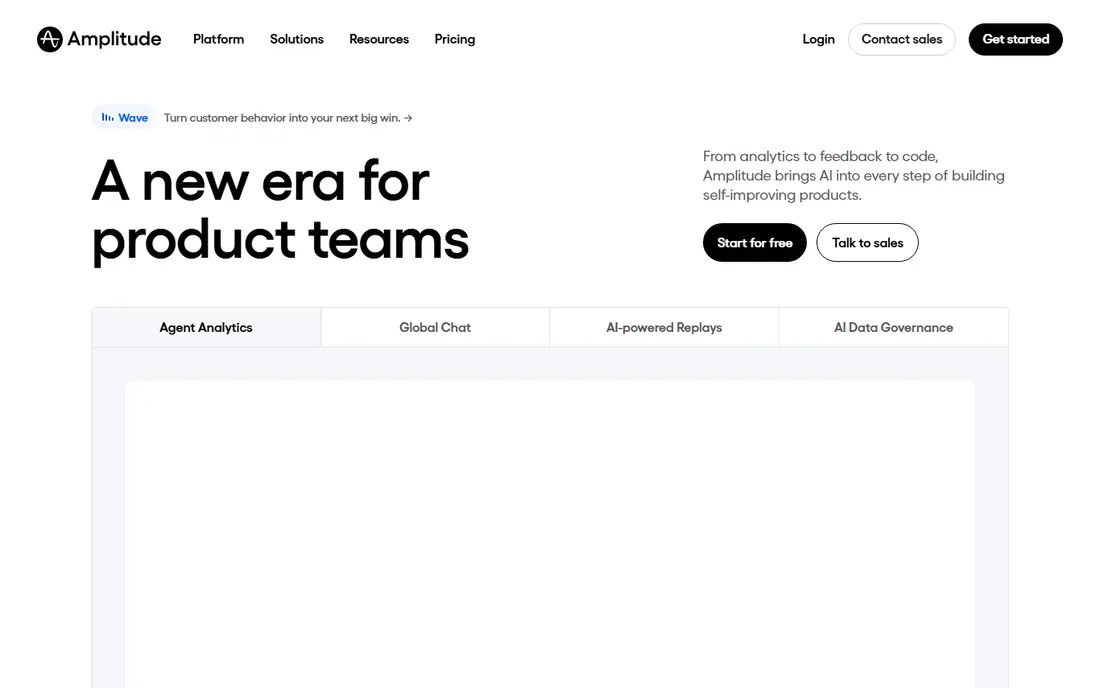
Amplitude is the most direct Mixpanel replacement for product and growth teams. It covers event funnels, retention curves, cohorts and journey analysis, plus experimentation and session replay on higher tiers. The free tier lets a small team start without a sales call, and paid pricing scales with monthly active users and features.
The catch is governance. Amplitude rewards a clean event taxonomy, and a messy implementation produces messy reports in any tool, but Amplitude's depth makes bad taxonomy more visible. It is also overkill for a solo founder with a small app. For a growing SaaS team that lives in retention and funnel reports, Amplitude is the natural first alternative to evaluate.
- Deep funnels, retention and cohorts
- Experimentation built in
- Free tier for small teams
- Costs rise with monthly active users
- Setup and taxonomy need discipline
- Overkill for tiny apps
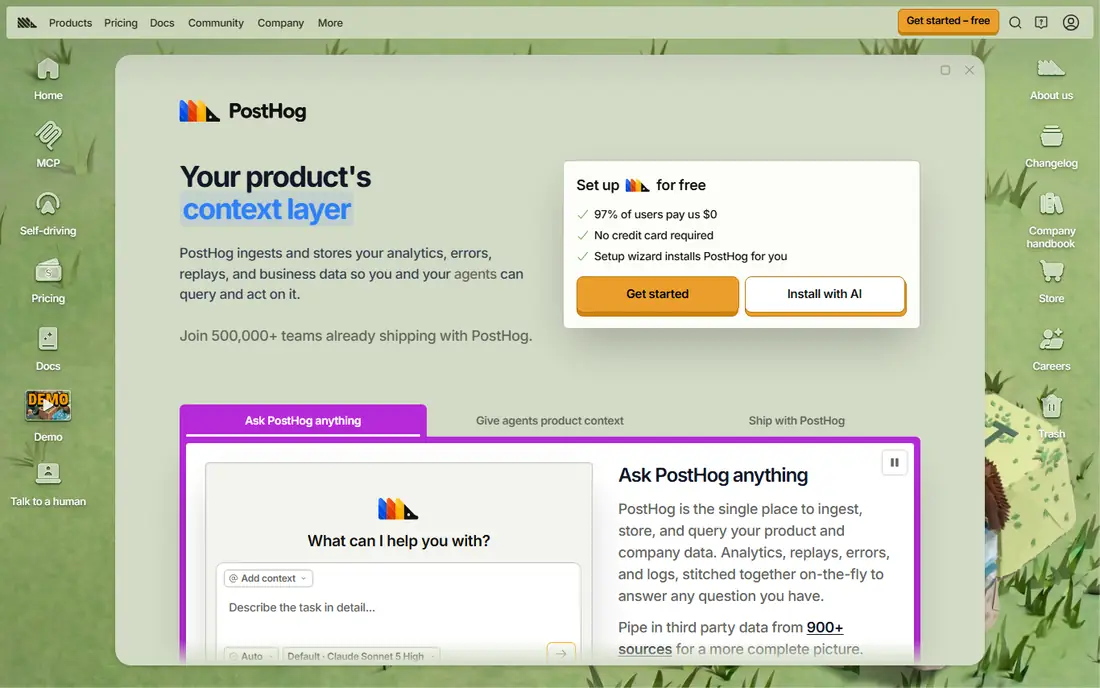
PostHog is the engineering-led alternative that bundles product analytics with session replay, feature flags, experiments and surveys. That breadth means a startup can replace several tools with one platform, and the self-hosting option gives full data control for teams that need it. Usage-based pricing with a free tier makes it easy to start small.
Breadth is also the trade-off. PostHog covers many products, so a team that only wants clean funnel reports may find the interface busier than Mixpanel. Usage-based bills also need careful forecasting once event volume grows. PostHog suits developer-led teams that want one open platform and are happy to own their setup.
- Analytics, replay, flags and surveys in one platform
- Self-hosting option
- Usage-based pricing with a free tier
- Usage bills need modelling at scale
- Interface covers many products, so focus takes time
- Support depth varies by plan
Heap's main selling point is autocapture: it records clicks, page views, form submissions and other interactions automatically, so analysts can define events after the fact instead of waiting for engineers to instrument each one. That saves weeks on implementation and lets product teams answer new questions from historical data without a new release.
Paid pricing is quote-led, and Heap has a reputation for higher enterprise costs, so small teams should test the free tier carefully and get a written quote before scaling. Session replay sits as an add-on rather than a core feature. Heap suits teams whose bottleneck is instrumentation time, not analysis skill.
- Autocapture means less manual instrumentation
- Retroactive analysis
- Strong journey and funnel tools
- Quote-led paid pricing
- Can be expensive at scale
- Session replay is an add-on
Pendo combines product analytics with in-app guides, tooltips and surveys, which suits SaaS teams that want to measure behaviour and shape it in the same tool. You can see where users drop off in onboarding, then publish a guide to help them through that step, and measure whether it worked. A free tier covers small products with limited monthly active users.
Paid pricing is quote-led, and the guidance features add setup work that pure analytics tools do not need. Pendo is also more SaaS-focused than consumer-app focused. It suits product teams that own onboarding and adoption, not just reporting, and that want analytics and guidance from one vendor.
- Analytics plus in-app guides and surveys
- Good for SaaS onboarding
- Free tier for small products
- Quote-led paid pricing
- Guidance features add complexity
- Best for SaaS, less for consumer apps
FullStory starts from session replay: watch real user sessions, search them by behaviour, and link them to funnels and journeys. That makes it the best Mixpanel alternative for teams whose main question is why users struggle, rather than how many convert. Replay shows rage clicks, confusing forms and broken flows that aggregate charts can hide.
FullStory is not a pure analytics replacement for every team. Its funnel and cohort depth is lighter than Amplitude or Mixpanel, and paid pricing is quote-led. Privacy setup also needs care, since replay can capture sensitive fields unless masked. FullStory suits UX and product teams that debug experience problems from real sessions.
- High-quality session replay
- Strong search across sessions
- Funnel and journey analysis
- Quote-led paid pricing
- Replay-heavy focus means lighter pure analytics depth
- Privacy setup needs care
Google Analytics 4 is free for standard use and remains the default for marketing and acquisition reporting. It shows where users come from, which channels convert, and how web and app traffic behaves at a high level, and BigQuery export lets larger teams analyse raw data themselves. For a small business, it may be all the analytics needed.
Product depth is the limit. Funnels, cohorts and retention analysis exist, but they are less flexible than Mixpanel or Amplitude, and the event model takes time to learn. GA4 suits teams that prioritise marketing reporting and cost, and it pairs well with a product tool for deeper analysis. It does not replace Mixpanel for a product-led SaaS team on its own.
- Free for standard use
- Strong acquisition and marketing reporting
- BigQuery export available
- Weaker for deep product funnels and cohorts
- Event model takes learning
- Sampling on large volumes
Matomo is the privacy-first alternative, built for teams that want to own their analytics data rather than send it to a third-party cloud. The self-hosted version is free and open source, with IP anonymisation and cookieless options that help with privacy rules. Cloud hosting is available for teams that do not want to run servers.
Product analytics depth is lighter than Mixpanel or Amplitude, and features such as heatmaps, session recording and A/B testing sit as add-ons. Matomo suits publishers, public sector teams and privacy-sensitive businesses that value data ownership over the deepest funnel tooling. It is a strong GA4 replacement first, and a Mixpanel replacement second.
- Self-hosted version is free
- Full data ownership
- Privacy-friendly with IP anonymisation
- Product analytics depth is lighter than Mixpanel
- Cloud pricing is per-traffic
- Add-ons cost extra
Smartlook combines session replay with funnels, heatmaps and event analytics in a lighter package than FullStory or Amplitude. It supports web and mobile apps, and the free tier covers small sites with limited monthly sessions. For a small product team, that combination answers both how many users convert and why the rest struggle.
Depth is the trade-off. Funnel and cohort analysis are simpler than Mixpanel, and the ecosystem of integrations is smaller than the large platforms. Smartlook suits small teams that want replay and basic product analytics together without enterprise pricing. Larger teams with complex analysis needs should compare it directly with Amplitude or PostHog.
- Session replay plus funnels and heatmaps
- Mobile app support
- Free tier for small sites
- Lighter analytics depth than Amplitude
- Paid pricing rises with sessions
- Smaller ecosystem
How we picked these
We compared official feature and pricing pages, plus public reviews, and kept only tools that are live and actively sold in October 2026. We covered full product platforms, autocapture tools, replay-led tools and free analytics, since Mixpanel buyers split across those needs. Where a price could not be verified on the vendor's own page, we wrote "See website" rather than guessing. We did not claim hands-on testing; our comparison rests on published features, pricing and integrations.
How to migrate without losing history
Export your Mixpanel events and cohorts before you cancel, and map your event names to the new tool's taxonomy on paper first. Run both tools in parallel for at least two weeks so you can compare funnel numbers and catch instrumentation gaps. Clean up duplicate or unused events during migration, since a fresh taxonomy is the main benefit of switching.
Compare bills on your real volume
Ask each vendor to price your actual monthly events and active users, not a generic tier. A tool that looks cheap at 100,000 events can cost several times more at 5 million, and session replay add-ons change the total further. Model growth for the next year, not just this month.
Frequently asked questions
What are the best alternatives to Mixpanel?
Amplitude is the best full replacement, PostHog leads for developer-led all-in-one use, and Heap leads for automatic capture. FullStory and Smartlook lead for replay-led analysis, while Google Analytics 4 leads for free marketing reporting.
What is the best Mixpanel alternative for startups?
PostHog and Amplitude are both strong startup choices because both offer free tiers that cover real early usage. PostHog suits engineering-led teams that want replay and flags too, while Amplitude suits product-led teams focused on funnels and retention.
Is there a free alternative to Mixpanel?
Yes. Amplitude, PostHog, Google Analytics 4 and Matomo all offer free tiers or free self-hosting, and Heap, Pendo, FullStory and Smartlook offer limited free plans. Free tiers usually cap events, sessions or users, so check limits against your traffic.
How does Amplitude compare with Mixpanel?
Amplitude and Mixpanel both offer event funnels, retention and cohorts, but Amplitude prices mainly by monthly active users and includes experimentation, while Mixpanel prices mainly by events. Teams often choose based on which pricing model fits their traffic shape and which interface their analysts prefer.
Should I use Google Analytics 4 instead of Mixpanel?
Use Google Analytics 4 if marketing and acquisition reporting is your main need and budget is tight. Keep Mixpanel, Amplitude or PostHog if deep product funnels, cohorts and retention analysis drive your product decisions, since GA4 is weaker in that area.
Sources we checked (8)

Online Jobs is an independent blog about careers, online work, learning new skills and the tools that help people earn. More about us.
Keep reading
All posts
n8n Alternatives
n8n alternatives compared for 2026, with Zapier, Make, Activepieces, and more, covering visual builders, code steps, self-hosting, and pricing models.

ZoomInfo Alternatives
The best ZoomInfo alternatives in 2026, compared on price, free plans, data coverage, and which tool fits small teams or large sales teams best in detail.

Zoom Alternatives for Webinars
Compare Zoom alternatives for webinars in 2026, from browser-based rooms to enterprise events, with prices, attendee limits, features and honest trade-offs.