Leadfeeder Alternatives in 2026: 8 Tools Compared

How we put this together: we compare official feature and pricing pages, app store listings, privacy policies and public user reviews. Prices change, so check the provider's site before you pay.
Key takeaways
- RB2B is the standout for person-level identification of US visitors, with a free tier and paid plans from $79 per month.
- Albacross from 59 euros per month, Snitcher from $49 per month, and Visitor Queue from $39 per month are the budget company-level picks.
- Leadinfo from 69 euros per month suits European teams that want clear pricing and GDPR-conscious identification.
- Warmly, Lead Forensics, and Factors.ai suit larger sales and revenue teams, with orchestration, support, or attribution beyond basic identification.
Quick comparison
| Name | Who it suits | Starting price | Free option | |
|---|---|---|---|---|
 RB2B | Person-level US identification | $79 per month | Yes | Visit |
 Albacross | European company identification | $59 per month | Free trial | Visit |
 Snitcher | Budget company identification | $49 per month | Free trial | Visit |
 Visitor Queue | Lowest-cost company tracking | $39 per month | Free trial | Visit |
 Leadinfo | European SMB identification | $69 per month | No | Visit |
 Warmly | Identification plus orchestration | See website | No | Visit |
 Lead Forensics | Mid-market company identification | See website | No | Visit |
 Factors.ai | Identification plus attribution | $199 per month | Free trial | Visit |
The best Leadfeeder alternatives
Leadfeeder identifies companies that visit a website, using IP and data matching to turn anonymous traffic into named accounts for sales follow-up. Teams look for alternatives when they want person-level identification, lower prices, better European coverage, or extra features such as orchestration and attribution. The tools below differ mainly in identification level, geography, and price, so match the tool to your traffic and your sales process, not just to the headline rate.
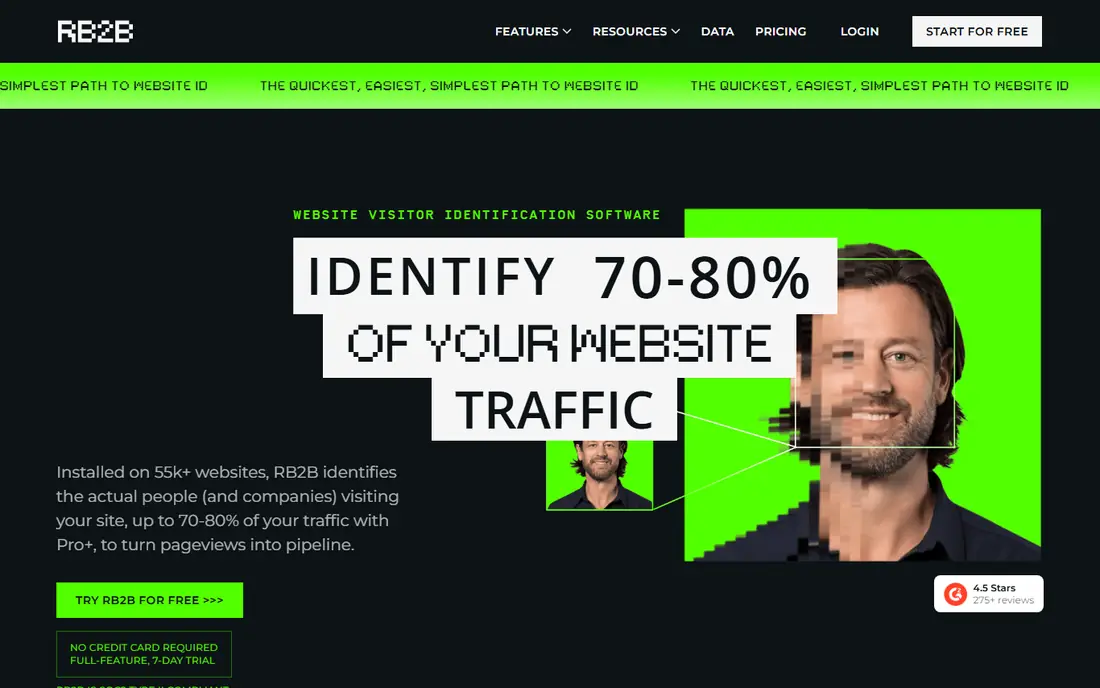
RB2B is our pick for US-focused sales teams that want names, not just companies. It identifies individual US visitors by name, role, and contact details where available, sends Slack alerts to reps, and pushes leads to HubSpot, Salesforce, and other CRMs. Paid plans start at $79 per month, and a free tier offers company-level results for teams testing the approach.
The catch is geography. Person-level identification is US-focused, while visitors outside the US are identified at company level on paid plans. Teams with mostly European traffic should check Albacross or Leadinfo first, and teams with privacy concerns should review RB2B data handling for their region. For US outbound teams, though, person-level data changes follow-up speed in a way company-level tools cannot match.
- Person-level identification for US visitors
- Slack alerts and CRM push
- Free tier for company-level results
- Person-level identification is US-focused
- Global coverage is company-level
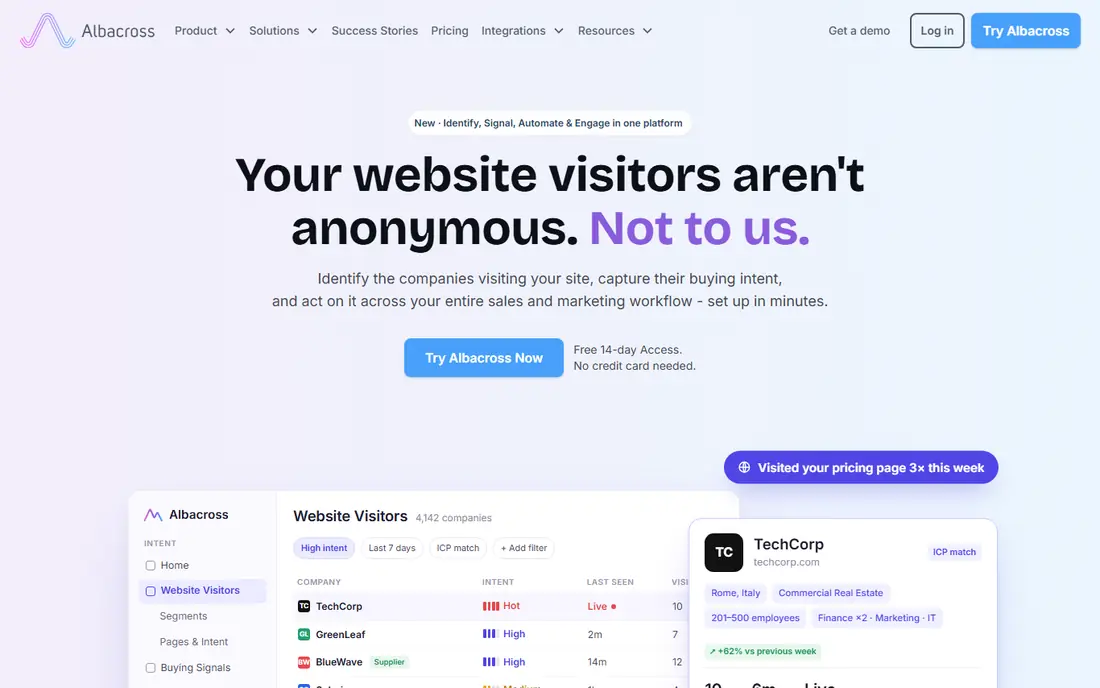
Albacross suits European teams that want company-level identification with good EU coverage. It identifies visiting companies, enriches them with contact data on suitable plans, and syncs with HubSpot and Salesforce. Entry pricing in published sources starts at 59 euros per month billed yearly, which keeps it competitive for small and mid-size European sales teams.
The limit is identification level. Albacross identifies companies, not individual visitors, so sales teams still need to find the right contact inside each account. Contact credits and some integrations also vary by plan, so check those limits before committing. For European company-level work with GDPR-conscious positioning, Albacross is a strong, straightforward alternative.
- Strong European visitor coverage
- CRM integrations
- Intent-based segmentation on some plans
- Company-level only, not person-level
- Contact credits and some integrations depend on plan
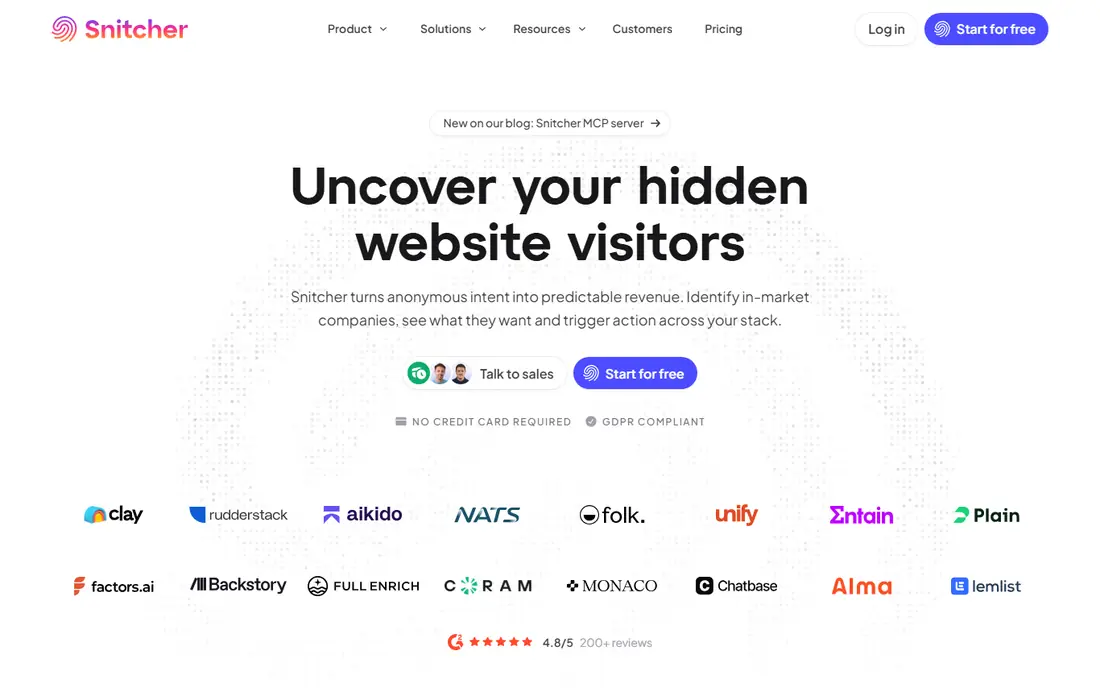
Snitcher is the budget pick for small teams that want company-level identification without enterprise sales calls. Published sources list entry pricing from $49 per month, with core features available on self-serve plans and unlimited users in its positioning. Real-time alerts and CRM sync help small sales teams follow up the same day a target account visits.
The catch is volume scaling. Pricing rises with the number of identified companies per month, so a high-traffic site can outgrow the entry tier quickly. Contact-level identification also depends on plan and data layer. For a small team with moderate traffic, Snitcher offers the lowest friction route to visitor identification. For high traffic, compare total cost at your actual volume, not just the entry price.
- Low entry price
- All core features on self-serve plans
- Unlimited users in its positioning
- Pricing scales with identified companies
- Contact-level features depend on plan
Visitor Queue suits budget-conscious teams that mainly need to know which companies visited and to route those leads to the right rep. Published sources list entry pricing from $39 per month for a set number of companies, with higher tiers for larger volumes and personalization as an add-on. Its focus is tracking and assignment, not a full sales orchestration suite.
The trade-off is depth. Visitor Queue identifies companies, not individual visitors, and it offers less enrichment, scoring, and orchestration than Warmly or Factors.ai. That is fine for teams that already have a CRM workflow and just need the company signal. Teams that want person-level data or attribution should look elsewhere, and should price Visitor Queue at their real company volume.
- Lowest entry price in this list
- Real-time company tracking
- Auto lead assignment features
- Company-level only
- Fewer orchestration and enrichment features than larger platforms
Leadinfo is a clear, European-focused alternative for small and mid-size teams. It identifies visiting companies with a GDPR-conscious approach, connects to more than 60 integrations in its product descriptions, and publishes entry pricing from 69 euros per month billed yearly. That transparency helps European teams budget without a sales call for the entry tier.
The limits are plan variation and free access. There is no permanent free plan, and user counts, automation access, CRM depth, and support can vary by plan, so a team should check the tier that covers its actual workflow. Leadinfo also identifies companies, with decision-maker data as an added layer, rather than offering US-style person-level identification as its core. For European SMB sales teams, it is a tidy, honest pick.
- GDPR-conscious European identification
- Many CRM integrations
- Clear published entry pricing
- No permanent free plan
- User, automation, and support access vary by plan
Warmly suits sales organizations that want identification plus action in one platform. It combines website de-anonymization with live chat, AI SDR features, lead scoring, and orchestration, so a visiting account can trigger chat, routing, and outreach without stitching several tools together. Published sources list agent-style pricing from about $10,100 per year, which reflects that broader scope.
The catch is cost and complexity. Warmly is far more than a visitor identification script, and small teams that only need company names will pay for orchestration they do not use. Person-level accuracy also needs checking for your geography, since coverage varies. Choose Warmly when sales orchestration is the goal and identification is one input to that workflow, not the whole job.
- Company and limited person-level identification
- Live chat, AI SDR, and orchestration
- Signal-based revenue workflows
- Enterprise-style pricing from about $10,000 per year in published sources
- Overkill for simple identification
Lead Forensics remains the mid-market company-level option for teams that value support and a long track record. It identifies visiting businesses in real time, provides contact and company details for follow-up, and connects to CRMs used by sales teams. Its positioning emphasizes hands-on support, which suits teams that want help with setup and use rather than a self-serve trial.
The weakness is pricing transparency. Lead Forensics uses quote-only pricing, and published estimates place it well above budget tools, so small teams should expect an enterprise-style conversation. It also identifies companies, not individual visitors, so outbound teams that need person-level US data should compare RB2B. For mid-market teams that want a supported, company-level tool, Lead Forensics is still a credible alternative.
- Long record in company-level identification
- Hands-on support positioning
- Real-time visitor data and CRM connections
- Quote-only pricing
- Enterprise-style sales process
- Company-level only
Factors.ai suits marketing and revenue teams that want identification inside a wider account story. It tracks visitor journeys, scores accounts, and attributes pipeline to channels and campaigns, with company-level identification as one part of that picture. Published sources list a Lite plan from $199 per month after trial, which reflects its analytics scope.
The trade-off is focus. A sales team that only wants a list of visiting companies will find Factors.ai broader and pricier than Snitcher or Visitor Queue. A revenue team that needs to know which campaigns brought target accounts to the site, and how those accounts moved through the funnel, will get more value from Factors.ai. Choose it when attribution and account intelligence matter as much as identification itself.
- Company identification plus journey tracking and attribution
- Account scoring
- Multi-source matching
- Wider scope than simple identification
- Entry price higher than budget tools
How we picked these
We compared official product pages, pricing pages, and 2026 roundups of visitor identification tools, focusing on tools that identify website visitors at company or person level and that are actively sold today. We kept a mix of budget, European, US person-level, and enterprise options, and we used "See website" where vendors use quote-only pricing rather than repeating a third-party estimate as a vendor price. Identification level and geography matter more than feature count here, so we noted those limits for each tool.
What to check before you choose a visitor identification tool
Start with your traffic geography and your sales motion. Person-level identification is mainly a US story, while European traffic is usually company-level for privacy reasons, so a tool that promises person-level data everywhere deserves a careful privacy check. Also decide whether sales needs a company name to research, or a person name to contact today, since that choice alone narrows the list to RB2B and Warmly on one side and company-level tools on the other.
Next, test identification rate on your own site, not on a demo site. Install the tracking script on a test page, compare identified companies against known visitors, and check how many are useful accounts versus internet providers, bots, or irrelevant firms. A high identification count means little if most names are not target accounts. Also check CRM sync, alert speed, and duplicate handling, since a lead that arrives late or duplicated wastes rep time.
Finally, check privacy, consent, and data handling for your region. Review each vendor privacy policy, data processing terms, and opt-out handling, and confirm how it treats EU visitors under GDPR and US visitors under state privacy laws where relevant. Visitor identification sits close to privacy regulation, so a tool that fits your sales process but not your compliance needs is not a safe pick, even if its price looks good.
Company-level versus person-level
Company-level tools identify the organization behind a visit, which suits account-based sales where reps research the right contact. Person-level tools identify an individual visitor, which suits fast outbound follow-up but raises privacy and accuracy questions, especially outside the US. Choose company-level when your sales motion is account-based and European traffic matters. Choose person-level when US outbound speed is the priority and you have reviewed privacy handling.
Pricing at your real volume
Entry prices in this list assume a set number of identified companies or visitors, and costs rise with volume. Before comparing, estimate your monthly identified companies from current traffic, then price each tool at that volume, including guest users, contact credits, and add-ons. A $39 entry plan that doubles at your volume can cost more than a $79 plan with a higher included volume.
Frequently asked questions
What is the best Leadfeeder alternative?
It depends on geography and identification level. RB2B is best for person-level US identification, Albacross and Leadinfo are best for European company-level work, and Snitcher and Visitor Queue are best for budget company-level tracking. Warmly suits orchestration, while Lead Forensics suits mid-market teams that want supported company-level identification.
Is there a free Leadfeeder alternative?
RB2B offers a free tier with company-level results, and several tools offer free trials, including Albacross, Snitcher, Visitor Queue, and Factors.ai. Leadfeeder itself also offers a free tier in published sources, though paid plans start from 79 euros per month. Free tiers are useful for testing identification rate, but paid plans are usually needed for full CRM sync and higher volumes.
What is the difference between company-level and person-level identification?
Company-level identification names the organization that visited, using IP and company data matching. Person-level identification names an individual visitor, using identity matching that is mainly available for US traffic in tools like RB2B. Person-level data enables faster direct outreach, while company-level data suits account-based sales and European privacy requirements.
Are website visitor identification tools GDPR compliant?
It depends on the tool, the data used, and how you configure it. European-focused tools like Albacross and Leadinfo position themselves as GDPR-conscious and use company-level identification for EU visitors. Person-level identification for EU visitors raises stricter legal questions, so review each vendor data processing agreement, privacy policy, and regional handling before use, and seek legal advice for your specific setup if needed.
How accurate is website visitor identification?
Accuracy varies by tool, traffic mix, and geography, and vendors do not all measure it the same way. Company-level identification works best for business visitors on company networks, and worse for home, mobile, and VPN traffic. Test on your own site with known accounts, and judge a tool by useful, target accounts identified, not by total raw matches.
Can these tools replace a CRM or sales engagement tool?
No, in most cases. Visitor identification tools feed leads into a CRM and sales workflow, but they do not replace CRM records, sequences, or outreach tools on their own. Warmly and Factors.ai go further, adding orchestration or attribution, yet most teams still need a CRM for pipeline, contact history, and reporting. Treat identification as an input to sales, not as a sales system itself.
Sources we checked (8)

Online Jobs is an independent blog about careers, online work, learning new skills and the tools that help people earn. More about us.
Keep reading
All posts
n8n Alternatives
n8n alternatives compared for 2026, with Zapier, Make, Activepieces, and more, covering visual builders, code steps, self-hosting, and pricing models.

ZoomInfo Alternatives
The best ZoomInfo alternatives in 2026, compared on price, free plans, data coverage, and which tool fits small teams or large sales teams best in detail.
Zoom Alternatives for Webinars
Compare Zoom alternatives for webinars in 2026, from browser-based rooms to enterprise events, with prices, attendee limits, features and honest trade-offs.