Best LangChain Alternatives in 2026: 8 Frameworks Compared

How we put this together: we compare official feature and pricing pages, app store listings, privacy policies and public user reviews. Prices change, so check the provider's site before you pay.
Key takeaways
- LlamaIndex suits retrieval heavy apps, while Haystack suits production search and document pipelines.
- CrewAI suits role based multi agent work, while Pydantic AI suits type safe Python agents with structured outputs.
- Vercel AI SDK suits TypeScript web apps with streaming interfaces, while Mastra suits TypeScript agents and workflows.
- Switching frameworks can cost more than fixing a LangChain issue, so test a small prototype before you migrate a full app.
- Model and vector database costs are separate from framework costs, so budget for API and hosting fees as well.
Quick comparison
| Name | Who it suits | Starting price | Free option | |
|---|---|---|---|---|
 LlamaIndex | RAG and data retrieval | Free | Yes | Visit |
 Haystack | Production search pipelines | Free | Yes | Visit |
 CrewAI | Role based multi agent teams | Free | Yes | Visit |
 Pydantic AI | Type safe Python agents | Free | Yes | Visit |
 Mastra | TypeScript agents and workflows | Free | Yes | Visit |
 DSPy | Prompt optimisation | Free | Yes | Visit |
 Flowise | Low code AI apps | Free | Yes | Visit |
 Vercel AI SDK | TypeScript web AI apps | Free | Yes | Visit |
The best LangChain alternatives
LangChain is a popular framework for building apps with large language models, but it is not the only choice. Some teams find it too broad, too complex, or too opinionated for a specific job. Others need stronger retrieval, clearer agent roles, type safety, or a better fit for TypeScript. The frameworks below cover those needs, from document search to multi agent teams and low code builders.
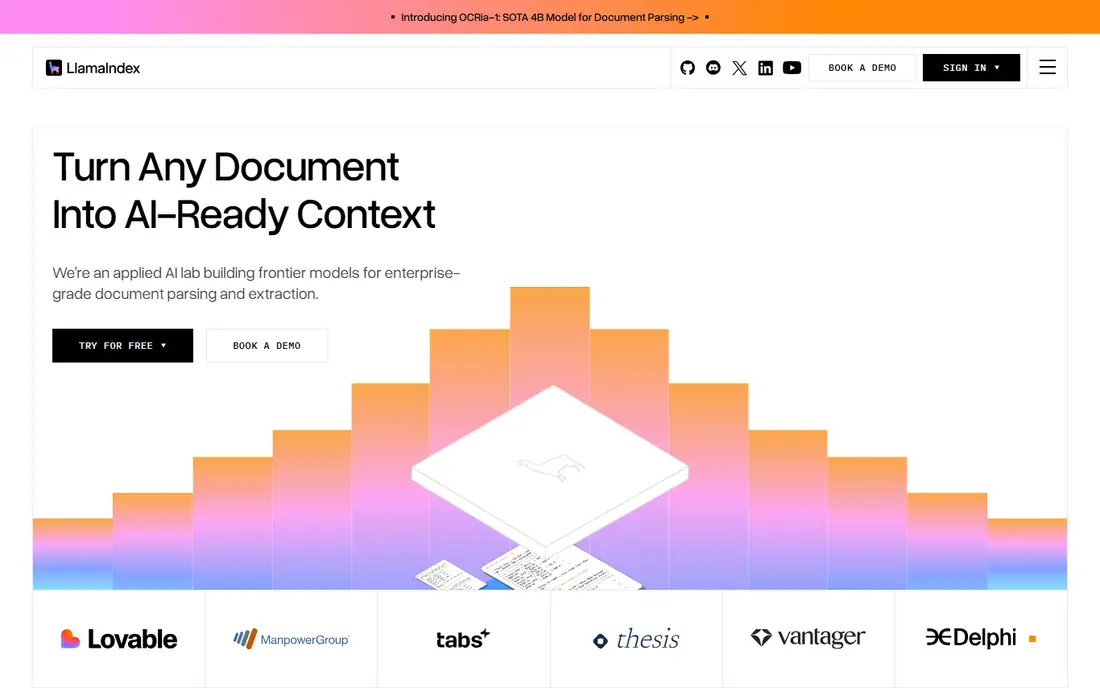
LlamaIndex is built around one job: connecting a language model to your data. It offers loaders, indexing, chunking, and query engines that help an app find the right documents before it answers. That focus makes it a strong choice for document question answering, knowledge bases, internal search, and support bots that must cite company files. The framework supports many data sources through connectors, and it offers different index types for keyword, vector, and hybrid search. Developers can tune chunk size, retrieval depth, and response modes for long documents, which helps when a single file is too large for a model context window. LlamaIndex also offers agent workflows for teams that need more than simple retrieval. LlamaIndex is less focused on general agent orchestration than CrewAI or Mastra, so teams building complex multi agent systems may need another framework or a mix. For retrieval heavy apps, though, its data layer is a clear reason to choose it over a general framework.
- Strong data connectors and indexing
- Retrieval focused design
- Python and TypeScript support
- Thinner multi agent story than CrewAI
- Paid cloud features add cost
- Learning curve for advanced retrieval
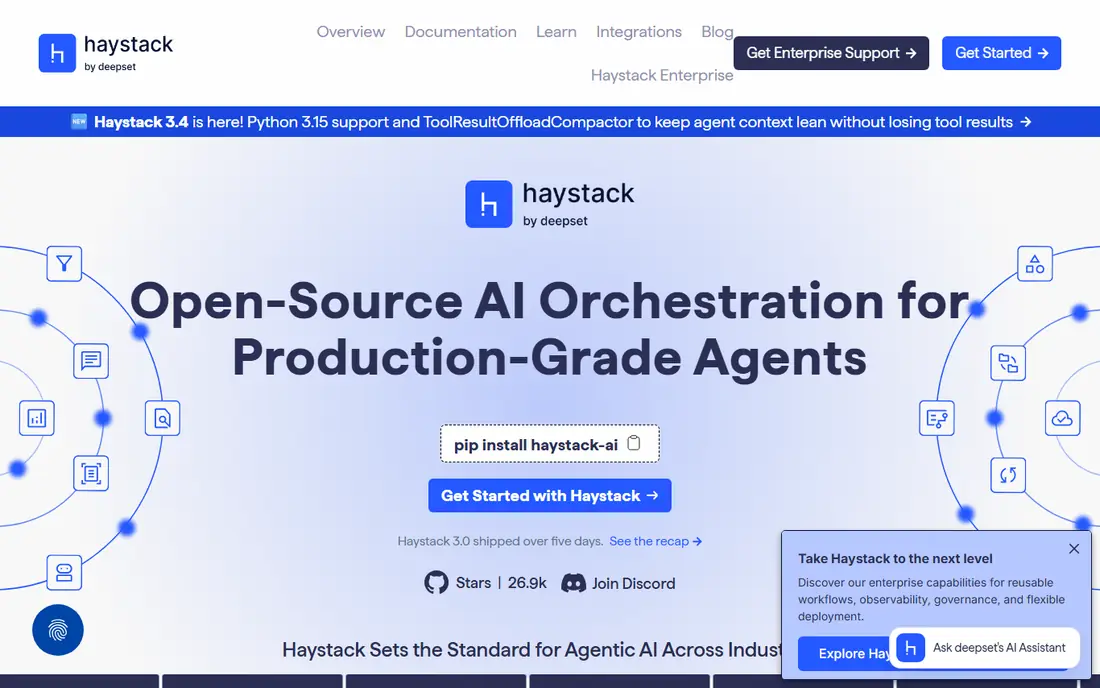
Haystack, from deepset, is designed for production search and retrieval pipelines. Developers build pipelines from components for document cleaning, splitting, embedding, retrieval, ranking, and answer generation. That modular design helps teams audit each step, test changes, and run the same pipeline in development and production. Haystack suits enterprise search, question answering over large document sets, and retrieval systems where accuracy and traceability matter. It supports hybrid retrieval, document stores, and evaluation tools, which help teams measure whether a change improves answers or makes them worse. Enterprise support is available for firms that need service agreements and extra features. Setup can feel heavier than a simple chain library, and Haystack is Python focused, so TypeScript teams may prefer Mastra or Vercel AI SDK. For Python teams building serious search pipelines, Haystack offers a production minded alternative to LangChain.
- Pipeline based design
- Strong document processing
- Enterprise options from deepset
- Steeper setup than simple frameworks
- Python only focus
- Smaller community than LangChain
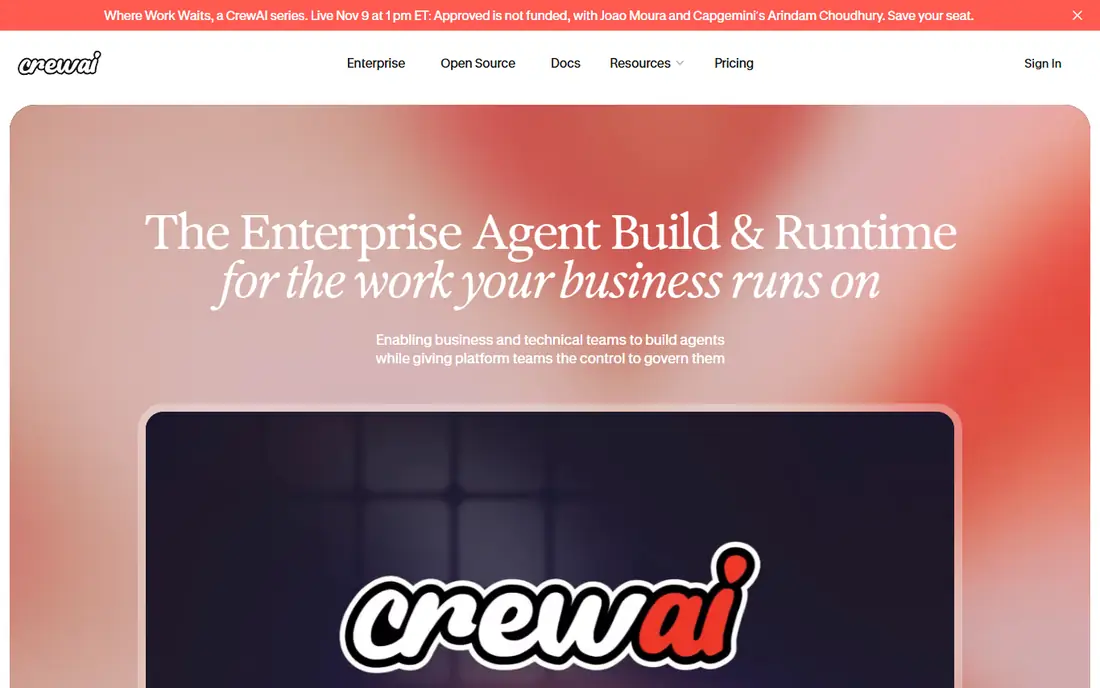
CrewAI models multi agent work as a crew of agents, each with a role, a goal, and tasks to complete. That model maps well to business workflows, such as research, writing, review, and planning, where different agents handle different steps. Developers can get a working multi agent prototype running with relatively little code, which helps teams test an idea before they invest in a larger system. The framework supports sequential and hierarchical crews, tool use, and memory, and it offers a visual platform for enterprise teams. That structure helps when agents need to hand work to each other in a clear order, rather than acting in a free form loop. CrewAI is also independent of LangChain, which appeals to teams that want a smaller dependency set. Debugging can become harder as agent count grows, since agent decisions interact in ways that are hard to trace. CrewAI also has less built in retrieval depth than LlamaIndex, so retrieval heavy apps may need to pair it with a dedicated data framework. For role based agent teams, it is a strong and readable choice.
- Simple role, goal, and task model
- Fast multi agent prototypes
- Python focused
- Debugging grows harder with many agents
- Enterprise features are paid
- Less RAG depth than LlamaIndex
Pydantic AI is built for Python developers who want type safety and structured outputs from language models. It uses Pydantic models to define what an agent should return, validates those outputs, and makes it easier to catch errors before they reach production. Dependency injection also helps with testing, since developers can swap real tools for test doubles. The framework is lightweight compared with LangChain, with fewer abstractions to learn. Developers define agents, tools, and models in plain Python, which suits teams that prefer explicit code over chain abstractions. Observability through Logfire, from the same makers as Pydantic, helps teams trace agent runs and costs. Pydantic AI is Python only, so TypeScript teams should look elsewhere. Its ecosystem is also smaller than LangChain, with fewer ready made integrations. For Python teams that value type safety, clear code, and reliable structured data, Pydantic AI is a compelling alternative.
- Type safe structured outputs
- Pydantic validation
- Dependency injection for testing
- Python only
- Smaller ecosystem than LangChain
- Newer than some rivals
Mastra is a TypeScript framework for agents, workflows, RAG, and evaluation. It suits web developers who want to build AI features in the same language as their front end and back end, without switching to Python. Agents, tools, memory, and workflows share a common model, which helps teams build a full app rather than a single agent script. Workflows in Mastra can handle multi step processes with branching and retries, while RAG tools help agents use company documents. Evaluation support helps teams test whether changes improve output quality, which matters as prompts and models change. Mastra also offers a cloud option for teams that want hosted agent infrastructure. As a newer framework, Mastra changes faster than mature options, and its community is smaller than LangChain. Teams should check current docs and version notes before they build a large system on it. For TypeScript teams that want an opinionated agent framework, Mastra is one of the strongest LangChain alternatives.
- TypeScript first design
- Agents, workflows, and RAG in one framework
- Evaluation tools
- Newer framework with faster changes
- Smaller community than LangChain
- Docs still growing
DSPy takes a different approach from most frameworks. Instead of hand writing prompts, developers define signatures for what a programme should do, then use DSPy optimisers to tune prompts and few shot examples against a dataset. That programmatic approach can improve accuracy on tasks such as classification, extraction, and question answering, where prompt wording matters. The framework suits teams with evaluation data and a clear quality target. By measuring output on a test set, DSPy can search for prompt and example combinations that perform better than a hand written prompt. That method also makes prompt changes more repeatable, since optimisation runs can be rerun as models change. DSPy has a steep learning curve and a different mental model from chain libraries, so simple chat apps may not need it. Teams that already struggle with prompt quality, and that have data to evaluate against, will get the most value. For prompt optimisation work, DSPy has no close match in the LangChain ecosystem.
- Programmatic prompt tuning
- Modular signatures and modules
- Evaluation driven design
- Steep learning curve
- Different mental model
- Less suited to simple chat apps
Flowise is a low code builder for AI apps, with a visual canvas where developers drag nodes for models, retrievers, tools, and memory. That visual approach helps product teams, analysts, and developers who want a working prototype without writing a full codebase. Flows can be exported and run as APIs, so a prototype can become part of a larger app. Self hosting gives teams control over data and costs, while cloud options suit teams that want a managed service. Flowise supports many language models, vector databases, and tools, which helps when a team wants to test different models without rewriting code. It is also useful for internal tools, chatbots, and document assistants that follow a clear flow. Visual builders have limits. Complex branching, custom logic, and large agent systems can become hard to manage on a canvas, and code frameworks offer more control for those cases. Flowise suits low code teams, rapid prototypes, and apps with a clear, repeatable flow rather than open ended agent research.
- Visual drag and drop builder
- Self hosted option
- Many integrations
- Less control than code frameworks
- Complex logic can get messy visually
- Scaling needs care
Vercel AI SDK is a TypeScript library for building AI features in web and mobile apps, with a focus on streaming interfaces. It offers a unified API across model providers, tools for chat and completion streaming, and React hooks that make it easier to build chat interfaces, generative UI, and tool calling in a web app. Teams using Next.js will find it especially natural. The SDK suits product teams that need a polished user interface for AI features, such as chat, summarisation, and assisted writing. Streaming keeps the interface responsive while a model generates a long answer, and provider switching is easier than with a provider specific library. The SDK also includes agent support for TypeScript apps that need tool use. Vercel AI SDK is not a full replacement for a Python agent framework in every case. Teams building complex multi agent systems, heavy RAG pipelines, or Python services may still need LlamaIndex, Haystack, or CrewAI. For TypeScript web apps, it is a practical and widely used alternative to LangChain.
- Streaming UI support
- Unified provider API
- Strong Next.js and React fit
- Web focused, not a full agent framework
- Provider costs are separate
- TypeScript only
How we picked these
We compared official feature pages, pricing pages, app store listings where relevant, and public reviews for AI frameworks that serve as LangChain alternatives today. We looked at language support, RAG depth, agent design, workflow support, evaluation tools, deployment options, and community size. We used first person plural language for our method, and we did not claim hands on testing that did not happen. We also considered the cost of switching. A framework that looks simpler in a demo can still require rewriting tools, prompts, and evaluation code, so we favoured options with a clear use case rather than a general claim. That focus shaped our best for labels and our advice to prototype before migrating.
Choosing a LangChain alternative
Start from the bottleneck
Identify whether your main problem is retrieval quality, agent behaviour, type safety, language fit, or prompt quality. LlamaIndex and Haystack help retrieval, CrewAI helps role based agents, Pydantic AI helps type safety, Mastra and Vercel AI SDK help TypeScript teams, and DSPy helps prompt optimisation. A framework that fixes a different problem will not help, even if it is popular.
Prototype with real data
Build a small prototype with your own documents, tools, and evaluation questions. Measure answer quality, latency, and cost, and check how easy it is to trace a bad answer back to a step. A prototype with real data reveals gaps that a tutorial with sample data will hide.
Plan for evaluation and observability
Every framework still needs evaluation and tracing. Budget for an evaluation set, a tracing tool, and a process to review failures. Switching frameworks moves that work, it does not remove it, so keep your evaluation code separate from framework code where possible.
Check migration cost honestly
Count custom tools, prompts, integrations, and deployment code that would need rewriting. If that count is high and your current LangChain app works, consider LangGraph or a partial fix first. Migrate when the new framework clearly solves a bottleneck that a smaller change cannot fix.
Frequently asked questions
Is LlamaIndex better than LangChain for RAG?
LlamaIndex is often stronger for retrieval heavy apps because its data layer, indexing, and query engines are the core product. LangChain covers more general orchestration, so it may suit apps that need many tool types beyond retrieval. Choose based on whether retrieval or general orchestration is your main need.
Can I use CrewAI with LlamaIndex?
Yes, many teams pair a retrieval framework with an agent framework. LlamaIndex can handle document search and indexing, while CrewAI handles role based agent work. Keep the boundary clear, so retrieval code and agent code do not become tangled.
Is LangChain free?
LangChain open source libraries are free under an MIT licence, though model API costs and LangSmith platform fees are separate. Alternatives in this guide also have free open source cores, with paid cloud or enterprise options for hosting, support, and extra features.
Which LangChain alternative is best for TypeScript?
Mastra suits TypeScript agents and workflows, while Vercel AI SDK suits TypeScript web apps with streaming interfaces. Choose Mastra for agent heavy back end work and Vercel AI SDK for front end AI features, or use both in different parts of the same app.
Do I need to leave LangChain to fix complexity?
Not always. LangGraph offers a graph based model for stateful agents within the LangChain ecosystem, and simpler LangChain code can fix some complexity issues. Leave LangChain when a different framework clearly fits your language, retrieval, or agent model better.
What about AutoGen and Semantic Kernel?
AutoGen, now AG2, suits conversational multi agent research in Python, while Semantic Kernel suits .NET and Azure enterprise apps. Both are credible alternatives, but we focused this list on the eight frameworks with the clearest fit for common RAG, agent, and web app needs.
Sources we checked (8)

Online Jobs is an independent blog about careers, online work, learning new skills and the tools that help people earn. More about us.
Keep reading
All posts
n8n Alternatives
n8n alternatives compared for 2026, with Zapier, Make, Activepieces, and more, covering visual builders, code steps, self-hosting, and pricing models.

ZoomInfo Alternatives
The best ZoomInfo alternatives in 2026, compared on price, free plans, data coverage, and which tool fits small teams or large sales teams best in detail.

Workday Alternatives
We compared the best workday alternatives for HR, payroll, and global hiring, from BambooHR and Gusto to Rippling, Deel, and HiBob for growing teams in 2026.