Best GoDaddy Alternatives in 2026: 9 Providers Compared

How we put this together: we compare official feature and pricing pages, app store listings, privacy policies and public user reviews. Prices change, so check the provider's site before you pay.
Key takeaways
- Hostinger and Namecheap offer the lowest starting prices, but renewal rates matter more than intro deals for long-term cost.
- Bluehost and DreamHost suit WordPress beginners, with managed setup, staging, and daily backups on entry plans.
- SiteGround costs more at renewal but adds managed support and performance that busy site owners value.
- For domains alone, Porkbun and Namecheap offer transparent pricing with free privacy, while Cloudflare Registrar sells at registry cost.
Quick comparison
| Name | Who it suits | Starting price | Free option | |
|---|---|---|---|---|
 Hostinger | Budget all-in-one hosting | $3.99 per month | No | Visit |
 Namecheap | Low-cost domains and hosting | $2.28 per month | No | Visit |
 Bluehost | WordPress beginners | $4.99 per month | No | Visit |
 DreamHost | Flexible month-to-month hosting | $2.89 per month | No | Visit |
 SiteGround | Managed WordPress performance | $2.99 per month | No | Visit |
 IONOS | Business bundles on a budget | $1 per month | No | Visit |
 Wix | Drag-and-drop website building | $17 per month | Yes | Visit |
 Squarespace | Design-led websites | See website | No | Visit |
 Porkbun | Transparent domain pricing | $11.08 per year | No | Visit |
The best GoDaddy alternatives
GoDaddy is easy to recognize but often frustrates users with upselling, cluttered checkout, and renewal prices far above intro rates. The providers below cover the same ground, hosting, domains, and site builders, with clearer pricing or better support in most cases.
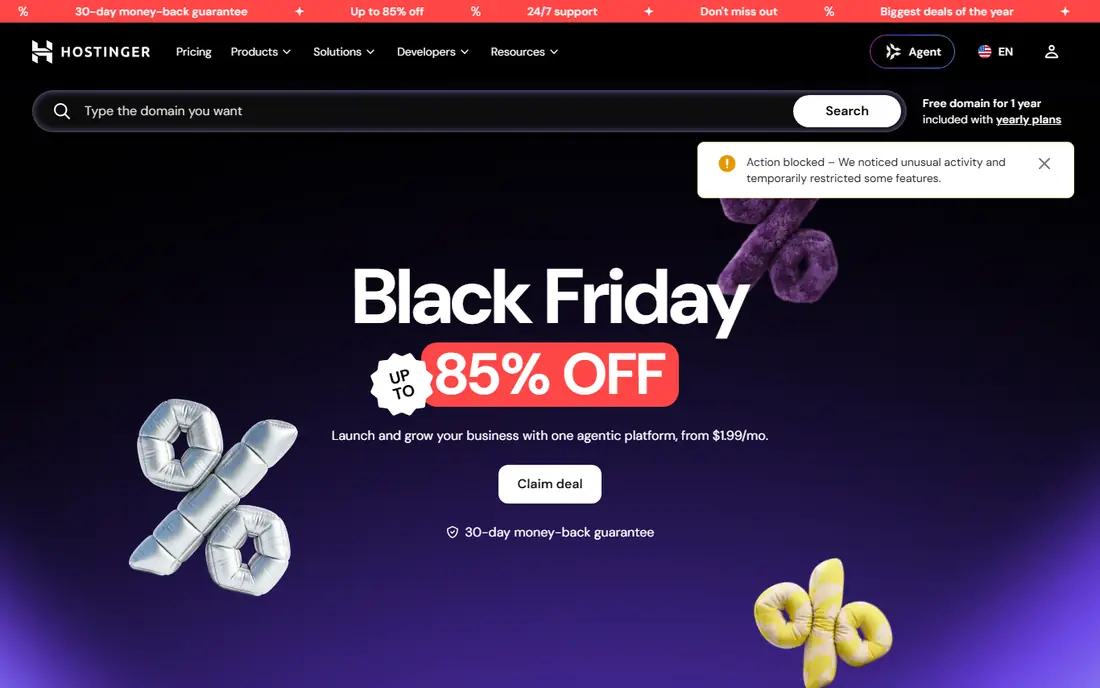
Hostinger is the budget pick for users who want hosting, a domain, email, and SSL in one cheap package. Entry plans start at $3.99 per month on annual billing, with a free domain for the first year and AI tools for building pages quickly. The control panel is modern and easy for beginners to learn.
Renewal pricing is the catch, rising to around $10.99 per month after the first term, so the long-term cost is closer to mid-range hosts. Users who plan to stay for years should compare the total multi-year cost, not just the first-year deal.
- Low entry price
- Free domain for the first year on many plans
- AI site tools included
- Renews around $10.99 per month
- Support is chat-based on lower tiers
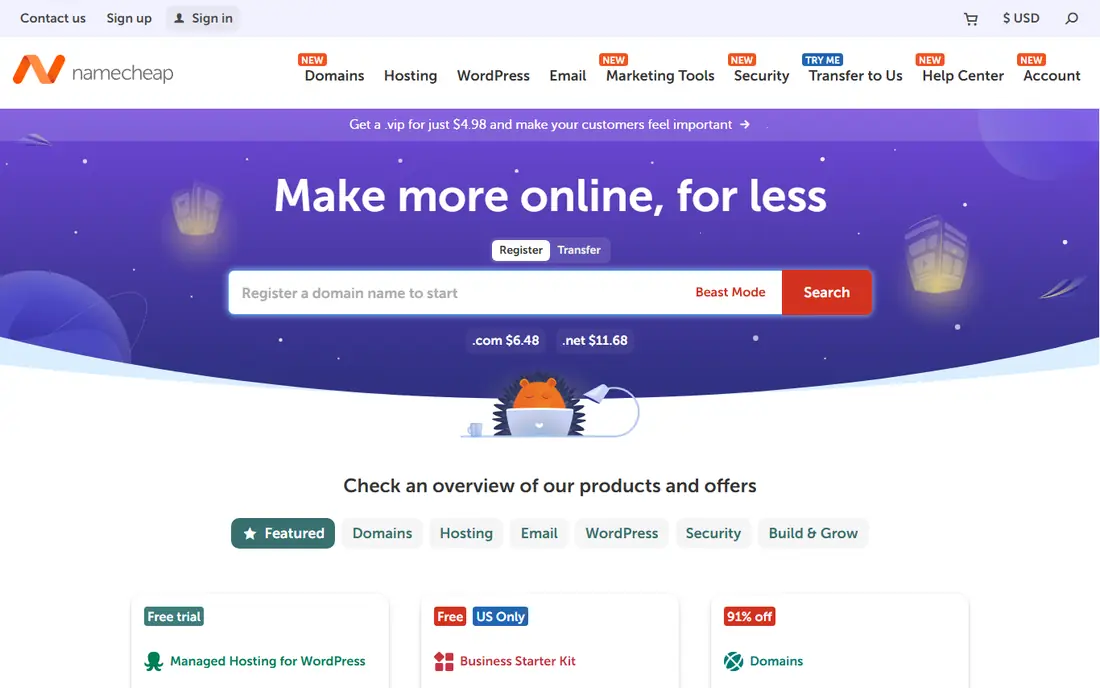
Namecheap is best known for domains, where it pairs competitive registration prices with free WHOIS privacy for life. Its Stellar shared hosting starts at $2.28 per month and renews at $4.66 per month, which is gentler than most rivals. Domain management is clean, with bulk tools for owners of many names.
Hosting itself is basic shared hosting, so high-traffic sites will outgrow it sooner than managed WordPress hosts. For domain-first buyers and small sites on a budget, Namecheap is the most transparent alternative to GoDaddy.
- Free WHOIS privacy for life
- Low hosting renewals
- Straightforward domain management
- Hosting performance is basic
- Premium support costs extra on some plans

Bluehost is a natural first host for WordPress beginners, with guided setup, staging on higher plans, and a free domain for the first year. Entry plans start at $4.99 per month on annual billing, and the WordPress dashboard integration keeps updates and plugins simple for new site owners.
Renewal rates rise to around $11.99 per month, and checkout includes upsells that beginners should review carefully. For a first WordPress site where guided setup matters more than rock-bottom pricing, Bluehost remains a solid GoDaddy alternative.
- Official WordPress recommendation
- Managed setup and staging
- Free domain for the first year
- Renews around $11.99 per month
- Upsells appear during checkout
DreamHost stands out for flexibility, with entry plans from $2.89 per month for the first year and month-to-month billing for users who dislike long contracts. Daily backups, a free domain for the first year, and a long money-back window make it low-risk to try. Renewal sits around $10.99 per month.
Support is mainly chat and ticket-based, and the custom control panel takes adjustment for users used to cPanel. For site owners who value flexibility and backups over phone support, DreamHost is a strong pick.
- Daily backups included
- Month-to-month billing available
- Generous money-back window
- No phone support on some plans
- Control panel differs from cPanel
SiteGround is the premium managed option, running on Google Cloud with daily backups, staging, and support that WordPress users consistently praise. Entry plans start at $2.99 per month for the first year, with a free domain for the first year and phone support included on all plans.
The renewal price of $17.99 per month is the highest on this list, and the entry plan covers only one website. SiteGround suits owners who would rather pay more for support and performance than troubleshoot hosting problems themselves.
- Managed support and Google Cloud platform
- Daily backups
- Phone support on all plans
- Renews at $17.99 per month, the highest here
- Entry plan covers one site
IONOS offers the cheapest first year on this list, with entry plans at $1 per month for the first year, plus a free domain and wildcard SSL. Business bundles add email, a personal consultant, and site tools that appeal to small companies setting up their first online presence.
Renewal jumps to around $14 per month, so the first-year saving fades quickly, and the control panel feels dated compared with Hostinger or SiteGround. IONOS fits businesses that want the lowest possible first-year bill and are willing to reassess at renewal.
- Lowest first-year price here
- Wildcard SSL included
- Personal consultant on business plans
- Renews around $14 per month
- Interface feels dated next to newer hosts
Wix replaces the hosting-plus-builder puzzle with a single drag-and-drop platform. Users pick from thousands of templates, add features with apps, and publish without touching server settings. Plans start at $17 per month, with a free plan for testing the builder.
The trade-off is portability. A Wix site cannot easily move to WordPress or another host later, and large or highly custom sites may hit the builder limits. For small business sites and portfolios where ease beats flexibility, Wix is a simpler alternative to GoDaddy hosting.
- Drag-and-drop builder with many templates
- Free plan available
- AI builder included
- Less flexible than WordPress for large sites
- Moving away from Wix later is difficult
Squarespace is the design-first alternative, with polished templates, strong typography controls, and blogging tools that suit portfolios, restaurants, and creative businesses. Domain pricing is all-inclusive, and a free domain comes with annual plans. Pricing varies by location, so check the current plan page before budgeting.
The app ecosystem is smaller than WordPress, and advanced customization needs code or workarounds. For owners who care most about how the site looks and want everything in one bill, Squarespace is the most refined builder here.
- Polished templates and design controls
- All-inclusive domain pricing
- Good blogging tools
- Pricing varies by location
- Fewer third-party apps than WordPress
Porkbun is a domain registrar with unusually transparent pricing: a .com costs $11.08 per year for both registration and renewal, with free WHOIS privacy and free SSL certificates included. The checkout is refreshingly free of upsell pressure compared with GoDaddy.
Porkbun does not offer a full website builder, and hosting is not its focus, so it pairs best with a separate host from this list. For domain-only buyers who hate renewal surprises, Porkbun is the clearest alternative available.
- Same price for registration and renewal on .com
- Free WHOIS privacy and SSL
- No upsell pressure
- No full website builder
- Hosting is not the focus
How we picked these
We compared vendor pricing pages, renewal rates, included features, and support models for providers that replace GoDaddy hosting, domains, or site building. We favored providers that publish renewal pricing and include free privacy or SSL, since hidden renewals are the most common complaint about GoDaddy. Prices reflect recent October 2026 pricing checks, and Squarespace is marked See website because its pricing varies by location.
How to switch from GoDaddy without downtime
Move the domain and hosting in the right order
Set up the new hosting account first, copy site files and email, and test the site on a temporary address before changing DNS. Only then update nameservers or transfer the domain, and keep the old account active until the new setup is proven.
Check email, SSL, and DNS records before you cancel
Email accounts, DNS records, and SSL certificates are the items most often lost in a move. Export mailboxes, note every DNS record, and confirm SSL works on the new host before cancelling GoDaddy services.
Read the renewal price, not just the intro price
Intro rates of $1 to $4 per month often renew at $10 to $18 per month, which changes the cheapest option over three years. Compare the total cost over your expected stay, including domain renewal and privacy fees, before choosing.
Frequently asked questions
What is the best GoDaddy alternative for web hosting?
Hostinger is the best budget alternative at $3.99 per month, while SiteGround is the best managed alternative for owners who value support and performance. Bluehost and DreamHost sit between the two for WordPress beginners who want guided setup.
What are the best GoDaddy hosting alternatives with cheap renewals?
Namecheap has the gentlest hosting renewal on this list at $4.66 per month for Stellar, followed by Bluehost and DreamHost at around $10 to $12 per month. Always confirm the renewal rate on the provider page, since intro deals change often.
What is the best alternative to GoDaddy for domains?
Porkbun is the best domain alternative for transparent pricing, with .com registration and renewal at $11.08 per year and free privacy. Namecheap is close behind, with competitive domain prices and free WHOIS privacy for life.
Is it hard to transfer a domain away from GoDaddy?
No, domain transfers usually take a few days and involve releasing the domain, getting an authorization code, and approving the transfer at the new registrar. Keep the old account active and avoid changing nameservers and registrar at the exact same moment to reduce downtime risk.
Should I use a website builder instead of hosting?
A builder such as Wix or Squarespace suits small sites where ease and design matter more than flexibility, while hosting with WordPress suits larger sites that need plugins and full control. Builders are harder to leave later, so choose one only if you are comfortable staying on that platform.
Sources we checked (9)

Online Jobs is an independent blog about careers, online work, learning new skills and the tools that help people earn. More about us.
Keep reading
All posts
ZoomInfo Alternatives
The best ZoomInfo alternatives in 2026, compared on price, free plans, data coverage, and which tool fits small teams or large sales teams best in detail.

Workday Alternatives
We compared the best workday alternatives for HR, payroll, and global hiring, from BambooHR and Gusto to Rippling, Deel, and HiBob for growing teams in 2026.

Which SaaS Tools Have the Best Customer Support
Which SaaS tools have the best customer support? Compare eight popular tools on help centres, live help, response options and overall support quality.