Best Firebase Alternatives in 2026: 8 Platforms Compared

How we put this together: we compare official feature and pricing pages, app store listings, privacy policies and public user reviews. Prices change, so check the provider's site before you pay.
Key takeaways
- Supabase is the closest Firebase alternative for most teams, with Postgres, auth, storage, realtime, and functions in one platform.
- Appwrite and PocketBase suit teams that want open-source self-hosting, with Appwrite for larger projects and PocketBase for small, simple apps.
- AWS Amplify suits teams already on AWS, while Convex suits TypeScript teams that want reactive data by default.
- The right choice depends on your data model, because moving from Firestore documents to Postgres tables is the largest migration task.
Quick comparison
| Name | Who it suits | Starting price | Free option | |
|---|---|---|---|---|
 Supabase | Postgres Firebase replacement | $25 per month | Yes | Visit |
 Appwrite | Open-source all-in-one backend | $25 per month | Yes | Visit |
 PocketBase | Small self-hosted apps | Free | Yes | Visit |
 AWS Amplify | AWS-native app backend | See website | Yes | Visit |
 Convex | Reactive TypeScript apps | $25 per month | Yes | Visit |
 Nhost | GraphQL on Postgres | $25 per month | Yes | Visit |
 Backendless | Visual low-code backend | $15 per month | Yes | Visit |
 Back4App | Parse-based backend | $15 per month | Yes | Visit |
The best Firebase alternatives
Firebase gives app teams auth, a NoSQL database, storage, functions, and hosting in one Google-managed platform. Alternatives differ mainly in database type, hosting control, and pricing model. Some keep a similar managed experience with Postgres instead of Firestore. Others give you open-source code you can host yourself. Start with your data model, then check auth, realtime, and cost.
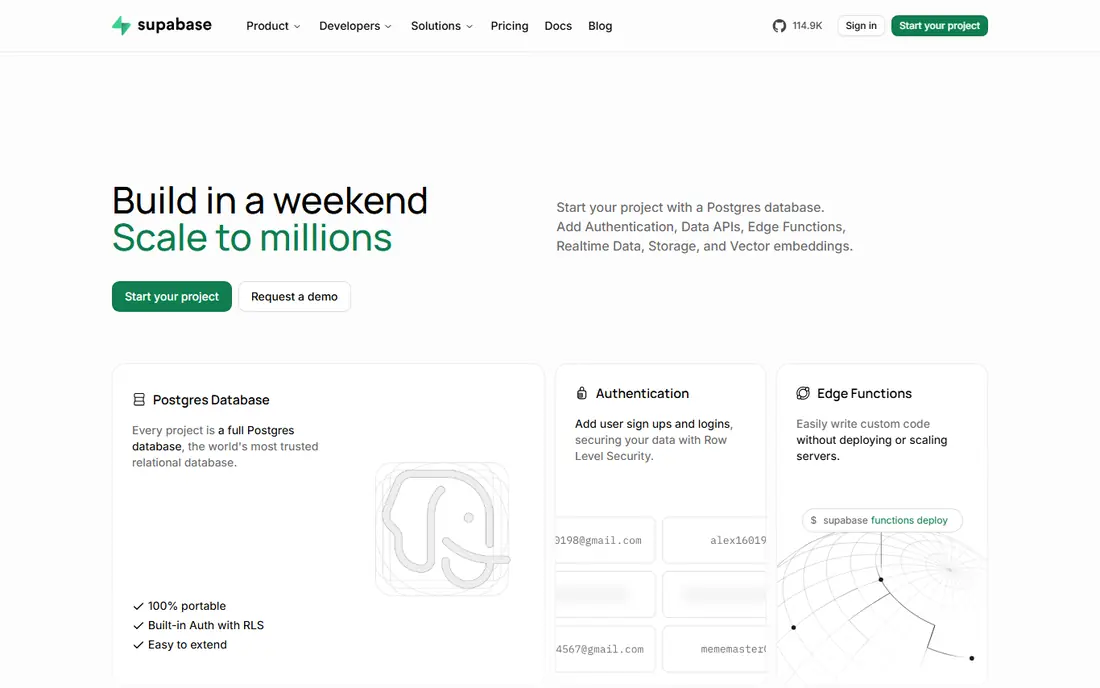
Supabase is the most direct Firebase alternative for teams that want a managed backend with a relational database. You get a full Postgres database, auth with row-level security, file storage, realtime subscriptions, and edge functions, all from one dashboard. Instant REST APIs mean a front-end team can start building without writing a separate API layer.
The main change is mental, not just technical. Firestore documents and subcollections map to Postgres tables and foreign keys, which is cleaner for structured data but needs planning for existing Firebase apps. Supabase is open source, so you can self-host if you later need full control, though most teams start on the managed cloud.
- Full Postgres database
- Auth, storage, realtime, and edge functions
- Open source with self-host option
- Instant REST APIs
- Postgres modelling differs from Firestore documents
- Free projects can pause after inactivity
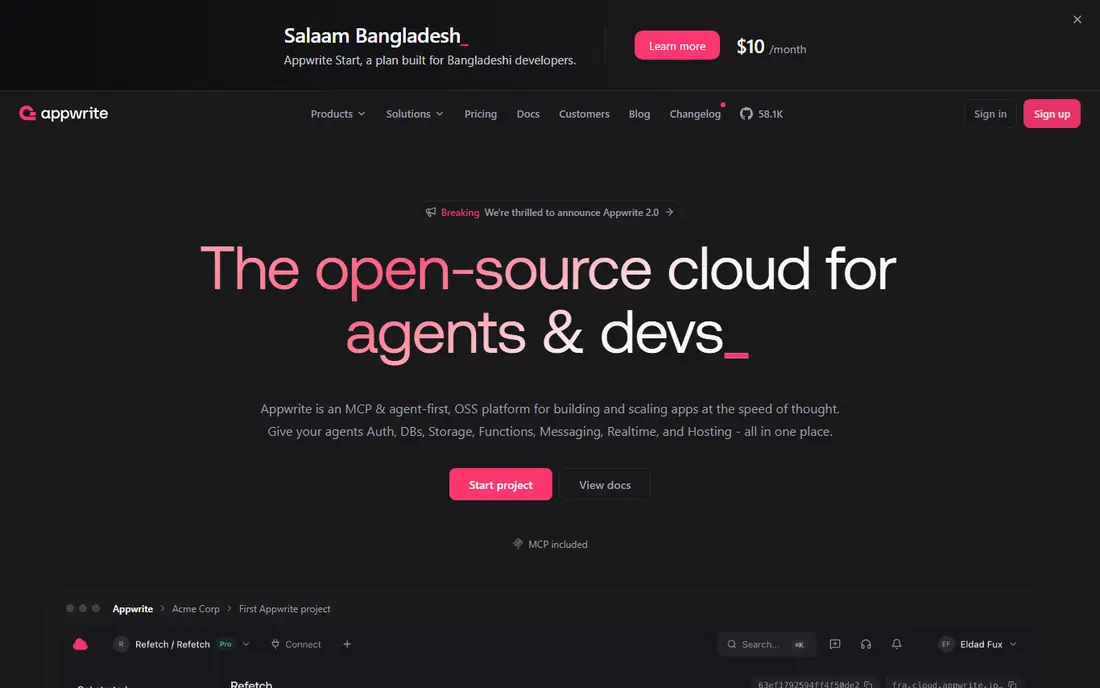
Appwrite is an open-source backend platform that covers auth, databases, storage, functions, and messaging in one system. You can self-host it with Docker, which gives you full control over data and infrastructure, or use Appwrite Cloud for a managed version. That choice between self-hosting and cloud is a key reason teams pick Appwrite over a locked-in platform.
Self-hosting is not free in effort, even though the software is open source. You still need to manage updates, backups, scaling, and security. For teams with DevOps capacity, or teams that need data residency control, Appwrite is a strong and flexible Firebase alternative.
- Open source and self-hostable
- Auth, databases, storage, and functions
- Managed cloud option
- Good docs
- Smaller ecosystem than Firebase
- Self-hosting needs DevOps time
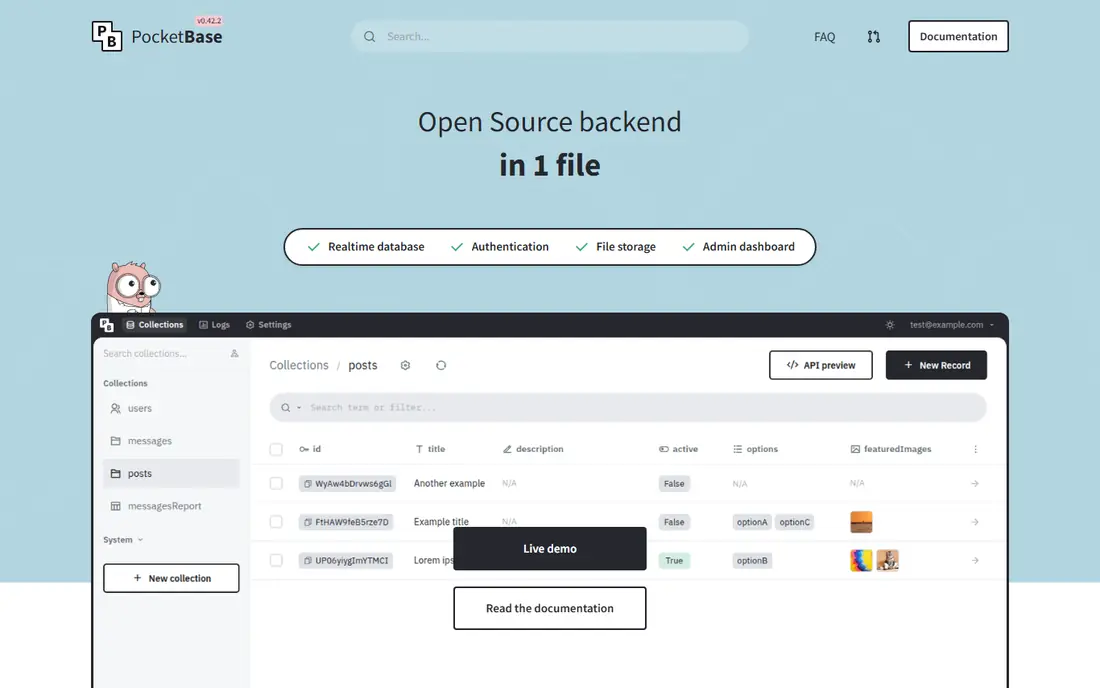
PocketBase is a small, single-binary backend built on SQLite, with auth, realtime subscriptions, file storage, and an admin UI included. You can run it on a small server, a VPS, or even locally for a prototype, with very little setup. That simplicity makes it ideal for side projects, internal tools, and small apps.
Scale is the limit. SQLite and a single-node design suit small and medium apps, but not a large app with heavy concurrent writes. PocketBase is best when you want a backend you fully control for a modest app, not when you need Firebase-scale managed infrastructure from day one.
- Single binary, easy to run
- Built-in admin UI
- Auth, realtime, and file storage
- Free open-source software
- SQLite database limits large-scale use
- Single-node design
- Fewer managed cloud options
AWS Amplify suits teams already using AWS, because it ties together Cognito for auth, AppSync for APIs, S3 for storage, and Lambda for functions. You can build a full app backend inside your AWS account, with enterprise scaling and compliance options that AWS provides. Hosting for web apps is also included.
The trade-off is complexity and pricing. Amplify charges through underlying AWS services, so costs depend on usage across several services rather than one simple plan. Beginners may find Amplify harder to learn than Firebase or Supabase. For AWS-native teams, though, that integration is a real advantage.
- Deep AWS integration
- Auth with Cognito
- GraphQL and REST APIs
- Hosting and storage on AWS services
- Pay-as-you-go pricing is harder to predict
- AWS learning curve
- Less simple than Firebase for beginners
Convex is built for TypeScript teams that want realtime data without manual subscription code. Queries are reactive by default, so the user interface updates when data changes, without extra polling or websocket handling. Functions are written in TypeScript, and auth integrates with common providers.
Convex uses its own document-relational database, which is not Postgres and not Firestore. That model is powerful for realtime apps, but it means migration from Firebase still needs data modelling work, and hiring for Convex experience is harder than for Postgres. For a new TypeScript app with realtime needs, Convex is a clean and modern choice.
- Reactive queries update automatically
- TypeScript-first functions
- Auth integrations
- Good developer experience
- Document-relational model is distinct from Postgres
- Smaller ecosystem than Supabase or AWS
Nhost combines Postgres, Hasura GraphQL, auth, storage, and functions into a Firebase-like platform for GraphQL teams. If your front end already uses GraphQL, Nhost gives you a typed, queryable API over Postgres without building a separate GraphQL server. Auth and file storage are included, so a full app backend is possible from one platform.
GraphQL is also the limit. Teams that prefer REST, or that do not want to learn GraphQL, may prefer Supabase or Appwrite. For GraphQL-first teams, Nhost is a focused and capable alternative, with open-source parts you can self-host if needed.
- Postgres with Hasura GraphQL
- Auth, storage, and functions
- Open-source components
- Self-host option
- GraphQL-first approach needs GraphQL knowledge
- Ecosystem is smaller than Supabase
Backendless suits teams that want a visual backend without writing every API by hand. You can model data, build logic with visual blocks or code, manage users, and send push notifications from one console. That low-code approach helps product teams, agencies, and internal tool builders ship faster.
Developer teams that want full code control and a large open-source ecosystem may find Backendless less flexible than Supabase or Appwrite. Pricing and API limits also need checking as an app grows. For visual development and rapid prototypes, Backendless is a practical Firebase alternative.
- Visual data and logic tools
- Auth, push, and file services
- Good for low-code and no-code teams
- Less developer-focused than Supabase or Appwrite
- Pricing and limits need checking at scale
Back4App is a managed backend built on the open-source Parse platform. It offers databases, auth, cloud code, push notifications, and file storage, with both REST and GraphQL APIs. Teams that used Parse in the past, or that want a managed Parse backend without running servers themselves, will find Back4App familiar.
Parse is a mature but smaller ecosystem than Firebase or Supabase today, so library and hiring options are thinner. Back4App still suits teams that like the Parse data model, need managed hosting, and want a clear migration path from a self-hosted Parse server to a managed service.
- Built on open-source Parse
- Auth, realtime, and push
- Managed hosting with scaling options
- GraphQL and REST APIs
- Parse model differs from Firebase
- Community is smaller than in the Firebase peak years
How we picked these
We started with web search for Firebase alternatives, then checked each vendor's own documentation, feature, and pricing pages, plus public reviews and migration guides. We kept only platforms that are working in October 2026 and that offer auth, a database, and a route to storage or functions, because those are the core Firebase jobs.
We also checked pricing transparency. Where a vendor publishes a starting monthly price, we used it. Where pricing is pay-as-you-go across cloud services, as with AWS Amplify, we wrote "See website" rather than inventing a monthly figure. That distinction matters, because a simple starting price can hide usage costs at scale.
How to migrate from Firebase without breaking your app
Map your data model first
List every Firestore collection, subcollection, and query, then map each one to a table, foreign key, or document in the new system. Do not start coding until that map is complete, because data model mistakes are the hardest to fix after migration.
Migrate auth with password hashes where possible
Many alternatives can import Firebase Auth users with password hashes, so users can keep their passwords. Test that import on a small group first, and plan a password reset flow for any users whose hashes cannot be imported.
Run both backends in parallel
Keep Firebase running while you move traffic in stages. Move read-only features first, then writes, and compare outputs between old and new backends before you cut over fully. A parallel run catches query and security rule differences before users notice them.
Rewrite functions and security rules, do not copy them
Cloud Functions and Firestore security rules rarely transfer directly. Rewrite functions for the new platform's runtime, and rewrite access rules using the new platform's model, such as Postgres row-level security in Supabase. Test those rules with real user roles, not just admin accounts.
Frequently asked questions
What is the best alternative to Firebase?
Supabase is the best overall alternative for most teams, because it matches Firebase features with a Postgres database and open-source self-hosting. Appwrite is best for open-source control, AWS Amplify is best for AWS teams, and PocketBase is best for small self-hosted apps.
Is Supabase better than Firebase?
Supabase is better if you want a relational database, open-source code, and less vendor lock-in. Firebase is still strong for mobile apps that need offline sync, push through Firebase Cloud Messaging, and tight Google Cloud integration. The better choice depends on your data model and your existing cloud setup.
Can I self-host a Firebase alternative?
Yes. Appwrite and PocketBase are built for self-hosting, and Supabase and Nhost offer self-host options for their open-source components. Self-hosting gives control over data and costs, but adds maintenance, backup, and security work that a managed plan would handle.
Which Firebase alternative is cheapest?
PocketBase is cheapest in software cost, because it is free and you only pay for your own hosting. Among managed platforms, starting prices are often around $15 to $25 per month, with usage charges on top at scale. Always price your expected database size, storage, and function calls, not just the starting tier.
How hard is it to migrate from Firebase to Supabase?
Migration effort depends on your app size and data model. Auth import is often straightforward, while Firestore to Postgres mapping and function rewrites take the most time. A staged migration with parallel running is safer than a single cutover, especially for apps with active users.
Do Firebase alternatives support realtime data?
Yes, most options in this list support realtime updates, including Supabase, Appwrite, PocketBase, Convex, and Nhost. Implementation differs, from Postgres change feeds to reactive queries, so test realtime behaviour with your actual data patterns before you commit.
Sources we checked (8)

Online Jobs is an independent blog about careers, online work, learning new skills and the tools that help people earn. More about us.
Keep reading
All posts
n8n Alternatives
n8n alternatives compared for 2026, with Zapier, Make, Activepieces, and more, covering visual builders, code steps, self-hosting, and pricing models.

ZoomInfo Alternatives
The best ZoomInfo alternatives in 2026, compared on price, free plans, data coverage, and which tool fits small teams or large sales teams best in detail.

Workday Alternatives
We compared the best workday alternatives for HR, payroll, and global hiring, from BambooHR and Gusto to Rippling, Deel, and HiBob for growing teams in 2026.