Best Usage-Based Billing Platforms in 2026: 8 Platforms Compared


Teams already on Stripe · Starting price: 0.7% of billing volume
How we put this together: we compare official feature and pricing pages, app store listings, privacy policies and public user reviews. Prices change, so check the provider's site before you pay.
Key takeaways
- Stripe Billing is the default for teams already on Stripe, while Metronome adds advanced rating for high-volume usage and enterprise contracts.
- Chargebee suits subscription businesses adding usage, and Maxio suits finance-led teams that want billing and revenue recognition together.
- Orb and Lago suit developer-led and open source teams that want control over metering and pricing logic.
- Usage billing fees sit on top of payment processing, so model the total cost, including any metering or platform fee.
- Start by defining your billable metric clearly, since a messy metric will cause billing disputes no platform can fix.
Quick comparison
| Name | Who it suits | Starting price | Free option | |
|---|---|---|---|---|
| Stripe Billing | Teams already on Stripe | 0.7% of billing volume | No | Visit |
 Metronome | High-volume usage and commits | 0.8% of billing volume | No | Visit |
 Chargebee | Hybrid subscription and usage | 0.80% of invoicing volume | No | Visit |
 Orb | Developer-led metering | See website | Free trial | Visit |
 Lago | Open source self-hosting | Free | Yes | Visit |
 Maxio | Finance-led B2B billing | $599 per month | No | Visit |
 Zuora | Enterprise quote-to-cash | See website | No | Visit |
 Schematic | Entitlement and usage pricing | Free | Yes | Visit |
The best usage-based billing platforms
Usage-based billing charges customers for what they actually use, such as API calls, tokens, seats over time, or data processed, rather than a flat monthly fee alone. The best usage-based billing platforms meter events accurately, turn them into rated charges, and produce invoices customers can understand. We compared official pricing pages and public platform descriptions for tools that are live today.

Stripe Billing is the natural starting point for a team that already processes payments with Stripe. It handles subscriptions, per-seat pricing, and usage charges, and it connects to checkout, tax, and revenue reporting tools in the same system. For a self-serve SaaS product with straightforward usage, that integration saves a lot of build time.
The limit is advanced rating. Complex commits, credits, and multi-dimensional usage are better handled by Metronome, which Stripe now owns and sells as an add-on. A team should also remember that the billing percentage is separate from card processing fees, so the total cost is higher than the headline rate alone.
- Deep integration with Stripe Payments, Tax, and Checkout
- Supports subscriptions, seats, and usage
- Widely adopted
- Advanced usage rating needs Metronome as an add-on
- Billing fee sits on top of card processing
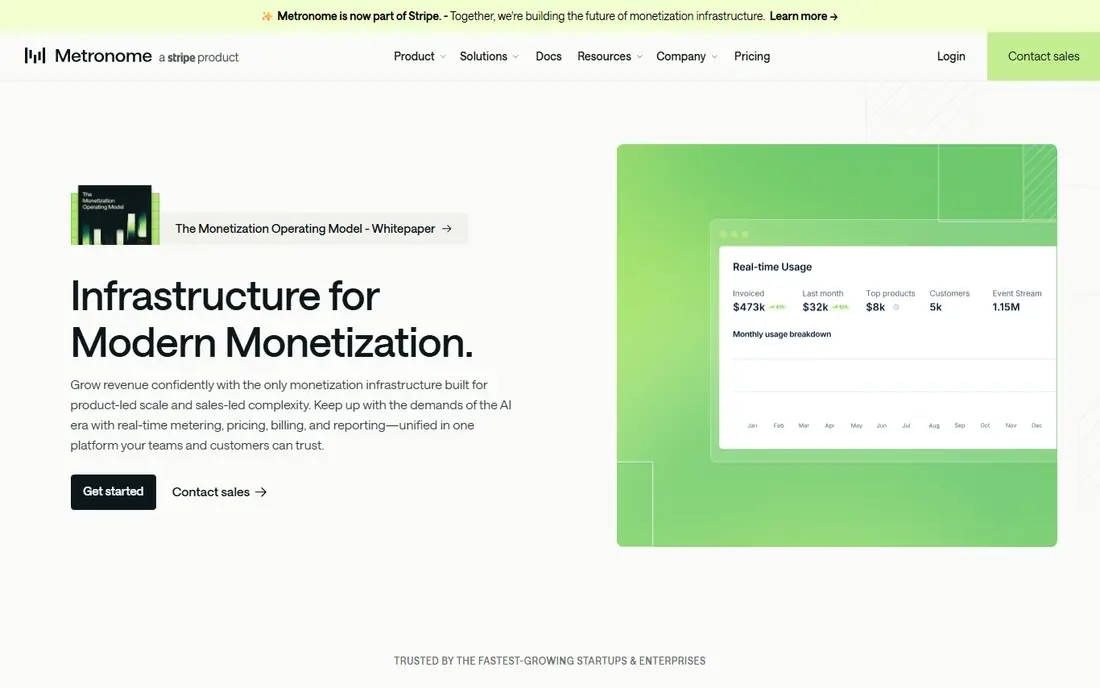
Metronome is built for companies that bill serious usage volume, including AI products charging for tokens and API products charging for requests. Billable metrics are defined as queries over raw events, so pricing logic can change without losing history, and the platform handles prepaid credits, committed spend, drawdowns, and overages. Customer spend dashboards and threshold alerts help reduce billing surprises.
The catch is that Metronome is not a standalone billing system for most buyers, since it works with Stripe Billing underneath. It also rewards a clean event schema, so a team should budget engineering time for its metering pipeline before launch. For high-volume, contract-heavy usage, it is one of the strongest options here.
- SQL-based billable metrics over raw events
- Credits, commits, and rate cards
- Enterprise contract support
- Sold as an add-on to Stripe Billing
- Needs clean event data to work well
- Quoted custom plans for larger deals
Chargebee suits a subscription business that is adding usage charges to existing plans. It handles recurring billing, trials, discounts, and usage events together, and it supports multiple payment gateways, which matters for teams that do not want to rely on Stripe alone. Published pricing makes it easier to estimate costs than with quoted-only vendors.
The trade-off is that revenue recognition sits in a separate Chargebee product, so finance teams may need two systems. Chargebee is still a practical choice for hybrid pricing, especially for a team that already thinks in subscriptions and wants usage as an addition rather than a rebuild.
- Published pricing options
- Strong subscription management
- Multi-gateway support
- Advanced revenue recognition is a separate product
- Very high event volumes may need a higher tier
Orb is designed for product and finance teams that want to test pricing changes before they ship them. It keeps raw usage events, lets teams simulate a new price against historical usage, and then recalculates bills when pricing changes. That workflow helps a team avoid the common mistake of launching a price that looks good in a spreadsheet but fails on real data.
The downside is that Orb is a developer-led tool with quoted pricing, so a small team may find the sales process and setup heavier than a simpler billing tool. For an API or AI product where pricing is a core product decision, the simulation and recalculation features are worth that effort.
- Metering from raw events with historical recalculation
- Pricing simulation
- Invoicing and reporting in one system
- Custom pricing
- Needs engineering involvement to get the most from it
Lago is the open source option for teams that want full control over metering and billing. The core can be self-hosted at no license cost, and it handles event ingestion, rating, and invoicing for usage-based products. A team that cannot send billing data to a vendor cloud, or that wants to customise billing logic deeply, will value that control.
The honest cost is engineering time. Self-hosting means owning upgrades, monitoring, and reliability, and the paid cloud tier is quoted rather than published. Lago suits a technical team with a clear reason to self-host. For a team that wants a managed service, Stripe, Chargebee, or Orb will be faster.
- Open source core that can be self-hosted
- Event-based metering and billing
- No license cost for the core
- Self-hosting needs engineering time
- Premium cloud features are quoted
- Smaller ecosystem than Stripe
Maxio, formed from Chargify and SaaSOptics, is aimed at finance-led B2B SaaS teams that want billing and revenue recognition in one system. It handles subscriptions and usage, supports complex B2B contracts, and gives finance a clearer view of recognised revenue without a separate tool. That combination matters when investors or auditors ask for clean revenue numbers.
The limit is price and fit. At its entry tier, Maxio is a serious monthly cost for an early-stage product, and it is not designed for consumer billing at scale. For a B2B SaaS company past the early stage, the finance focus can justify the price.
- Billing and revenue recognition together
- Built for B2B SaaS finance teams
- Clear entry pricing for its tier
- Entry price is high for early-stage teams
- Less suited to consumer or very high-volume API billing
Zuora is the enterprise choice for companies with complex quote-to-cash needs, multiple entities, and formal compliance requirements. It handles subscriptions, usage, and negotiated contracts at scale, and it integrates with common CRM and ERP systems. Large companies with long sales cycles and custom deals often need that depth.
The trade-off is scale and effort. Zuora is quoted, implementation takes time, and a small or mid-sized team will find it heavy. It belongs on a shortlist for an enterprise buyer, not for a startup launching its first usage plan.
- Mature enterprise billing and quote-to-cash
- Multi-entity and complex contract support
- Broad integrations
- Custom pricing
- Implementation is a major project
- More than a small team needs
Schematic suits a product that needs to gate features by plan while also billing for usage. Its starter tier is free up to a set billing volume, which makes it easy for an early-stage team to launch usage pricing without a large upfront cost. Entitlements help a team control what each plan can access, which is useful for AI and API products with credit-based limits.
The limit is scope. Schematic is not a full replacement for an enterprise billing system, and teams with complex contracts or revenue recognition needs will still need another tool. For a young product testing usage pricing, it is a low-risk starting point.
- Free starter tier for low billing volume
- Entitlements and feature gating alongside usage
- Quick to start
- Higher tiers are paid and usage grows with volume
- Not a full enterprise billing replacement
How we picked these
We compared official pricing pages and public platform descriptions for billing systems that support usage-based pricing today, and we kept a mix of payments-native, developer-led, open source, and enterprise options. We favoured tools that explain metering, rating, credits, and invoicing clearly, and we used See website where a vendor quotes pricing. Billing fees shown are platform fees and do not include card processing unless stated.
Choosing the right usage-based billing platform
Usage pricing fails most often because the metric is unclear, not because the tool is wrong. Define the metric, test it with real customers, and only then choose the platform that rates it best.
Define the billable metric first
Pick a metric customers understand, such as active users, API calls, tokens, or gigabytes, and check that your product already logs it reliably. A metric that needs heavy cleaning before billing will cause disputes and support work. Write the metric definition down, share it with finance and product, and test invoices with a small customer group before a full launch.
Check metering, rating, and invoicing together
Confirm how events are ingested, whether pricing can be recalculated when a plan changes, and how credits and commits appear on an invoice. A customer should be able to read an invoice and match it to their own usage without asking support. Also check usage alerts, so customers get warned before they hit a limit or a large bill.
Model total cost, including processing
Add the platform fee, any per-event fee, and card processing to get the true cost per dollar billed. A percentage-based platform can look cheap at low volume and expensive at high volume, while a flat monthly platform can look expensive early and cheap later. Model both at your current volume and at three times that volume before you sign.
Frequently asked questions
What is the best usage-based billing platform?
Stripe Billing is the best default for teams already on Stripe, while Metronome adds advanced rating for high-volume usage. Chargebee suits hybrid subscription businesses, Orb suits developer-led teams, and Lago suits teams that want open source control.
What is the best usage-based billing software for a startup?
A startup should start with Stripe Billing for simple usage, or Schematic for a free starter tier with entitlements. Both let you launch usage pricing without an enterprise contract, and you can move to Metronome or Orb as volume and contract complexity grow.
How much does usage-based billing software cost?
Costs vary by model: Stripe Billing charges 0.7% of billing volume on pay-as-you-go, Chargebee charges 0.80% of invoicing volume on one tier, and Maxio starts at $599 per month. Several vendors quote custom pricing, and card processing sits on top of platform fees.
Can usage-based billing handle credits and committed spend?
Yes, Metronome, Orb, and Schematic handle credits and commits, with different levels of depth. Check how prepaid credits, drawdowns, overages, and true-ups appear on invoices, since customers need to see those clearly to trust the bill.
Do I need a separate revenue recognition tool?
It depends on your finance needs. Maxio includes revenue recognition, while Chargebee and Zuora offer it as a separate product or module. If your contracts are simple, a billing platform alone may be enough, but complex B2B deals usually need a dedicated recognition workflow.
Is open source usage billing a good idea?
Lago is a strong open source choice if your team wants control and can run the system reliably. Self-hosting saves license cost but adds engineering work for upgrades and monitoring, so weigh that time against a managed platform fee.
Sources we checked (8)

Online Jobs is an independent blog about careers, online work, learning new skills and the tools that help people earn. More about us.
Keep reading
All posts
n8n Alternatives
n8n alternatives compared for 2026, with Zapier, Make, Activepieces, and more, covering visual builders, code steps, self-hosting, and pricing models.

ZoomInfo Alternatives
The best ZoomInfo alternatives in 2026, compared on price, free plans, data coverage, and which tool fits small teams or large sales teams best in detail.

Zoom Alternatives for Webinars
Compare Zoom alternatives for webinars in 2026, from browser-based rooms to enterprise events, with prices, attendee limits, features and honest trade-offs.