Best AI Search Visibility Tools in 2026: 9 Tools Compared

How we put this together: we compare official feature and pricing pages, app store listings, privacy policies and public user reviews. Prices change, so check the provider's site before you pay.
Key takeaways
- Profound is the deepest enterprise option, but its ongoing price is custom, so small teams should start with a trial or a cheaper tracker first.
- Peec AI and Otterly.AI give the clearest daily tracking for mid-size teams, with Peec AI stronger on sentiment and Otterly.AI cheaper at the entry level.
- Scrunch AI and Goodie AI go further than a dashboard, with content audits and action plans, but both cost far more than a basic monitor.
- AthenaHQ is the only pick here with a free tier, which makes it a low risk way to test whether AI answers matter for your brand.
- Rankscale and Promptwatch offer wide engine coverage for the price, while Semrush suits teams that already pay for its SEO suite.
Quick comparison
| Name | Who it suits | Starting price | Free option | |
|---|---|---|---|---|
 Profound | Large brands and agencies | See website | Free trial (7 days) | Visit |
 Peec AI | Daily tracking with sentiment | $95 per month | Free trial (7 days) | Visit |
 Scrunch AI | Teams that want audits plus monitoring | $250 per month | Free trial (7 days) | Visit |
 AthenaHQ | Trying AI visibility without paying first | Free | Yes | Visit |
 Otterly.AI | Small teams on a tight budget | $29 per month | Free trial (7 days) | Visit |
 Goodie AI | Brands that want monitoring tied to action | $295 per month | Free trial (7 days) | Visit |
 Rankscale | Wide engine coverage for a low monthly fee | $20 per month | Free trial (7 days) | Visit |
 Promptwatch | Agencies and multi-location brands | $95 per month | Free trial (7 days) | Visit |
 Semrush AI Visibility Toolkit | Teams already paying for Semrush | $99 per month | No | Visit |
The best AI search visibility tools
AI answers now shape buying decisions before a person clicks a link. These tools show how often your brand appears, which sources get cited, and where competitors show up instead. We compared pricing pages, feature pages and public reviews to sort the strong options from the noisy ones.
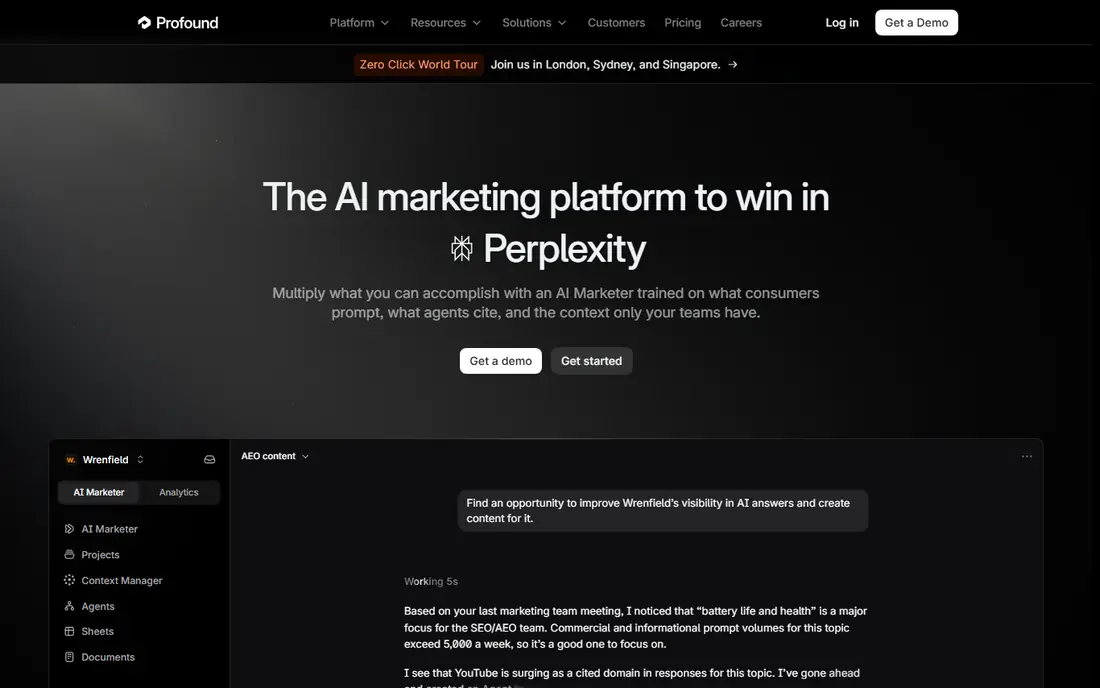
Profound is built for teams that need depth, not just a weekly score. It tracks how answer engines describe a brand, which pages get cited, and how AI crawlers interact with a site, then turns those findings into content briefs and prioritised tasks. The catch is access and cost. The current public route is a free 7-day trial covering ChatGPT, Gemini and Google AI Overviews, with 50 prompts a day, followed by a custom Enterprise plan. A small business with one brand and a short prompt list will pay for scale it does not need. Start here only if AI visibility is a board level metric, or if you already need crawler data, API access and dedicated support in one contract.
- Broad answer engine coverage on Enterprise
- Crawler and agent analytics
- Content briefs and prioritised actions
- Ongoing pricing is custom
- Entry is not self-serve for most buyers
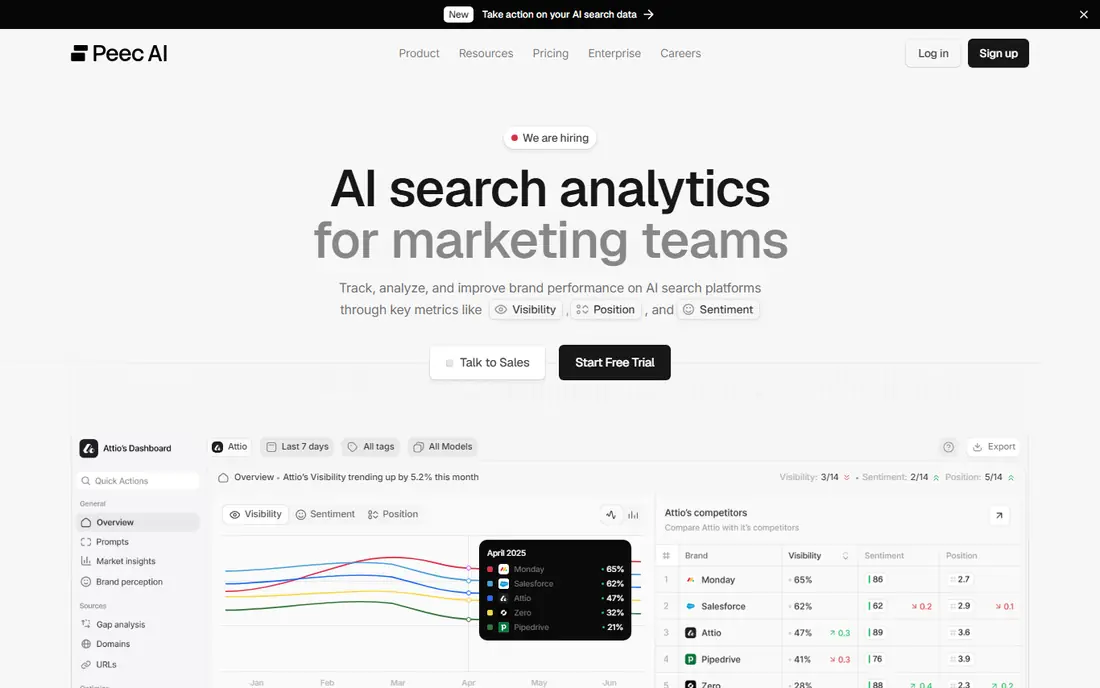
Peec AI keeps the dashboard focused on a simple question: did AI answers mention you, your competitors, or neither, and how did the tone read. You pick prompts, choose three models on Starter, and get daily updates with citation sources and competitor share of voice. Unlimited users make it easy to share the same view with content, PR and leadership teams without adding seat fees.
The limit is choice, not quality. Starter includes 50 prompts and one project, so a team tracking many product lines will need Pro at $245 per month or Advanced at $495 per month. Extra engines also add cost. If your buyers mainly ask questions in ChatGPT, Perplexity and Google AI Overviews, Starter is a sensible fit. If you need Claude, Gemini and several other engines at once, budget for Enterprise or compare Rankscale first.
- Daily tracking
- Unlimited users
- Sentiment and source gap views
- Starter covers three engines of your choice
- Extra engines cost more
Scrunch AI pairs visibility tracking with technical checks that many pure monitors skip. It looks at prompts by topic and persona, audits pages for issues that block AI citation, and flags cases where an AI answer states something wrong about your brand. That audit layer matters for regulated brands, or for any team that has seen a confident but incorrect AI answer spread.
Pricing is the barrier. Starter is $250 per month billed annually, or $300 month to month, with a 7-day trial. Growth and Enterprise add more prompts and seats, but the entry tier already costs more than several competitors combined at the low end. Choose Scrunch AI when you will act on audit findings each week. If you only need a mention count for a monthly report, a cheaper tracker will do the same job.
- Prompt level monitoring
- Page audits
- Hallucination checks
- High entry price
- API access is limited to Enterprise
AthenaHQ stands out because you can start without a card or a sales call. The free Essential tier includes 300 credits, five engines, competitor views and content recommendations, which is enough to test whether AI answers mention your brand at all. Paid Starter is $295 per month with 3,600 credits, where one credit equals one AI response, and coverage rises to 11 models.
Credit pricing is both the strength and the risk. It lets a small team scale by responses rather than by a fixed prompt cap, but a growing prompt list across many models can burn credits faster than expected. AthenaHQ also links visibility to traffic and revenue through GA4 and Shopify, which helps ecommerce teams show why the work matters. Use the free tier to validate the category, then model a full month before committing to Starter.
- Free Essential tier
- Credit based scaling
- Revenue links through GA4 and Shopify
- Credits can be hard to forecast
- Scheduled runs are not always daily
Otterly.AI is the cheapest credible way to get daily AI visibility data. Lite at $29 per month covers 15 prompts across ChatGPT, Google AI Overviews, Perplexity and Microsoft Copilot, with unlimited team members and a GEO audit. Standard at $189 per month and Premium at $489 per month add prompts, API and MCP access, Looker Studio reporting and agent analytics.
The headline price needs a second look if Google AI Mode matters to you, because AI Mode, Gemini and Claude are add-ons on every self-serve plan. On Lite, AI Mode costs $9 per month extra, which still keeps the total low. On higher tiers the add-on price rises sharply. Otterly.AI fits a solo marketer or a small team testing AI search, but a team that needs all seven engines should price the full bundle before comparing it with Peec AI or Rankscale.
- Lowest published entry price here
- Unlimited team members
- Exports on every paid plan
- Google AI Mode, Gemini and Claude are paid add-ons
- Lite covers only 15 prompts
Goodie AI is designed for teams that are tired of reports that end with a chart. Core at $295 per month billed annually covers five engines, ChatGPT, Google AI Overviews, Perplexity, Google AI Mode and Microsoft Copilot, with 110 prompts, 50 optimisation actions a month, MCP access and revenue attribution. Pro at $999 per month adds Gemini, Alexa for Shopping and Sparky, plus SKU level visibility for commerce brands.
That closed loop is the reason to pay more, and also the reason to pause. Goodie AI fits a mid-size or large brand with a content team ready to publish fixes each week. It is less suited to a brand that only wants to watch mentions and report them once a month.
- Closed loop monitoring and optimisation
- Revenue attribution
- Unlimited seats
- Claude and several other engines need Enterprise
- Entry tier covers five engines
Rankscale gives the broadest engine list at the lowest starting price in this guide. Essentials at $20 per month includes 120 credits, which the vendor equates to about 480 AI responses, plus two brand dashboards. Pro at $99 per month raises that to 1,200 credits and 10 dashboards, with Looker Studio integration. Scheduling can run hourly to monthly, which suits teams that want fresh data during a launch or a crisis.
Credit pricing needs care. Different engines draw different amounts from the pool, so the same prompt list can cost more when you add expensive models. There is also no credit rollover on Essentials, and API access is reserved for Enterprise and Agency Growth. Rankscale is a strong pick for a team that wants to compare many engines without paying enterprise prices, provided someone on the team will track credit use each month.
- Covers 17 or more engines
- Credit based flexibility
- Hourly to monthly scheduling
- Credit maths can confuse new users
- API access sits on higher tiers
Promptwatch is built around real business locations and client work. Essential at $95 per month covers 50 prompts, with city and state tracking included, which helps a business with many branches see local differences instead of one national average. Professional at $245 per month adds crawler logs and a second project, while Business at $579 per month covers five projects and 350 prompts.
The platform also turns gaps into work, with content gap analysis, action items and a content agent that drafts briefs for review before anything publishes. The limit is platform choice on the entry tier, where you select four platforms from a larger pool, so a team that needs every engine at once will need a higher tier or an agency plan. Confirm the current tier limits on the pricing page before you buy, since this vendor has revised its plans during 2026.
- City and state tracking on every plan
- Crawler logs on higher tiers
- Content gap actions
- Entry tier covers four platforms of your choice
- Pricing has changed over time
Semrush AI Visibility Toolkit
Who it suits: Teams already paying for Semrush
Semrush is the practical pick if your team already lives in Semrush for keyword research, rank tracking and site audits. The standalone AI Visibility Toolkit costs $99 per month per domain, billed annually, with 25 prompts tracked daily, one brand domain, prompt research and an AI audit of 100 pages. Prompt tracking names ChatGPT and Google AI Mode, with other reports covering additional surfaces.
The weakness is scale. Twenty-five prompts is a narrow sample for a brand with many products, and each extra domain adds cost. There is also no free trial for the standalone toolkit, although Semrush offers a free domain check a few times a day. Buy this tool when AI visibility should sit in the same login as your SEO reports. Buy a dedicated tracker instead when you need hundreds of prompts, many engines, or a lower cost per prompt.
- AI visibility beside classic SEO data
- Prompt research
- 100 page AI site audit
- Only 25 prompts on the standalone toolkit
- No free trial
- Per domain pricing
How we picked these
We started with vendor feature pages, pricing pages, app store listings and privacy policies, then checked those claims against independent reviews and comparison pages published in 2026. We kept only tools that are live, that track brand visibility in AI answers in a clear way, and that publish enough detail to compare prompt limits, engine coverage and price. We removed tools that only promised AI visibility without a working product, and tools whose pricing was hidden behind a demo with no public starting point at all, except Profound, where the trial route is public and the enterprise focus is part of the point.
Prices are starting prices unless a free tier is listed. Check the vendor pricing page at checkout.
What to check before you pay
Start with your prompt list, not the tool. Write down 20 to 50 questions a real buyer would ask, including comparison questions, problem questions and brand questions. Next, check engine coverage at the tier you will actually buy. Many vendors list a long engine list on the homepage, then include only three or four engines on the entry plan and sell the rest as add-ons. Confirm Google AI Mode, Google AI Overviews, ChatGPT, Perplexity, Gemini and Claude separately, because each one can return a different answer for the same question.
How to read the numbers without overreacting
AI answers change from day to day, and a single mention or absence is not a trend. Look for share of voice over several weeks, citation patterns across similar prompts, and whether the same sources keep appearing for your category. If a tool shows a sudden drop, check whether the prompt set changed, the model changed, or your cited page changed before you rewrite a whole site section.
A simple first month plan
In week one, set up your prompt list, add competitors, and record a baseline. In week two, read the cited sources for prompts where competitors appear and you do not, and note which pages those sources link to. In week three, fix the clearest gaps: a missing FAQ, a thin product page, or a page that AI crawlers cannot read.
Frequently asked questions
What is the best tool for AI search visibility for a small business?
Otterly.AI is the lowest cost starting point, at $29 per month, while AthenaHQ offers a free tier for a first test. Both let a small team see whether AI answers mention the brand before committing to a larger contract.
How is AI search visibility different from classic SEO rank tracking?
Classic rank tracking shows a position for a keyword in a list of links. AI visibility shows whether an answer engine mentions your brand, cites your pages, or recommends a competitor in a written answer. The two overlap, because cited pages often rank well, but a page can rank on page one and still be absent from an AI answer.
Do I need to track every AI engine?
No, track the engines your buyers actually use, plus Google AI Mode and Google AI Overviews if search traffic matters to you. ChatGPT and Perplexity cover many buying questions, while Gemini, Claude and Copilot matter more in specific markets. Adding engines you never read only raises the bill and dilutes attention.
Can these tools improve my visibility, or do they only measure it?
Most tools in this guide measure first and suggest second. Scrunch AI and Goodie AI go further with audits, briefs and optimisation actions, while Profound adds agents and content workflows on Enterprise.
How many prompts should I track?
Start with 25 to 50 prompts that cover buyer questions, comparison questions and problem questions. That range fits the entry tiers of Peec AI, Otterly.AI on higher plans, and Semrush, and it gives enough data to spot patterns without drowning in noise. Add prompts only when you have acted on the first set, or when you add a product line or market.
Is a free AI visibility tool enough?
A free tier or a free trial is enough to learn whether AI answers matter for your brand and to test a tool interface. It is rarely enough for ongoing work, because free tiers cap credits, prompts or engines. AthenaHQ is the exception here for a first test, but most teams that report monthly will need a paid plan within a few months.
Sources we checked (9)

Online Jobs is an independent blog about careers, online work, learning new skills and the tools that help people earn. More about us.
Keep reading
All posts
Workday Alternatives
We compared the best workday alternatives for HR, payroll, and global hiring, from BambooHR and Gusto to Rippling, Deel, and HiBob for growing teams in 2026.
Which SaaS Tools Have the Best Customer Support
Which SaaS tools have the best customer support? Compare eight popular tools on help centres, live help, response options and overall support quality.
Top AI Helpdesk Software
Searching for top AI helpdesk software in 2026? We compared 8 AI helpdesks on automation, pricing, channels and ease of setup for small and growing teams.