Best Ticketing Software in 2026: 8 Platforms Compared

How we put this together: we compare official feature and pricing pages, app store listings, privacy policies and public user reviews. Prices change, so check the provider's site before you pay.
Key takeaways
- Eventbrite is our pick for most event organizers, because it covers listing, discovery, payments and check-in in one familiar platform.
- Ticket Tailor suits organizers who want lower per-ticket fees and more control over branding and checkout.
- Humanitix is a strong choice for charities and community events that want ticketing fees directed to social good.
- Dice fits music and nightlife events where discovery and mobile-first entry matter most.
- Ticketmaster, SeatGeek, Vivid Seats and AXS serve larger venues and high-demand events, where resale and distribution reach matter more.
Quick comparison
| Name | Who it suits | Starting price | Free option | |
|---|---|---|---|---|
 Eventbrite | Most event organizers | See website | Yes | Visit |
 Ticketmaster | Large venues and major events | See website | No | Visit |
 Dice | Music and nightlife discovery | See website | No | Visit |
 Humanitix | Charities and community events | See website | No | Visit |
 Ticket Tailor | Low-fee branded ticketing | See website | No | Visit |
 SeatGeek | Sports and live event discovery | See website | No | Visit |
 Vivid Seats | Resale and hard-to-find tickets | See website | No | Visit |
 AXS | Venues and large tours | See website | No | Visit |
The best ticketing software
Event ticketing software lets organizers sell tickets, manage entry, handle refunds and reach buyers who are already looking for events. The best platform depends on event size, ticket price, audience and how much discovery help you need. We compared official product pages and pricing information for platforms that are live and widely used for events in 2026.
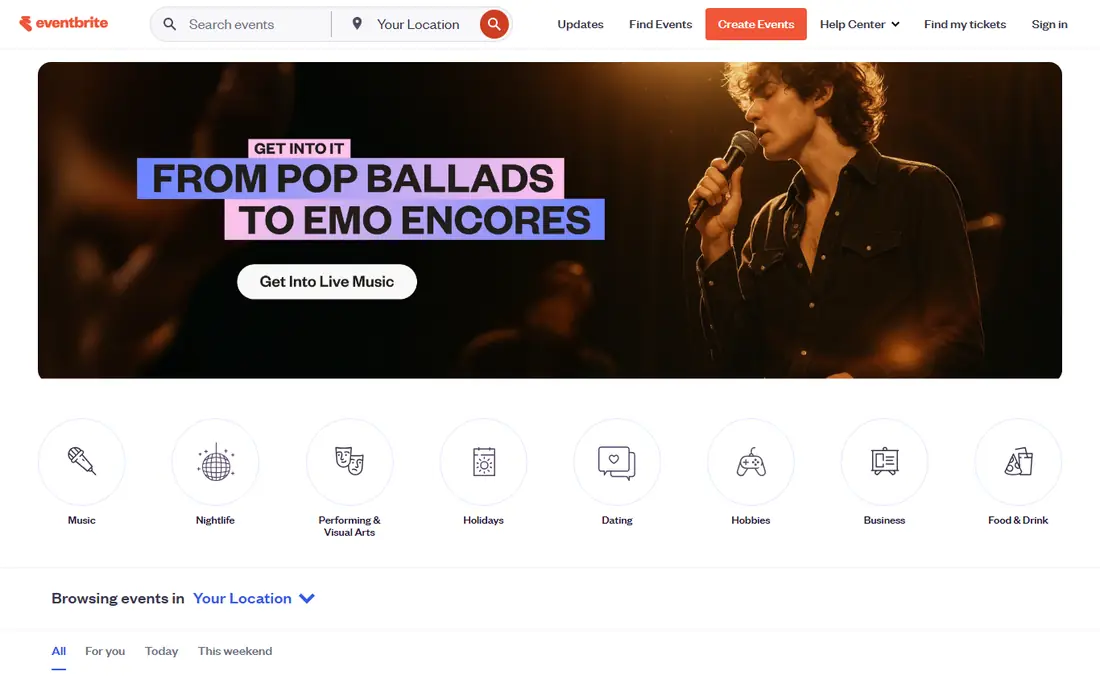
Eventbrite is the default choice for many organizers because buyers already know it. You can create a listing, set ticket types, collect payments and check people in with the organizer app, all without building your own checkout. The discovery marketplace also helps smaller events reach people browsing for things to do nearby, which is a real advantage over a standalone ticketing page.
The main cost is fees on paid tickets, which can be significant for a large or high-priced event. Organizers who want full branding control or the lowest possible fee may prefer Ticket Tailor. But for conferences, classes, festivals and community events that need a reliable, familiar platform, Eventbrite remains our pick for most organizers.
- Large event discovery audience
- Simple listing, payment and check-in tools
- Free events can be listed without ticket fees
- Fees on paid tickets add up for large events
- Less control over checkout branding than some rivals
Ticketmaster dominates major live entertainment, from arena concerts to big sports fixtures. Its audience reach, venue partnerships and official resale system make it the natural choice for high-demand events where distribution and fraud control matter. Buyers trust the platform for major shows, and organizers get access to a large pool of ticket seekers.
Small organizers will find it less flexible. Fees are a frequent complaint, and the platform is built around large venues and tours rather than a local workshop or community festival. If you run a major event through a large venue, Ticketmaster is often part of the deal already. If you run a small event, a simpler platform will fit better.
- Huge audience for major concerts and sports
- Official resale and verified ticket options
- Deep venue and tour integrations
- Fees can be high for buyers and organizers
- Less suited to small independent events
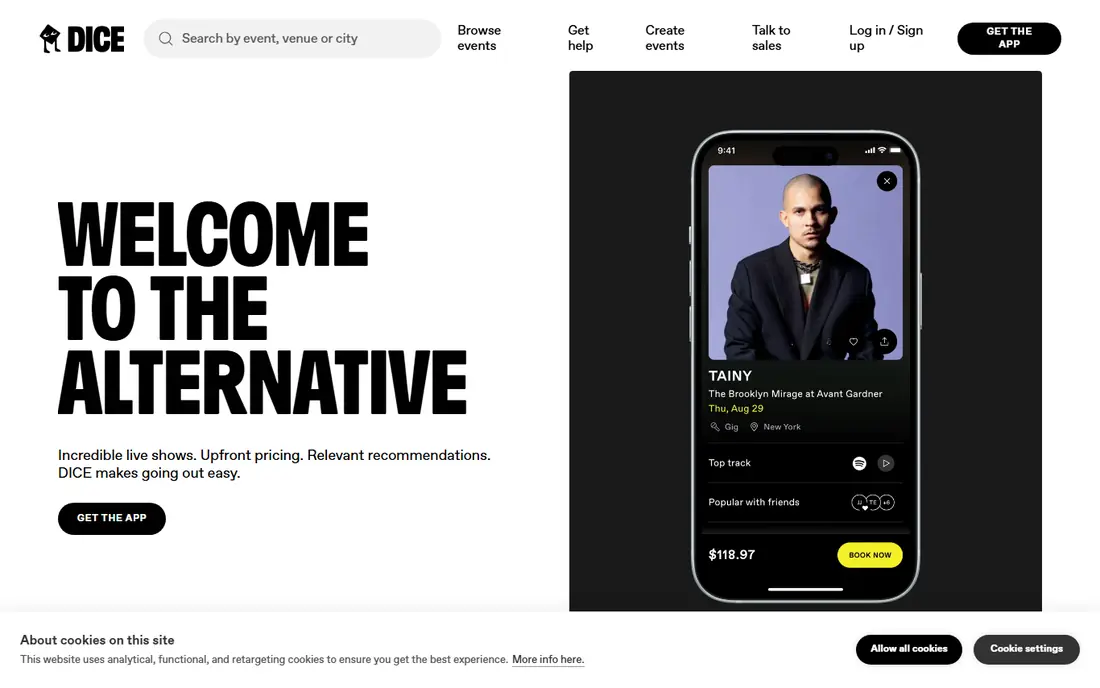
Dice has built a loyal following for music, club and live events, especially in major cities. Fans discover shows in the app, buy mobile tickets and enter with their phone, while tickets stay tied to the buyer to discourage touting. For promoters in music and nightlife, that discovery audience and mobile-first entry are genuine advantages.
The limit is scope. Dice is less suited to conferences, trade shows or family festivals, and its coverage varies by city. If your event is a gig, DJ set or club night in a Dice city, it is a strong choice. If your event is a business conference, Eventbrite or Ticket Tailor will fit better.
- Strong discovery for music and club events
- Mobile tickets tied to the buyer to reduce resale abuse
- Clean app experience for fans
- Best for music and nightlife, less for conferences
- Availability varies by city
Humanitix is a ticketing platform with a social purpose: its booking fees fund education and community projects rather than going to shareholders as profit. For charities, schools and community groups, that story can help with promotion and sponsor support, and the platform itself covers the basics well, including event pages, ticket types and check-in.
The trade-off is reach and depth. Its discovery audience is smaller than Eventbrite, and very large or complex events may need more advanced features. If your event has a community or charitable angle, Humanitix offers a clear and honest alternative. If you need the largest possible discovery audience, compare it with Eventbrite first.
- Booking fees go to social good projects
- Simple event pages and check-in tools
- Good fit for schools, charities and community groups
- Smaller discovery audience than Eventbrite
- Fewer advanced enterprise features
Ticket Tailor appeals to organizers who want to keep more of each ticket sale and control how checkout looks. Instead of charging buyers a large fee per ticket, it uses subscription-style plans, which can work out cheaper for events with many tickets or higher prices. You can embed checkout on your own website, which keeps branding consistent.
The catch is discovery. Ticket Tailor does not bring the same browsing audience as Eventbrite, so you need your own email list, social following or partnerships to fill seats. If you already have an audience and want lower fees and cleaner branding, Ticket Tailor is an excellent choice. If you need help finding buyers, a marketplace platform may serve you better.
- Lower per-ticket costs than many rivals
- Branded checkout on your own site or page
- No per-ticket fee model on some plans
- Less built-in discovery than Eventbrite
- You need your own marketing to drive sales
SeatGeek is best known as a ticket marketplace where fans compare prices for sports, concerts and theater. Its deal scoring helps buyers judge value, and its mobile tickets make entry simple. For fans, it is a useful way to find seats across many sellers in one place, including resale listings.
Small organizers will find SeatGeek less of a direct ticketing tool and more of a distribution channel, since its strength is buyer discovery rather than event setup. Large venues and teams use it to reach fans, while independent organizers usually list elsewhere first. If you are buying tickets or distributing a major event, SeatGeek belongs on your shortlist.
- Large marketplace for sports, concerts and theater
- Deal scores help buyers compare seats
- Mobile tickets and resale options
- Geared to buyers more than small organizers
- Fees and pricing vary by event
Vivid Seats is a resale marketplace, not an organizer platform, and it fits buyers looking for sold-out or hard-to-find tickets. It aggregates listings from many sellers, offers buyer guarantees on many orders and covers sports, concerts and theater across the US. For a fan who missed the on-sale, it is a practical place to look.
Prices on resale markets can run well above face value, and availability depends on sellers, so compare with official sellers first when you can. Organizers should not treat Vivid Seats as a replacement for Eventbrite or Ticket Tailor. Buyers, on the other hand, will find it useful when an event is sold out elsewhere.
- Large resale inventory for popular events
- Buyer guarantees on many orders
- Wide sports, concert and theater coverage
- Resale prices can exceed face value
- Not a tool for organizing your own event
AXS is a ticketing platform used by many large venues, festivals and tours, and it competes directly with Ticketmaster in that space. It offers mobile tickets, official resale and venue integrations, which help large events manage entry and distribution. Fans attending shows at AXS venues will already know the system.
As with Ticketmaster, small organizers are not the main audience. If your event runs through an AXS venue, the platform choice may already be made for you. If you run an independent event, a general platform such as Eventbrite or Ticket Tailor will give you more control and a simpler setup.
- Strong venue and tour partnerships
- Mobile entry and official resale options
- Good fit for arenas and festivals
- Less suited to small independent events
- Availability depends on venue deals
How we picked these
We compared official product pages and pricing information for event ticketing platforms that are live in 2026 and used for concerts, sports, festivals, conferences and community events. We included marketplace platforms, organizer tools, a low-fee option and a charity-focused option, because different events need different strengths. We favored platforms with clear fee information, mobile check-in and refund tools, and we left out platforms that only sell tickets without organizer features.
We did not claim hands-on event testing, and we did not invent prices, fees or attendance claims. Where a vendor does not publish a simple starting price, we wrote See website, since ticketing fees often depend on ticket price, volume and who pays the fee. Read the fee terms carefully before you set ticket prices.
What to check before you choose a ticketing platform
Fees, refunds and entry are where ticketing choices succeed or fail, so check those details early.
Work out who pays the fee and what it totals
Some platforms charge the organizer, some charge the buyer, and some split the fee. Model the total cost for your expected ticket price and volume, including payment processing, and decide whether to absorb the fee or pass it on. A low headline fee can still be costly once processing and service charges are added.
Test refunds, transfers and check-in
Check how refunds, exchanges and ticket transfers work, and whether you control those policies. Test the check-in app with a small event or a rehearsal, including offline handling if your venue has weak signal. Entry problems on the night will damage an event far more than a small fee difference.
Note the other meaning of ticketing software
The phrase ticketing software also covers IT help-desk ticketing, where support teams track and resolve internal requests. That is a different product category, with tools built for support queues, service levels and asset tracking rather than event entry. If you need help-desk software, search specifically for IT support ticketing tools, since the event platforms on this list are not built for that job.
Frequently asked questions
What is the best ticketing platform?
Eventbrite is our pick for most organizers, because it balances discovery, payments and check-in in one familiar platform. Ticket Tailor suits organizers who want lower fees and branded checkout, while Humanitix suits charities and community events. Large venues often use Ticketmaster or AXS through existing venue deals.
What is the best ticketing software for small events?
For small events, Eventbrite and Ticket Tailor are the main choices. Eventbrite helps you reach new buyers through its marketplace, while Ticket Tailor keeps fees lower and branding cleaner if you already have an audience. Humanitix is a good option for community and charity events with a social purpose.
What is the best event ticketing platform for concerts?
For concerts, the answer depends on scale. Dice suits music and club events in major cities, Ticketmaster and AXS serve large venues and tours, and Eventbrite suits independent gigs and festivals. Check which platform your venue uses, since that often decides the choice for larger shows.
How much does ticketing software cost?
Costs vary by platform, ticket price and volume, and by whether the organizer or the buyer pays the fee. Some platforms use per-ticket fees, some use subscription plans, and some combine both with payment processing charges. Model the total cost for your expected sales before you set ticket prices, and read the fee terms in full.
What is the best ticketing system for festivals?
Festivals need strong check-in, multi-day passes, refund handling and entry control, so Eventbrite, Ticketmaster and AXS are common choices depending on size. Ticket Tailor can work for smaller festivals with their own audience and a need for lower fees. Test check-in and offline handling before the event, since entry speed matters most at festival scale.
Sources we checked (8)

Online Jobs is an independent blog about careers, online work, learning new skills and the tools that help people earn. More about us.
Keep reading
All posts
ZoomInfo Alternatives
The best ZoomInfo alternatives in 2026, compared on price, free plans, data coverage, and which tool fits small teams or large sales teams best in detail.

Workday Alternatives
We compared the best workday alternatives for HR, payroll, and global hiring, from BambooHR and Gusto to Rippling, Deel, and HiBob for growing teams in 2026.
Which SaaS Tools Have the Best Customer Support
Which SaaS tools have the best customer support? Compare eight popular tools on help centres, live help, response options and overall support quality.