Best subscription billing software in 2026: 9 platforms Compared


Stripe-native SaaS billing · Starting price: See website
How we put this together: we compare official feature and pricing pages, app store listings, privacy policies and public user reviews. Prices change, so check the provider's site before you pay.
Key takeaways
- Stripe Billing is the strongest starting point for teams already using Stripe for payments.
- Chargebee suits finance-led teams that need multi-gateway billing and subscription operations in one place.
- Recurly stands out for dunning and retention, where failed-payment recovery directly affects revenue.
- Maxio and Zuora fit larger B2B companies with complex contracts, usage billing, and revenue recognition needs.
- Paddle and FastSpring suit software sellers that want a merchant of record to handle global tax and compliance.
Quick comparison
| Name | Who it suits | Starting price | Free option | |
|---|---|---|---|---|
| Stripe Billing | Stripe-native SaaS billing | See website | No | Visit |
 Chargebee | Flexible subscription operations | See website | Free trial | Visit |
 Recurly | Retention and dunning | See website | Free trial | Visit |
 Maxio | B2B SaaS finance teams | See website | No | Visit |
 Zuora | Enterprise monetisation | See website | No | Visit |
 Paddle | Merchant of record for software | See website | No | Visit |
 Orb | Usage-based billing | See website | Free trial | Visit |
 Billsby | Simple subscription billing | See website | Free trial | Visit |
 FastSpring | Global software sales | See website | No | Visit |
The best subscription billing software
Subscription billing is more than charging a card each month. A good platform handles trials, plan changes, proration, failed payments, invoices, tax, and revenue reporting without manual workarounds. The wrong platform shows up later as billing errors, churn, and month-end reconciliation pain, so it is worth testing the full lifecycle before you commit.
The platforms below cover different stages and models, from a first SaaS product to a global enterprise with hybrid pricing. Use the guide at the end to match complexity, payment providers, and finance needs to the right shortlist.
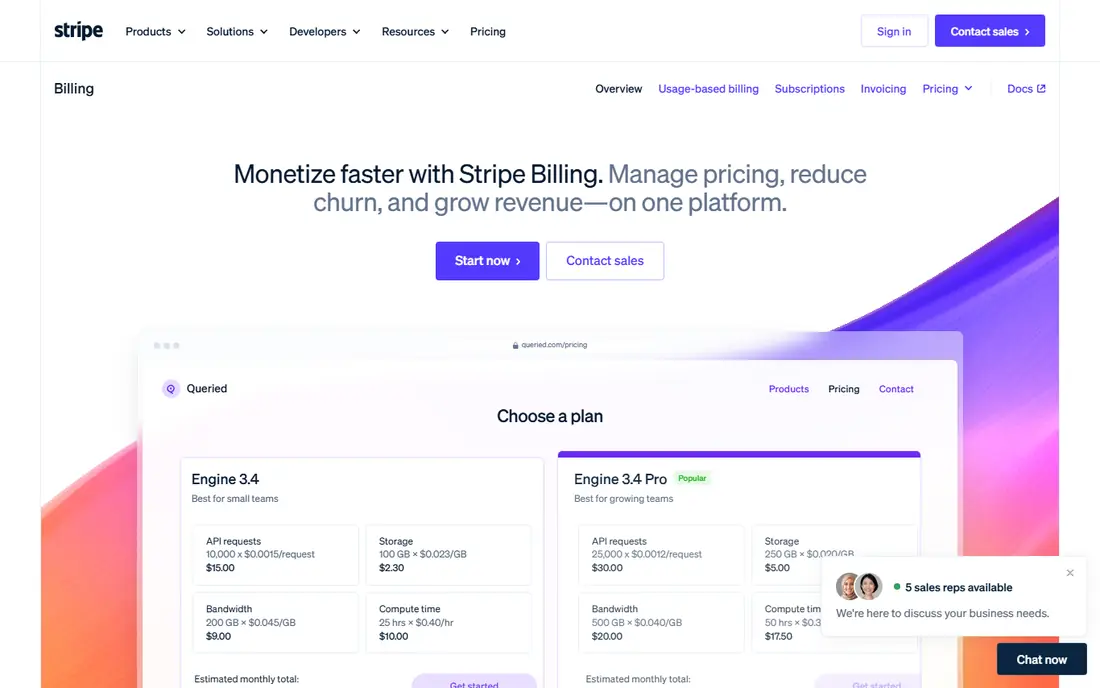
Stripe Billing is our pick for engineering-led teams already on Stripe. Subscriptions, invoices, trials, and proration work inside the same Stripe account as payments, which keeps webhooks, reporting, and customer data in one place. The customer portal also lets customers upgrade, downgrade, and cancel without custom code, which saves support time.
The main limit is lock-in. If you need a second payment gateway, a separate billing platform may suit you better. For a team building on Stripe from the start, though, Stripe Billing is fast to implement, well documented, and proven at scale.
- Deep API control and a mature developer ecosystem
- Customer portal for self-serve plan changes
- Strong support for trials, coupons, and metered billing
- Stripe-only for payments, with no multi-gateway option
- Finance features may need extra Stripe products
- Usage pricing can grow with volume
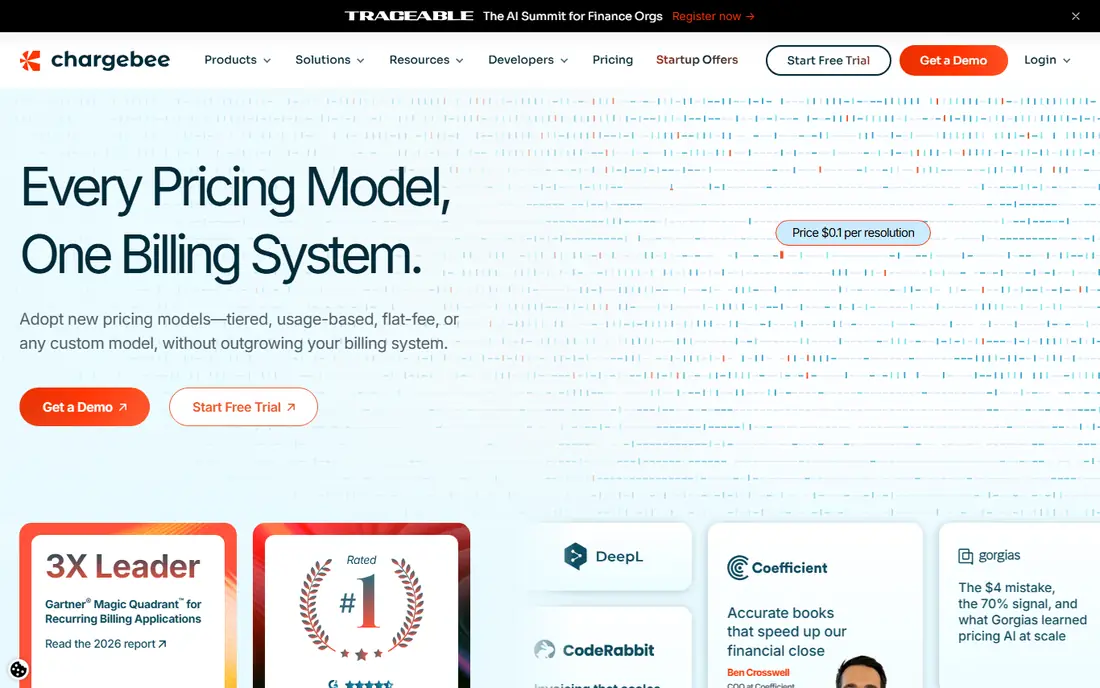
Chargebee suits teams where finance and operations, not only developers, manage billing. Non-technical staff can adjust plans, coupons, and billing rules, while dunning workflows chase failed payments automatically. Multi-gateway support also helps companies that process payments through more than one provider or in more than one region.
Chargebee is less of a quick plug-in than Stripe Billing for a Stripe-only product. It earns its place when subscription logic gets complex, when revenue recognition matters, and when the billing team needs control without waiting for engineering. For growing SaaS companies, that operational control is often the deciding factor.
- Multi-gateway subscription management
- Built-in dunning and revenue recovery workflows
- Revenue recognition and subscription analytics
- Pricing and plan tiers need careful comparison
- Implementation can take time for complex catalogues
- Some advanced features sit on higher plans

Recurly is the platform to shortlist when retention is a strategic goal. Its dunning tools, retry logic, and payment-update flows are designed to recover revenue from failed payments, which is often a larger win than a small pricing change. Subscriber lifecycle reporting also helps teams see where churn happens and which plans retain best.
Recurly works well for subscription businesses with mature operations, including media, consumer subscriptions, and B2B SaaS. If your main need is a simple first billing setup, a lighter tool may be faster. If failed payments already cost real revenue, Recurly deserves a serious trial.
- Strong dunning and involuntary-churn recovery
- Gateway-agnostic subscription management
- Detailed subscriber lifecycle reporting
- Enterprise features and pricing need a sales conversation for larger use
- Reporting depth can feel complex at first
- Setup needs care for complex pricing
Maxio, formed from Chargify and SaaSOptics, is built for B2B SaaS finance. It handles complex, sales-led billing, including usage models, quote-to-cash workflows, and revenue recognition in one platform. Finance teams get metrics and reporting that connect billing to contract value, rather than only to monthly charges.
That depth comes with cost and setup effort, so Maxio fits companies with real RevOps needs rather than a first product with one plan. If contracts, usage, and revenue recognition already create spreadsheet work, Maxio can replace several manual processes and give finance a cleaner month-end close.
- Billing plus revenue recognition for B2B SaaS
- Usage-based and contract-led models supported
- SaaS metrics and reporting for finance teams
- Higher entry cost than consumer billing tools
- Implementation suits teams with RevOps support
- Overkill for simple monthly subscriptions
Zuora is the enterprise heavyweight in this list. It handles hybrid pricing, multi-entity billing, complex contracts, and global operations that smaller tools struggle to model. For large companies with many product lines, regions, and pricing rules, Zuora provides the controls finance and compliance teams need.
Zuora is not a quick-start tool. Expect a sales process, an implementation project, and internal owners for billing and finance. For a startup with a simple catalogue, that effort is hard to justify. For an enterprise monetisation programme, Zuora is often the platform other tools are compared against.
- Deep order-to-revenue controls for global companies
- Multi-entity and complex pricing support
- Strong revenue recognition and CPQ options
- Enterprise sales cycle and implementation time
- Cost and complexity exceed small-team needs
- Best with dedicated billing and finance resources
Paddle takes a different approach. As a merchant of record, Paddle sells your software on your behalf, handles global sales tax, and manages compliance, so a small team can sell worldwide without building a tax operation. That simplicity is valuable for indie software makers and small SaaS teams with global customers.
The trade-off is control. You give up some direct control over payments and customer relationships compared with Stripe Billing or Chargebee. If tax and compliance are your main burden, Paddle is worth it. If you need deep billing customisation or non-software products, a direct platform may fit better.
- Merchant of record handles payments, global tax, and compliance
- Useful for lean software teams selling worldwide
- Subscription and checkout in one service
- Less control than a direct billing platform
- All-in fee structure needs comparison with gateway plus billing costs
- Not ideal for non-software subscriptions
Orb suits products priced by use, such as API calls, seats used, AI tokens, or data processed. It meters events, applies flexible rating rules, and generates usage invoices that customers can understand. That precision matters when usage is the product, because a flat billing tool can struggle to model complex usage fairly.
For a simple monthly subscription with one price, Orb is more tool than you need. For usage-based and hybrid models, where customers expect transparent usage bills, Orb is one of the strongest specialist platforms available. Define your billable events clearly before implementation, since that design shapes everything downstream.
- Granular event-based metering for usage pricing
- Flexible rating and pricing models
- Built for API and AI-era usage products
- Usage focus means simpler flat subscriptions may not need it
- Pricing is custom for many plans
- Implementation needs clear event definitions
Billsby is a good fit for subscription businesses that want a clean setup without enterprise complexity. It covers recurring billing, plan management, and customer handling in an interface that smaller teams can learn quickly. That simplicity helps consumer subscriptions, memberships, and small SaaS products get billing right early.
Larger companies with complex contracts or usage models may outgrow Billsby, but many businesses never need that depth. If your catalogue is clear, your team is small, and you value support and ease of use, Billsby is a practical and lower-friction choice.
- User-friendly setup for subscription businesses
- Clear billing and customer management
- Good support reputation for smaller teams
- Smaller ecosystem than Stripe or Chargebee
- Advanced enterprise features are limited
- Best for straightforward subscription models
FastSpring, like Paddle, offers a full-service route for software sellers. It handles checkout, payments, global tax, and compliance, so a small team can sell in many countries without building that infrastructure. That service is particularly useful for desktop software, games, and SaaS products with a global audience.
As with Paddle, weigh the all-in fee against the cost of a gateway plus a billing platform plus tax tools. For many software sellers, the saved time and reduced compliance risk justify the fee. For companies that need full control over billing logic, a direct platform such as Stripe Billing or Chargebee remains the better fit.
- Full-service ecommerce for software, including tax and compliance
- Global payment methods and checkout
- Useful for lean teams selling worldwide
- Merchant-of-record model means less direct control
- Fee structure needs comparison with direct billing
- Focus is software rather than all subscription types
How we picked these
We reviewed official product pages, pricing pages, and documentation for each platform, along with public comparisons of billing models and finance features. We kept only platforms that are live in October 2026, genuinely handle recurring subscription billing, and are practical for either a growing SaaS company or an enterprise programme. Where pricing was not clearly published on the vendor site, we used See website rather than repeating a third-party figure.
We also judged each platform on the full lifecycle, not only on checkout. Trials, plan changes, failed payments, invoicing, tax, and revenue reporting all affect whether a platform stays workable as a business grows, so those areas weighed heavily in the ranking.
Choosing the right billing platform
Start with your pricing model. A single monthly plan needs a different tool from a hybrid model with usage, seats, contracts, and annual prepay. Write down your plans, trial rules, upgrade and downgrade rules, and tax regions before you shortlist, because those details quickly separate simple tools from enterprise platforms.
Test the full lifecycle, not just signup
Build a test subscription, change its plan mid-cycle, apply a coupon, fail a payment, update the card, and issue a credit note. Then check the invoice, the revenue report, and the webhook data. A platform that handles signup well but struggles with plan changes will create support work every month.
Decide who owns billing
If developers own billing, an API-first tool such as Stripe Billing or Orb may be fastest. If finance owns billing, a platform with strong operations, revenue recognition, and reporting, such as Chargebee, Maxio, or Zuora, may be better. The owner should be able to make routine changes without a code release, or billing will become a bottleneck.
Plan for tax and global sales early
Tax rules vary by product type and region, and global sales add payment methods, currencies, and compliance work. A merchant of record such as Paddle or FastSpring can absorb much of that burden for software sellers. A direct platform needs a tax tool and a clear plan for each region you sell into, so cost that work into your comparison.
Frequently asked questions
What is the best subscription billing platform?
Stripe Billing is the best starting point for Stripe-native SaaS teams, while Chargebee is better for finance-led teams needing multi-gateway operations. Recurly leads on retention and dunning, and Maxio or Zuora suit larger B2B companies with complex contracts and revenue recognition needs.
What is the top subscription management software?
The top subscription management software depends on your model. For general SaaS billing, Stripe Billing and Chargebee are the most widely used starting points. For enterprise monetisation, Zuora and Maxio offer deeper controls, while Paddle and FastSpring offer a simpler merchant-of-record route for software sellers.
How much does subscription billing software cost?
Costs vary widely, from usage-based fees on billing volume to fixed monthly tiers and custom enterprise pricing. Some platforms charge a percentage of billed revenue, others charge per month plus a transaction fee, and merchant-of-record services charge an all-in fee. Check the vendor pricing page for your volume and model, since published tiers often depend on monthly billings.
Do I need a separate payment gateway with subscription billing software?
It depends on the platform. Stripe Billing works only with Stripe, while Chargebee and Recurly support multiple gateways. Merchant-of-record services such as Paddle and FastSpring handle payments themselves, so you do not need a separate gateway, but you give up some direct payment control.
What is dunning in subscription billing?
Dunning is the process of recovering payment after a failed charge, through retries, card-update prompts, and customer messages. Good dunning can recover a meaningful share of failed payments without manual chasing, which is why Recurly and Chargebee highlight it as a core feature for subscription businesses.
Can subscription billing software handle usage-based pricing?
Yes, but depth varies. Stripe Billing, Chargebee, and Recurly support metered billing for many use cases, while Orb specialises in granular usage pricing. If usage is central to your product, test event metering, rating rules, and invoice clarity carefully before you choose, since usage bills need to be easy for customers to understand.
Sources we checked (9)

Online Jobs is an independent blog about careers, online work, learning new skills and the tools that help people earn. More about us.
Keep reading
All posts
DocuSign Alternatives
We compared the best DocuSign alternatives on price, free plans, templates, audit trails and ease of use, including free DocuSign alternatives for small teams.

Best Spend Management Software
Looking for the best spend management software? We compared 8 platforms on cards, approvals, travel and price to help your finance team pick the right one.

Best SaaS Ecommerce Platforms
Best SaaS ecommerce platforms compared: Shopify, BigCommerce, Wix and more for small stores and growing brands, with prices, pros and cons to compare.