Best Spend Management Software in 2026: 8 Platforms Compared


Startups and growth companies wanting cards, expenses and bill pay free · Starting price: Free
How we put this together: we compare official feature and pricing pages, app store listings, privacy policies and public user reviews. Prices change, so check the provider's site before you pay.
Key takeaways
- Ramp and Brex both offer genuinely free entry tiers covering cards, expenses and bill pay, which makes them the cheapest starting point for US companies that qualify.
- Navan is the clear pick when travel is a large share of spend, because booking, cards and expenses sit in one flow rather than in three tools.
- Spendesk, Airbase and the European prepaid options charge by quote or by subscription, so the real cost depends on headcount, users and card counts, not just the headline price.
- Prepaid cards from Pleo and Soldo suit teams that want hard limits funded in advance, while credit-based cards from Ramp and Brex suit companies with steady cash balances.
- Before signing, check card eligibility, whether accounting sync covers your ledger, and which features sit behind a paid tier.
Quick comparison
| Name | Who it suits | Starting price | Free option | |
|---|---|---|---|---|
| Ramp | Startups and growth companies wanting cards, expenses and bill pay free | Free | Yes | Visit |
 Brex | Venture-backed and global teams wanting cards, banking and travel | Free | Yes | Visit |
 Navan | Companies where travel is a major spend category | Free | Yes | Visit |
 Airbase | Mid-market companies wanting procure-to-pay control | See website | See website | Visit |
 Spendesk | European finance teams needing cards, invoices and procurement together | See website | See website | Visit |
 Mesh Payments | Global teams needing subscription and travel spend control | Free | Yes | Visit |
 Pleo | European small and mid-size teams wanting smart cards and receipts | £9.50 per month | No | Visit |
 Soldo | Teams wanting prepaid cards with strict per-user limits | £27 per month | No | Visit |
The best spend management software for every finance team
Ramp
Who it suits: Startups and growth companies wanting cards, expenses and bill pay free
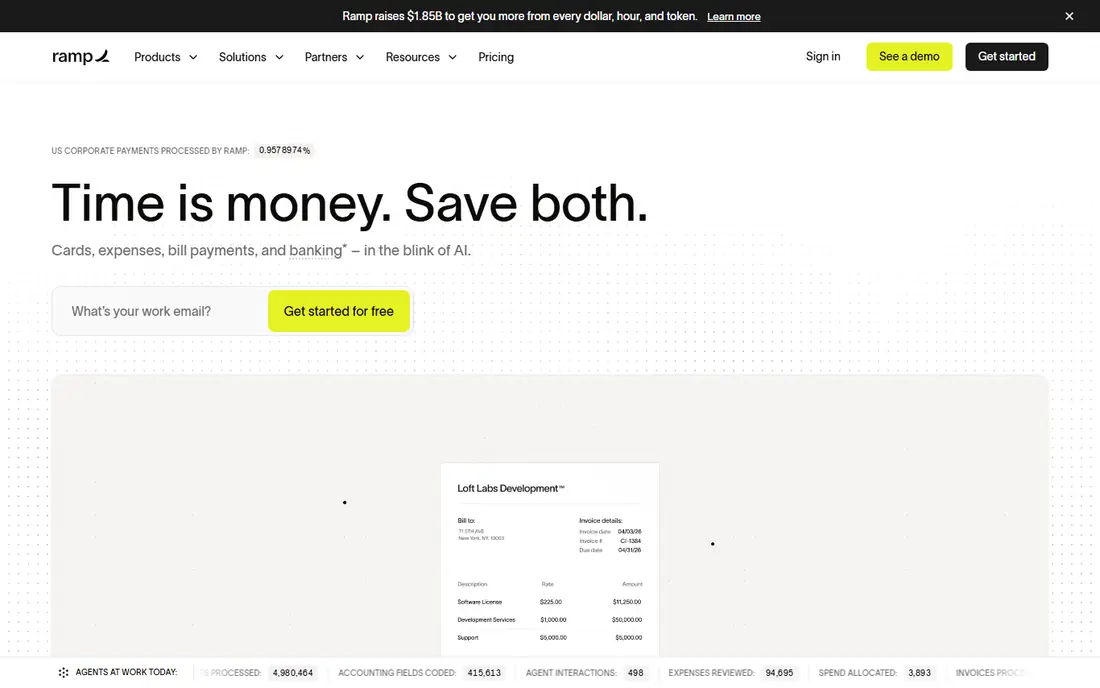
Ramp is the hardest platform to beat on value for a US company that qualifies. The free tier covers corporate cards, expense management, bill pay and travel booking, with unlimited physical and virtual cards. Spending limits and merchant controls sit on the cards themselves, so out-of-policy spend gets stopped before it happens rather than argued about after the statement arrives.
The automation is where Ramp earns its keep. Receipts get matched to transactions, expenses get coded for accounting, and approval workflows route themselves. That shortens the month-end close for teams that currently chase receipts by email. Ramp Plus, at $15 per user per month, adds deeper automation, custom workflows and multi-entity support, so growing companies can stay on the same platform instead of migrating.
- Unlimited physical and virtual cards on the free tier
- Automated receipt matching
- Bill pay and travel included
- Advanced automation and controls sit behind Ramp Plus
- Card issuance depends on qualification
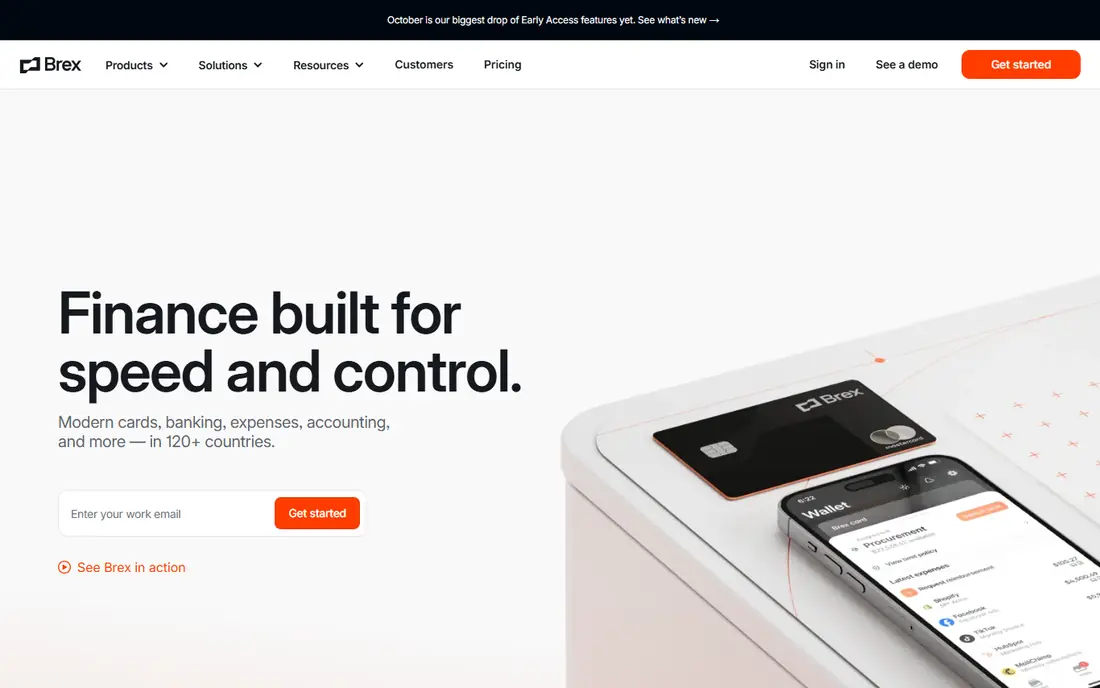
Brex bundles global corporate cards, business banking, bill pay and expense management into one stack, and the Essentials tier costs nothing. That combination suits venture-backed startups and distributed teams that need cards working across many countries without personal guarantees. Rewards run on a points basis by category, and cards can be used in more than 120 countries.
One strength that sets Brex apart is flexibility. The corporate card can be used with other expense software, and the travel and expense software can work with other corporate cards, so a company is not forced into an all-or-nothing switch. Premium, at $12 per user per month, adds customizable expense policies, procurement features and expanded travel, while Enterprise adds local-currency cards and billing in more than 50 countries.
- Free Essentials tier with global cards and bill pay
- Rewards by category
- Cards and software can be used separately
- Paid Premium tier needed for deeper policy customization
- Underwriting favors funded companies
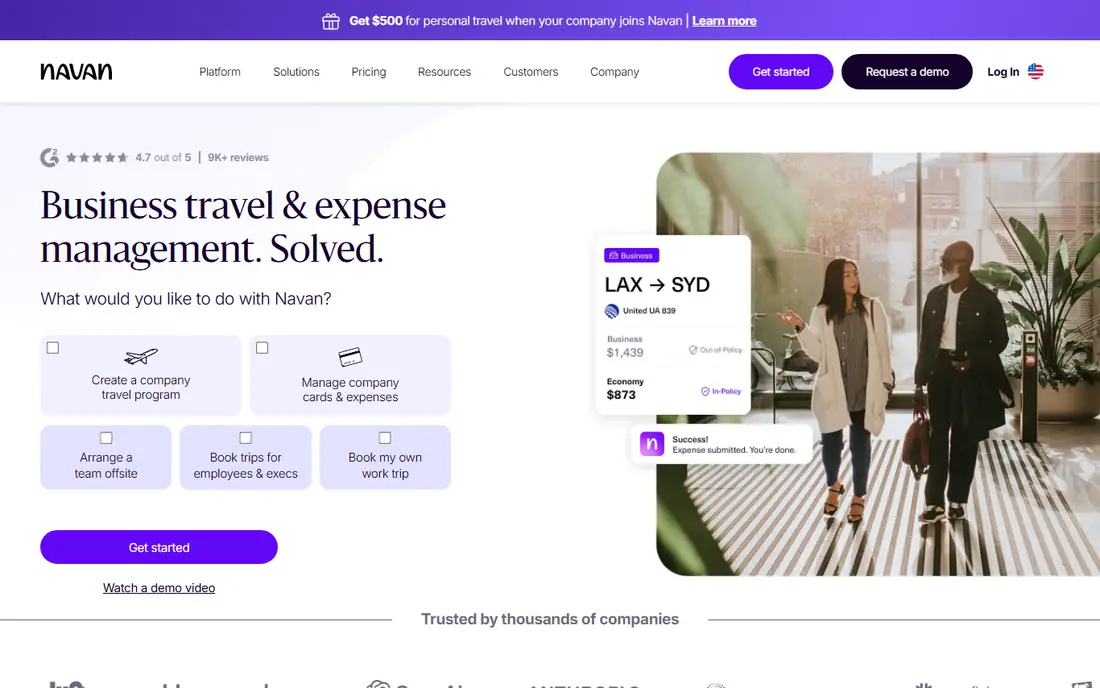
Navan, formerly TripActions, starts from travel and works outward to spend. Employees book flights, hotels and cars from a large inventory, with policy guardrails applied at booking time, and expenses, cards and reimbursements sit alongside in the same system. That matters because travel is often the hardest spend to control: bookings made outside the system show up weeks later as surprise expenses.
Travel booking itself is free, and the expense plan is priced at $15 per user per month after a small number of free monthly expensing users. Navan corporate cards offer up to 1.5% back, and Navan Connect links existing Visa, Mastercard or American Express corporate cards for teams that do not want to switch issuers. Employees who book under budget can earn personal travel rewards at no cost to the company, which is a neat way to align incentives.
- Strong travel booking with live inventory
- Corporate cards and expenses in the same flow
- Rewards for booking under budget
- Overkill for companies with little travel
- Enterprise pricing is quoted, not published
Airbase covers the full procure-to-pay cycle: software-controlled physical and virtual cards, bill payments, reimbursements, approval workflows and optional purchase orders. Vendor-specific virtual cards let finance teams lock a card to one supplier with its own limit, which is a practical way to control subscription spend without cancelling cards every month. Receipt OCR fills in merchant, date and amount, and expenses sync to NetSuite, Sage Intacct, QuickBooks and Xero.
Airbase is now part of Paylocity, and its homepage points visitors toward Paylocity for Finance, which combines spend management with the wider HR platform. That could suit companies that already run payroll on Paylocity, since payroll and non-payroll spend would sit closer together. It also means buyers should check the roadmap during a demo, since the product is now sold as part of a larger suite.
- Cards, bill pay, expenses and purchase orders in one platform
- Strong accounting integrations
- Detailed audit trails
- Pricing is quote-based, so costs are hard to compare
- Now part of Paylocity, so the product direction is tied to a larger suite
Spendesk
Who it suits: European finance teams needing cards, invoices and procurement together
Spendesk is built for European finance teams that want every spend type in one connected system. Corporate cards, expense claims, supplier invoices, purchase orders and team budgets all flow into the same dashboard, with approval workflows and real-time visibility across entities. That breadth suits companies that have outgrown basic card tools but do not want enterprise procurement complexity.
The platform's own description puts its sweet spot at companies of 50 to 250 employees, though it supports smaller and larger businesses too. Implementation typically takes three to four weeks including data migration and policy setup, with hands-on support rather than a self-serve signup. Integrations cover Sage, Xero, NetSuite, SAP and DATEV, plus Slack and HR systems, so transactions flow into the ledger without manual retyping.
- Cards, expenses, invoices and budgets in one system
- Multi-entity and multi-currency support
- Guided onboarding
- Pricing is quote-based
- Aimed at companies of around 50 to 250 employees, so smaller teams may find it heavy
Mesh Payments
Who it suits: Global teams needing subscription and travel spend control
Mesh Payments focuses on the spend that slips through unnoticed: recurring SaaS subscriptions and global travel. Vendor-specific virtual cards can be locked to one supplier with a spending limit, so a single subscription can be capped or cancelled without touching other cards. Real-time categorization and one-click ERP sync cut reconciliation work, and the platform supports cards in more than 40 countries with local-currency Visa options.
The free PRO tier is a genuine draw, covering virtual cards, real-time expense tracking, budget controls and receipt management at no monthly cost, with cashback on purchases. Premium, reported at $10 per month, adds more controls for growing businesses, while Enterprise is quoted for complex global operations. That free entry point makes Mesh easy to test alongside Ramp or Brex.
- Free PRO tier with virtual cards and cashback
- Vendor-specific cards for subscriptions
- Multi-currency and travel support
- Premium and Enterprise tiers are less transparent
- Some comparisons report a minimum monthly spend on larger tiers
Pleo gives employees smart company cards with spending limits and approvals built in, while finance teams get automatic receipt capture and accounting sync in the background. The workflow is deliberately simple: spend on the card, snap the receipt in the app, and the expense is coded and ready for the ledger. That simplicity is why Pleo has found a home with tens of thousands of European companies.
Pricing is a base fee plus a per-user charge, which is the number to model carefully. Starter starts at £9.50 per month billed annually and covers up to three users, with no additional users available on that tier. Essential is £39 per month with extra users at £11 each, Advanced is £99 per month with extra users at £15 each, and Beyond is £199 per month with extra users at £18 each. Cashback of 0.5% on Advanced and 0.75% on Beyond can offset part of the subscription for high-spending teams.
- Simple card and receipt workflow employees actually use
- Broad accounting integrations
- Multi-entity support on Advanced
- No free plan anymore
- Per-user pricing climbs steadily as headcount grows
- Cashback only on higher tiers
Soldo takes a different approach from the credit-card platforms: prepaid Mastercard cards funded from a company wallet. Employees can only spend what has been loaded, which gives finance teams a hard ceiling rather than a policy promise. Limits, rules and budgets sit on each card, receipts get captured in the mobile app, and transactions sync to Xero, QuickBooks, NetSuite, Sage and DATEV.
UK pricing starts at £27 per month plus VAT for Standard, which includes three users, with additional users at £9 per user per month. Plus is £39 per month plus VAT with additional users at £13 each and adds pre-purchase approval workflows, where an employee requests spend, a manager approves, and Soldo generates a temporary virtual card for that transaction. Unlimited is priced on request. Card issuance costs £5 for a physical card and £1 for a virtual card, and FX fees apply on foreign transactions.
- Prepaid cards mean spending stops at the funded balance
- Per-user limits, rules and budgets
- No credit check for prepaid use
- Prepaid only, with no credit facility
- Card issuance and FX fees add up
- Dashboard users count toward the user total
How we picked these
We compared official feature pages, pricing pages, app store listings and public reviews for the leading spend management platforms, and we kept only products that cover cards or expenses plus approvals and accounting sync in October 2026. Free tiers had to be genuinely usable, not just a demo, and quoted prices had to be confirmed on the vendor site or clearly marked as See website where the vendor does not publish them.
We weighted breadth of spend covered, strength of controls before money leaves the account, accounting integrations, and total cost at small and mid-size headcounts. That is why the list mixes free US platforms with paid European ones: the cheapest option in one country is not always available in another, and prepaid cards suit some teams better than credit cards. We did not include tools that only track expenses without issuing cards or controlling spend, since those answer a narrower question.
What to check before you choose
Cards or prepaid, credit or funded
Credit cards from Ramp and Brex give spending power tied to company finances, while prepaid cards from Pleo and Soldo cap spend at the funded balance. Credit suits companies with steady cash flow that want rewards and flexibility. Prepaid suits teams that want a hard ceiling, seasonal staff, or contractors who should never be able to overspend. Ask which model fits your cash flow, not just which app looks nicer.
Who counts as a user
Per-user pricing looks simple until approvers, bookkeepers and finance directors are added to the count. Soldo charges for dashboard users as well as cardholders, and Pleo adds a per-user fee on top of a base fee. Model the full headcount, including people who never hold a card, and compare that total against flat per-company pricing from rivals.
Travel share and accounting sync
If travel is a large share of spend, Navan or Mesh will save more time than a cards-only tool, because bookings and expenses reconcile in one place. If travel is rare, that depth is wasted money. Equally, test the accounting sync with real transactions during a trial: a platform that syncs cleanly to NetSuite or Xero saves days at month-end, while one that needs manual mapping will quietly eat the savings.
Eligibility and hidden fees
Free tiers come with qualification rules, and quoted tiers come with fees that do not appear in headlines. Check card eligibility, FX fees, card issuance fees, bill pay transaction fees and any minimum spend requirements before committing. Get the full fee schedule in writing, and confirm which features sit behind a paid tier, since demos often show the top tier.
Frequently asked questions
What is the best spend management software for a small business?
For a small US business that qualifies, Ramp or Brex offer the strongest free starting point, covering cards, expenses and bill pay at no monthly cost. For a small European team, Pleo or Soldo are simpler to adopt, though both charge a subscription. The right answer depends on country, headcount and whether you want credit or prepaid cards.
What is the difference between spend management and expense management?
Expense management usually means tracking and reimbursing costs after they happen. Spend management adds controls before money leaves the account, through cards with limits, approval workflows and budgets. Most platforms on this list do both, but the control side is what separates a spend platform from a receipt app.
Do spend management platforms replace accounting software?
No, they sit alongside it. Cards, expenses and bill pay feed coded transactions into QuickBooks, Xero, NetSuite or Sage, which remain the system of record. The value is in cleaner data and a faster close, not in replacing the ledger.
Which spend management software is best for travel expenses?
Navan is the strongest choice when travel dominates, because booking, cards and expenses live in one flow with policy applied at booking time. Mesh is a good alternative for global teams that need multi-agency travel coordination and multi-currency cards. Ramp and Brex also cover travel, but it is one module among many rather than the core.
Is there a free spend management platform?
Yes, in the US. Ramp offers a free tier with unlimited cards, expense management, bill pay and travel, and Brex Essentials is free with global cards, bill pay and expense management. Mesh also offers a free PRO tier. European platforms mostly charge a subscription, so check availability in your country before assuming a free tier applies.
What should I check about pricing before signing?
Model the total cost at your real headcount, including approvers and dashboard users, and add card issuance, FX and bill pay transaction fees. Confirm card eligibility and any minimum spend requirements, and ask which features sit behind paid tiers. A written quote beats a headline price when tiers are quoted rather than published.
Sources we checked (13)
- https://ramp.com/
- https://www.brex.com/
- https://navan.com/
- https://www.airbase.com/
- https://www.spendesk.com/
- https://meshpayments.com/
- https://pleo.io/
- https://www.soldo.com/
- https://www.saasworthy.com/product/airbase-io
- https://www.saasworthy.com/product/spendesk/pricing
- https://www.g2.com/products/mesh-payments/pricing
- https://www.businessexpert.co.uk/expense-cards/pleo-review/
- https://www.businessexpert.co.uk/expense-cards/soldo-review/

Online Jobs is an independent blog about careers, online work, learning new skills and the tools that help people earn. More about us.
Keep reading
All posts
DocuSign Alternatives
We compared the best DocuSign alternatives on price, free plans, templates, audit trails and ease of use, including free DocuSign alternatives for small teams.

Best Recruitment Software for Direct Hire
Looking for the best recruitment software for direct hire? We compared 8 ATS tools on price, pipelines, interviews and hiring tools to pick the right one.

Best OKR Software
We compared the best OKR software for 2026, checking prices, free plans and check-in rhythms, so you can pick the goal tracker your team will use today.