Best Shipping Company for Small Business in 2026: 8 Services Compared

How we put this together: we compare official feature and pricing pages, app store listings, privacy policies and public user reviews. Prices change, so check the provider's site before you pay.
Key takeaways
- Most small businesses save more by buying discounted labels through a shipping platform than by switching carriers alone.
- Pirate Ship suits low-volume sellers who want free access to discounted USPS and UPS rates with no subscription.
- ShipStation and Shippo suit multi-channel sellers who need automation, integrations, and multi-carrier rate shopping.
- USPS suits light parcels, while UPS and FedEx Ground often win on heavier parcels and longer distances.
- Measure boxes accurately, compare rates by lane and weight, and test one platform with real orders before moving all shipping over.
Quick comparison
| Name | Who it suits | Starting price | Free option | |
|---|---|---|---|---|
 Pirate Ship | Free discounted labels | Free | Yes | Visit |
 ShipStation | Multi-channel automation | $14.99 per month | Free trial | Visit |
 Shippo | Multi-carrier flexibility | Free | Yes | Visit |
 USPS | Light parcels and PO boxes | See website | No | Visit |
 UPS | Heavier ground parcels | See website | No | Visit |
 FedEx | Ground and home delivery | See website | No | Visit |
 Easyship | International shipping | $29 per month | No | Visit |
 Veeqo | Amazon sellers at no subscription | Free | Yes | Visit |
The best shipping company for small business
Shipping for a small business is really two choices: which carrier moves the parcel, and which platform you use to buy the label. Platforms like Pirate Ship and ShipStation negotiate or aggregate discounts and add label printing, tracking, and order imports, while carriers set the underlying service and delivery network. The list below mixes both, so you can pick the combination that fits your volume, parcel size, and sales channels.
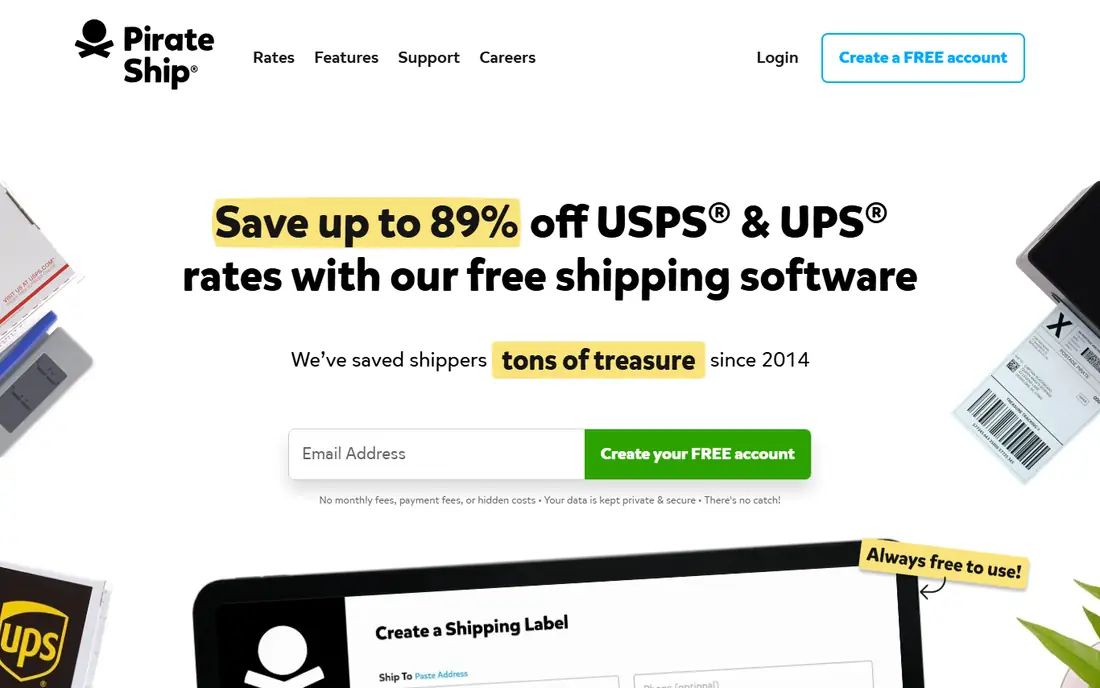
Pirate Ship is our pick for small sellers shipping a modest number of parcels each week. There is no subscription, no minimum, and no contract, and you pay only postage plus any platform fees on the label itself. Discounted USPS commercial rates and UPS options give small sellers access to pricing tiers that counter rates cannot match.
The limit is scope. Pirate Ship focuses on USPS and UPS, so sellers who need FedEx or DHL rate shopping for every order should pair it with another platform or pick Shippo or ShipStation. Automation is also lighter than paid platforms. For Etsy, eBay, and Shopify sellers shipping mostly domestic light parcels, Pirate Ship keeps costs and complexity low.
- No subscription or monthly fee
- Discounted USPS and UPS rates
- Simple label buying for small sellers
- Carrier choice is narrower than multi-carrier platforms
- No advanced automation for large stores
- US origin focus
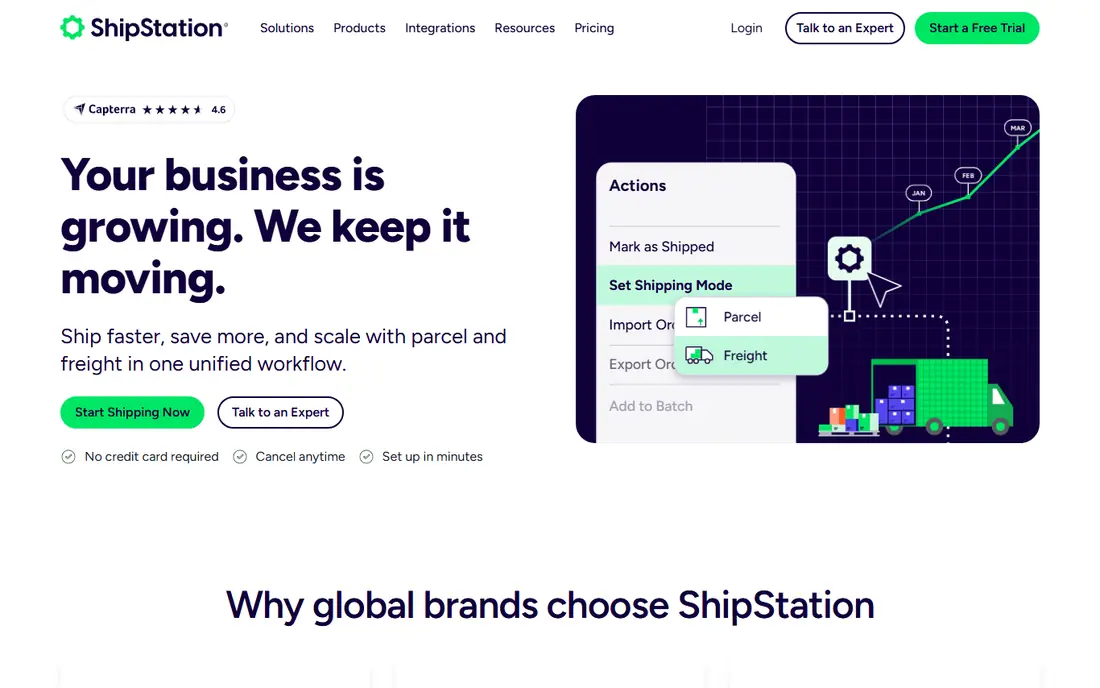
ShipStation suits sellers who ship across several channels and need orders to flow into one shipping queue. It imports from Shopify, WooCommerce, Amazon, eBay, and many other platforms, applies automation rules for carrier and service selection, and prints labels in batches. That workflow saves hours once volume passes a few dozen orders a week.
A subscription is the trade-off, starting around $14.99 per month, with higher tiers for more shipments and users. Slow months still carry the fee, so small sellers should confirm that automation savings beat the subscription cost. Once volume and channel count grow, ShipStation automation and carrier discounts usually justify the fee.
- Wide store and carrier integrations
- Automation rules and batch printing
- Discounted carrier rates
- Monthly subscription even in slow months
- Setup takes time for automation rules
- Support quality varies by plan
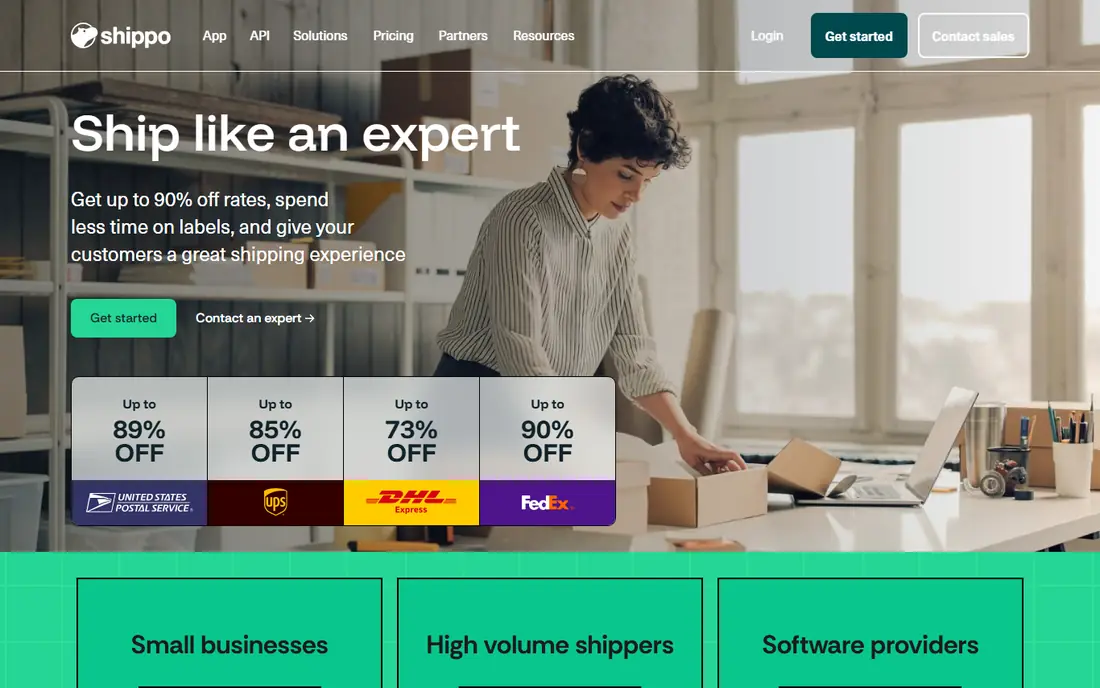
Shippo gives growing sellers multi-carrier rate shopping without committing to a subscription on day one. The free starter tier adds a small fee per label, while paid plans from around $19 per month add more features and volume. Comparing USPS, UPS, FedEx, DHL, and regional carriers side by side helps sellers pick the cheapest service per parcel rather than defaulting to one carrier.
Per-label fees deserve a quick calculation at your volume. At low volume the free tier is excellent, but at hundreds of labels a month a subscription platform may cost less overall. Shippo sits in the middle ground well: flexible, multi-carrier, and easy to start, with a clear upgrade path as volume grows.
- Many carrier options in one account
- Free starter tier with a small per-label fee
- Returns portal and tracking tools
- Paid plans needed for higher volume features
- Per-label fees add up at scale
- Carrier discounts vary by account
USPS remains the default carrier for many small sellers, especially for parcels under a few pounds. It delivers to PO boxes and rural addresses that private carriers serve less directly, and services like Ground Advantage and Priority Mail cover a wide range of light and mid-weight parcels. Flat-rate boxes also help when an item is small but dense.
Heavy parcels tell a different story. UPS and FedEx Ground often beat USPS on price and consistency once weight passes roughly five to ten pounds, depending on zone. Counter retail rates also cost far more than discounted labels bought through Pirate Ship or Shippo. Use USPS for light domestic parcels, and buy labels through a discount platform rather than at the counter.
- Best reach for PO boxes and rural delivery
- Competitive for light parcels
- Flat-rate options for dense items
- Ground pricing grows less competitive on heavy parcels
- Delivery speed varies by service
- Retail counter rates cost more than discounted labels
UPS Ground suits sellers shipping heavier parcels across the country. Once weight and distance rise, UPS pricing often beats USPS, and tracking granularity plus pickup options suit business shippers. UPS through Pirate Ship or ShipStation also gives small sellers discounted rates that close the gap with larger shippers.
Two limits matter. UPS does not deliver to PO boxes, so sellers with PO box customers need a USPS option. Dimensional weight pricing also punishes large light boxes, so measure carefully and drop a box size where the product allows. For heavy, non-PO-box parcels, UPS is often the best value carrier in this list.
- Strong ground network for heavier parcels
- Detailed tracking
- Pickup and business services
- No PO box delivery
- Dimensional weight pricing on bulky items
- Retail rates are high without discounts
FedEx Ground and Home Delivery suit a similar profile to UPS: heavier parcels, longer distances, and business-to-home delivery. Home Delivery with Saturday options helps sellers whose customers are home on weekends, and FedEx tracking and delivery options are strong for ecommerce. Through discount platforms, small sellers can access rates well below retail.
As with UPS, PO box delivery is not available, and bulky light parcels face dimensional weight charges. Compare FedEx and UPS lane by lane rather than assuming one always wins, since the cheaper carrier flips by weight and zone. For many sellers, offering both through Shippo or ShipStation and letting rate shopping pick per order saves the most.
- Competitive ground rates on heavier parcels
- Home delivery options including Saturday
- Strong tracking
- No PO box delivery
- Dimensional weight pricing applies
- Retail rates are high without a discount platform
Easyship suits small businesses where a meaningful share of orders crosses a border. It compares many international couriers, calculates duties and taxes at checkout, and helps with customs paperwork that otherwise causes delays and surprise fees for buyers. That checkout clarity reduces abandoned carts and support messages about import charges.
Domestic-only sellers gain less from Easyship, since its strength is cross-border complexity. The subscription also adds cost in months with little international volume. If international orders are occasional, a domestic platform plus carrier international services may suffice. If they are regular, Easyship duties handling alone can justify its price.
- Many international couriers in one platform
- Duties and tax calculations at checkout
- Customs paperwork support
- Monthly subscription from around $29
- Domestic-only sellers gain less
- Setup for duties rules takes care
Veeqo suits Amazon sellers who want multi-carrier discounted rates without a monthly platform fee. Backed by Amazon, it offers USPS, UPS, FedEx, and DHL options alongside order and inventory tools that fit marketplace sellers. Low-volume and growing Amazon sellers gain rate access that would otherwise need a paid subscription elsewhere.
Sellers outside Amazon can still use Veeqo, but its deepest value sits in that ecosystem. Check that your preferred carriers and lanes are covered, and compare its rates against Pirate Ship for your typical parcel profile. For Amazon-heavy sellers, free access plus multi-carrier choice makes Veeqo a strong default platform.
- No subscription for core shipping
- Multi-carrier discounted rates
- Amazon seller focus with inventory tools
- Best value inside Amazon ecosystem
- Smaller sellers may not use inventory depth
- Check carrier coverage for your lanes
How we picked these
We compared official pricing pages, carrier service pages, and current small business shipping comparisons, and we checked that each vendor homepage loads and matches the product or carrier named. We favored platforms and carriers that small US sellers can actually use today, with free or low entry costs where available. Where carrier pricing depends on weight, zone, and discounts, we wrote See website rather than presenting one lane price as a universal rate.
How to cut shipping costs without hurting delivery
Start with two numbers: parcels per month, and how many cross a border. Under thirty domestic parcels, a free platform usually beats a subscription. Over a few hundred, automation and carrier discounts on a paid platform usually save more than the fee. Between those points, test a free tier first and upgrade when label volume proves the need.
Measure boxes and compare by lane
Dimensional weight means a large light box can bill as a heavy parcel, so measure every standard box and drop a size where packaging allows. Compare rates by lane and weight, not by carrier loyalty, since the cheapest carrier to a nearby state often differs from the cheapest across the country. Re-check rates quarterly, since carrier prices and platform discounts change.
Protect the customer experience
Cheap labels lose value if tracking is unclear or delivery fails. Send tracking automatically, set delivery expectations by service, and offer a PO-box-friendly option when customers need it. A slightly pricier service with reliable tracking often costs less in support time and repeat orders than the cheapest option with poor visibility.
Frequently asked questions
Which shipping company is best for small business?
It depends on parcel profile. Pirate Ship suits low-volume domestic sellers, ShipStation suits multi-channel sellers, USPS suits light parcels, and UPS or FedEx suit heavier parcels. Most sellers do best with a discount platform plus two carriers, not one carrier alone.
What is the best free shipping service for small business?
Pirate Ship is free to use with no subscription, and Shippo offers a free starter tier with a small per-label fee. Veeqo is also free for core shipping. Compare label rates for your typical parcels, since free access does not always mean the lowest label price.
What is the best postage service for small business?
For US sellers, USPS through a discount platform is usually the best postage option for light parcels, while UPS and FedEx through the same platform suit heavier parcels. Buying at the retail counter almost always costs more than buying through a platform.
How much does ShipStation cost?
ShipStation paid plans start around $14.99 per month, with a free trial for testing. Higher tiers cover more shipments, users, and features, so check the current pricing page for the tier that matches your monthly volume.
Should small businesses use UPS, FedEx, or USPS?
Use USPS for light parcels and PO boxes, and compare UPS and FedEx Ground for parcels above roughly five to ten pounds. The winner varies by weight, zone, and discount, so rate-shop per order through a multi-carrier platform where possible.
How can small businesses reduce international shipping costs?
Use a platform like Easyship for duties calculations and courier comparison, pack tightly to reduce dimensional weight, and show duties at checkout to avoid surprise fees. Consolidate international volume with one or two couriers where discounts improve with volume.
Sources we checked (8)

Online Jobs is an independent blog about careers, online work, learning new skills and the tools that help people earn. More about us.
Keep reading
All posts
n8n Alternatives
n8n alternatives compared for 2026, with Zapier, Make, Activepieces, and more, covering visual builders, code steps, self-hosting, and pricing models.

ZoomInfo Alternatives
The best ZoomInfo alternatives in 2026, compared on price, free plans, data coverage, and which tool fits small teams or large sales teams best in detail.

Zoom Alternatives for Webinars
Compare Zoom alternatives for webinars in 2026, from browser-based rooms to enterprise events, with prices, attendee limits, features and honest trade-offs.