Best Secret Management Tools for Enterprise DevSecOps in 2026: 9 Tools Compared


Multi-cloud enterprises · Starting price: See website
How we put this together: we compare official feature and pricing pages, app store listings, privacy policies and public user reviews. Prices change, so check the provider's site before you pay.
Key takeaways
- AWS Secrets Manager costs 40 cents per secret per month plus 5 cents per 10,000 API calls, which makes small setups cheap and large ones worth modeling.
- Azure Key Vault charges from 3 cents per 10,000 operations, while Google Secret Manager charges 6 cents per secret per month plus 3 cents per 10,000 operations.
- HashiCorp Vault Community is free to self-host, while its managed and enterprise editions are priced by quote or cluster size.
- Cloud-native tools win inside their own cloud, while Vault, CyberArk, Doppler, and Infisical suit multi-cloud and hybrid setups.
- The biggest cost driver is not the list price but secret count multiplied by API calls, so cache secrets rather than fetching them on every request.
Quick comparison
| Name | Who it suits | Starting price | Free option | |
|---|---|---|---|---|
| HashiCorp Vault | Multi-cloud enterprises | See website | Yes | Visit |
 AWS Secrets Manager | AWS-native teams | $0.40 per secret per month | No | Visit |
 Azure Key Vault | Azure-native teams | $0.03 per 10,000 operations | No | Visit |
 Google Secret Manager | Google Cloud teams | $0.06 per secret per month | No | Visit |
 CyberArk Secrets Manager | Regulated enterprises | See website | No | Visit |
 Doppler | Developer-friendly teams | See website | Yes | Visit |
 Infisical | Open-source alternative | See website | Yes | Visit |
 Akeyless | SaaS secrets platform | See website | Free trial | Visit |
 1Password | Teams already on 1Password | $7.99 per user per month | Free trial | Visit |
The best secret management tools for enterprise DevSecOps
Secrets like API keys, database passwords, and certificates should never live in code or chat logs. The tools below store them centrally, control who can read them, rotate them, and log every access. We compared official pricing pages, feature lists, and documentation to sort cloud-native options from multi-cloud platforms.
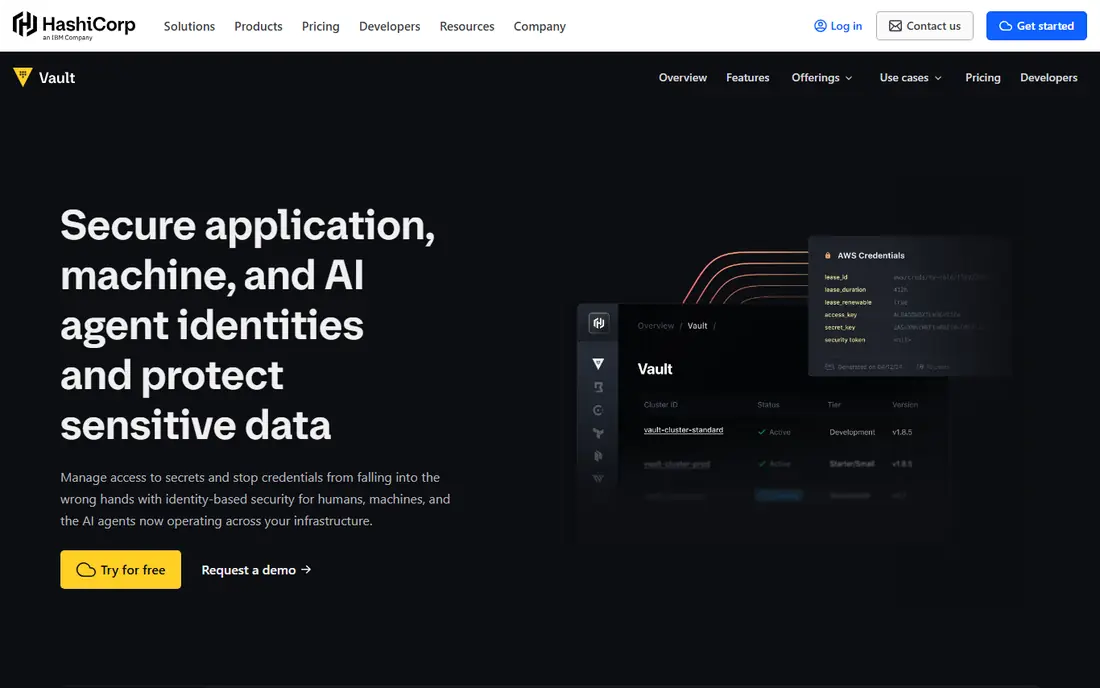
HashiCorp Vault is the default choice for multi-cloud secrets management. It issues dynamic credentials that expire quickly, supports many secret engines for databases, clouds, and PKI, and logs every access for audit. Vault Community Edition is free to self-host, while Vault Enterprise and the managed HCP Vault Dedicated service are paid, with managed development-tier clusters reported around 62 cents per hour.
The cost is operational. Running Vault well needs expertise in clustering, backup, and upgrades, and small teams may find a managed service simpler. For an enterprise spanning AWS, Azure, and on-premises systems with one secrets policy, Vault remains the strongest option.
- Works across clouds and on-premises
- Dynamic secrets with short lifetimes
- Strong audit logging
- Needs real operational effort
- Enterprise and managed pricing needs a quote
AWS Secrets Manager charges 40 cents per secret per month plus 5 cents per 10,000 API calls, with no setup fee. It integrates natively with IAM, Lambda, and RDS, supports automatic rotation for supported databases and partner services, and replicates across regions. A small app with 15 secrets and modest calls runs around 6 dollars per month on AWS's own examples.
The bill scales with usage. A fleet of 10,000 secrets read frequently can reach thousands per month, so caching secrets locally rather than fetching on every request matters. For a team fully committed to AWS, Secrets Manager removes an entire category of infrastructure decisions.
- No infrastructure to run
- Native IAM, Lambda, and RDS integration
- Automatic rotation for supported services
- Costs grow with secret count and API calls
- AWS-only view of secrets
Azure Key Vault charges from 3 cents per 10,000 operations, with storage pricing that varies by tier, and premium tiers add hardware security module backing. It stores secrets, keys, and certificates together, integrates with Azure services and managed identities, and supports access policies and private networking. For an Azure shop, it is the natural counterpart to AWS Secrets Manager.
Premium storage costs more per secret than standard, so teams should check which tier their keys and certificates need. Like its AWS equivalent, Key Vault gives a fragmented view if your workloads also run on other clouds.
- Stores secrets, keys, and certificates in one service
- Deep Azure integration
- Managed HSM option
- Premium tier storage costs more
- Azure-centered view
Google Secret Manager charges 6 cents per active secret version per month plus 3 cents per 10,000 operations, making it the cheapest cloud-native storage option for high secret counts. It integrates with Cloud Run, GKE, and Compute Engine through IAM, and versioning keeps a history of secret values.
Rotation is less automatic than AWS, often needing Cloud Functions and Pub/Sub to implement, which adds cost and code. For a Google Cloud team with many secrets and moderate API traffic, Secret Manager's storage price is a genuine advantage.
- Lowest storage cost among cloud-native options
- Simple API
- Integrates with Google Cloud workloads
- Rotation needs extra setup
- Fewer built-in integrations than Vault
CyberArk Secrets Manager, built on Conjur, targets regulated enterprises that already treat privileged access seriously. It centralizes secrets for applications, CI/CD pipelines, and cloud workloads, with audit trails and policy controls that satisfy compliance teams. Conjur open source gives smaller teams a free starting point, while the enterprise product adds scale and support.
Pricing is custom, and implementation expects a security team that can own it. For a bank, insurer, or healthcare company with strict audit needs, CyberArk's privileged access background is a real differentiator.
- Strong privileged access heritage
- Conjur open-source roots
- Compliance-friendly audit trails
- Custom pricing only
- Implementation suits larger security teams
Doppler is the developer-favorite secrets manager. It offers a clean dashboard and CLI, syncs secrets into applications and CI/CD pipelines, and handles environments from development to production with access controls and audit logs. A free tier covers small teams, with paid plans adding collaboration and enterprise features.
The ecosystem is smaller than Vault's, and enterprise pricing requires a quote. For a product team that wants secrets management developers actually enjoy using, Doppler is the easiest sell on this list.
- Clean developer experience
- Syncs secrets to apps and CI/CD
- Good collaboration features
- Enterprise pricing needs a quote
- Smaller ecosystem than Vault
Infisical is the open-source challenger in this space. Its core can be self-hosted free, it integrates with Kubernetes, Terraform, CI/CD tools, and cloud secret stores, and it adds features like dynamic secrets and access controls that teams otherwise build themselves. A cloud version removes the hosting burden for teams that prefer it.
Being younger means a smaller track record than Vault or CyberArk, and some enterprise features sit on paid plans. For a team that wants Vault-like capability with open-source flexibility and a modern interface, Infisical is worth evaluating.
- Open-source core you can self-host
- Broad integrations
- Fast-moving feature development
- Younger platform than Vault or CyberArk
- Enterprise features on paid plans
Akeyless delivers secrets management as a SaaS platform, so teams get a unified vault for secrets, keys, and certificates without running clusters. It supports dynamic secrets, zero-knowledge encryption, and integrations with major clouds, Kubernetes, and CI/CD tools, with a free trial to test it.
Pricing is custom, and it lacks the name recognition of Vault or CyberArk, which can matter in procurement. For a team that wants a managed platform without cloud lock-in, Akeyless offers a middle path between cloud-native tools and self-hosted Vault.
- SaaS delivery with no infrastructure to run
- Unified secrets, keys, and certificates
- Broad integrations
- Pricing is custom
- Less name recognition than Vault or CyberArk
1Password Business costs 7.99 dollars per user per month, and its Secrets Automation features let developers pull secrets from 1Password vaults into applications and CI/CD pipelines. Teams already using 1Password for human passwords get developer secrets in the same system, with the same access controls and audit events.
The developer secrets feature set is narrower than Vault's, and per-user pricing fits human teams better than machine-heavy workloads. For a small company already standardized on 1Password, Secrets Automation is a low-friction way to stop secrets living in code.
- Familiar to teams already using 1Password
- Secrets Automation for developers
- Strong security reputation
- Secrets features are narrower than Vault
- Priced per user, not per secret
How we picked these
We compared official pricing pages, feature lists, and documentation for secrets managers that serve enterprises today. Prices are the standard published rates from each vendor's own site, and where pricing is custom or quote-based we say so rather than guessing. We included cloud-native, multi-cloud, open-source, and SaaS options, since a team's cloud strategy should decide the shortlist more than any single feature.
What to check before you choose
Start with where your workloads run. A single-cloud team gets the most value from its own cloud's tool, while a multi-cloud team needs Vault, CyberArk, Doppler, Infisical, or Akeyless for one policy everywhere. Mixing cloud-native tools across clouds fragments audit trails and access control.
Model secret count and API calls together
List prices mislead in this category. AWS at 40 cents per secret looks cheap until 10,000 secrets and heavy reads push the bill into thousands per month. Count secrets across environments and regions, estimate reads per day, and price that workload on two or three options.
Test rotation for your actual secret types
Automatic rotation covers databases and partner services on AWS, but many API keys need custom code, and some providers offer no creation endpoint at all. List your ten most important secret types and confirm each tool rotates them before committing.
Check audit and access controls early
Secrets management is a security control, so audit logs, least-privilege access, break-glass procedures, and compliance reports matter as much as storage price. Confirm the tool logs every read, supports your identity provider, and exports audit data to your SIEM.
Frequently asked questions
What is the best secret management tool?
HashiCorp Vault is our pick for multi-cloud enterprises, while AWS Secrets Manager, Azure Key Vault, and Google Secret Manager lead inside their own clouds. Doppler and Infisical suit developer-led teams, and CyberArk suits regulated enterprises. The right choice follows your cloud strategy.
What are the best secrets management tools for enterprises?
Vault, CyberArk, and Akeyless lead for enterprises needing multi-cloud coverage and compliance-grade audit trails. Cloud-native tools lead for single-cloud enterprises. Doppler and Infisical offer modern alternatives with lower operational overhead.
What is the best-rated secrets management software?
Ratings vary by reviewer, but Vault, AWS Secrets Manager, and Azure Key Vault consistently rank at the top for enterprise use, with Doppler and 1Password praised for usability. Check current reviews for your use case, since this market moves fast and pricing changes often.
How much does AWS Secrets Manager cost?
AWS Secrets Manager costs 40 cents per secret per month plus 5 cents per 10,000 API calls, with no setup fee. A small app with 15 secrets and modest calls runs about 6 dollars per month on AWS's own examples, while 1,500 secrets used heavily can exceed 600 dollars per month.
Is HashiCorp Vault free?
Vault Community Edition is free to self-host, though you pay for the infrastructure and engineering time to run it. Vault Enterprise and the managed HCP Vault Dedicated service are paid, with pricing by quote or cluster size. Small teams often start with Community and move to managed hosting as needs grow.
Should small teams use a secrets manager?
Yes, even a small team benefits from keeping secrets out of code and chat logs. Start with your cloud's native tool or a free tier like Doppler or Infisical, and add rotation and audit controls as you grow. The cost of a leaked key in production far exceeds the cost of a secrets manager.
Sources we checked (9)
- https://www.hashicorp.com/products/vault/pricing
- https://aws.amazon.com/secrets-manager/pricing/
- https://azure.microsoft.com/en-us/pricing/details/key-vault/
- https://cloud.google.com/secret-manager/pricing
- https://www.cyberark.com/products/secrets-manager
- https://www.doppler.com/pricing
- https://infisical.com/pricing
- https://www.akeyless.io/pricing/
- https://1password.com/business/pricing/

Online Jobs is an independent blog about careers, online work, learning new skills and the tools that help people earn. More about us.
Keep reading
All posts
Workday Alternatives
We compared the best workday alternatives for HR, payroll, and global hiring, from BambooHR and Gusto to Rippling, Deel, and HiBob for growing teams in 2026.
Which SaaS Tools Have the Best Customer Support
Which SaaS tools have the best customer support? Compare eight popular tools on help centres, live help, response options and overall support quality.
Top AI Helpdesk Software
Searching for top AI helpdesk software in 2026? We compared 8 AI helpdesks on automation, pricing, channels and ease of setup for small and growing teams.