Best Risk Management Software in 2026: 8 Platforms Compared


Mid-market teams building their own risk workflows · Starting price: See website
How we put this together: we compare official feature and pricing pages, app store listings, privacy policies and public user reviews. Prices change, so check the provider's site before you pay.
Key takeaways
- LogicGate leads for teams that want to build their own risk workflows without code, while Optro leads for audit connected risk at larger companies.
- Resolver and MetricStream suit large, complex programmes with many frameworks, entities, and third parties.
- Drata and Vanta suit growing companies automating a first compliance programme, such as SOC 2 or ISO 27001, rather than a full enterprise risk programme.
- Almost all enterprise pricing is quote based, so budget for implementation and for the staff time needed to run the programme, not just the licence.
Quick comparison
| Name | Who it suits | Starting price | Free option | |
|---|---|---|---|---|
| LogicGate Risk Cloud | Mid-market teams building their own risk workflows | See website | No | Visit |
 Optro | Mid to large enterprises running audit connected risk | See website | No | Visit |
 Resolver | Large organisations wanting risk intelligence | See website | No | Visit |
 MetricStream | Massive enterprises with AI driven risk programmes | See website | No | Visit |
 ServiceNow Integrated Risk Management | Enterprises already standardised on ServiceNow | See website | No | Visit |
 Workiva | Teams connecting risk work to financial reporting | See website | No | Visit |
 Drata | Growing companies automating first compliance audits | See website | No | Visit |
 Vanta | Growing companies automating security compliance | See website | No | Visit |
The best risk management software
Risk management software gives a company one place to register risks, assign owners, test controls, manage third-party risk, and produce reports that auditors and boards can use. Spreadsheets can work for a small risk register, but they fail when risks, controls, and vendors multiply and when evidence needs to be current. The platforms below range from flexible no-code builders to enterprise suites and compliance automation tools.
LogicGate Risk Cloud
Who it suits: Mid-market teams building their own risk workflows
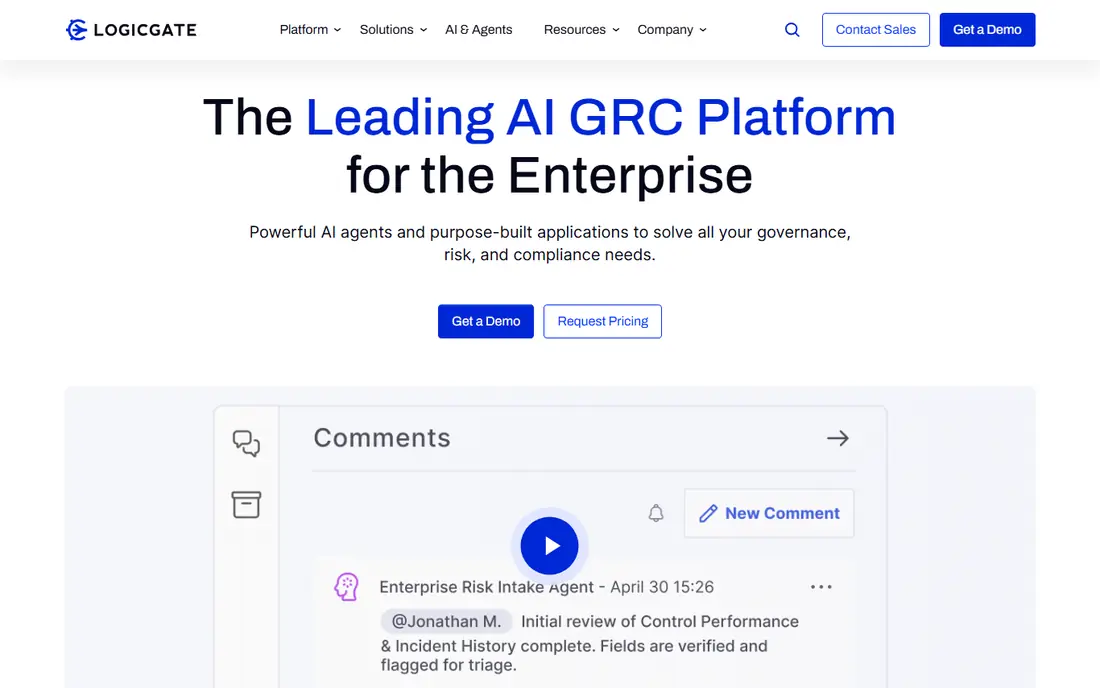
LogicGate Risk Cloud is built for teams that would rather configure their own risk programme than hire consultants for every change. A drag and drop workflow builder lets risk and compliance staff build control libraries, run assessments, and route remediation tasks without writing code, and pre-built applications cover enterprise risk, IT risk, compliance, policy, and third-party risk. A graph view links controls, assets, and risks so owners can trace how one risk touches several programmes.
The trade-off is ownership. LogicGate adapts to a team with a clear process and someone to build it, and it underperforms for a team without that owner. Pricing is quote based with no published tiers, so expect a demo and a sales conversation before you see numbers. For a mid-market team that finds fixed templates too rigid, it is the most flexible choice.
- No-code workflow builder for controls, assessments, and remediation
- Modular applications for enterprise, IT, and third-party risk
- Graph view linking risks and controls
- Quote only pricing
- Needs a dedicated owner to configure well
- Depth in any single area below specialist audit tools
Optro, formerly AuditBoard, is the connected risk platform used by many large companies for SOX, internal audit, and enterprise risk in one system. Linking audit work to risk and controls means evidence, findings, and remediation live in one place, and board reporting draws on current data rather than a quarterly spreadsheet scramble. That connection is why large, audit heavy companies choose it over a standalone risk register.
Cost and scale are the limits. Pricing is quote only and enterprise level, and implementation is a programme, not a quick setup. Smaller companies will find Optro heavy and expensive for a first risk register. For a mid to large enterprise that already runs SOX or internal audit at scale, Optro's audit connection is a decisive advantage.
- Connected risk platform linking audit, risk, and compliance
- Strong for SOX and internal audit
- Board ready reporting
- Quote only pricing
- Enterprise focus and cost
- Implementation is a major programme for large companies

Resolver pitches itself as a risk intelligence platform: it gathers risk data, analyses it in context, and translates risk into business impact, so leaders can see how a compliance issue, an incident, or a vendor failure affects the wider organisation. Workflows cover risk, audit, compliance, and incidents, with automation for reporting and remediation that helps large teams move from data collection to action.
Resolver is an enterprise tool, and it needs enterprise resourcing. Pricing is quote only, configuration takes time, and the intelligence features only pay off when data is kept current across programmes. A small team will not use its depth. A large organisation with many risk types and a need to show business impact, not just a risk list, will get the most from it.
- Risk intelligence platform tracing risk impact across the business
- Strong incident, audit, and compliance workflows
- Used by many large organisations
- Quote only pricing
- Enterprise complexity
- Needs resourcing to use its full intelligence features
MetricStream is the massive enterprise GRC suite, covering governance, risk, compliance, audit, and third-party risk at global scale, with AI features woven into risk assessment and monitoring. Companies with many entities, frameworks, and regulators choose MetricStream when they need one governed system that can handle complexity without breaking into separate tools.
The price and project size reflect that scale. Pricing is quote only, implementation can run long, and the platform is overkill for a mid-market programme. MetricStream suits a global enterprise that has already outgrown a flexible builder or a compliance automation tool, and that can staff a GRC programme properly. Smaller buyers should start with LogicGate, Drata, or Vanta.
- Broad GRC coverage across risk, compliance, audit, and third-party risk
- AI features for risk programmes
- Global enterprise scale
- Quote only pricing at enterprise level
- Implementation can be long
- Overkill for mid-market programmes
ServiceNow Integrated Risk Management
Who it suits: Enterprises already standardised on ServiceNow
ServiceNow Integrated Risk Management makes most sense for a company already running ServiceNow for IT service, HR, or operations. Risk, compliance, audit, and vendor risk live on the same platform and workflows as the rest of the business, so a risk finding can trigger an IT task, a vendor review, or an audit action without switching systems. That integration is hard to replicate with a standalone tool.
Outside ServiceNow, the case weakens. Pricing is quote only, configuration needs ServiceNow skills, and buying ServiceNow just for risk would be an expensive detour. ServiceNow IRM suits an enterprise that has already standardised on the platform and wants risk governed alongside IT. Other buyers will get faster value from LogicGate or Optro.
- Risk, compliance, audit, and third-party risk inside ServiceNow
- Strong workflow and automation
- Single platform for IT and risk
- Best value only inside ServiceNow
- Quote only pricing
- Needs ServiceNow skills to configure well
Workiva connects risk and audit work to financial reporting, which matters for companies where a risk finding, a control test, and a financial disclosure all need to agree. Teams collaborate on live documents with audit trails, version control, and linked data, so a number that changes in one place updates everywhere it is used. That linkage reduces the manual checking that causes reporting errors.
Workiva is a reporting platform first, so pure risk modelling depth varies by module, and pricing is quote only at enterprise level. It suits a company that already reports through Workiva or that needs tight linkage between risk, audit, and financial statements. A team that only needs a risk register will find it broader and costlier than necessary.
- Connected reporting linking risk, audit, and financial data
- Strong controls and audit trails
- Collaboration on live documents
- Quote only pricing
- Reporting focus means risk depth varies by module
- Enterprise orientation
Drata automates the compliance work that growing tech companies dread: collecting evidence, monitoring controls continuously, and preparing for SOC 2, ISO 27001, and other framework audits. Instead of chasing screenshots before an audit, teams connect systems once and Drata flags gaps as they appear, which shortens the first audit and keeps readiness current between audits.
Drata is a compliance automation tool, not a full enterprise risk platform. It will not replace LogicGate or MetricStream for a complex enterprise risk programme with many risk types and board level quantification. It suits a growing company heading toward its first audit, or maintaining a small set of frameworks, where automation saves more time than a general risk suite would.
- Automated evidence collection for SOC 2, ISO 27001, and other frameworks
- Continuous control monitoring
- Faster first audit
- Focused on compliance automation rather than full enterprise risk
- Pricing scales with frameworks
- Needs staff to fix flagged controls
Vanta is the other main compliance automation choice for growing companies, with automated monitoring across SOC 2, ISO 27001, HIPAA, and other frameworks, integrations with the tools startups already use, and evidence collection that auditors can review directly. Teams use it to prove security controls to customers and auditors without building a compliance team from scratch.
As with Drata, the focus is compliance automation, not broad enterprise risk management with quantification and board risk appetite modelling. Pricing scales with frameworks and scope, so a company adding many frameworks should get a written total. Vanta suits a tech focused growing company that needs to show customers and auditors that its controls work, quickly and continuously.
- Automated framework monitoring for SOC 2, ISO 27001, HIPAA, and more
- Integrations with common business tools
- Audit ready evidence
- Compliance focus rather than broad enterprise risk
- Pricing scales with scope
- Smaller ecosystem for non-tech frameworks in some areas
How we picked these
When we compared risk management software, we checked official product pages and current comparison material on risk registers, controls, third-party risk, audit linkage, and pricing models. We favoured platforms that state their risk, control, and reporting features clearly and that are live in 2026. We left out pure spreadsheet templates, single framework checklists with no risk register, and tools that only monitor one risk type, such as cyber risk alone.
How to choose without buying too much platform
Start with the programme you actually run. A first SOC 2 audit points to Drata or Vanta. A mid-market risk and compliance programme with custom workflows points to LogicGate. An audit heavy enterprise programme points to Optro. A global, multi-framework enterprise programme points to MetricStream, Resolver, or ServiceNow IRM.
Map modules before you get a quote
Enterprise pricing scales with modules, frameworks, entities, and users, so a vague quote is meaningless. List the frameworks, risk types, third parties, and users you need in year one, and ask for a quote against that exact scope. Compare year one totals including implementation, not just licence fees.
Assign an owner before go-live
A risk platform without an owner becomes an empty register. Name the person who will keep risks, controls, and evidence current, and check that they have time for the job. A simpler tool with an active owner beats an enterprise suite that no one maintains.
Frequently asked questions
What is the best risk management software?
LogicGate is best for flexible no-code workflows, Optro is best for audit connected risk, ServiceNow IRM is best for ServiceNow enterprises, and MetricStream is best for global enterprise GRC. The best choice depends on programme size and audit needs.
What are the best risk management tools for small companies?
Drata and Vanta suit growing companies automating a first compliance programme, while LogicGate suits a mid-market team that needs a custom risk register. Small companies should avoid enterprise suites until their programme outgrows these tools.
What is the best risk management platform for third-party risk?
LogicGate, Resolver, MetricStream, and ServiceNow IRM all cover third-party risk, with ServiceNow strongest where vendor workflows already live in ServiceNow. Check whether vendor questionnaires, scoring, and monitoring are included in your tier.
What is the best software for risk management in banks and regulated industries?
Optro, MetricStream, Resolver, and Archer suit highly regulated industries with complex risk programmes, audit needs, and board reporting. Regulated buyers should prioritise audit trails, control testing, and reporting depth over a low entry price.
How much does risk management software cost?
Enterprise platforms are almost entirely quote based, with mid-market deployments often running into five or six figures a year and large enterprise suites higher. Compliance automation tools publish clearer starting points but scale with frameworks, so always get a written total.
Sources we checked (8)

Online Jobs is an independent blog about careers, online work, learning new skills and the tools that help people earn. More about us.
Keep reading
All posts
ZoomInfo Alternatives
The best ZoomInfo alternatives in 2026, compared on price, free plans, data coverage, and which tool fits small teams or large sales teams best in detail.

Workday Alternatives
We compared the best workday alternatives for HR, payroll, and global hiring, from BambooHR and Gusto to Rippling, Deel, and HiBob for growing teams in 2026.
Which SaaS Tools Have the Best Customer Support
Which SaaS tools have the best customer support? Compare eight popular tools on help centres, live help, response options and overall support quality.