Best Requirements Management Tools in 2026: 8 Tools Compared

How we put this together: we compare official feature and pricing pages, app store listings, privacy policies and public user reviews. Prices change, so check the provider's site before you pay.
Key takeaways
- Jama Connect and IBM DOORS Next suit regulated teams that need strict traceability and audit-ready records.
- Helix RM, Visure and Polarion cover the middle ground between full lifecycle governance and day-to-day engineering work.
- Modern Requirements4DevOps is the natural pick for teams already living in Azure DevOps.
- ReqView is the low-cost option for small teams that want versioned requirements without an enterprise rollout.
- Most enterprise tools in this category do not publish prices, so budget for a quoted plan and implementation time.
Quick comparison
| Name | Who it suits | Starting price | Free option | |
|---|---|---|---|---|
 Jama Connect | Regulated product teams | See website | Free trial | Visit |
 IBM DOORS Next | Large governed programs | See website | No | Visit |
 Helix RM | Software and hardware teams | See website | Free trial | Visit |
 Visure Requirements | Safety-critical compliance work | See website | Free trial | Visit |
 Polarion ALM | End-to-end lifecycle governance | See website | No | Visit |
 Modern Requirements4DevOps | Azure DevOps teams | See website | Free trial | Visit |
 Codebeamer | Systems engineering at scale | See website | Free trial | Visit |
 ReqView | Small teams on a budget | See website | Free trial | Visit |
The best requirements management tools
Requirements tools exist to answer one hard question: can you prove that what was built matches what was asked for, and what changed along the way. The tools below handle that job in different ways, from strict document control to lighter, developer-friendly tracking.
Jama Connect centres on live traceability, which means a requirement, a test case and a risk item stay linked as each one changes. That link is the point for medical, automotive and aerospace teams, because an auditor can follow a decision from an original requirement through to verification without hunting through spreadsheets. Review cycles, baselines and change history sit in the same system, so teams spend less time reconstructing what happened.
The trade-off is scope. Jama Connect is built for governed product development, not for a quick backlog list, and smaller teams may find its structure heavier than they need. Pricing is quoted, so the honest first step is a demo and a conversation about user count and deployment. If your program faces external audits, that weight is a feature, not a flaw.
- Live traceability between requirements, tests and risks
- Structured review workflows
- Strong reporting for audits
- Pricing is quoted rather than published
- Setup takes real planning on large programs
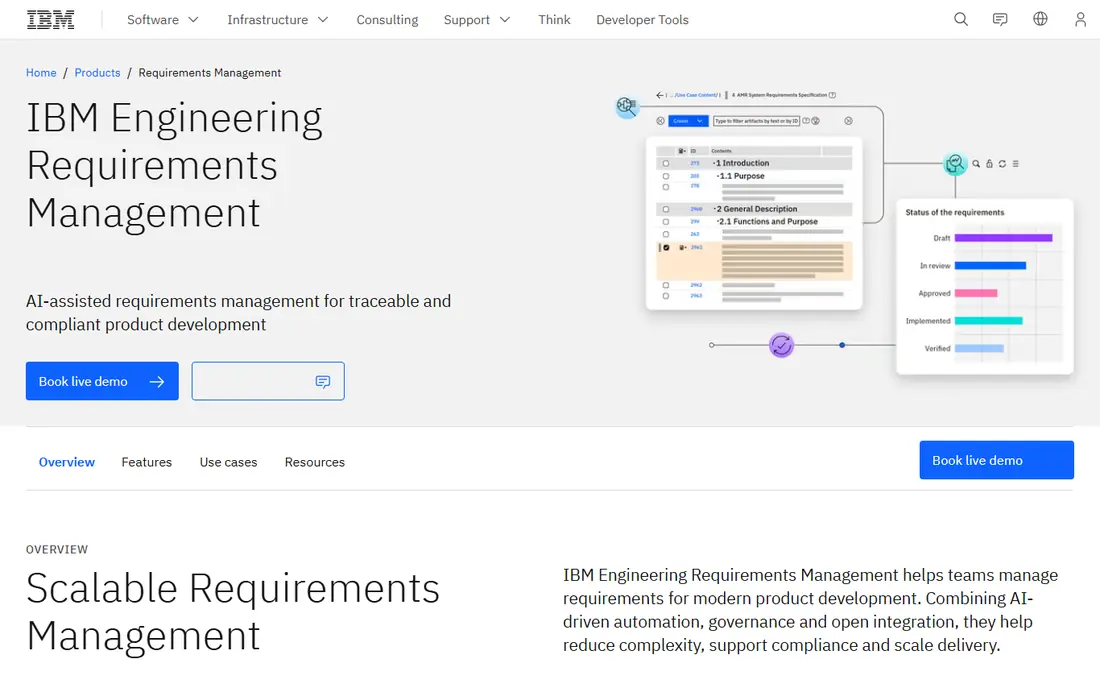
IBM DOORS Next is the long-established choice for very large, complex engineering programs. It handles structured requirements, modules, baselines and links across thousands of items, and it fits organisations that already use other IBM engineering tools. For defence, transport and industrial programs, that history and scale matter, because the tool has to survive a program that runs for years.
New teams should expect a learning curve. The interface rewards trained users and disciplined process, and casual users may struggle at first. Pricing is quoted, and costs rise with the wider IBM suite. Choose it when governance, scale and long-term records outweigh speed of setup.
- Deep traceability across large requirement sets
- Baselines and change control
- Part of a broad engineering lifecycle suite
- Quoted pricing
- A steep learning curve for new users
Helix RM from Perforce focuses on the practical work of managing requirements through approval, change and reuse. Teams can link requirements to test cases and source code, run impact analysis before approving a change, and reuse approved requirements on later projects instead of rewriting them. That reuse saves real time in product families where many requirements repeat with small variations.
The tool sits between a simple tracker and a full lifecycle suite, which is a good place for mid-sized engineering teams. It does take deliberate configuration to keep views and workflows clean as a project grows. A free trial is available, so a team can test its review and traceability flow on a real project before committing.
- Requirement reuse across projects
- Traceability matrix and impact analysis
- Links to tests and source code
- Quoted pricing
- Configuration needs care to stay simple
Visure Requirements is built for teams that must show compliance with industry standards, including automotive, aerospace and medical work. It combines requirements, risk management, test management and change control, with templates that give a regulated project a sensible starting point rather than a blank page. Traceability runs through requirements, risks and tests, which helps when an auditor asks for evidence.
That breadth comes with setup effort. Teams should plan time to configure templates, roles and reports for their own standard, rather than expecting a finished compliance pack on day one. A free trial lets you check whether the workflow fits your review process. For safety-critical work, the combined risk and test view is a genuine advantage over a requirements-only tool.
- Templates for regulated industries
- Risk, test and change management in one place
- Traceability and reporting
- Quoted pricing
- Setup can feel complex at first
Polarion ALM, from Siemens, covers requirements alongside test management, defect tracking and lifecycle workflows. That breadth suits organisations that want one governed system from an initial requirement to a released product, with traceability that crosses team boundaries. It is web-based, so distributed teams can review and approve in the same place.
Polarion is an enterprise platform, and it should be bought as one. Expect administration, training and process design, and get a quoted price for your user count and deployment choice. Smaller teams will find lighter tools faster to adopt. Larger engineering organisations, by contrast, may value having requirements and testing governed together.
- Requirements, testing and lifecycle workflows in one platform
- Traceability across the lifecycle
- Web-based collaboration
- Quoted pricing
- Enterprise setup and administration
Modern Requirements4DevOps is the clearest pick for teams already running Azure DevOps. Instead of asking engineers to live in a separate system, it adds structured requirements, document editing, diagrams, reviews and traceability inside the environment they already use. Stakeholders can review requirements in a document-style view while engineers keep working in work items.
The obvious limit is the ecosystem. If your team does not use Azure DevOps, most of the advantage disappears, and another tool on this list will fit better. Pricing is available on request, with a free trial offered. For Microsoft-centred teams, the shorter learning curve and tighter integration are hard to beat.
- Native Azure DevOps integration
- Document-style editing with versioning
- Review and traceability inside a familiar tool
- Pricing on request
- Less useful for teams outside the Microsoft stack
Codebeamer is a lifecycle platform with strong requirements and risk management for complex, multi-discipline products. It suits systems engineering teams that must connect software, hardware and safety work in one governed record, with workflows that can be shaped to a company process rather than forced into a fixed template. Traceability across those disciplines is its core strength.
Scale brings administration. A large Codebeamer rollout needs owners for configuration, permissions and reporting, and pricing is quoted. Teams that only need simple requirement lists should look at ReqView instead. Teams building complex products with many interlinked parts will get more value from Codebeamer's breadth.
- Requirements and risk management for complex products
- Traceability across engineering disciplines
- Configurable workflows
- Quoted pricing
- Needs administration at scale
ReqView takes a different approach from the enterprise suites: requirements live in structured documents that work well with version control, and the tool stays focused on writing, linking and tracing requirements rather than running a whole lifecycle platform. That focus makes it approachable for small engineering teams, consultants and startups that need discipline without a heavy rollout.
The limit is scope. ReqView does not try to replace test management, risk management and full lifecycle governance in one package, so larger regulated programs may outgrow it. Pricing is listed on the vendor site and a free trial is available, so cost is easy to check before you commit. For a small team moving off spreadsheets, it is a sensible first step.
- Lightweight and affordable in spirit
- Offline-friendly desktop use
- Version control friendly requirement documents
- Fewer enterprise governance features
- Smaller ecosystem than the big suites
How we picked these
We compared official product pages, pricing pages, documentation and public reviews for tools that manage requirements as a first-class object, not just as backlog tickets. We kept tools that support traceability, baselining or versioning, reviews and change history, and we dropped generic project boards that only offer a text field for requirements. Where a vendor does not publish a price, we say so rather than repeating a third-party estimate. We did not claim hands-on testing; this list reflects what the vendors publish and what reviewers report about real use.
Choosing the right requirements tool
Start with the audit question. If an external auditor, regulator or customer will ask for proof, you need traceability, baselines and change history that survive staff changes. That points to Jama Connect, IBM DOORS Next, Visure or Polarion, even though they cost more and take longer to set up. If the main risk is internal confusion, a lighter tool with good linking and reviews may be enough.
Next, check where your engineers already work. A tool that sits inside Azure DevOps, Jira or your existing test system will get used, while a separate system that only the requirements manager opens will go stale. Ask for a trial on a real, small project, not a demo dataset, and test the exact flow you will use every week: writing a requirement, getting it reviewed, changing it, and finding every test it affects.
Watch the total cost
Quoted pricing hides more than the licence fee. Add implementation, training, migration from documents or spreadsheets, and the admin time to keep workflows and reports current. A cheaper tool that your team actually maintains beats an expensive suite that nobody updates. Agree who owns the requirement set, who approves changes, and how often baselines are taken, before you sign.
Frequently asked questions
What is the best requirements management software?
There is no single winner, because regulated programs and small product teams need different things. Jama Connect and IBM DOORS Next lead for audit-heavy work, while Modern Requirements4DevOps leads for Azure DevOps teams and ReqView leads for small budgets.
What is the best software requirements management tool for a small team?
ReqView is a good starting point for small teams, and Helix RM suits teams that expect to grow into reuse and impact analysis. Start with a trial on one real project and check that reviews and traceability feel natural, not forced.
How is requirements management different from a backlog tool?
A backlog tool tracks tasks to be done, while a requirements tool tracks what the product must do, why, and how each requirement is verified. Traceability, baselines and controlled change are the difference, and they matter most when a change has safety, cost or contract consequences.
Do these tools replace documents and spreadsheets?
They can, but only if the team commits to the tool as the single record. Many teams start by importing documents and then keep editing the spreadsheet out of habit, which defeats the point. Pick one owner for the requirement set and retire the old copy once the trial proves the flow.
What should I ask a vendor before buying?
Ask for total quoted cost at your real user count, what a trial includes, how migration works, and how traceability reports look for an auditor. Also ask how the tool handles change approval, baselines and access control, since those controls decide whether the system stays trustworthy.
Sources we checked (8)
- https://www.jamasoftware.com
- https://www.ibm.com/products/requirements-management-doors-next
- https://www.perforce.com/products/helix-rm
- https://visuresolutions.com
- https://polarion.plm.automation.siemens.com
- https://www.modernrequirements.com
- https://www.ptc.com/en/products/codebeamer
- https://www.reqview.com

Online Jobs is an independent blog about careers, online work, learning new skills and the tools that help people earn. More about us.
Keep reading
All posts
n8n Alternatives
n8n alternatives compared for 2026, with Zapier, Make, Activepieces, and more, covering visual builders, code steps, self-hosting, and pricing models.

ZoomInfo Alternatives
The best ZoomInfo alternatives in 2026, compared on price, free plans, data coverage, and which tool fits small teams or large sales teams best in detail.

Zoom Alternatives for Webinars
Compare Zoom alternatives for webinars in 2026, from browser-based rooms to enterprise events, with prices, attendee limits, features and honest trade-offs.