Best Recruiting Tools in 2026: 8 Tools Compared

How we put this together: we compare official feature and pricing pages, app store listings, privacy policies and public user reviews. Prices change, so check the provider's site before you pay.
Key takeaways
- Workable suits small teams that want a self-serve system with published pricing and a trial.
- Greenhouse and Lever suit larger teams that need structured interviews, CRM features, and deep integrations.
- Ashby suits startups that want strong reporting without spreadsheets, while JazzHR and Manatal suit tight budgets.
- Zoho Recruit suits teams already using Zoho, because its free plan covers basic tracking.
Quick comparison
| Name | Who it suits | Starting price | Free option | |
|---|---|---|---|---|
 Workable | small teams, self-serve hiring | $299 per month | No | Visit |
 Greenhouse | structured enterprise hiring | See website | No | Visit |
 Lever | ATS plus candidate CRM | See website | No | Visit |
 Ashby | reporting and analytics | See website | No | Visit |
 Breezy HR | unlimited users on a flat price | $157 per month | Yes | Visit |
 JazzHR | low-cost small business hiring | $49 per month | No | Visit |
 Zoho Recruit | free basic tracking | Free | Yes | Visit |
 Manatal | low per-user pricing | $15 per user per month | No | Visit |
The best recruiting tools
Recruiting tools cover different jobs: posting jobs, sourcing candidates, managing interviews, and reporting on hiring. The picks below include applicant tracking systems, a candidate CRM, and sourcing tools, so you can match the system to your team size and hiring volume rather than buying the biggest platform by default.
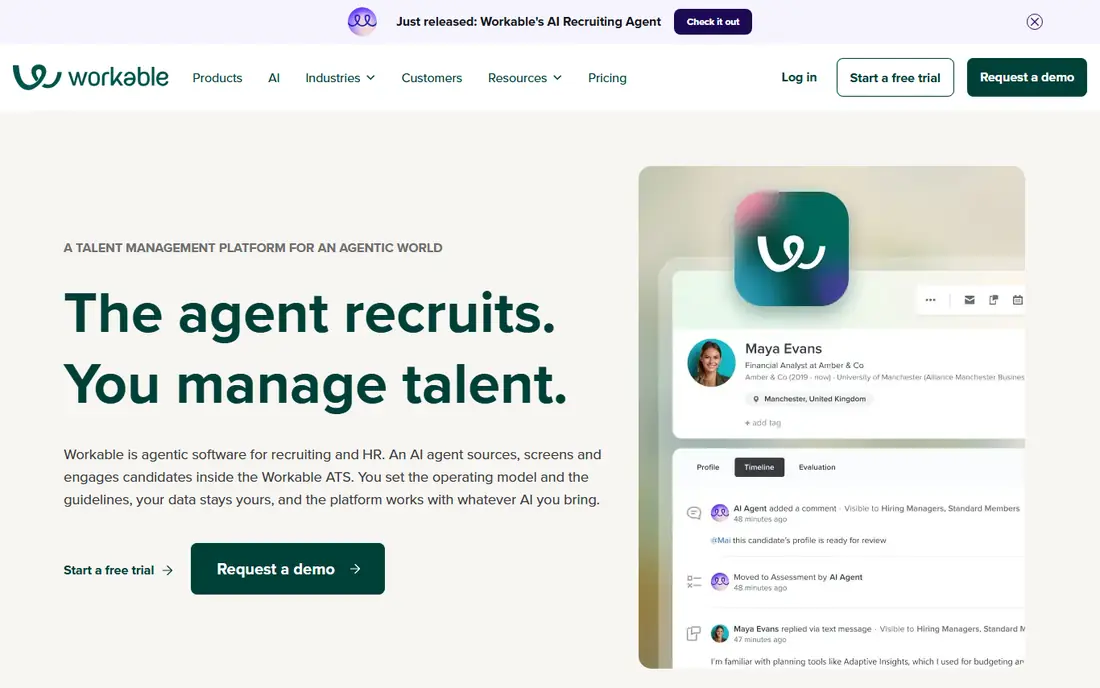
Workable is the most approachable full system in this list for a small team. You can post a job, share it to job boards, collect applications in one pipeline, schedule interviews, and send offers, without a long implementation project. Its pricing is published, with plans listed from about $299 per month for smaller teams on annual billing, and a 15-day trial lets you test the workflow on a real role.
The limits are scale and depth. Larger teams may want Greenhouse's structured interview tools or Ashby's reporting, and Workable's HR add-ons cost extra. For a team hiring a few roles a quarter, though, Workable's balance of price, ease, and board reach is hard to beat. Test it with one live role during the trial, not just a demo account.
- Published pricing
- Posts to many job boards
- AI sourcing and screening tools
- 15-day trial
- Price rises with headcount bands
- HR features cost extra
- Reporting is less deep than Ashby for some teams
Greenhouse is the structured choice for mid-sized and large teams. Interview plans, scorecards, and consistent stages help every candidate get a fair, comparable interview, which matters when many interviewers are involved. It also offers a large integration library, so it can connect with HR, scheduling, and assessment tools your team already uses.
Pricing is quote-only, and implementation takes longer than a self-serve tool, so Greenhouse suits teams with enough hiring volume to justify the setup. Small teams hiring a few people a year will likely find it too heavy and too costly. If consistency, reporting, and scale matter more than a quick start, Greenhouse deserves a demo.
- Structured interview plans and scorecards
- Many integrations
- Strong reporting and compliance tools
- Quote-only pricing
- Implementation takes longer than self-serve tools
- Cost is high for small teams
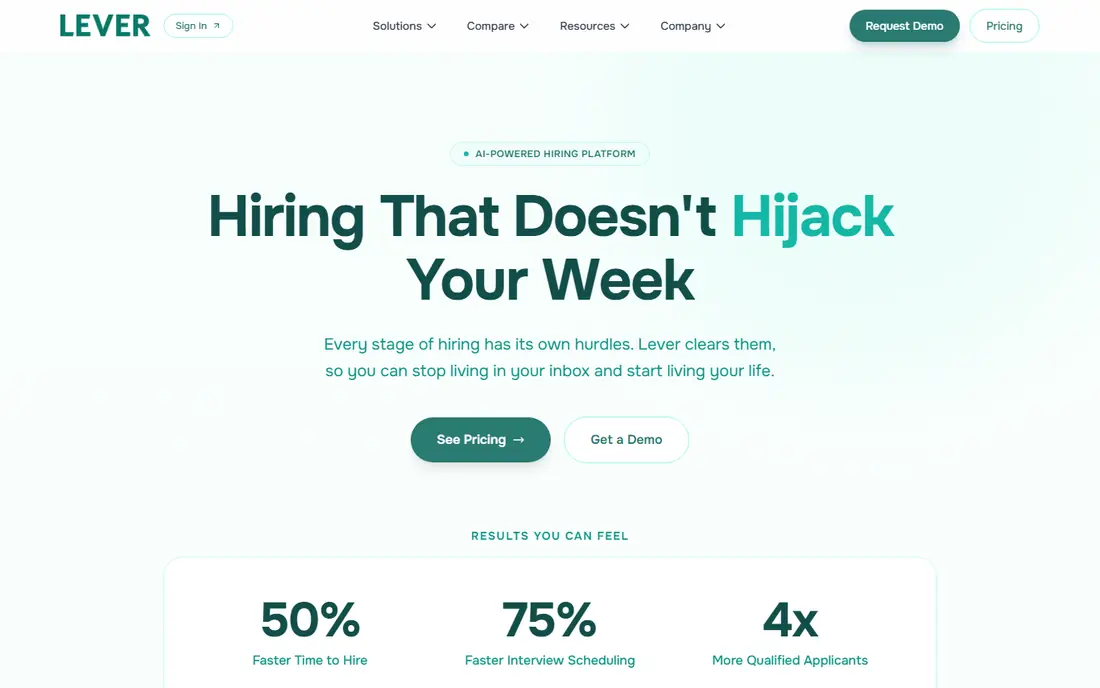
Lever, now branded LeverTRM, blends an applicant tracking system with a candidate CRM, which suits teams that nurture passive candidates over months rather than only processing inbound applications. You can source from LinkedIn and other sites with its extension, build talent pools by skill, and run nurture sequences so a role that opens later already has warm candidates.
Like Greenhouse, Lever does not publish pricing, so budget planning needs a sales call. Buyer-reported ranges have varied widely by company size, so get a written quote for your team size and hiring volume. Lever suits growth teams with longer hiring cycles, especially for technical or executive roles where relationships matter.
- Combines ATS with candidate relationship management
- Nurture sequences for passive candidates
- Strong sourcing extension
- Quote-only pricing
- Historically less deep on some screening features
- Needs a sales conversation to price
Ashby appeals to startups and scale-ups that want recruiting analytics they can actually use. Instead of exporting data to spreadsheets, you get pipeline, source, and interviewer reports inside the system, which helps hiring managers see where candidates drop off. It also covers posting, scheduling, and offers in one product, so small teams can avoid buying several tools.
Recent summaries describe size-based pricing bands, with entry plans listed from a few hundred dollars per month for smaller companies, but check Ashby's current pricing page, because bands change. There is no free plan, though demos are available. If reporting is your main pain, Ashby is a strong shortlist pick. If you only hire occasionally, a cheaper tool may suffice.
- Strong reporting without spreadsheets
- All-in-one recruiting features
- Published size-based pricing bands in recent summaries
- No free plan in recent listings
- Price rises with company size
- Smaller integration list than Greenhouse for some tools
Breezy HR suits small teams where every manager needs a login, because its flat pricing model avoids per-user charges that add up fast. Recent summaries list a paid plan from about $157 per month with unlimited users, and a free Bootstrap plan covers one open job for teams just starting out. Setup is quick, and the interface is friendly for non-recruiters.
The trade-off is depth: reporting and automation are simpler than on Greenhouse or Ashby, and some features sit on higher plans. For a small business hiring steadily, though, Breezy's flat price and ease of use are real advantages. Start on the free plan if you have only one role open, and upgrade when hiring picks up.
- Flat price with unlimited users in recent listings
- Free Bootstrap plan for one job
- Easy setup for small teams
- Reporting is simpler than Ashby or Greenhouse
- Some advanced features need higher plans
- Free plan is limited to one open job
JazzHR is a budget-friendly system for small businesses that need to post jobs and manage applicants without enterprise complexity. Its Starter plan has been listed at about $49 per month for a small number of jobs, with automated posting to job boards, which suits teams hiring a few roles at a time. Setup is fast, often within a day for a basic workflow.
JazzHR lacks the CRM depth of Lever and the reporting depth of Ashby, so larger teams may outgrow it. It also offers a trial rather than a free plan. For a bootstrapped team that wants a simple, affordable ATS, JazzHR is a sensible pick, especially if you hire fewer than five roles a year and want to avoid a sales-heavy buying process.
- Low entry price
- Posts to many job boards
- Quick setup for small teams
- Trial only, no free plan
- Fewer advanced CRM features
- Reporting is basic next to Ashby
Zoho Recruit is the pick for teams already inside the Zoho ecosystem, and for solo recruiters who want a free starting point. Its free plan covers basic applicant tracking, and paid plans have been listed from about $25 per user per month in recent summaries, which keeps costs low for small teams. It also connects with other Zoho apps for email, CRM, and HR tasks.
The interface can feel busy, because Zoho packs in many features, and it lacks some of the polished interview structure of Greenhouse. For a small agency or in-house team that needs solid tracking at a low price, though, Zoho Recruit is hard to beat. Test the free plan with a real role before upgrading, to see if the workflow fits your team.
- Free plan for basic tracking
- Affordable paid plans
- Fits teams already using Zoho apps
- Interface feels busy to some users
- Advanced features need paid plans
- Less specialised than Greenhouse for large teams
Manatal suits small teams and agencies that want a low per-user price without giving up sourcing and CRM features. Recent summaries list entry pricing from about $15 per user per month, with AI candidate recommendations on the entry plan, and a 14-day trial to test it. That price point makes it one of the cheapest ways to give several recruiters their own seats.
Manatal is less well known than Greenhouse or Workable, and some integrations are less deep, so check the tools you rely on before committing. For a small agency or startup that needs multiple seats on a tight budget, though, Manatal's pricing is a clear advantage. Compare its total cost for your seat count with Breezy's flat price, because the cheaper option flips as your team grows.
- Low per-user entry price
- AI recommendations on entry plans in recent listings
- Sourcing and CRM features
- Trial only, no free plan
- Smaller brand presence than larger ATS tools
- Some integrations are less deep
How we picked these
We compared official product pages, pricing pages, and help documentation for recruiting tools that post jobs, manage applicants, or source candidates, and are still sold in 2026. We kept a mix of self-serve and enterprise systems, free and trial options, and per-user and flat pricing, and we marked quote-only tools as See website. We did not claim hands-on testing, and we noted where pricing varies by headcount, seats, or billing term.
What to check before you buy a recruiting tool
Start with hiring volume, not features. A team hiring two people a year needs a different tool from a team hiring twenty people a quarter. Count your open roles, your interviewers, and your must-have integrations, then shortlist only tools that fit those numbers. A powerful system that no one uses is worse than a simple system the team actually opens.
Trial with a real role
Run a trial on a live job, not a demo account, and measure how long each stage takes: posting, screening, scheduling, feedback, and offer. Check how candidates experience the application, because a clunky apply flow loses good applicants. Also test reporting: can you answer, without a spreadsheet, where candidates come from and where they drop off?
Cost, compliance, and data
Ask for the total annual cost for your team size and job volume, including add-ons and implementation fees. Check data handling, candidate consent, and equal-opportunity features, especially if you hire across regions. Finally, confirm how you can export your candidate data if you leave, because your hiring history should not be locked inside one vendor.
Frequently asked questions
What is the best recruiting software for small businesses?
Workable, Breezy HR, JazzHR, and Manatal all suit small businesses, with different pricing models. Workable suits self-serve hiring, Breezy suits teams with many users, JazzHR suits low budgets, and Manatal suits low per-user pricing.
What is the top recruiting software for large teams?
Greenhouse and Lever are strong picks for larger teams, because they offer structured interviews, CRM features, and deep integrations. Ashby also suits scale-ups that want strong reporting, while Workable can work for mid-sized teams with simpler needs.
Is there a free recruiting tool?
Yes, Zoho Recruit offers a free plan for basic tracking, and Breezy HR offers a free plan for one open job. Free plans suit very small hiring volumes, while most active teams will need a paid plan for more jobs, users, or features.
How much does recruiting software cost?
Entry prices in this list range from free plans to about $15 per user per month for Manatal, $49 per month for JazzHR, $157 per month for Breezy HR, and $299 per month for Workable, while Greenhouse, Lever, and Ashby use quote or band pricing. Always confirm the total annual cost for your team size.
What is the best recruiting sourcing tool?
Lever and Apollo-style sourcing tools suit teams that build talent pools, while Workable and Manatal include AI sourcing features. For pure sourcing, check whether the tool covers your target roles and regions, and test it on real accounts before buying.
Sources we checked (8)

Online Jobs is an independent blog about careers, online work, learning new skills and the tools that help people earn. More about us.
Keep reading
All posts
Workday Alternatives
We compared the best workday alternatives for HR, payroll, and global hiring, from BambooHR and Gusto to Rippling, Deel, and HiBob for growing teams in 2026.
Which SaaS Tools Have the Best Customer Support
Which SaaS tools have the best customer support? Compare eight popular tools on help centres, live help, response options and overall support quality.
Top AI Helpdesk Software
Searching for top AI helpdesk software in 2026? We compared 8 AI helpdesks on automation, pricing, channels and ease of setup for small and growing teams.