Best Print on Demand Platforms in 2026: 8 Platforms Compared

How we put this together: we compare official feature and pricing pages, app store listings, privacy policies and public user reviews. Prices change, so check the provider's site before you pay.
Key takeaways
- Printful suits brands that care most about consistent quality and branded packaging, even if base costs are slightly higher.
- Printify suits sellers who want the widest catalog and the lowest base cost from a large provider network.
- Gelato suits sellers with buyers in many countries, thanks to local production that can cut shipping time and cost.
- Redbubble and Spring suit creators who want a marketplace or a storefront that brings traffic, rather than building their own store.
- Nearly all platforms are free to start, so the real comparison is base cost, product quality, shipping, and who handles the customer.
Quick comparison
| Name | Who it suits | Starting price | Free option | |
|---|---|---|---|---|
 Printful | Branded fulfillment and quality | Free | Yes | Visit |
 Printify | Widest catalog and low base cost | Free | Yes | Visit |
 Gelato | Global local production | Free | Yes | Visit |
 Redbubble | Marketplace discovery for artists | Free | Yes | Visit |
 Spring | Creator storefronts | Free | Yes | Visit |
 Spreadshop | Free custom merch shops | Free | Yes | Visit |
 Gooten | Home and lifestyle products | Free | Yes | Visit |
 CustomCat | Fast US apparel fulfillment | Free | Yes | Visit |
The best print on demand platforms
Print on demand lets you sell custom products without holding stock. A customer orders, the platform prints and ships the item, and you keep the difference between your retail price and the base cost plus shipping. That model lowers upfront risk, but margins depend on base cost, shipping, and how much control you have over branding and customer service.
We compared official pricing pages, catalog breadth, production models, and store integrations. Most platforms are free to start, with paid plans that cut base costs or add branding features, so we list starting price as Free where that applies and note paid plan prices in the text where they are published. Order samples from any platform you shortlist before you launch, since print quality varies by product and provider.
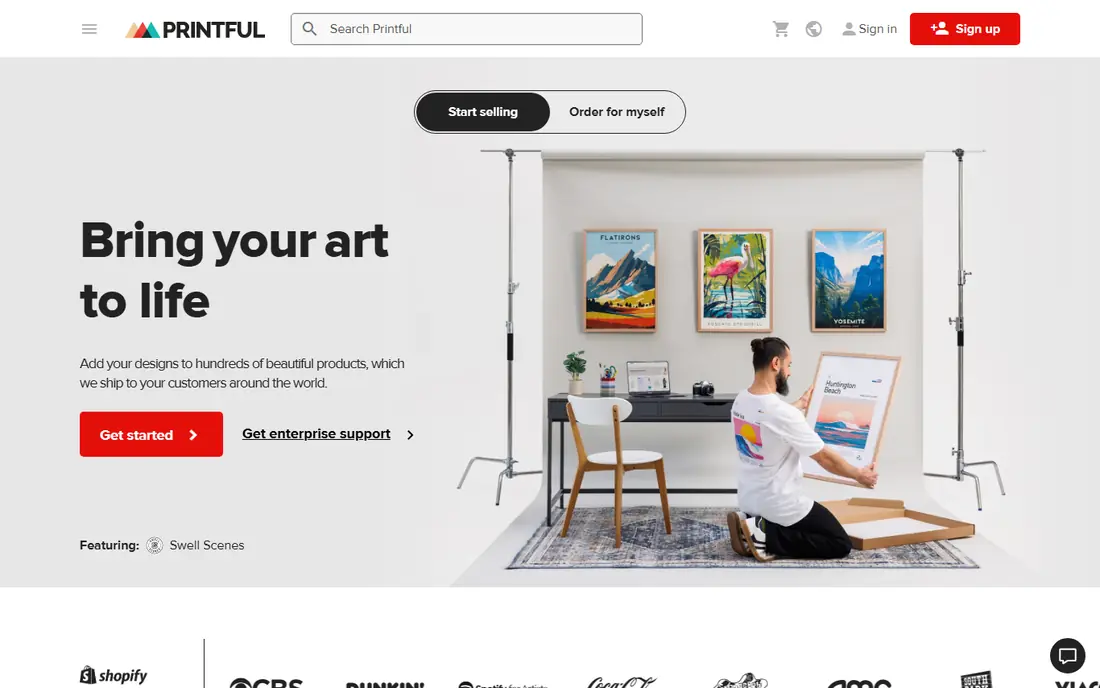
Printful is our pick for brands where quality and unboxing matter most. Because Printful owns many of its production facilities, quality is more consistent than on a network model where many providers print the same design. Custom labels, packing inserts, and branded packaging help a brand feel like a real store, not a generic print shop.
The trade is base cost. Printful products often cost a dollar or two more per unit than the cheapest network options, which squeezes margins on low priced items. A Growth plan can cut base costs, and it is free once annual sales pass a published threshold in some cases, so check current terms. If brand presentation beats raw margin for your store, Printful is the strongest pick.
- Own production facilities for consistent quality
- Strong white label branding, including labels and inserts
- Wide store integrations
- Base costs are often higher than network competitors
- Paid Growth plan needed for larger discounts
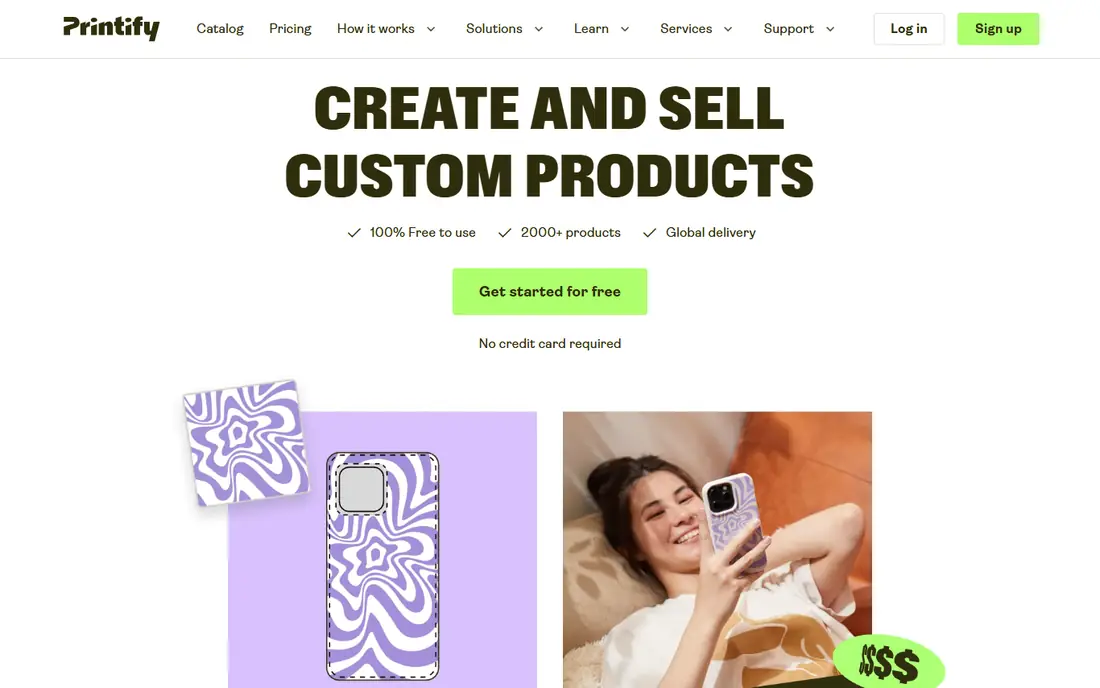
Printify is a network model, which means it connects you to many print providers rather than printing everything itself. That breadth gives you one of the largest catalogs in print on demand, from apparel to home goods, and it lets you choose a provider by price, location, and product. For sellers who want choice and low base cost, Printify is hard to beat.
Quality variation is the catch. Two providers can print the same design differently, so you need to order samples from the specific provider you plan to use, not just from Printify in general. Once you find a reliable provider, lock it in for your best sellers and retest if you switch providers for cost reasons.
- Very large catalog from many providers
- Competitive base costs
- Strong integrations with Shopify, Etsy, and other stores
- Quality can vary by provider, so samples matter
- Branding options vary by provider
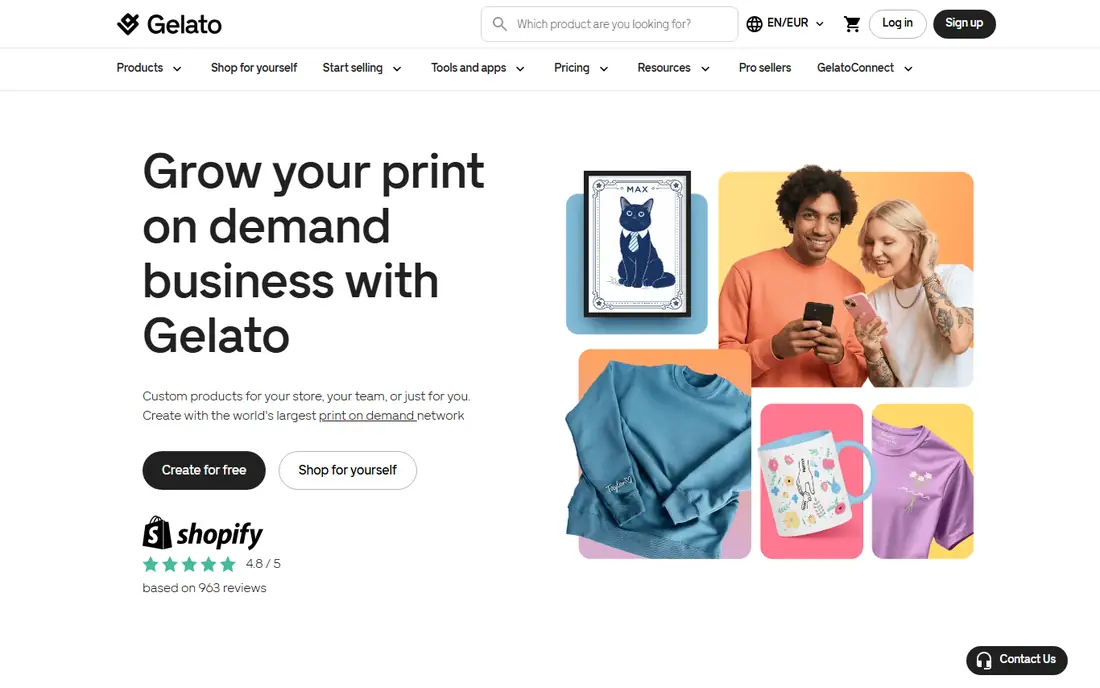
Gelato suits sellers whose customers live in many countries. Instead of shipping every order from one country, Gelato routes production to a local provider near the customer where possible. That can shorten delivery times, cut shipping costs, and reduce customs friction for international orders, which matters for a store with a global audience.
The catalog is more limited than Printify, and branding features like custom labels are stronger on paid plans. For a US only seller with a simple catalog, Printful or Printify may be simpler. For a seller with buyers in Europe, Asia, and North America, Gelato local production is a real advantage worth testing with sample orders to different countries.
- Local production in many countries can cut shipping time
- Global network for international sellers
- Branding options on paid plans
- Catalog is smaller than Printify
- Some branding features need a paid plan
Redbubble is a marketplace, not a fulfillment service for your own store. Artists upload designs, Redbubble prints them on products, and shoppers discover those products through Redbubble search and browsing. That discovery is valuable for an artist without an audience, since you do not need to drive all traffic yourself.
Control is the trade. You set a markup within marketplace rules, but you do not control the storefront, the packaging, or the customer relationship in the same way as on your own Shopify store. Use Redbubble to reach new buyers and to test which designs sell, and use Printful or Printify for your own branded store where control matters more.
- Marketplace brings traffic to artists
- No store setup needed
- Wide product range for artwork
- Less control over pricing and branding
- Margins are set by marketplace terms, not by you alone
Spring, formerly Teespring, is built for creators who sell merch to followers. You create products, share a storefront link, and Spring handles printing and shipping when fans order. That simplicity suits YouTubers, streamers, and social creators who want merch without building a full ecommerce site.
A creator who wants a fully branded store with custom checkout, upsells, and customer data will find Spring limited compared with Shopify plus Printful or Printify. For a creator whose main channel is social, Spring speed and simplicity often outweigh that control, especially for a first merch launch.
- Free storefront for creators
- Easy link in bio selling
- No upfront stock costs
- Less control than a full Shopify store
- Product range and branding are more limited
Spreadshop offers a free shop for creators and small brands, with products printed on demand when customers order. It integrates well with YouTube and social channels, which helps creators who already have an audience and want a merch shop without monthly platform fees. Setup is straightforward, and you can launch with a small set of designs.
Customization is more limited than a Shopify store with Printful, and shop design options are narrower. For a creator who wants a quick, free shop, Spreadshop works well. For a brand that needs full store control, analytics, and branding, a store plus a fulfillment platform will be a better long term home.
- Free shop setup
- Useful for YouTube and social creators
- No monthly fee to start in many cases
- Design and shop customization are more limited than a full store
- Margins depend on product and pricing choices
Gooten suits sellers who want more than apparel, especially home decor, wall art, and lifestyle products. Its catalog and provider network cover products that apparel focused platforms handle less well, and it charges no monthly fee to start in many cases, with base cost paid when a customer orders. That model suits a seller testing new product lines without a subscription.
As with any network platform, quality varies by product and provider, so order samples for your best sellers. Gooten is less famous for apparel than Printful or Printify, so compare apparel base costs and quality side by side if apparel is your main category. For home and lifestyle expansion, Gooten is a useful addition to a shortlist.
- Broad home and lifestyle catalog
- No monthly fees to start in many cases
- Useful for scaling sellers
- Less well known for apparel than Printful or Printify
- Sample and provider testing still needed
CustomCat focuses on fast US apparel fulfillment, with a catalog that suits sellers who sell mainly t-shirts, hoodies, and related apparel. Production speed in the US can shorten delivery times for US customers, and base costs are competitive for apparel, especially on paid plans. That focus makes it a strong pick for an apparel heavy store.
Sellers who want a broad home, accessory, and apparel catalog will find Printify broader. CustomCat is best as a specialist for apparel, either as a primary platform for an apparel brand or as a second platform for fast US apparel orders alongside a broader catalog elsewhere.
- Fast US production for apparel
- Competitive base costs for many apparel items
- Useful for high volume apparel sellers
- Catalog is more apparel focused than Printify
- Paid plan needed for some discounts and features
How we picked these
We compared official pricing pages, catalog breadth, production models, store integrations, and the seller type each platform serves best. We favored platforms that are free to start, that are actively maintained, and that cover distinct models, from branded fulfillment to network catalogs, marketplaces, and creator storefronts. We left out platforms that require large upfront fees or that do not ship to US customers, since they do not fit most readers in this guide.
How to choose a print on demand platform without losing margin
Start with your product and your customer location, not with a platform logo. If you sell apparel to US customers, compare Printful, Printify, and CustomCat on base cost and sample quality for your exact products. If you sell worldwide, add Gelato and test delivery times to your top three countries. If you sell art, test Redbubble for discovery alongside your own store.
Next, order samples and price your products backwards. Order a sample of each best seller from each shortlisted platform, check print quality, fabric, packaging, and delivery time, then set a retail price that leaves a margin after base cost, shipping, platform fees, and payment processing. A platform that looks cheap on base cost but charges high shipping can still lose to a slightly higher base cost with lower shipping.
For a branded store
Use Printful for consistent quality and branding, or Printify with a tested provider for lower base cost. Build your store on Shopify, Etsy, or WooCommerce, and keep customer service in house so you control refunds and replacements.
For a creator shop
Use Spring or Spreadshop for a quick free shop, and Redbubble for marketplace discovery. Keep designs simple at launch, test which ones sell, and expand the winners to your own store later if you want more control.
For global selling
Use Gelato for local production, and test delivery to each major market. Check customs, returns handling, and how refunds are processed for international orders before you scale advertising to those countries.
Frequently asked questions
What is the best print on demand platform?
Printful is the best pick for branded quality, Printify is the best pick for catalog breadth and low base cost, and Gelato is the best pick for global local production. The best platform depends on whether you prioritize quality, cost, catalog, or international shipping.
What is the best print on demand software for ecommerce?
For an ecommerce store on Shopify or Etsy, Printful and Printify are the strongest software choices, thanks to store integrations, product sync, and order automation. Gelato also integrates with major stores and adds global production. Choose based on sample quality and base cost for your exact products.
What is the best ecommerce platform for print on demand?
Shopify is the most common ecommerce platform for print on demand, thanks to integrations with Printful, Printify, Gelato, and other fulfillment services. Etsy also works well for print on demand, especially for art and niche designs, while WooCommerce suits sellers who want full control over their site.
What is the best print on demand app for Shopify?
Printful and Printify both offer strong Shopify apps, with product creation, sync, and automatic order forwarding. Printful leads on branding and consistency, while Printify leads on catalog breadth and provider choice. Test both with samples before you commit your store to one app.
What are the best print on demand services for beginners?
Printful, Printify, and Spring are good beginner services, since they are free to start and offer simple product creation. Start with a small set of designs, order samples, and learn pricing and shipping before you expand to many products or many platforms.
What are the best print on demand companies for artists?
Redbubble suits artists who want marketplace discovery without building a store, while Printful and Gelato suit artists who want their own branded store with higher control. Many artists use both, with Redbubble for discovery and a branded store for repeat buyers.
How much money can I make with print on demand?
Earnings depend on retail price minus base cost, shipping, platform fees, and payment processing, plus how much traffic you can drive to products. Margins are often modest per item, so volume, repeat buyers, and strong designs matter more than a single high priced product. Order samples and model margins before you set prices.
Sources we checked (8)

Online Jobs is an independent blog about careers, online work, learning new skills and the tools that help people earn. More about us.
Keep reading
All posts
n8n Alternatives
n8n alternatives compared for 2026, with Zapier, Make, Activepieces, and more, covering visual builders, code steps, self-hosting, and pricing models.

ZoomInfo Alternatives
The best ZoomInfo alternatives in 2026, compared on price, free plans, data coverage, and which tool fits small teams or large sales teams best in detail.

Zoom Alternatives for Webinars
Compare Zoom alternatives for webinars in 2026, from browser-based rooms to enterprise events, with prices, attendee limits, features and honest trade-offs.