Best Predictive Analytics Software in 2026: 8 Tools Compared


Business teams needing models without data scientists · Starting price: See website
How we put this together: we compare official feature and pricing pages, app store listings, privacy policies and public user reviews. Prices change, so check the provider's site before you pay.
Key takeaways
- DataRobot and H2O.ai are the strongest AutoML picks for teams that want models without a large data science team.
- KNIME is the best free starting point, with a visual workflow that covers data prep and modeling at no license cost.
- Dataiku suits organizations where data scientists, analysts, and business users work on the same platform.
- Most enterprise predictive tools are quote-based, so budget for implementation and skilled staff, not just a license fee.
Quick comparison
| Name | Who it suits | Starting price | Free option | |
|---|---|---|---|---|
| DataRobot | Business teams needing models without data scientists | See website | Free trial | Visit |
 H2O.ai | Technical teams wanting open-source-rooted AutoML | See website | Yes | Visit |
 Dataiku | Collaborative data science across roles | See website | Free trial | Visit |
 Alteryx | Analysts needing data prep plus predictive workflows | See website | Free trial | Visit |
 KNIME | Teams wanting serious analytics for free | Free | Yes | Visit |
 SAS Viya | Regulated industries needing governed modeling | See website | No | Visit |
 IBM SPSS Statistics | Researchers doing classical statistical modeling | See website | Free trial | Visit |
 Microsoft Azure Machine Learning | Cloud teams building models on Azure | See website | Yes | Visit |
The best predictive analytics software
Predictive analytics turns historical data into forecasts, such as churn risk, demand, lead scores, and fraud risk. The tools below fall into three groups, AutoML platforms that build models automatically, data prep and workflow tools that feed modeling, and governed enterprise platforms for regulated work. We compared official product pages, pricing terms, and deployment options to sort them by team skill and governance needs.
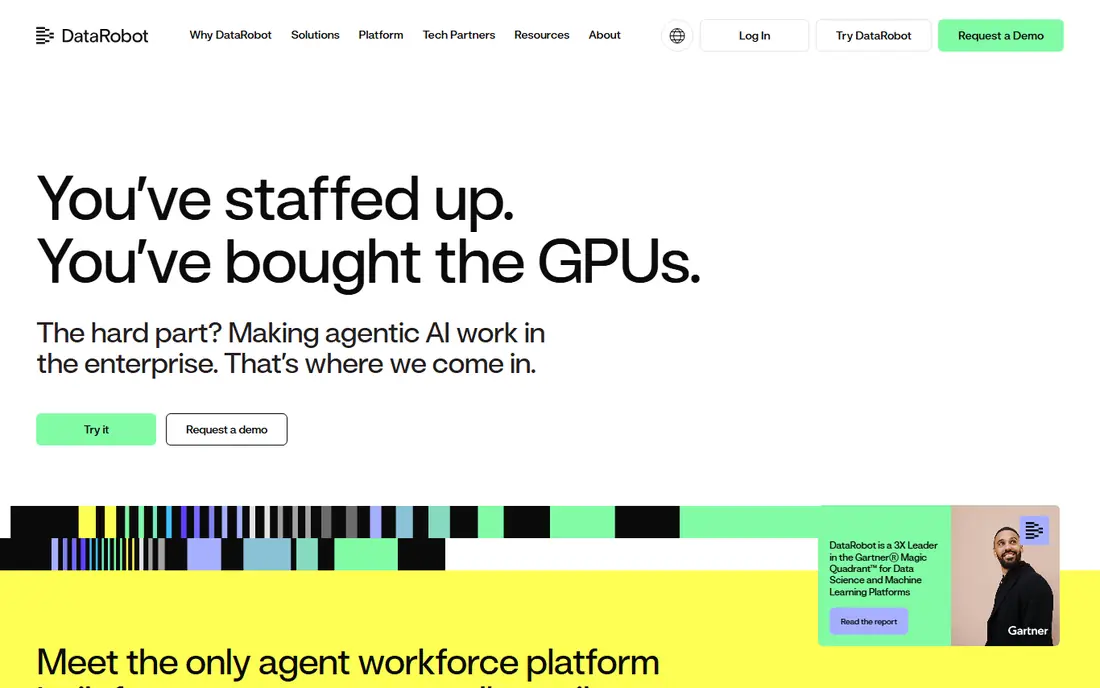
DataRobot is the classic AutoML choice for a business team that has data but not a large data science staff. It tests many candidate models, ranks them, explains feature impact, and deploys the winner with monitoring for drift and performance. That full path, from experiment to production, is why many mid-market and enterprise teams pick it for churn, demand, and risk predictions.
The catch is price and transparency. DataRobot publishes no paid price, and a 30-day trial is advertised for testing, so a team must get a quote to budget accurately. Automation also means a team still needs a clear target variable, clean data, and a way to validate predictions before acting on them. For a team that wants models fast with governance built in, DataRobot is a leading pick.
- End-to-end AutoML with deployment and drift monitoring
- Model explanations and governance tools
- Works for business and technical users
- No published paid price, so budgeting needs a sales quote
- Automation can hide how a model reaches a prediction
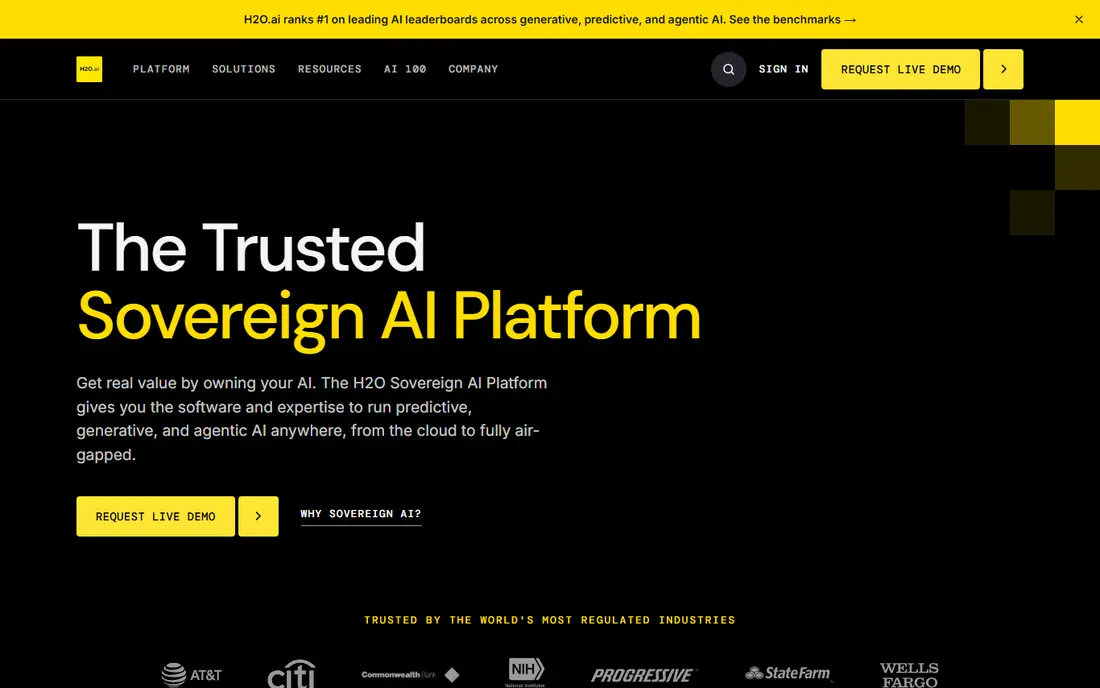
H2O.ai appeals to technical teams because its core tools are open source and powerful. H2O-3 and its AutoML functions let a data scientist train, compare, and explain models without a license fee, while Driverless AI adds automatic feature engineering and enterprise deployment for teams that need it. That open-source root also means models and code stay portable in ways a closed platform cannot match.
The trade-off is skill. H2O.ai rewards teams that can set up, tune, and deploy models themselves, and enterprise pricing for Driverless AI and generative products is quote-based. A team with data science talent will get more from H2O.ai per dollar than from a closed AutoML tool, while a business-only team may prefer DataRobot guided workflow.
- Open-source H2O-3 and AutoML tools are free
- Driverless AI adds automatic feature engineering
- Model interpretability tools included
- Enterprise products are quote-based
- Setup and tuning reward technical skill
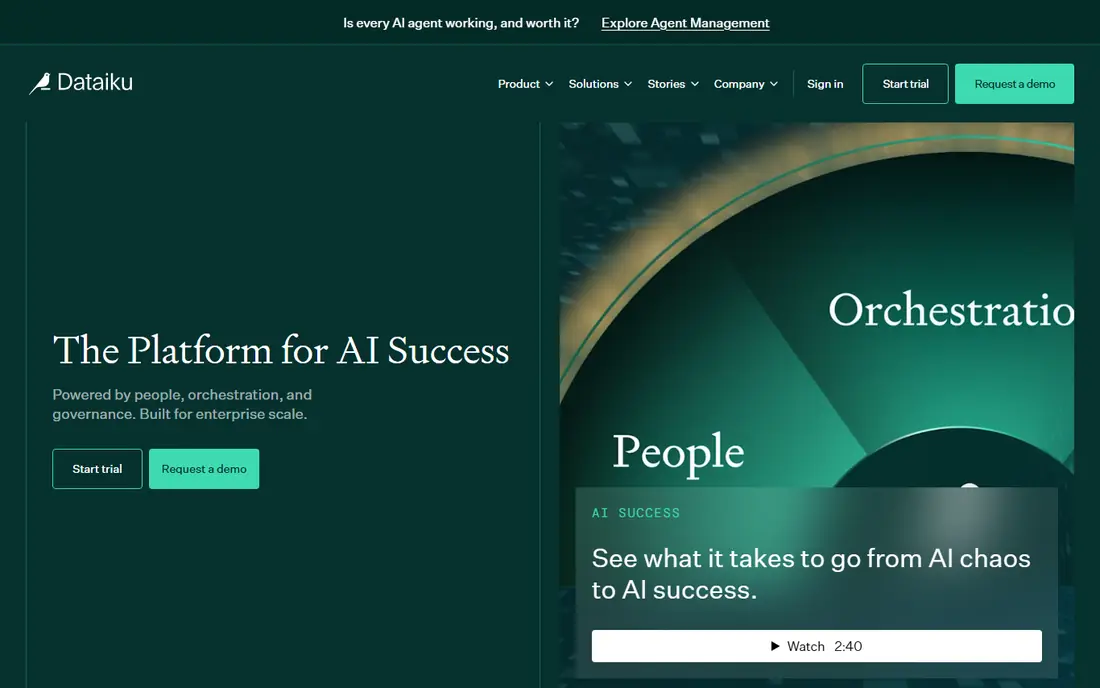
Dataiku suits organizations where predictive work is a team effort, not a solo data scientist project. Analysts can build visual flows, data scientists can add code and models, and business users can view and use predictions in the same governed workspace. That shared platform reduces handoffs and makes it easier to trace a prediction back to its data and model version.
The downside is cost and complexity. Pricing is quote-based, and the platform covers so much ground that a small team may find it heavy for a single churn model. Dataiku fits best when several teams, several data sources, and several production models all need one governed home.
- One platform for data scientists, analysts, and business users
- Visual and code workflows together
- Strong governance and deployment
- Quote-based pricing
- Platform breadth means a longer learning curve than a single-purpose AutoML tool
Alteryx owns the layer that every predictive project needs first, data preparation. Analysts can blend, clean, and transform data in visual workflows, then add predictive models and forecasting without writing full code. That prep strength is why many teams use Alteryx even when models are built elsewhere, since clean, repeatable data work decides model quality.
The catch is price and focus. Alteryx is a premium analyst tool, and its desktop roots mean cloud deployment and collaboration work differently than in a cloud-native platform. For an analyst-led team that spends most of its time preparing data, Alteryx is worth the cost, while a code-first data science team may prefer KNIME or H2O.ai.
- Excellent data preparation and repeatable workflows
- Predictive tools without heavy coding
- Strong for analysts
- Among the pricier analyst tools, with Designer listed around $5,000 per year in third-party listings
- Desktop heritage
KNIME is the best free entry point to predictive analytics, and it is far more than a toy. Its visual workflow editor covers data prep, modeling, machine learning, and reporting, with extensions for text, images, and cloud services. A student, analyst, or small team can build a real churn or forecasting model at no license cost, then share the workflow with others.
The limits are learning curve and enterprise features. The interface rewards patience, and the free platform does not include the enterprise server, scheduling, and collaboration features that larger teams need, which are paid. For a team on a zero budget, or a team testing whether predictive work pays off before buying, KNIME is the clear starting point.
- Free open-source analytics platform
- Visual workflows for prep, modeling, and deployment
- Large extension library
- Interface and setup take learning time
- Enterprise server and support cost extra
SAS Viya is the pick for regulated industries where a model must be explainable, validated, and auditable, not just accurate. Banks, insurers, and pharma teams use SAS because regulators already accept its output and governance, with lineage, validation, and documentation treated as core features. Its cloud-native design also suits enterprises moving SAS work off older desktop setups.
The trade-off is cost and skill. Pricing is quote-only, and Viya rewards statisticians and data scientists who understand modeling deeply, rather than business users who want a one-click forecast. For a regulated team, that governance is worth the price, while a small business with a simple forecast should start with KNIME or an AutoML tool.
- Deep statistical modeling with governed, auditable workflows
- Regulator-accepted output in banking, insurance, and pharma
- Cloud-native platform
- Quote-only pricing
- Needs skilled staff to use well
- Heavier than AutoML tools for simple models
IBM SPSS Statistics
Who it suits: Researchers doing classical statistical modeling
IBM SPSS Statistics remains a standard in academic and social research, where menu-driven regression, clustering, and time-series forecasting matter more than cloud scale. A researcher can run a predictive model, check assumptions, and produce output that survives peer review, without writing code. That familiarity is a real advantage in universities, hospitals, and government research teams.
The limits are scale and modern data work. SPSS is less suited to large streaming datasets, real-time scoring, or modern machine learning pipelines than DataRobot or Azure Machine Learning. Third-party listings put pricing from about $99 per user per month, but IBM licensing varies, so check the current IBM page. For classical statistical prediction, SPSS is still a solid and trusted choice.
- Menu-driven classical statistics without coding
- Academic and research standard
- Regression, clustering, and time-series tools
- Dated interface
- Less suited to large-scale or streaming data
- Paid pricing varies by license
Microsoft Azure Machine Learning
Who it suits: Cloud teams building models on Azure
Azure Machine Learning suits teams already committed to Microsoft and Azure, since it covers the full model lifecycle in one cloud service. Teams can use AutoML for a fast baseline, then move to code-first notebooks, pipelines, and managed endpoints for production scoring. Integration with Azure data, security, and monitoring tools is a strong advantage for enterprise IT teams.
The catch is billing and complexity. Pay-as-you-go pricing varies by compute, storage, and endpoints used, so a team should estimate training and scoring usage before budgeting. Azure expertise also helps, since the service has many options. For a Microsoft-centered organization that wants predictive models in production, Azure Machine Learning is a natural and scalable pick.
- Full ML lifecycle on Azure, from data prep to deployment
- AutoML plus code-first options
- Scales with Azure services
- Pay-as-you-go pricing is hard to predict without usage estimates
- Azure expertise helps a lot
How we picked these
We compared official product pages and pricing terms for predictive tools that are available today and that cover modeling, not just dashboards or reporting. We favored products that span different team types, from free analyst tools to governed enterprise platforms, and we used See website where pricing is quote-based or pay-as-you-go. We excluded pure business intelligence tools whose predictive features are limited to simple trend lines.
What to check before you buy predictive software
Start with the prediction you actually need, not the tool. Define the target, such as churn in the next 90 days, the data available to predict it, and how the prediction will be used, since those answers decide whether you need AutoML, classical statistics, or a governed enterprise platform. Next, check data quality, because no tool fixes missing, biased, or stale data, and a model trained on bad data will produce confident but wrong forecasts.
Validate before you act on predictions
Hold out recent data to test a model, check predictions by segment, and monitor drift after deployment. A model that worked last quarter can fail when customer behavior, prices, or products change, so plan for retraining and human review of high-stakes decisions. For regulated or financial predictions, add a disclaimer and a review step before any automated action.
Frequently asked questions
What is the best predictive analytics software?
DataRobot and H2O.ai lead for AutoML, KNIME leads for free analytics, and SAS Viya leads for regulated industries. The best pick depends on team skill, governance needs, and budget, not on a single ranking.
What are the best predictive analytics tools for small businesses?
KNIME is the best free starting point, while H2O.ai open-source tools and Azure Machine Learning free tiers suit small technical teams. Small businesses should start with one clear prediction, such as churn, before buying an enterprise platform.
What is the best tool for predictive analytics without data scientists?
DataRobot is the strongest AutoML pick for business teams, since it builds, explains, and deploys models with guided workflows. A business team still needs clean data and a clear target, and should validate predictions before acting on them.
How much does predictive analytics software cost?
Prices range from free for KNIME and open-source H2O tools to quote-based enterprise pricing for DataRobot, Dataiku, and SAS Viya. Implementation, skilled staff, and cloud compute often cost more than the license itself, so budget for all three.
Can predictive analytics software guarantee accurate forecasts?
No, predictions are estimates based on historical patterns, and accuracy drops when behavior, markets, or products change. Use holdout testing, segment checks, and drift monitoring, and keep human review for high-stakes decisions.
Sources we checked (8)

Online Jobs is an independent blog about careers, online work, learning new skills and the tools that help people earn. More about us.
Keep reading
All posts
n8n Alternatives
n8n alternatives compared for 2026, with Zapier, Make, Activepieces, and more, covering visual builders, code steps, self-hosting, and pricing models.

ZoomInfo Alternatives
The best ZoomInfo alternatives in 2026, compared on price, free plans, data coverage, and which tool fits small teams or large sales teams best in detail.
Workday Alternatives
We compared the best workday alternatives for HR, payroll, and global hiring, from BambooHR and Gusto to Rippling, Deel, and HiBob for growing teams in 2026.