Best Platforms to Sell Digital Products in 2026: 9 Compared

How we put this together: we compare official feature and pricing pages, app store listings, privacy policies and public user reviews. Prices change, so check the provider's site before you pay.
Key takeaways
- Gumroad and Payhip are the fastest ways to start, with no monthly fee and a simple link checkout.
- Etsy suits printables and planners that benefit from built-in search traffic, though fees add up per sale.
- Shopify suits sellers who want a full branded store and plan to scale a larger catalog.
- Podia and Teachable suit courses and memberships, with student management built in.
- Lemon Squeezy suits software sellers who want sales tax handled as merchant of record.
Quick comparison
| Name | Who it suits | Starting price | Free option | |
|---|---|---|---|---|
 Gumroad | Simple first sales with no monthly fee | Free | Yes | Visit |
 Payhip | Low-fee direct store with a free plan | Free | Yes | Visit |
 Etsy | Printables and planners with search traffic | Free | Yes | Visit |
 Shopify | Full branded store at scale | $39 per month | Free trial | Visit |
 Podia | Courses, memberships, and downloads in one place | See website | Free trial | Visit |
 Lemon Squeezy | Software sales with tax handled | Free | Yes | Visit |
 Ko-fi | Tips, small shops, and existing fans | Free | Yes | Visit |
 Sellfy | Store plus print on demand | See website | Free trial | Visit |
 Teachable | Structured online courses with student tools | See website | Free trial | Visit |
The best platforms to sell digital products
Selling a digital product is mostly about three choices: where buyers find you, what you pay per sale, and who handles tax and delivery. A marketplace gives you traffic but takes a larger cut and controls the customer relationship. A direct store gives you control and your buyer list, but you must bring your own traffic. The nine platforms below cover both paths.
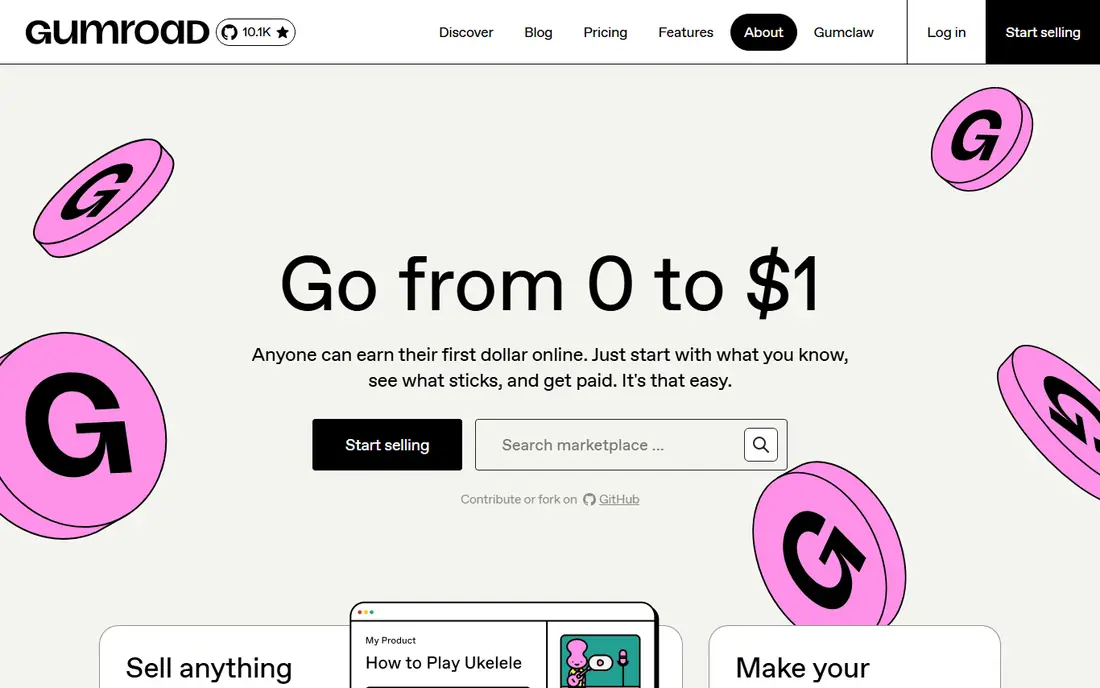
Gumroad is the fastest route from a finished file to a first sale. You upload a product, set a price, and share a link. There is no store to design and no plan to choose, which helps creators who want to test whether a product sells before building a full shop.
The trade is the per-sale fee. Published comparisons list Gumroad at 10 percent plus 50 cents per direct sale, with payment processing on top in some cases, and a higher share on Discover sales. That is easy to accept for early sales, but it becomes expensive at scale. Gumroad also acts as merchant of record, which simplifies tax handling for many sellers.
If you are testing an idea, start here. If sales grow steadily, compare Payhip, Lemon Squeezy, or Shopify to see whether a lower per-sale cost or a monthly plan saves money.
- Very fast setup from upload to link
- Handles tax as merchant of record
- No monthly fee to start
- Per-sale fee is high once volume grows
- Storefront branding is basic
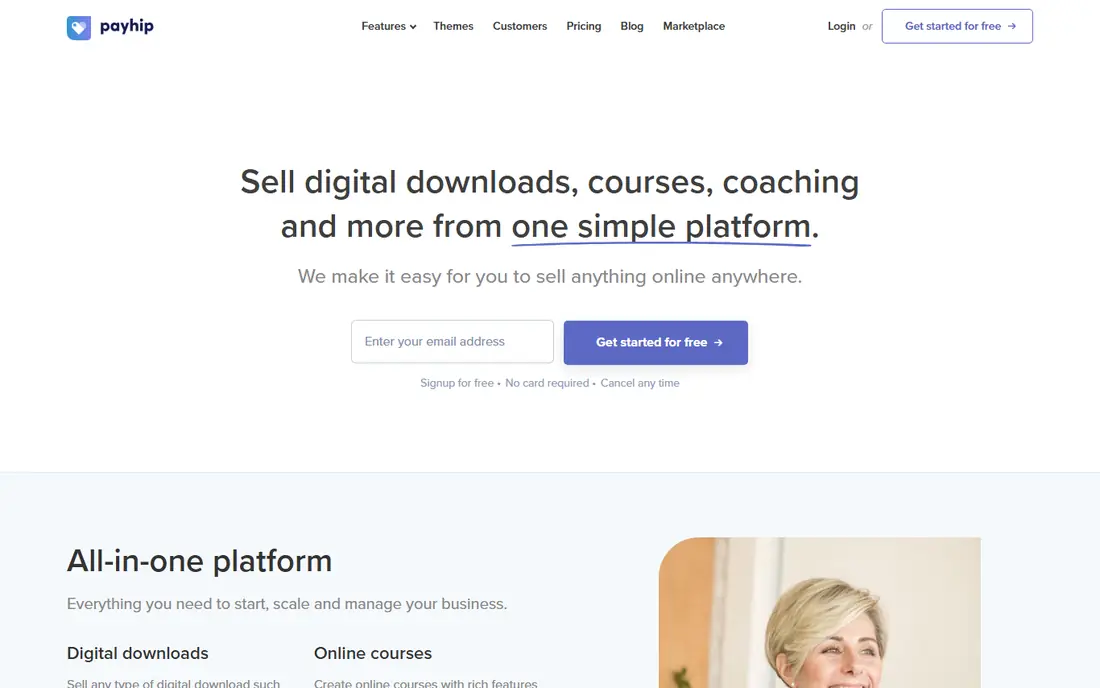
Payhip is a strong middle ground between Gumroad and a full store. The free plan lets you sell downloads, courses, and memberships with a 5 percent platform fee, and paid plans reduce that fee further. You get a storefront, checkout, and delivery without a monthly bill at the start.
For sellers who already have an audience on social media, email, or a blog, Payhip keeps more of each sale than Gumroad. It also handles EU and UK VAT collection in many cases, which removes a common headache for digital sellers.
The main limit is discovery. Buyers will not find you through Payhip search in the way they find products on Etsy. You need your own traffic, but in return you keep your customer list and a larger share of revenue.
- Free plan with a 5 percent platform fee
- Paid plans lower the fee
- VAT handling for EU and UK sales
- No built-in marketplace traffic
- Design options are simpler than Shopify

Etsy is the best choice when you need buyers you do not already have. People search Etsy every day for planners, templates, printable art, and party downloads. A well-titled listing can bring steady sales without paid ads, which is hard to match on a standalone store.
Fees are the catch. Published fee summaries list a 20 cent listing fee plus a 6.5 percent transaction fee, with payment processing on top. Those costs are manageable for higher-priced bundles, but they eat into low-priced single printables. Etsy also sets shop rules and can change search ranking, so sellers should not rely on one channel alone.
Use Etsy to find buyers and prove a product, then build an email list and a direct store for repeat sales. That pairing gives you traffic now and control later.
- Large built-in buyer search
- Trusted checkout
- Easy shop setup for digital downloads
- Listing fee plus transaction fee plus processing on each sale
- Competition is intense in popular niches
Shopify suits sellers who want a real store, not just a link. You control the design, domain, product pages, and checkout, and you can add apps for digital delivery, bundles, subscriptions, and email. That control matters for brands with a growing catalog or a clear visual identity.
The monthly plan starts at 39 dollars in published comparisons, with payment processing on top. That cost makes sense once sales are regular, but it is a poor fit for a first product that has not sold yet. Digital delivery also needs the free Digital Downloads app or a paid alternative, so setup takes a little longer than Gumroad.
Choose Shopify when you have proven demand and want to own the customer experience. Start with Gumroad or Payhip if you are still testing.
- Full control over branding, pages, and apps
- Strong checkout and discount tools
- Scales to large catalogs
- Monthly cost before sales
- Digital delivery needs an app
- No built-in marketplace traffic
Podia is built for creators who sell learning products. You can host a course, run a membership, sell a download, and send email from the same account. That all-in-one setup saves the time spent stitching together a course plugin, a checkout, and an email tool.
Students get a clean learning area, and creators get a storefront without code. For coaches, teachers, and course creators, that simplicity is worth a monthly plan once sales start. Lower plans carry a transaction fee in published comparisons, while higher plans remove it, so check the current plan page before you commit.
Podia will not bring buyers on its own. It works best for creators who already have an audience and want a tidy home for courses and memberships.
- Courses, memberships, email, and downloads in one dashboard
- No separate course plugin needed
- Clean student experience
- Transaction fees on lower plans
- Less marketplace traffic than Etsy
- Monthly cost for full features
Lemon Squeezy is a strong pick for software, plugins, templates for developers, and SaaS-style products. It acts as merchant of record, which means it handles sales tax and VAT in many regions for you. For a solo developer selling worldwide, that alone can justify the platform fee.
Published fee summaries list 5 percent plus 50 cents per sale, with no monthly fee to start. Checkout is simple, license keys and file delivery are built in, and you can sell subscriptions as well as one-off products.
The limit is scope. Lemon Squeezy is a checkout and delivery tool, not a full course school or a marketplace. If you sell courses with lessons and student progress, Podia or Teachable will fit better. If you sell software, Lemon Squeezy is hard to beat for tax simplicity.
- Acts as merchant of record for global tax
- Simple checkout for software and SaaS
- No monthly fee to start
- Per-sale fee of 5 percent plus 50 cents
- Less suited to large course schools than Podia or Teachable
Ko-fi started as a tipping tool and now covers shops, memberships, and commissions. It suits creators with an existing audience who want a simple page where fans can tip, buy a download, or join a membership. Setup takes minutes, and the free tier is genuinely useful.
Published comparisons note that Ko-fi takes no fee on donations, with a 5 percent fee on free shop sales and no shop fee on the Gold plan. Payment processing still applies, as it does on most platforms. That structure keeps costs low for small sellers.
Ko-fi is not a full store or a course platform. Product pages are simple, and there is little built-in discovery. Use it to monetize fans you already reach, and move to a larger store if your catalog grows.
- No platform fee on donations
- Simple page and shop setup
- Gold plan removes shop fees
- Shop features are lighter than Shopify
- Discovery is limited
- Payment processing still applies
Sellfy suits sellers who mix digital products with print on demand. You can sell an ebook, a template, and a printed shirt from the same storefront, which helps creators who want one shop for everything. Paid plans carry no platform fee on sales, so processing is the main per-sale cost.
Marketing tools such as discounts, upsells, and email are built in, which reduces the need for extra apps. The storefront is easy to set up, and the design is clean enough for most small brands.
The catch is the monthly plan. There is a trial, but no free ongoing tier, so Sellfy fits sellers who are ready to pay for a store. If you are still testing, Gumroad, Payhip, or Ko-fi will cost less at the start.
- No platform fee on sales on paid plans
- Digital and print-on-demand products in one store
- Built-in marketing tools
- No free ongoing plan
- Monthly cost from the start
- Smaller app ecosystem than Shopify
Teachable is built for courses first. The builder supports structured lessons, quizzes, drip content, and student progress tracking, which makes it a better fit than a simple checkout when you teach a multi-week course. Students get a dedicated school area, and creators get sales pages and checkout in one place.
Published comparisons list a transaction fee on the starter plan, with no fee on higher plans. That makes the starter plan a fair test, but larger schools will want a higher plan to keep more revenue. Monthly pricing varies by billing period, so check the vendor page for the current plan.
If you sell one PDF or template, Teachable is more than you need. If you sell courses as your main product, its student tools justify the extra structure.
- Strong course builder with lessons, quizzes, and student progress
- Checkout and student management built in
- Good for larger schools
- Transaction fee on lower plans
- Monthly cost
- Less suited to simple single downloads than Gumroad
How we picked these
We compared official pricing pages, fee summaries from vendor sites, and public reviews for platforms that still operate in October 2026. We favored platforms with clear fee pages, secure checkout, file delivery, and a way to collect buyer emails. We left out platforms that had shut down, platforms with no official homepage, and platforms that only sold physical goods.
What to look for before you choose
Start with your product type. A single download needs a simple checkout, while a course needs lessons, progress, and student support. A marketplace needs traffic, while a direct store needs an audience you can reach yourself.
Add up the full cost, not just the headline fee. Platform fees, payment processing, listing fees, and monthly plans all count. A free plan with a 10 percent fee can cost more than a monthly plan with no fee once sales pass a certain volume, so run the math on your expected price and volume.
Check tax handling early. If you sell worldwide, a merchant-of-record platform can save hours of tax work. Finally, check whether you can export your buyer list. Owning that list protects your business if a marketplace changes its rules or ranking.
Frequently asked questions
What is the best platform to sell digital products for beginners?
Gumroad is the simplest start, because there is no monthly fee and you can sell from a link in an afternoon. Payhip is a close second, with a lower free-plan fee and a fuller storefront.
What is the best platform to sell digital downloads?
Payhip and Gumroad both suit downloads, with Payhip keeping more per sale on its free plan. Etsy suits downloads that benefit from search traffic, such as planners and printables.
Which platform is best for selling courses?
Podia suits creators who want courses, memberships, and email in one place, while Teachable suits larger schools that need quizzes, drip content, and detailed student progress.
What is the best platform for digital products with low fees?
Payhip, Lemon Squeezy, and Sellfy all keep per-sale costs lower than Gumroad at volume, though Sellfy needs a monthly plan. Compare your expected sales volume, since a monthly plan can beat a high per-sale fee once sales grow.
Does Etsy or Shopify suit digital products better?
Etsy suits sellers who need built-in traffic for printables and templates. Shopify suits sellers who want a branded store and already have traffic, since it gives full control but no marketplace discovery.
What is the best platform to sell digital products online without a monthly fee?
Gumroad, Payhip, Lemon Squeezy, Ko-fi, and Etsy all let you start without a monthly fee, though per-sale fees apply. Choose by product type: software suits Lemon Squeezy, downloads suit Payhip, and search-driven printables suit Etsy.
Sources we checked (9)

Online Jobs is an independent blog about careers, online work, learning new skills and the tools that help people earn. More about us.
Keep reading
All posts
n8n Alternatives
n8n alternatives compared for 2026, with Zapier, Make, Activepieces, and more, covering visual builders, code steps, self-hosting, and pricing models.

ZoomInfo Alternatives
The best ZoomInfo alternatives in 2026, compared on price, free plans, data coverage, and which tool fits small teams or large sales teams best in detail.
Workday Alternatives
We compared the best workday alternatives for HR, payroll, and global hiring, from BambooHR and Gusto to Rippling, Deel, and HiBob for growing teams in 2026.