Best Platforms for Freelance Hiring in 2026: 9 Platforms Compared

How we put this together: we compare official feature and pricing pages, app store listings, privacy policies and public user reviews. Prices change, so check the provider's site before you pay.
Key takeaways
- Upwork suits broad hiring across many skills, while Fiverr suits fixed-scope creative gigs you can buy quickly.
- Toptal, Arc.dev, and Braintrust suit senior hires where a bad hire is expensive, but they cost more and screen strictly.
- Fees matter on both sides: check the freelancer fee, the client fee, and any membership or payment costs before you compare rates.
- Open marketplaces give you choice and control, while vetted networks save screening time but narrow the pool.
- A short paid test task predicts fit better than ratings alone, especially for ongoing roles.
Quick comparison
| Name | Who it suits | Starting price | Free option | |
|---|---|---|---|---|
 Upwork | Broad hiring across categories | Free | Yes | Visit |
 Fiverr | Fixed-scope creative gigs | Free | Yes | Visit |
 Toptal | Vetted senior talent | See website | No | Visit |
 Freelancer.com | Competitive bidding and contests | Free | Yes | Visit |
 Guru | Long-term professional projects | Free | Yes | Visit |
 PeoplePerHour | UK and European freelancers | Free | Yes | Visit |
 Contra | Commission-free hiring for creatives | Free | Yes | Visit |
 Braintrust | Senior freelancers who keep full rate | See website | No | Visit |
 Arc.dev | Vetted senior developers | See website | No | Visit |
The best platforms for freelance hiring
Hiring freelancers is not one job. A logo, a developer for six months, and a writer for weekly posts need different platforms. The list below covers open marketplaces, vetted networks, and commission-free options, so you can match the platform to the hire, not only to the brand name.
Upwork is the default when you need talent in almost any category, from development and design to writing, marketing, and admin. You post a job, review proposals, and manage contracts, milestones, and payments in one system. Escrow protection and work tracking help for hourly and fixed-price work alike.
The honest catch is screening effort. A popular job can attract many proposals of uneven quality, so you need a clear brief, a short test, and a structured interview. Fees also need checking: freelancer fees are set per contract in a variable range, and clients pay a marketplace fee, so the total cost is higher than the freelancer rate alone.
- Largest broad talent pool across many categories
- Escrow and milestone protection
- Work tracking and contracts built in
- Quality varies widely and screening takes time
- Freelancer fees are variable per contract
- Client marketplace fees apply on top of rates
Fiverr flips the hiring model: freelancers package a service as a gig, and you buy it. That speed suits one-off creative work like a logo, a voiceover, a short video edit, or a social graphic. You can compare portfolios, prices, and delivery times before you commit, without writing a job post.
The trade-off is depth. Fiverr is weaker for ongoing roles, complex projects, and long-term collaboration, where a custom brief and a relationship matter more than a package. The 20 percent seller fee is also the highest among major marketplaces, and buyers pay a checkout service fee as well, so check the total price.
- Buy packaged gigs quickly without a proposal process
- Huge creative category range
- Clear packages, delivery times, and revisions
- Seller fee is 20 percent, which can push prices up
- Less suited to ongoing roles
- Package tiers can limit negotiation
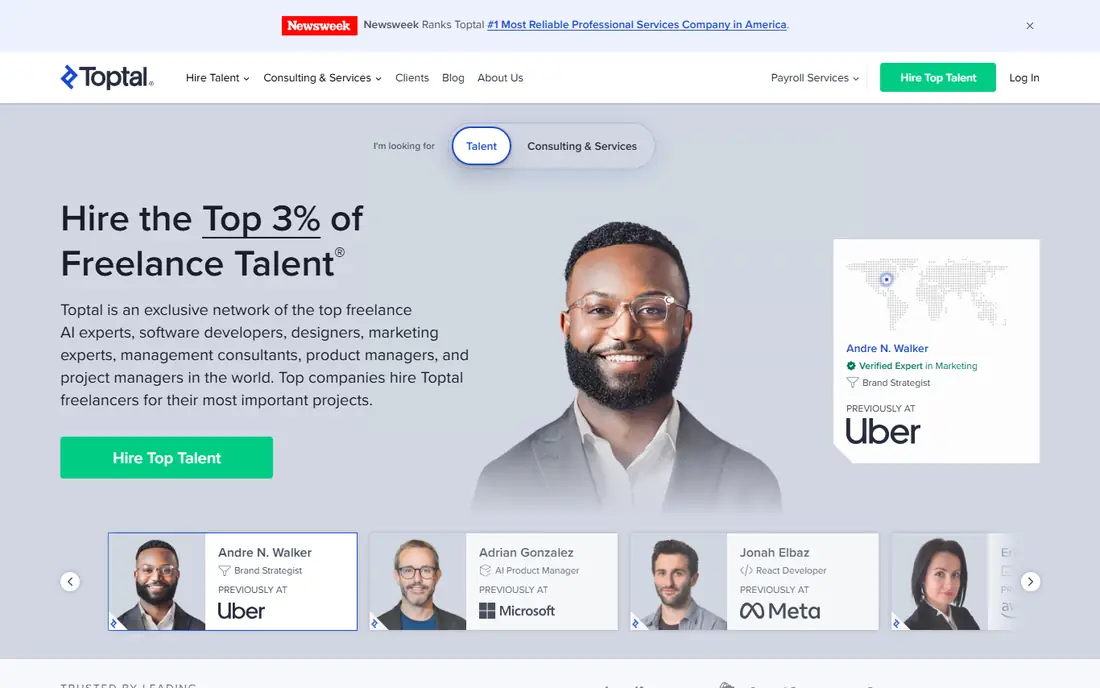
Toptal suits senior hires where a miss is expensive. Its screening process, often described as accepting fewer than 3 percent of applicants, tests communication, technical skill, and live project work. Clients are usually matched quickly, and a trial period reduces the risk of a poor fit.
The catch is cost and scope. Toptal rates reflect senior talent and the screening service, so small tasks and tight budgets will not fit. It is best for a developer, designer, or finance expert on a meaningful engagement, not for a $50 gig.
- Rigorous multi-stage screening
- Senior developers, designers, and finance experts
- Fast matching, often within a day, with a trial period
- Premium pricing, typically $60 or more per hour for developers
- Not suited to small one-off tasks
- Narrow pool by design
Freelancer.com suits budget-conscious hiring and design contests. Bidding creates price competition, and a contest lets you see several design directions before you pick a winner. For a clear, fixed-scope task with a tight budget, that model can work well.
The weakness is screening. Low bids do not always mean good work, and sorting through many proposals takes time. Use a detailed brief, a paid test for shortlisted candidates, and milestone payments to reduce risk on a first engagement.
- Very large global pool
- Bidding can lower prices
- Contests let you compare design work before choosing
- Quality varies and bid sorting takes time
- Freelancer fee is typically 10 percent
- Client fees and membership tiers add complexity
Guru suits ongoing professional work where a stable relationship matters. Its SafePay escrow, workrooms, and milestone tools support longer projects, and freelancer fees fall to 5 to 9 percent depending on membership. For a business that hires the same freelancer repeatedly, that fee structure can save money over time.
The trade-off is pool size and polish. Guru does not match Upwork for breadth, and its interface feels older than Contra or Toptal. If you need a niche skill quickly, a larger marketplace may give you more candidates to compare.
- Lower freelancer fees than Fiverr or Freelancer.com on paid memberships
- SafePay escrow
- Workrooms for managing longer projects
- Smaller pool than Upwork
- Fee depends on membership tier
- Interface feels dated compared with newer platforms
PeoplePerHour is a practical pick for UK and European buyers, and for writing, marketing, and design work. Its escrow system protects payments, and its talent base is strong in those categories. Time zone alignment also helps for ongoing collaboration.
The catch is fees. The freelancer fee starts at 20 percent for early work with a client and falls as lifetime billings grow, so early projects carry a higher platform cost. Buyers should also check current buyer fees, since they vary by payment method.
- Strong UK and European talent base, especially writing and marketing
- Escrow protection
- Flexible hourly and fixed-price work
- Freelancer fee is tiered from 20 percent down to 3.5 percent by lifetime billings with a client
- Smaller global pool than Upwork
Contra appeals to clients and freelancers who dislike high marketplace cuts. Freelancers keep 100 percent of earnings on the commission model, with platform fees per payment on the free plan or a Pro subscription instead. Portfolio-first profiles suit designers, developers, and web builders who sell on past work.
The limitation is scale. Contra's pool is growing but smaller than the major marketplaces, so niche or urgent hires may take longer. It is best for creative and tech hires where portfolio quality matters more than sheer candidate volume.
- No commission on freelancer earnings
- Portfolio-first profiles for designers and builders
- Modern, clean hiring flow
- Smaller pool than Upwork or Fiverr
- Free-plan platform fees apply per payment
- Less suited to large enterprise procurement
Braintrust suits companies that want vetted senior talent without cutting freelancer pay. Talent is screened, and clients pay a fee on top of the freelancer rate, so freelancers keep what they quote. That model can attract stronger senior candidates who avoid high-commission platforms.
The trade-off is speed and scope. Braintrust is not built for quick $50 tasks, and matching takes more time than browsing gigs. It fits longer, higher-value engagements where senior quality justifies the process.
- Vetted senior talent who keep their full rate
- Client fee model rather than freelancer cut
- Replacement or refund terms for direct hires
- Vetting and matching take longer than an open marketplace
- Less suited to small gigs
- Pricing is quote-led
Arc.dev suits startups and tech teams that need a senior developer fast, without sorting through open proposals. Its screening is strict, and published rate ranges help with budgeting before a call. Freelance and full-time options also suit teams that may convert a contractor later.
The limitation is niche. Arc.dev is for developers, so a team hiring across many skills will still need Upwork, Fiverr, or Contra for other roles. Use Arc.dev for the developer hire, and a broader platform for the rest of the team.
- Vetted senior developers with published rate ranges
- Freelance or full-time hiring
- Faster matching than open bidding
- Developer-only focus
- Rates reflect senior talent
- Less useful for design, writing, or marketing hires
How we picked these
We compared official pricing and fee pages, vetting descriptions, and public marketplace comparisons, and we favored platforms with a clear hiring job: broad, fixed-scope, vetted, or commission-free. We treated fees honestly on both sides, since a low freelancer rate can hide a client fee, and a low client fee can hide a high freelancer cut. Where a platform does not publish a starting price, we wrote "See website" rather than repeating a third-party estimate. We also weighed pool size, screening depth, payment protection, and ease of managing ongoing work.
How to hire well on any freelance platform
Write a brief that filters for you
Include the task, deliverables, tools, time zone expectations, and a success measure. A vague brief attracts vague proposals. A specific brief lets strong candidates show relevant work and lets weak candidates self-select out.
Use a short paid test task
Give shortlisted candidates a 30 to 60 minute task that mirrors real work, and pay for it. Ratings can be gamed, and portfolios can be polished, but a real task shows communication, quality, and turnaround. For ongoing roles, start with a one to two week paid trial.
Protect payment and ownership
Use escrow or milestone payments for new relationships, agree on file ownership and revision limits in writing, and keep communication on the platform until trust is established. Those steps matter more than platform choice alone.
Frequently asked questions
What are the best freelancing platforms for hiring?
Upwork is the best broad platform, Fiverr is best for fixed-scope gigs, Toptal is best for vetted senior talent, and Contra is best for commission-free creative hiring. The best freelancing platform for you depends on the skill, budget, and length of the engagement.
Which is the best freelancer platform for small businesses?
Small businesses often do best with Upwork for varied hires and Fiverr for quick creative tasks. Guru suits longer professional projects with lower fees, while PeoplePerHour suits UK and European hires. Start with one platform and learn its fee and screening flow before spreading across many.
What is the best freelance hiring platform for developers?
Toptal, Arc.dev, and Braintrust lead for senior developers, with Toptal for the strictest vetting, Arc.dev for published rate ranges, and Braintrust for a model where developers keep their full rate. Upwork also works for developers when you have time to screen and test candidates yourself.
What are the best freelance services platforms for design work?
Fiverr suits packaged design gigs, Contra suits portfolio-led designer hiring, and Toptal suits vetted senior designers. Freelancer.com contests suit logo and brand work where you want to compare several directions. Choose by whether you need speed, portfolio depth, or senior vetting.
Do the best platforms for freelance hiring charge clients a fee?
Yes, most do in some form. Upwork charges clients a marketplace fee, Fiverr charges buyers a checkout service fee, and Toptal, Braintrust, and Arc.dev build their fee into a quoted rate. Contra charges a per-payment platform fee on its free plan. Always calculate the total cost, not only the freelancer rate.
How do I avoid a bad hire on a freelance platform?
Use a specific brief, check past work that matches your task, run a short paid test, and start with milestones or a trial period. Keep communication clear on scope, deadlines, and revisions, and use escrow until trust is built. A careful first hire saves far more than a fast hire costs.
Sources we checked (9)

Online Jobs is an independent blog about careers, online work, learning new skills and the tools that help people earn. More about us.
Keep reading
All posts
Best White Label SEO Companies
We compare the best white label SEO companies and tools in 2026 for agencies, from fulfilment services to branded reporting platforms, margins and prices.

Best Webinar Software
We compared the best webinar software for 2026 on price, attendee limits, automation and ease of use, to help you host better live sessions with confidence.
Best Web Scraping Tools
Compare the best web scraping tools in 2026, from no-code Octoparse and Browse AI to Apify, Firecrawl, Bright Data, Zyte, ScraperAPI and free Scrapy, with prices.