Best Open Source MLOps Platforms in 2026: 8 Platforms Compared

How we put this together: we compare official feature and pricing pages, app store listings, privacy policies and public user reviews. Prices change, so check the provider's site before you pay.
Key takeaways
- MLflow is the most common starting point, thanks to experiment tracking and a model registry that most teams already know.
- Kubeflow suits teams already running Kubernetes, while Metaflow and ZenML suit Python-first teams that want less infrastructure work.
- DVC and Feast solve different problems from tracking: DVC versions data and models, while Feast keeps training and serving features consistent.
- No single open source tool covers the whole ML lifecycle well, so most teams combine two or three of these platforms.
- Open source saves licence fees, but you still pay in setup, hosting, and maintenance time, so plan for that honestly.
Quick comparison
| Name | Who it suits | Starting price | Free option | |
|---|---|---|---|---|
 MLflow | Experiment tracking and registry | Free | Yes | Visit |
 Kubeflow | Kubernetes-native pipelines | Free | Yes | Visit |
 Metaflow | Python-native workflows | Free | Yes | Visit |
 Flyte | Large-scale workflow orchestration | Free | Yes | Visit |
 ZenML | Portable ML pipelines | Free | Yes | Visit |
 DVC | Data and model versioning | Free | Yes | Visit |
 Apache Airflow | General workflow scheduling | Free | Yes | Visit |
 Feast | Feature store consistency | Free | Yes | Visit |
The best open source MLOps platforms
MLOps covers a wide job: tracking experiments, versioning data and models, running pipelines, serving models, and watching them in production. No open source project does all of that equally well, so the honest way to compare them is by lifecycle stage. We compared official documentation, release activity, and public reviews, and we chose projects with active maintenance and a clear role, rather than tools that promise everything and deliver little.
MLflow is the default first tool for most ML teams, and for good reason. Its tracking component logs parameters, metrics, and artefacts for each run, so you can compare experiments without digging through notebooks. Its model registry then gives approved models a version, a stage, and a clear promotion path from testing to production.
MLflow does not try to be a full pipeline platform, so teams usually pair it with an orchestrator like Airflow, Flyte, or Metaflow, and a serving tool for production. That modular approach is a strength if you like choosing each piece, and a weakness if you want one vendor to own the whole stack. For tracking and registry, though, MLflow remains the safest open source starting point.
- Simple experiment tracking and model registry
- Framework-neutral
- Large community and integrations
- Not a full pipeline orchestrator
- Production serving needs extra tooling
- Self-hosting needs care at scale
Kubeflow is the platform for teams that already run Kubernetes and want ML to live on the same infrastructure. It brings together pipelines, notebooks, training operators, and serving components under one Kubernetes-native umbrella, so a model can move from a notebook to a pipeline to a served endpoint without leaving the cluster.
That power comes with real operational cost. Installing, upgrading, and securing Kubeflow needs platform engineering skill, and a small team without Kubernetes experience will spend more time on the platform than on models. If your organisation already runs Kubernetes well, Kubeflow is a strong, coherent choice. If not, start with a lighter pipeline tool and revisit Kubeflow later.
- Full Kubernetes-native ML stack
- Pipelines, notebooks, and serving components
- Portable across clouds
- Complex to install and operate
- Needs real Kubernetes skill
- Overkill for small teams
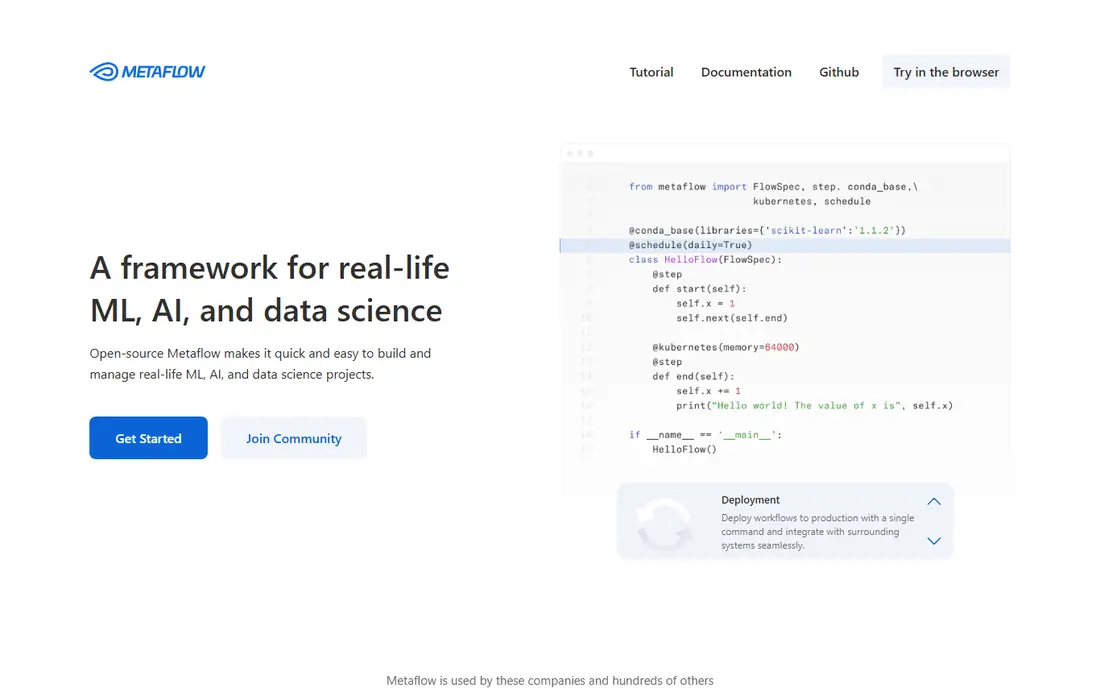
Metaflow, originally built at Netflix, is designed for data scientists who think in Python, not in YAML or infrastructure. You write a workflow as Python code, run it locally, and then scale the same code to the cloud, with built-in handling for data, dependencies, and versioning. That short path from prototype to production is its main appeal.
Metaflow is less flexible if your stack is not Python-first, and you still need cloud knowledge to run it well in production. For a Python team that wants pipelines without adopting a heavy platform, Metaflow is one of the most pleasant open source options. Pair it with MLflow for tracking if you want the best of both.
- Python-first workflow design
- Easy move from laptop to cloud
- Good for data scientists who code in Python
- Less suited to non-Python stacks
- Production setup still needs cloud skill
- Smaller ecosystem than Airflow
Flyte is built for large, complex ML workloads where reliability and repeatability matter more than a quick notebook run. Workflows are typed, tasks can be cached and reused, and execution scales on Kubernetes, which suits teams running many pipelines with many dependencies. Its design helps catch errors early, before a long training job fails halfway through.
The learning curve is steeper than Metaflow or ZenML, and a small team may find Flyte heavier than it needs. For a platform team supporting many data scientists, or for workloads where a failed pipeline is expensive, Flyte is a strong, well-engineered choice. For a first pipeline, start simpler and grow into Flyte if you need its scale.
- Strong workflow orchestration at scale
- Type-safe tasks and caching
- Kubernetes-native execution
- Steeper learning curve than Metaflow
- Setup needs platform effort
- Best for larger or more complex workloads
ZenML aims to stop pipeline lock-in. You write a pipeline once in Python, and ZenML lets you swap the underlying stack: a different orchestrator, a different tracking tool, or a different cloud, without rewriting the pipeline logic. That portability is valuable for teams that expect their infrastructure to change, or that run across more than one cloud.
ZenML is younger than MLflow and Airflow, so its ecosystem is smaller and some integrations are less mature. The core idea is sound, though, and for a team that wants clean, portable pipelines with a simple Python API, ZenML is worth a serious trial. Check its current integrations for your tracking and serving tools before you commit.
- Portable pipelines across clouds and tools
- Simple Python API
- Good stack abstraction for tracking and serving
- Younger ecosystem than MLflow or Airflow
- Some integrations depend on community work
- Production setup still needs planning
DVC solves a problem that experiment trackers do not: versioning the data and model files themselves. It brings Git-style versioning to large datasets and model artefacts, so you can check out the exact data version that produced a given model, and reproduce a pipeline step without guessing which file was used. For teams that care about reproducibility, that is essential.
DVC is not a replacement for MLflow, and it works best alongside a tracker. Large data also needs storage planning, whether that is cloud object storage or a shared drive, and the Git-based workflow takes a little learning for team members who have never used Git. If your models change when your data changes, and they always do, DVC belongs in your stack.
- Git-style versioning for data and models
- Works with existing Git workflows
- Reproducible pipelines for data
- Does not track experiments like MLflow
- Large data handling needs storage planning
- Learning curve for Git newcomers
Apache Airflow is the general-purpose scheduler that many ML teams already know. It schedules and monitors workflows as directed graphs, retries failed tasks, and integrates with a huge range of systems through operators. If your ML pipelines sit next to data pipelines, Airflow lets you run both on one scheduler, which simplifies operations.
Airflow is not ML-specific, so experiment tracking, model versioning, and feature handling still need other tools. Dynamic, data-driven ML workflows can also feel clumsy in Airflow compared with Flyte or Metaflow. For scheduled batch pipelines and for teams that already run Airflow for data work, it remains a solid, proven choice.
- Mature, widely known scheduler
- Huge operator and integration library
- Strong for scheduled pipelines
- Not ML-specific
- Dynamic ML workflows need extra code
- Operating Airflow at scale takes effort
Feast addresses a classic production bug: a model trained on one version of a feature, then served with a slightly different version, quietly performs worse. As a feature store, Feast gives training and serving the same feature definitions and values, so the model sees in production what it saw in training. That consistency matters most for real-time or frequently updated models.
Setting up Feast needs data engineering work, including feature definitions, offline and online stores, and data pipelines. For a simple batch model with a handful of stable features, it is more than you need. For a team serving many models, or a team that has already been bitten by training-serving skew, Feast is the open source feature store to evaluate first.
- Consistent features for training and serving
- Reduces training-serving skew
- Open feature store standard
- Needs data engineering effort to set up
- Overkill for simple models
- Online serving setup takes planning
How we picked these
We compared official documentation, release activity, and public reviews, and we required each project to be genuinely open source, actively maintained, and useful in production, not just in a demo. We also judged each tool by its stated role, because comparing a feature store with a scheduler as if they were rivals would mislead you. Where a project has a paid hosted version, we listed the open source project itself, and we noted where self-hosting effort is the real cost.
How to build an open source MLOps stack
Start with the problem that hurts most. If you cannot reproduce last month's best model, start with MLflow for tracking and DVC for data versioning. If pipelines keep failing or running out of order, start with an orchestrator: Metaflow or ZenML for a Python team, Flyte for scale, Airflow if you already run it for data.
Next, add only one piece at a time. Install it, run a real pipeline through it, and check that the team actually uses it for a month before adding the next tool. An MLOps stack with eight tools nobody fully understands is worse than a stack with three tools everyone trusts.
Finally, plan for operations from the start. Open source does not mean free to run: you need hosting, backups, upgrades, access control, and someone who owns the platform when it breaks. Budget that time honestly, or consider a managed version of the same tool where one exists. The best open source stack is the one your team can keep running, not the one with the longest feature list.
Frequently asked questions
What is the best open source MLOps platform for beginners?
MLflow is the best beginner pick, because experiment tracking and a model registry solve an immediate pain without a heavy platform install. Add DVC for data versioning next, then choose an orchestrator like Metaflow or ZenML when your pipelines need scheduling and repeatability.
Is Kubeflow better than MLflow?
They solve different problems, so a direct comparison misleads. MLflow tracks experiments and registers models, while Kubeflow provides a Kubernetes-native platform for pipelines, notebooks, and serving. Many Kubernetes teams use both, with MLflow for tracking inside Kubeflow pipelines.
Do I need a feature store like Feast?
You need a feature store when training and serving features start to drift apart, or when many models share the same features. For a single simple model with stable batch features, Feast is more setup than you need. For real-time serving or many production models, it prevents a costly class of bugs.
Can open source MLOps tools handle production models?
Yes, these tools run in production at many companies, but production needs more than the tool itself. You still need hosting, monitoring, access control, backups, and an upgrade plan. Teams that underestimate that operational work are the ones that struggle with open source MLOps.
What is the difference between ZenML and Metaflow?
Both offer Python-first pipelines, but ZenML focuses on portability across different orchestrators, trackers, and clouds, while Metaflow focuses on a smooth path from a laptop prototype to cloud execution. ZenML suits teams that expect to swap stack pieces, while Metaflow suits teams that want one coherent Python workflow tool.
Should I use Airflow for ML pipelines?
Airflow works well for scheduled ML pipelines, especially when data pipelines already run on Airflow. It is less suited to highly dynamic ML workflows or to experiment-heavy research, where Metaflow, Flyte, or ZenML may fit better. Many teams use Airflow for scheduling and MLflow for tracking together.
Sources we checked (8)

Online Jobs is an independent blog about careers, online work, learning new skills and the tools that help people earn. More about us.
Keep reading
All posts
ZoomInfo Alternatives
The best ZoomInfo alternatives in 2026, compared on price, free plans, data coverage, and which tool fits small teams or large sales teams best in detail.

Workday Alternatives
We compared the best workday alternatives for HR, payroll, and global hiring, from BambooHR and Gusto to Rippling, Deel, and HiBob for growing teams in 2026.

Which SaaS Tools Have the Best Customer Support
Which SaaS tools have the best customer support? Compare eight popular tools on help centres, live help, response options and overall support quality.