Best OKR Software in 2026: 8 Tools Compared


Small and growing teams wanting pure OKRs · Starting price: $6 per user per month
How we put this together: we compare official feature and pricing pages, app store listings, privacy policies and public user reviews. Prices change, so check the provider's site before you pay.
Key takeaways
- Dedicated OKR tools start at $6 per user per month, while OKRs inside HR platforms usually cost $8 to $11 per user per month and add reviews and engagement.
- Free options exist but are small: Perdoo is free up to 5 users and Weekdone is free for up to 3 users, while Tability offers free read-only seats instead.
- Watch the minimums. Lattice Goals and OKRs carries a $4,000 annual minimum, and Mooncamp has a 5-seat minimum, so small-team costs differ from headline prices.
- The check-in rhythm matters more than the feature list. Tools with weekly check-ins and auto-generated reports keep OKRs alive, while tools without them slide back into spreadsheets.
- If your team already runs projects in Asana, its Goals feature may beat buying a separate OKR tool, even at the higher Advanced price.
Quick comparison
| Name | Who it suits | Starting price | Free option | |
|---|---|---|---|---|
| Tability | Small and growing teams wanting pure OKRs | $6 per user per month | Free trial 14 days | Visit |
 Perdoo | Strategy maps for mid-size companies | Free (up to 5 users) | Yes | Visit |
 Mooncamp | Enterprises running strategy and OKRs together | 7 euros per user per month | Free trial | Visit |
 Weekdone | Weekly check-ins and simple OKR trees | Free (up to 3 users) | Yes | Visit |
 Lattice | HR teams combining goals with performance | $8 per seat per month | See website | Visit |
 Betterworks | Enterprises wanting goals plus performance | From $8 per user per month | See website | Visit |
 15Five | Mid-market teams wanting OKRs plus reviews | $11 per user per month | See website | Visit |
 Asana | Teams already managing work in Asana | $24.99 per user per month | Free trial | Visit |
The best OKR software in 2026
OKR stands for Objectives and Key Results, a goal-setting method where a team states an objective, then defines a few measurable key results that show whether it was met. The method is simple. Sticking to it is not. Spreadsheets go stale, check-ins get skipped, and quarterly goals are rediscovered at quarter end. OKR software exists to keep the rhythm going: one place for goals, regular check-ins, visible progress and reports that write themselves.
We compared official feature pages, pricing pages and pages quoting vendor pricing. Prices are current as of October 2026. Where a price or trial could not be verified, we wrote See website rather than guessing.
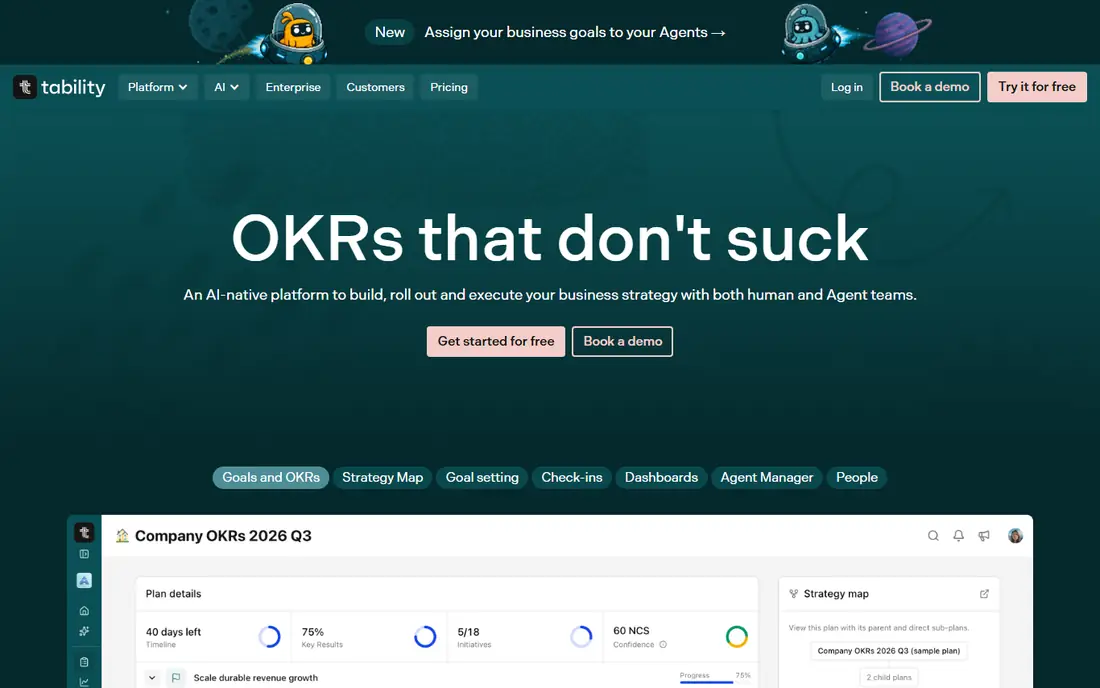
Tability is the simplest recommendation in this list for a team that wants OKRs and nothing else. It starts at $6 per user per month with no hidden fees, and free read-only seats let the whole company see the strategy without the whole company paying. The platform covers strategy maps, goal setting with AI suggestions, check-ins, progress charts and dashboards, plus integrations that pull progress from Jira, Linear and Salesforce so updates do not depend on manual entry.
The newer angle is agent support: goals can be assigned to human teammates, AI agents, or both, with agents checking in on their own progress. A 14-day trial needs no card. The honest limit is scope. If you also need reviews, feedback and engagement in the same tool, look at Lattice, Betterworks or 15Five instead.
- Cheapest dedicated OKR tool in this list
- Strategy maps, check-ins and dashboards
- Free read-only seats
- AI suggestions and integrations with Jira, Linear and Salesforce
- Pure OKR focus means no built-in performance reviews or engagement surveys
- Larger enterprises may need its higher tiers for advanced controls
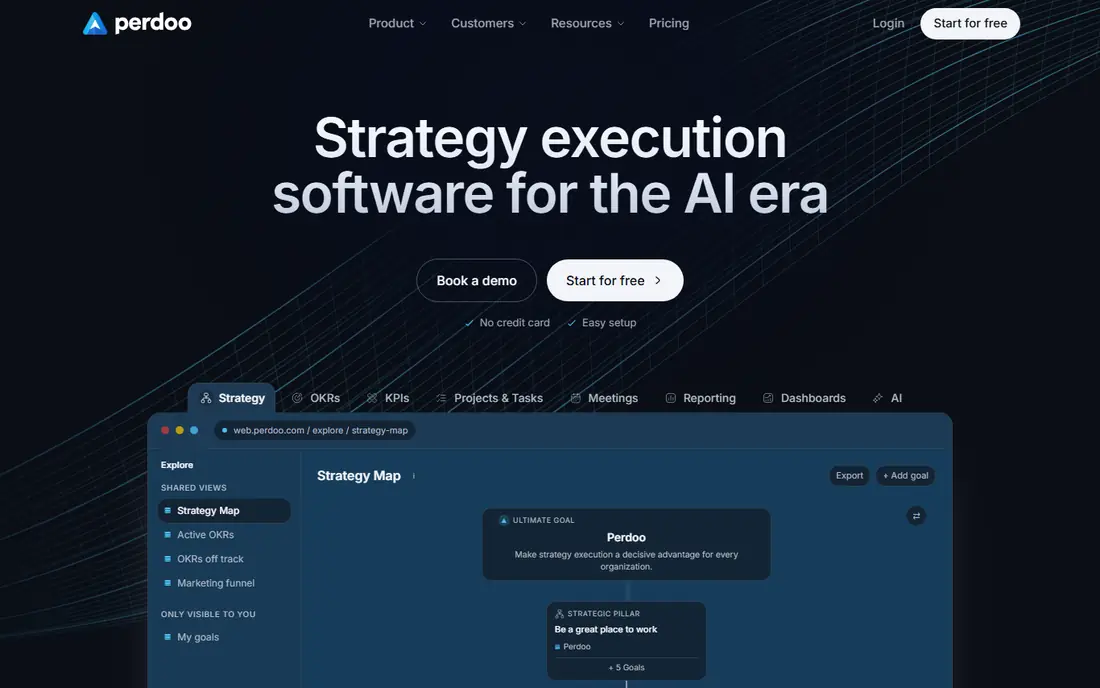
Perdoo frames OKRs as strategy execution, and its strategy map shows why. The map lays out the ultimate goal, strategic pillars, objectives, key results and KPIs in one view, so anyone can see how their work connects to company direction. Progress is pulled in from your apps and status reports are generated automatically, which cuts the manual reporting that kills most OKR rollouts.
The free tier covers up to 5 users, which suits a leadership team testing the method or a tiny company. Paid tiers move to Premium at 6.40 euros and Supreme at 8.00 euros per user per month, so check the current euro-to-dollar cost before budgeting. Perdoo suits mid-size companies that want strategy clarity first.
- Free tier for up to 5 users
- Strategy map showing ultimate goals, pillars, objectives and KPIs
- Progress pulled from other apps with auto-generated reports
- Paid tiers start in euros, so dollar budgeting needs conversion
- Free tier is too small for whole-company rollouts
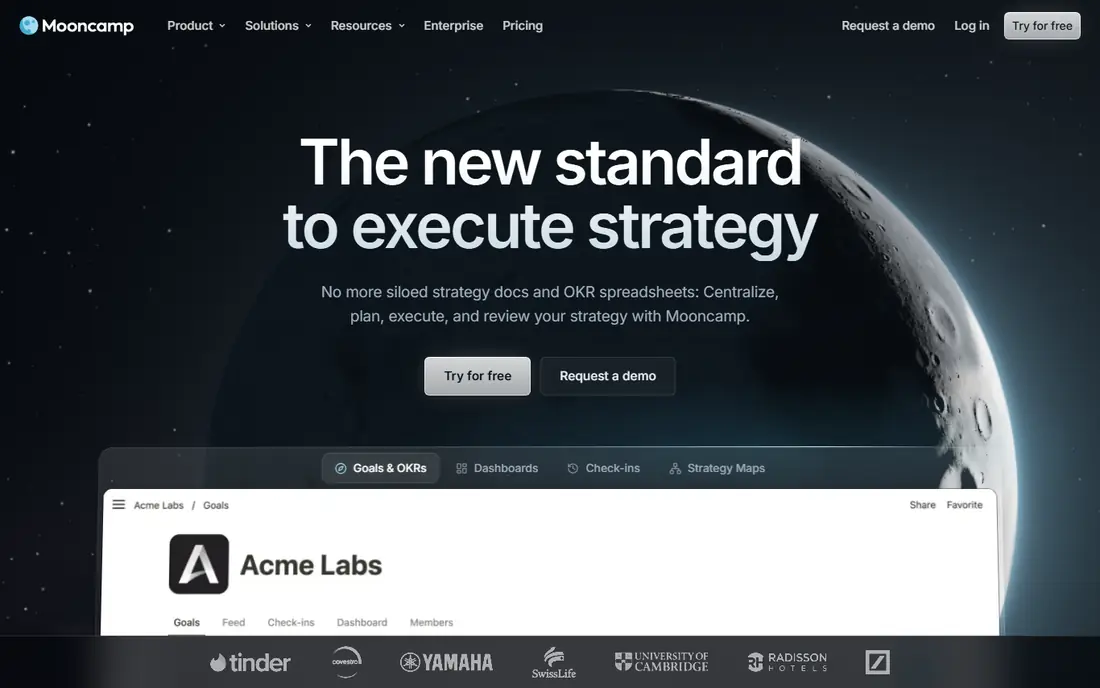
Mooncamp positions itself as the standard for executing strategy and OKRs, covering planning, execution and review in one place rather than bolting OKRs onto another tool. Teams can centralize strategy docs and spreadsheets into one system, run OKR check-ins, track KPIs in trees, and build dashboards that report up to board level. Its enterprise offering adds dedicated support through selection and rollout, which matters for large deployments.
Essential costs 7 euros per user per month and Professional costs 10 euros, with a 5-seat minimum, so the smallest monthly bill is higher than the headline rate suggests. A free trial is offered. Mooncamp fits organizations that treat OKRs as part of a wider strategy system and need reporting that survives executive scrutiny. Small teams wanting a quick start will find Tability or Weekdone simpler and cheaper.
- Full strategy planning, execution and review in one platform
- Customizable dashboards for board-level reporting
- Strong enterprise support and GDPR compliance
- 5-seat minimum raises the floor for tiny teams
- Euro pricing
- More platform than a team wanting simple OKRs may need
Weekdone has been an OKR staple for years, and its strength is the weekly rhythm. Quarterly OKRs pair with weekly plans, progress and problems reporting, so goals stay in weekly discussions instead of fading between quarters. The visual hierarchy tree shows company, team and personal OKRs at a glance, and built-in pulse surveys, feedback, kudos and 1:1 agendas add a people layer without a second tool.
It is free for 1 to 3 users or 14 days with full features and no card required, which makes it the easiest free start alongside Perdoo. Weekdone suits teams that want a simple, fast OKR tree with weekly reporting. Enterprises needing board dashboards and deep strategy planning should look at Mooncamp.
- Free for up to 3 users
- Weekly planning and status reports built in
- Visual OKR hierarchy tree
- Pulse surveys, feedback and 1:1 tools included
- Paid pricing is set by an on-page calculator rather than a published flat rate
- Simpler reporting than enterprise strategy platforms
Lattice is an HR platform first, and its Goals and OKRs module benefits from that context. Goals sit next to performance reviews, feedback, 1:1s, updates and engagement, so a goal conversation and a review conversation draw on the same data. Managers liked in user feedback that goal-setting is easy to do, and the platform integrates with HR systems such as Workday, BambooHR and Gusto plus Slack and Microsoft Teams.
Goals and OKRs costs $8 per seat per month, but with a $4,000 annual minimum, which sets a high floor. A 50-person team clears it easily; a 10-person team does not. Lattice fits HR-led companies that want goals, reviews and engagement in one system. Pure OKR buyers on a small budget will do better with Tability.
- Goals and OKRs inside a full HR platform
- Reviews, feedback, 1:1s and engagement in the same system
- Wide HRIS and chat integrations
- $4,000 annual minimum prices out small teams
- Goals are one module in a large platform, so pure OKR buyers pay for HR breadth
Betterworks is one of the established enterprise names in this space, built around connecting goals, feedback, skills and talent intelligence. Its platform supports year-round performance conversations, regular 1:1s, recognition and goals aligned to shared objectives, with reported completion rates for reviews and OKR adoption that enterprise buyers care about. Customers include large firms in finance, tech and manufacturing.
Pricing starts from $8 per user per month, with final figures set by quote based on modules and headcount, so treat the entry figure as a floor. Betterworks suits enterprises that want OKRs inside a performance system with change management support. Smaller teams will find the sales process and setup heavier than a self-serve tool like Tability or Perdoo.
- Long track record in enterprise OKRs
- Goals, feedback, recognition and reviews in one platform
- High reported review completion and OKR adoption rates
- Entry price is a floor, with final pricing by quote
- Enterprise focus means heavier setup than dedicated OKR tools
15Five is a continuous performance platform, and its pricing is unusually clear for this market. Engage costs $4 per user per month for surveys and analytics, Perform costs $11 per user per month and adds AI-powered reviews, 1:1s, check-ins, OKRs and career growth tools, and the Total Platform plan costs $16 per user per month with manager training included. That transparency makes budgeting easy compared with quote-only rivals.
The catch is tier placement: a team buying Engage for surveys does not get OKRs, so the real OKR entry price is $11, not $4. Add-ons for the Kona AI assistant, manager coaching content and compensation sit on top. 15Five fits mid-market companies that want reviews, engagement and OKRs together with published prices. Pure OKR buyers will find Tability cheaper, but they will miss the review and engagement layer.
- OKRs inside the Perform plan with reviews, 1:1s, check-ins and career growth
- Engagement surveys on the cheaper Engage plan
- Clear published plan prices
- OKRs require the $11 Perform plan, not the $4 Engage plan
- No free plan published
- AI and compensation features sit in add-ons
Asana is not an OKR tool, but its Goals feature earns it a place here for a practical reason: many teams already run their work in Asana. Goals link to portfolios, projects and tasks, so progress on work rolls up to goal progress without a second system. The work graph connects people, tasks, projects, goals and dependencies, and newer AI teammates can act inside the same workflows.
Goals sits on the Advanced plan at $24.99 per user per month, which is the highest entry price in this list and far above Tability or Perdoo. The OKR support is also thinner than a dedicated platform: no strategy map like Perdoo, no weekly OKR ritual like Weekdone. Choose Asana Goals when your team already lives in Asana and the value is one system, not the best OKR mechanics. Choose a dedicated tool when OKRs are the program itself.
- Goals connect directly to portfolios, projects and tasks
- No separate OKR tool to learn
- AI teammates and work graph keep goals tied to live work
- Highest starting price in this list
- Goals requires the Advanced plan
- OKR features are thinner than dedicated OKR platforms
How we picked these
We kept tools with a live OKR or Goals product and a confirmed homepage in October 2026, then mixed dedicated OKR platforms with HR platforms and one work management platform that includes Goals. Each tool had to support objectives with measurable key results, team or company alignment views, and progress tracking, not only a task list with a goals label.
We checked official feature pages and pricing pages, plus pages quoting vendor pricing where the vendor page did not show the figure. We favored clear pricing and free or trial access, and we flagged minimums and tier placement wherever they change the real cost. Where a price or trial could not be verified, we wrote See website.
How to pick OKR software your team will actually use
Most OKR rollouts fail on habit, not features. The tool that survives is the one whose check-in rhythm, seat rules and integrations fit how your team already works. These four checks matter most.
Check-in rhythm
Ask how often the tool asks for updates and how much work each update takes. Weekly check-ins with inline updates, like Weekdone and Tability offer, keep goals visible. A tool that only asks quarterly will go stale. Test the check-in flow with a real team during the trial, not just the admin view.
Free seats and minimums
Count who must pay and who can watch for free. Tability offers free read-only seats, Perdoo is free up to 5 users, and Weekdone is free up to 3 users, while Lattice has a $4,000 annual minimum and Mooncamp has a 5-seat minimum. Multiply the per-user price by your paying headcount, not your total headcount, and compare that total across tools.
HR features or pure OKRs
Decide whether goals should live with reviews and engagement or stand alone. HR platforms such as Lattice, Betterworks and 15Five connect goals to reviews, feedback and engagement, which suits HR-led programs. Dedicated tools such as Tability, Perdoo, Mooncamp and Weekdone keep the focus on strategy and goals, which suits operations-led programs. Mixing the two usually means paying for both.
Integrations
Check whether progress can sync from the tools where work happens. Tability syncs from Jira, Linear and Salesforce, and the HR platforms connect to HR systems and chat tools. If every key result needs manual typing, updates will lag and reports will lose trust. Put one real integration through its paces during the trial before committing.
Frequently asked questions
Sources we checked (8)

Online Jobs is an independent blog about careers, online work, learning new skills and the tools that help people earn. More about us.
Keep reading
All posts
DocuSign Alternatives
We compared the best DocuSign alternatives on price, free plans, templates, audit trails and ease of use, including free DocuSign alternatives for small teams.
Best Spend Management Software
Looking for the best spend management software? We compared 8 platforms on cards, approvals, travel and price to help your finance team pick the right one.
Best Recruitment Software for Direct Hire
Looking for the best recruitment software for direct hire? We compared 8 ATS tools on price, pipelines, interviews and hiring tools to pick the right one.