Best Marketing Automation Software in 2026: 9 Tools Compared

All-in-one CRM and inbound marketing · Starting price: Free
How we put this together: we compare official feature and pricing pages, app store listings, privacy policies and public user reviews. Prices change, so check the provider's site before you pay.
Key takeaways
- HubSpot is the strongest all-in-one choice when you want CRM, email, and automation in one database, but its Professional price jump is steep.
- ActiveCampaign gives the deepest workflow control for small and mid-sized teams, provided you choose at least the Plus plan for full branching.
- Klaviyo is the natural pick for online stores, while Brevo is the budget pick for teams with large contact lists and modest sending volume.
- Enterprise B2B teams usually narrow the choice to Adobe Marketo Engage or Salesforce Account Engagement, based on the CRM they already use.
- Pricing is usually tied to contacts or profiles, so model your cost at your real list size, not at the entry tier.
Quick comparison
| Name | Who it suits | Starting price | Free option | |
|---|---|---|---|---|
| HubSpot Marketing Hub | All-in-one CRM and inbound marketing | Free | Yes | Visit |
 ActiveCampaign | Deep email and behavior automation | $15 per month | Free trial | Visit |
 Klaviyo | Ecommerce email and SMS flows | Free | Yes | Visit |
 Brevo | Budget automation for large lists | Free | Yes | Visit |
 Mailchimp | Beginner-friendly email campaigns | Free | Yes | Visit |
 Adobe Marketo Engage | Enterprise B2B demand generation | See website | No | Visit |
 Salesforce Marketing Cloud Account Engagement | Salesforce-centered B2B teams | See website | No | Visit |
 Customer.io | Product-led lifecycle messaging | See website | Free trial | Visit |
 Omnisend | Online stores wanting omnichannel flows | Free | Yes | Visit |
The best marketing automation software
The best marketing automation software is the one that matches how you sell. A B2B team needs lead scoring, routing, and CRM reporting. An online store needs purchase triggers, abandoned cart flows, and SMS. A small team needs simple setup and honest pricing. The tools below cover those different jobs.
HubSpot Marketing Hub
Who it suits: All-in-one CRM and inbound marketing
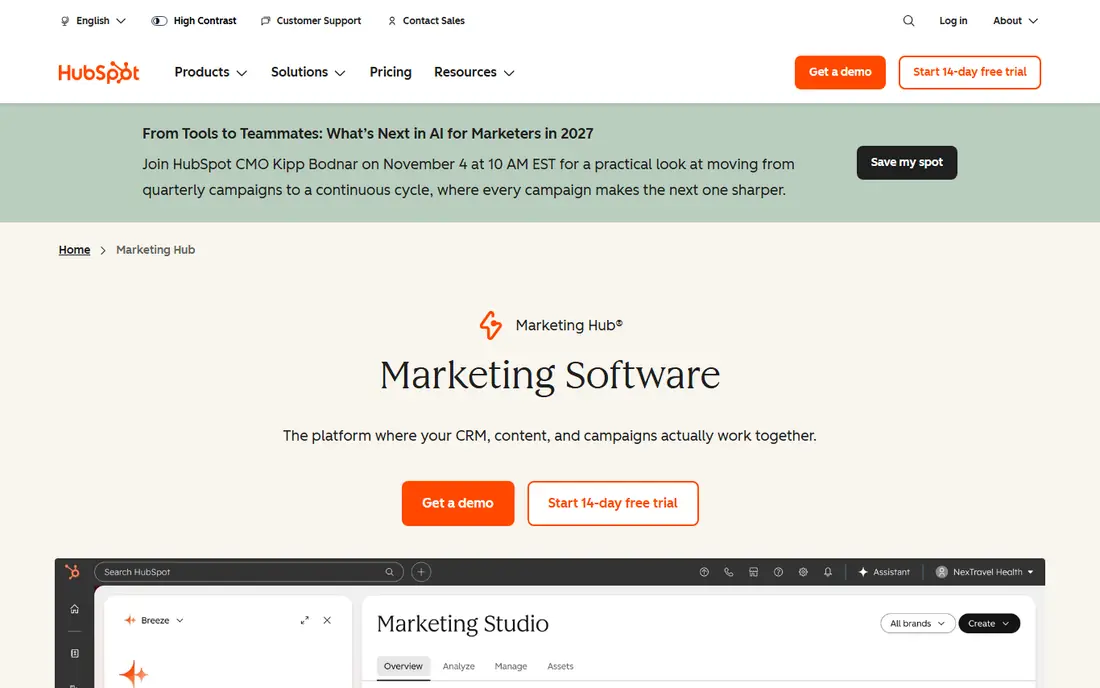
HubSpot is the easiest recommendation when a team wants one database for contacts, deals, and campaigns. Marketing activity links to CRM records without stitching separate tools together, which makes attribution and sales handoffs cleaner. The free tier covers basic email, forms, and CRM, so a small team can start without a paid plan.
The catch is the price curve. Starter is priced per seat, while Professional is a much larger monthly figure with an onboarding fee, and Enterprise is higher again. That jump buys automation depth and reporting, but it can surprise a growing team. Model the cost at your contact count and seat count before you commit.
- CRM, email, forms, landing pages, and reporting in one system
- Free tier for getting started
- Strong integration range
- Professional pricing jumps sharply from Starter
- Onboarding fees apply on higher tiers
- Costs rise with marketing contacts
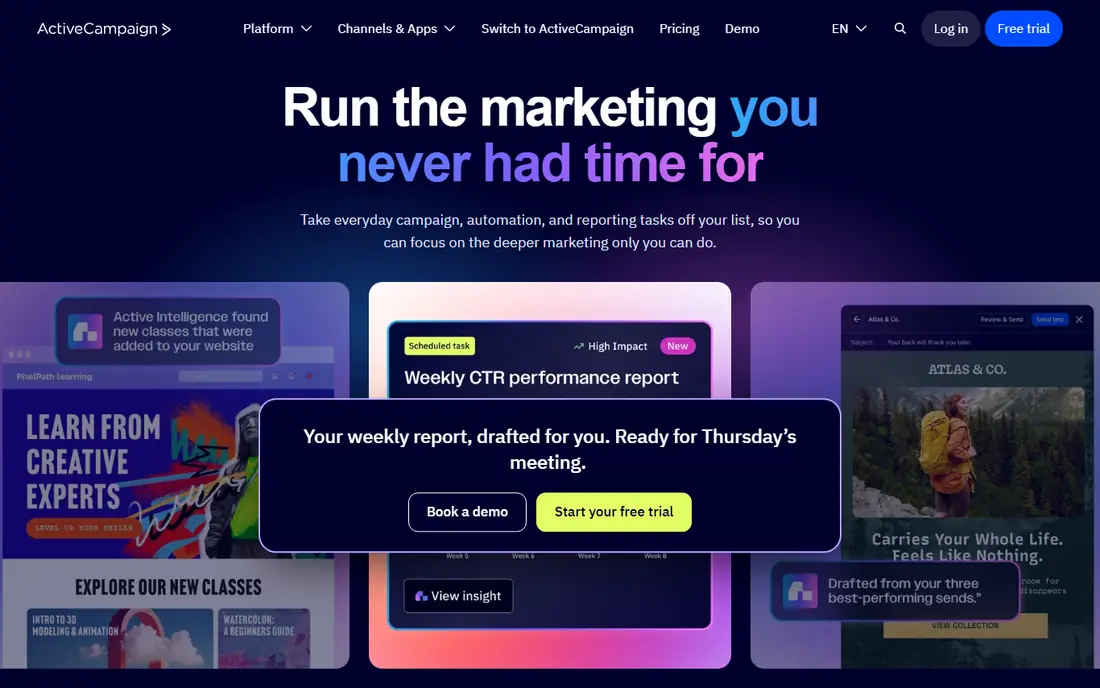
ActiveCampaign is built for teams where follow-up behavior matters. You can branch a journey based on what a person opened, clicked, bought, or did on your site, and you can move a deal through a pipeline when you add its CRM tools. That depth is why many small and mid-sized businesses choose it over simpler email tools.
The honest weakness is the entry tier. Starter at $15 per month for 1,000 contacts, billed annually, sounds cheap, but the five-action limit per automation will push most real welcome or nurture series to Plus at $49 per month. Budget for Plus if you plan multi-step journeys, and check the price at your actual contact count.
- Visual workflow builder with branching and behavioral triggers
- Strong segmentation
- Many automation recipes to start from
- No free plan
- Starter limits each automation to five actions, so most serious users need Plus
- Price rises with contacts
Klaviyo fits online stores because it is built around purchase behavior. Abandoned cart, browse abandonment, welcome, and post-purchase flows can use real order and product data, not only email opens. That makes it easier to send a relevant message at the right moment, and to measure revenue from each flow.
The trade-off is scope and cost. Klaviyo is less suited to long B2B sales cycles with complex lead scoring, and a growing profile count plus SMS sending can raise the bill faster than expected. Stores should separate email and SMS budgets and check which flows actually drive repeat orders.
- Store-data triggers for email and SMS
- Strong Shopify and WooCommerce integrations
- Prebuilt flows for cart, browse, and post-purchase
- Costs scale with profiles and SMS credits
- Best value is for stores, less so for pure B2B lead nurture
Brevo is the budget pick for teams that hold many contacts but do not email them constantly. The free plan allows unlimited contacts with a daily sending limit, and paid plans start low for a modest monthly email volume. For a small business or a nonprofit with a large list and a monthly newsletter, that model can be far cheaper than contact-based pricing.
The catch is volume. Brevo prices by monthly emails, with contact ceilings tied to each email tier, so a weekly send to a growing list can move you to a higher tier sooner than expected. Check your monthly send total, not only your list size, and confirm that the plan you choose includes the automation features you need.
- Free tier with unlimited contacts and a daily email limit
- Email, SMS, and CRM in one tool
- Low entry paid price
- Full automation needs a higher plan
- Pricing is based on email volume, so frequent senders must check their tier carefully
Mailchimp remains a sensible starting point for a team that mainly needs newsletters and simple automated emails. Setup is quick, templates are plentiful, and the free plan lets a beginner learn the basics without paying. For a small list with simple needs, that ease of use is a real advantage.
The weakness shows as you grow. Pricing rises with contacts, and the automation and segmentation depth does not match specialist tools. If you plan complex branching journeys or CRM-driven lead scoring, you will likely outgrow Mailchimp and face a migration later.
- Familiar interface and easy setup
- Many templates and integrations
- Free plan for small lists
- Price climbs as contacts grow, and unsubscribed contacts can still count
- Automation depth is weaker than ActiveCampaign or HubSpot
Marketo Engage is the enterprise standard for B2B demand generation. It handles complex lead lifecycles, scoring, nurture streams, and account-based programs at a scale that smaller tools cannot match. Large teams with long sales cycles and multiple segments will use that depth every day.
The honest catch is effort and cost. Pricing is custom, implementation takes time, and the platform rewards teams with dedicated marketing operations staff. A small team without that resource will pay for power it cannot use, and should choose HubSpot or ActiveCampaign instead.
- Deep lead lifecycle, scoring, and account-based marketing tools
- Strong enterprise B2B track record
- Broad integration options
- Quote-only pricing and implementation effort
- Needs skilled staff or a partner to run well
- Overkill for small teams
Salesforce Marketing Cloud Account Engagement
Who it suits: Salesforce-centered B2B teams
Account Engagement, formerly Pardot, makes most sense when Salesforce is already the center of your sales process. Leads, campaigns, and engagement history sit in the same CRM your sales team uses, which reduces sync problems and reporting gaps. For a Salesforce shop, that alignment is hard to beat.
Outside Salesforce, the case weakens. The platform is priced by quote, and its value depends on the CRM connection. Teams on HubSpot CRM, Pipedrive, or another CRM should compare a native alternative before committing to a Salesforce-centered tool.
- Native alignment with Salesforce CRM
- Lead scoring, grading, and campaign reporting inside Salesforce
- Strong for Salesforce-only stacks
- Quote-based pricing
- Weaker fit outside Salesforce
- Learning curve for teams new to Salesforce
Customer.io suits product-led SaaS teams that want messages triggered by what users actually do in the product. Onboarding, activation, trial expiry, and re-engagement flows can use event data rather than only list membership. That behavior-first model fits apps better than a traditional campaign calendar.
The catch is data work. You need clean events and a clear lifecycle map before the tool earns its keep, and pricing requires checking the current plan page for your volume. Teams without product analytics support may find HubSpot or ActiveCampaign easier to run.
- Behavior-based messaging across email, push, and SMS
- Strong for SaaS lifecycle and onboarding
- Flexible data and event triggers
- Pricing is quote-led for many plans
- Setup needs product data and events planned well
- Less of an all-in-one CRM
Omnisend is a practical alternative to Klaviyo for smaller stores. It covers email, SMS, and push in one flow builder, with templates for welcome, cart, and post-purchase messages. The free plan lets a new store test flows before paying, and setup is simpler than an enterprise platform.
The limitation is breadth. Omnisend is built for ecommerce, so B2B teams needing lead scoring, CRM pipelines, and account programs should look elsewhere. Stores should also compare its contact pricing and SMS costs with Klaviyo at their real order volume.
- Email, SMS, and push flows with templates for stores
- Free plan for getting started
- Straightforward store integrations
- Less suited to B2B lead scoring
- Paid pricing rises with contacts and SMS use
- Smaller integration range than Klaviyo
How we picked these
We compared official feature and pricing pages, app store listings, and public reviews for the leading marketing automation platforms, and we favored tools with a clear fit for a specific team type. We treated contact-based pricing as a key test, since a low entry price can hide a steep cost at a real list size. Where a vendor does not publish a starting price, we wrote "See website" rather than repeating a third-party estimate. We also weighed automation depth, CRM connection, ecommerce triggers, and ease of setup, because a powerful tool that a team cannot run well is a poor buy.
How to choose the right marketing automation platform
Start with your sales model
A B2B team should prioritize lead scoring, routing, and CRM reporting. An online store should prioritize purchase triggers and revenue reporting per flow. A creator or small service business should prioritize simple setup and a price that stays fair as the list grows.
Model the total cost
Check the price at your current contacts, and again at double that number. Add seats, SMS credits, and any onboarding fee. A tool that looks cheap at 1,000 contacts can become expensive at 10,000, and a tool with a higher entry price can be cheaper once automation depth is included.
Test one real journey before you migrate
Build one welcome series or one cart flow in a trial, and measure setup time, deliverability, and reporting clarity. A trial that only tests a newsletter will not reveal workflow limits, contact pricing traps, or CRM sync problems. Migrate only after that real journey works.
Frequently asked questions
What is the best marketing automation platform?
HubSpot Marketing Hub is the best all-in-one pick for most growing B2B and B2C teams, while ActiveCampaign is the best value pick for deep email automation. Klaviyo leads for ecommerce, Brevo leads on budget, and Marketo leads for enterprise B2B. The best digital marketing tools for your team depend on your sales model and list size.
What are the best marketing automation tools for small businesses?
Small businesses often do well with Brevo for budget, Mailchimp for simplicity, or ActiveCampaign Plus for deeper automation. HubSpot free and Starter plans also work when a CRM is needed. The best tools for marketing automation at this size are the ones a small team can run without a specialist.
What is the best marketing automation software platform for ecommerce?
Klaviyo is the strongest ecommerce pick for most stores, with Omnisend as a simpler and often cheaper alternative. Both offer store-data triggers, cart flows, and SMS. Choose Klaviyo for deeper store analytics and integrations, and Omnisend when simplicity and a lower starting cost matter more.
What are the top marketing automation software options for enterprise B2B?
Adobe Marketo Engage and Salesforce Marketing Cloud Account Engagement are the top enterprise B2B options. Choose Marketo when you need CRM-neutral enterprise depth, and Account Engagement when Salesforce is already your CRM. Both need skilled staff and a clear lead lifecycle plan.
Do the best email marketing automation platforms include a CRM?
Some do and some do not. HubSpot and Brevo include CRM features, ActiveCampaign adds CRM pipelines on higher plans, and Klaviyo and Omnisend focus on store and contact data rather than a full sales CRM. If sales pipeline management matters, check the CRM depth on the plan you will actually buy, not only the headline feature list.
How much do the best marketing automation software platforms cost?
Costs range from free tiers at HubSpot, Klaviyo, Brevo, Mailchimp, and Omnisend, to $15 per month for ActiveCampaign Starter, $49 per month for ActiveCampaign Plus, and quote-based pricing for Marketo and Salesforce. Always model the cost at your contact count, since most platforms scale with list size.
Sources we checked (9)

Online Jobs is an independent blog about careers, online work, learning new skills and the tools that help people earn. More about us.
Keep reading
All posts
Best White Label SEO Companies
We compare the best white label SEO companies and tools in 2026 for agencies, from fulfilment services to branded reporting platforms, margins and prices.
Best Webinar Software
We compared the best webinar software for 2026 on price, attendee limits, automation and ease of use, to help you host better live sessions with confidence.
Best Web Scraping Tools
Compare the best web scraping tools in 2026, from no-code Octoparse and Browse AI to Apify, Firecrawl, Bright Data, Zyte, ScraperAPI and free Scrapy, with prices.