Best LLM SEO Analysis Software in 2026: 9 Tools Compared

How we put this together: we compare official feature and pricing pages, app store listings, privacy policies and public user reviews. Prices change, so check the provider's site before you pay.
Key takeaways
- Surfer SEO costs 79 dollars per month on its Essential plan and remains the most complete content optimization tool for classic search rankings.
- Clearscope costs 189 dollars per month and suits editorial teams that want a simple letter grade for content quality.
- Profound, Peec AI, Otterly, and Scrunch track how AI answer engines mention and cite your brand, which classic rank trackers do not cover.
- Otterly starts at 29 dollars per month, making it the cheapest entry point into AI visibility tracking on this list.
- The smartest setup for most teams pairs a content optimizer like Surfer or Frase with one AI visibility tracker, rather than buying two tools that do the same job.
Quick comparison
| Name | Who it suits | Starting price | Free option | |
|---|---|---|---|---|
 Surfer SEO | Content optimization | $79 per month | No | Visit |
 Clearscope | Editorial content grades | $189 per month | Free trial | Visit |
 Frase | Briefs and SERP research | $45 per month | Free trial | Visit |
 MarketMuse | Topical authority strategy | $149 per month | Yes | Visit |
 Profound | Enterprise AI visibility | See website | Free trial | Visit |
 Peec AI | Agency AI tracking | See website | No | Visit |
 Otterly.AI | Budget AI visibility | $29 per month | No | Visit |
 Scrunch AI | AI monitoring plus fixes | $250 per month | Free trial | Visit |
 Semrush | All-in-one SEO plus AI | $139 per month | Yes | Visit |
The best LLM SEO analysis software
Search now has two fronts: classic results and answers from large language models. The tools below cover both, from content optimizers that score your pages against ranking competitors to trackers that watch how ChatGPT, Perplexity, and Google AI Overviews describe your brand. We compared official pricing pages, feature lists, and documentation to sort them.
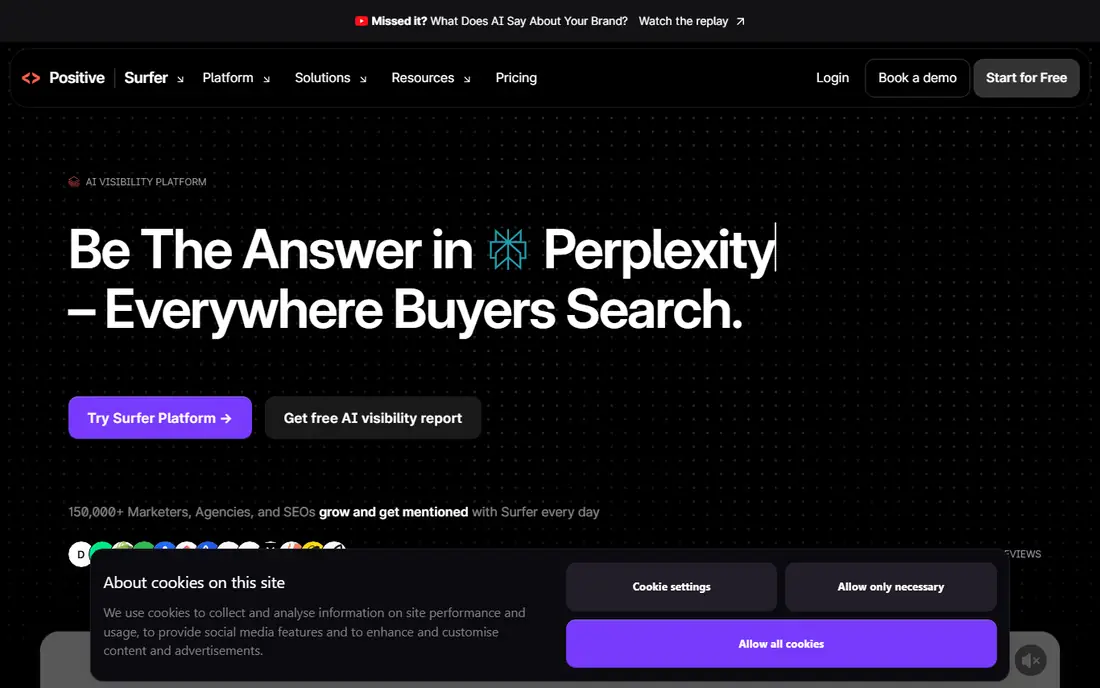
Surfer SEO analyzes the pages ranking for your target keyword and scores your draft against them in real time, covering terms, structure, length, and headings. The Essential plan costs 79 dollars per month billed annually and includes content tracking, keyword research, and AI article generation limits, with a 7-day money-back guarantee. Integrations with Google Docs and WordPress keep the score inside the editor where writers work.
The gap is AI visibility. Surfer tells you how a page should perform in classic search, not how ChatGPT answers questions in your category. For a content team whose traffic still comes mostly from Google, Surfer remains our pick. Teams that also need answer-engine tracking should pair it with a dedicated tracker below.
- Real-time content score against top-ranking pages
- Keyword research and audits included
- Google Docs and WordPress integrations
- No dedicated AI answer-engine tracking
- Higher tiers needed for large teams
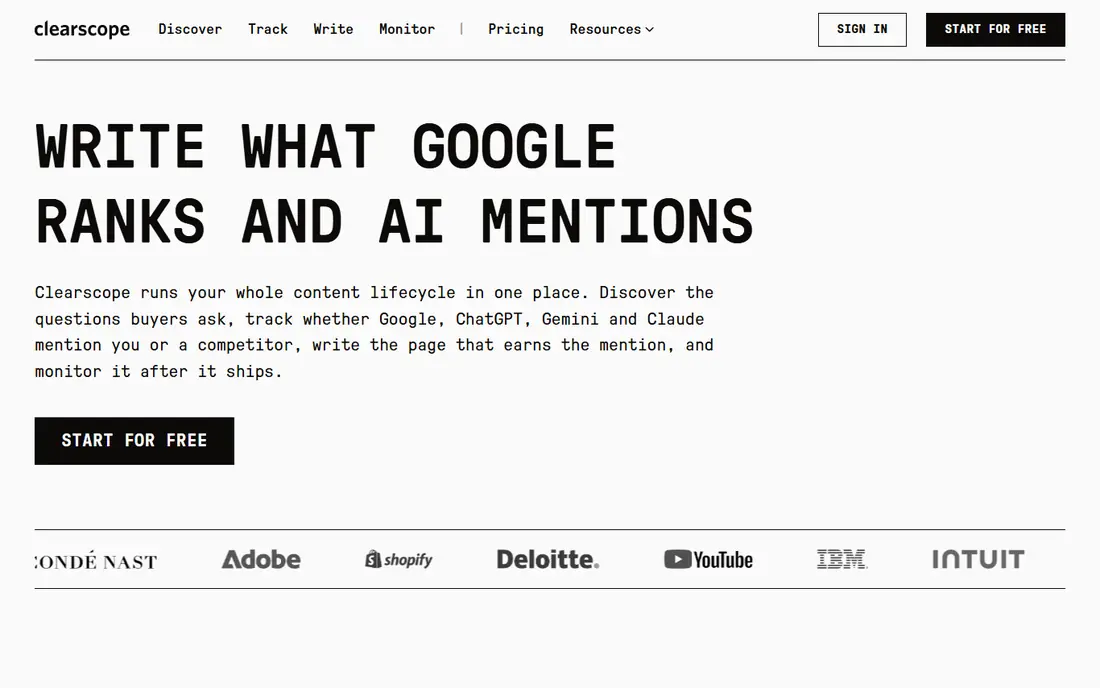
Clearscope grades content with a letter from A to F, based on terms found in top-ranking pages and analyzed with natural language processing. The Essentials plan costs 189 dollars per month and includes content inventory pages, keyword discovery, and monthly content reports, with unlimited users, which softens the price for larger editorial teams. Its Google Docs integration means writers optimize without learning a new editor.
The price is the obvious hurdle for a solo creator, and Clearscope does not track AI answer engines. It suits publishers and agencies where editors need one trusted grade and where the cost spreads across many writers. Smaller teams will get similar scoring from Surfer or Frase for less.
- Simple A to F content grades writers trust
- Google Docs integration
- Unlimited users on paid plans
- Highest starting price here
- No AI visibility tracking
- Keyword discovery limits
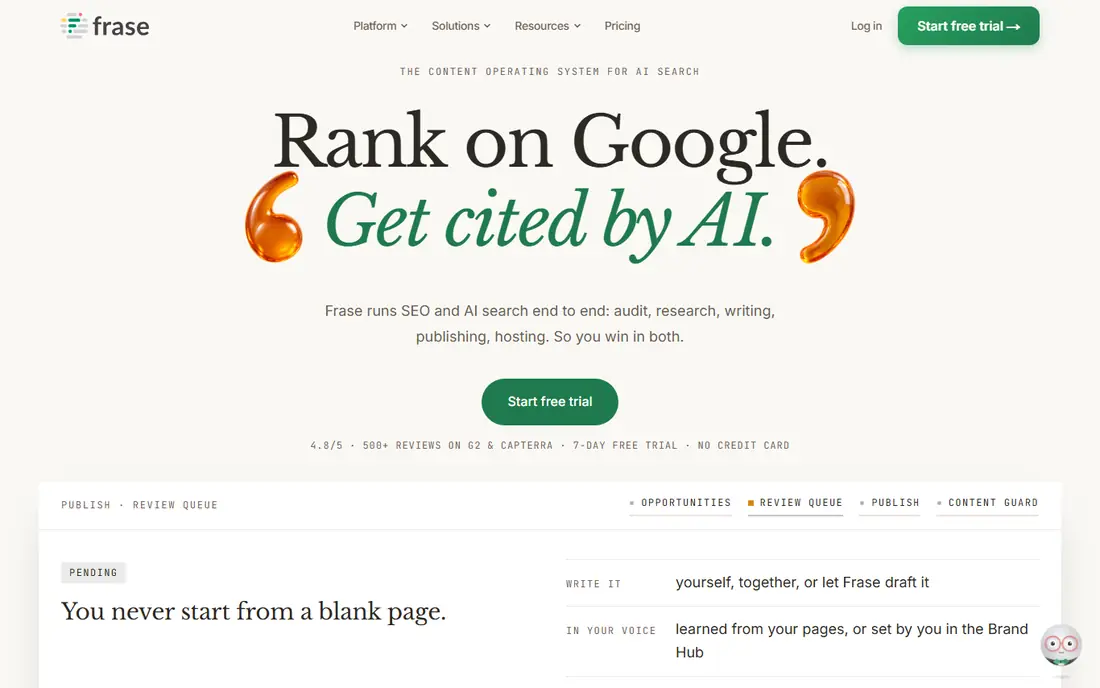
Frase excels at the first step of content work: research and briefs. It pulls the structure, headings, and questions from top-ranking pages and turns them into a brief a writer can follow in minutes, then offers an AI writer for drafting. The Basic plan costs 45 dollars per month, with a free trial, making it the friendliest entry point among the content optimizers on this list.
Scoring is less deep than Surfer's, and Frase does not monitor AI answer engines. For freelancers and small teams whose main bottleneck is turning research into briefs, Frase is the best value. Teams that live by content scores should weigh Surfer instead.
- Fast briefs from competitor analysis
- Solid AI writing help
- Lowest entry price among content optimizers here
- Content scoring is thinner than Surfer
- No AI visibility tracking
MarketMuse works above the individual page. It inventories your content, scores your authority on topics, finds gaps against competitors, and produces briefs for the pieces that will move authority most. The Standard plan costs 149 dollars per month, and a free tier covers limited queries, which is enough to test the inventory view.
It is not a writing editor, so teams still need Surfer, Frase, or Clearscope for page-level optimization. MarketMuse fits publishers and enterprises planning dozens of pieces a month around topic clusters. A small blog with a handful of posts will not use enough of it to justify the price.
- Content inventory and gap analysis
- Topical authority scoring
- Free tier with limited queries
- Strategy-level tool, not a page editor
- Price climbs fast for larger teams
Profound is the enterprise name in AI visibility. It tracks how answer engines mention your brand, which pages they cite, and what people actually ask in your category, across up to 9 engines on enterprise plans, including ChatGPT, Perplexity, Google AI Mode, Gemini, and Claude. A free trial covers a limited set of prompts on ChatGPT, and agencies get self-serve workspaces per client.
The catch is pricing transparency. After the trial, brand pricing is custom enterprise, so a small business cannot simply sign up at a listed rate. For a brand treating AI search as a real channel with budget to match, Profound's depth is unmatched. For a startup, Otterly or Peec AI will cover the basics at a published price.
- Tracks up to 9 answer engines on enterprise plans
- Citation and conversation analytics
- Agency workspaces
- No published brand price after the trial
- Overkill for small businesses
Peec AI tracks brand visibility, position, and sentiment across AI engines, with prompt-level history and competitor comparisons. Agencies like its white-label dashboards and client reporting, plus multi-market tracking for brands operating in several countries. Plans are tiered by prompt volume, with a Pro tier covering 150 prompts and an Advanced tier covering 350.
Pricing is the confusing part, since published figures differ across sources and regions, so check the vendor's own pricing page for your market before budgeting. For an agency managing AI visibility for several clients, Peec AI's reporting and seat model make it a strong middle option between Otterly and Profound.
- Prompt-level visibility and sentiment tracking
- White-label dashboards for agencies
- Multi-market tracking
- Published prices vary by source and plan
- Enterprise features gated behind higher tiers
Otterly.AI is the cheapest way to start tracking AI visibility seriously. The Lite plan costs 29 dollars per month and covers 15 prompts across ChatGPT, Google AI Overviews, Perplexity, and Microsoft Copilot, with unlimited workspaces. Higher tiers raise prompt counts to 100 on Standard at 189 dollars per month and 400 on Premium at 489 dollars per month.
The entry tier's prompt limit is tight for a brand with many products, and Claude, Google AI Mode, and Gemini coverage costs extra. Still, for a small team taking its first look at how AI answers describe it, Otterly gives real data at a price that needs no procurement meeting.
- Cheapest real entry point
- Tracks ChatGPT, AI Overviews, Perplexity, and Copilot
- Unlimited workspaces
- Claude, AI Mode, and Gemini need add-ons
- Prompt limits on the entry tier
Scrunch AI goes beyond monitoring. Its Core plan costs 250 dollars per month and tracks prompts, citations, and brand presence across ChatGPT, Perplexity, Google AI Overviews, and Copilot, with enterprise plans adding Claude, Gemini, Meta AI, Google AI Mode, and Grok. Its Agent Experience Platform also serves an AI-optimized version of your site to crawlers, aiming to fix what models get wrong rather than only reporting it.
That ambition comes at a price that rules out small blogs, and the deepest features sit behind enterprise quotes. For a mid-size brand that wants monitoring plus a way to act on it, Scrunch is the most complete single purchase on this list.
- Prompt monitoring and citation analysis
- Platform for serving AI-optimized content to crawlers
- 7-day trial
- Entry price is high for small teams
- Enterprise features behind custom pricing
Semrush is the all-in-one platform that many teams already pay for, covering keyword research, site audits, backlink analysis, and rank tracking. The Pro plan starts at 139 dollars per month, with a limited free tier, and an AI visibility toolkit is available as a paid add-on for teams that want answer-engine tracking tied to their existing SEO data.
The add-on pricing means AI visibility is not included in the base plan, and the sheer breadth of Semrush can overwhelm a new user. If your team already lives in Semrush, adding its AI toolkit is cheaper and simpler than buying a separate tracker. If you only need AI visibility, a focused tool like Otterly will be simpler.
- Keyword research, audits, and backlinks in one subscription
- AI visibility toolkit add-on
- Limited free tier
- AI visibility features cost extra per user
- Interface can overwhelm new users
How we picked these
We compared official pricing pages, feature lists, and documentation for tools that analyze content for classic search or track brand visibility in AI answers. Prices are the standard published rates from each vendor's own site, and where pricing is custom or varies by region we say so rather than publishing a number we could not confirm. We kept both sides of the market on the list, because a tool that only scores pages cannot tell you what ChatGPT says about you, and vice versa.
What to check before you choose
Start by deciding which question you need answered. If it is how to rank a page, a content optimizer is the tool. If it is how AI answers describe your brand, a visibility tracker is the tool. Many teams need one of each, and buying two tools from the same side wastes money.
Count prompts and pages honestly
AI trackers price by prompt volume, and content tools price by pages, reports, or articles. List your real workload for the next year, including new products and markets, before picking a tier. Entry tiers look cheap until you hit their limits in month two.
Check which engines and models are covered
Coverage varies a lot. Otterly includes four engines on its base plan and charges extra for Claude and Gemini, while Profound enterprise covers up to nine. Match the engine list to where your buyers actually ask questions, and confirm whether AI Overviews and AI Mode count separately.
Test with your own brand terms
Run a trial on your own brand and your top three competitors before committing. A tool that reports cleanly on a demo brand but misses your category's phrasing will not help. Trials from Profound, Scrunch, Frase, and Clearscope make this check cheap.
Frequently asked questions
What is the best LLM SEO analysis software?
There is no single winner, because the category splits in two. Surfer SEO is our pick for optimizing pages for classic search, while Profound leads for enterprise AI visibility tracking and Otterly leads on price. Most teams end up with one optimizer and one tracker.
What is the best LLM SEO analysis tool for small businesses?
Otterly at 29 dollars per month is the cheapest real AI visibility tracker, and Frase at 45 dollars per month is the cheapest content optimizer here. Together they cost less than Clearscope alone and cover both fronts. If you can only buy one, pick the side where your traffic actually comes from today.
What is the best LLM SEO analysis software for agencies?
Peec AI suits agencies with white-label dashboards and client reporting, while Profound suits agencies with enterprise clients and bigger budgets. Surfer SEO remains the agency standard for content scoring across many clients. Check seat limits and prompt volumes per client before choosing.
How is LLM SEO different from traditional SEO?
Traditional SEO optimizes pages to rank in a list of links, while LLM SEO tracks and shapes how AI models answer questions, including which sources they cite. The two overlap, since models cite pages that rank well, but AI visibility needs prompt-level tracking that classic rank trackers do not provide.
Do AI visibility tools track ChatGPT and Perplexity?
Yes, all the trackers on this list cover ChatGPT and Perplexity, and most also cover Google AI Overviews and AI Mode. Coverage of Claude, Gemini, Copilot, and Grok varies by tier, so check the engine list for the plan you would actually buy.
Can one tool replace both an SEO suite and an AI tracker?
Semrush comes closest, since it pairs a full SEO suite with an AI visibility add-on. The add-on costs extra per user, though, and focused trackers like Profound and Scrunch go deeper on citations and conversation data. For most teams, a suite plus a tracker beats either one alone.
Sources we checked (9)

Online Jobs is an independent blog about careers, online work, learning new skills and the tools that help people earn. More about us.
Keep reading
All posts
Workday Alternatives
We compared the best workday alternatives for HR, payroll, and global hiring, from BambooHR and Gusto to Rippling, Deel, and HiBob for growing teams in 2026.
Which SaaS Tools Have the Best Customer Support
Which SaaS tools have the best customer support? Compare eight popular tools on help centres, live help, response options and overall support quality.
Top AI Helpdesk Software
Searching for top AI helpdesk software in 2026? We compared 8 AI helpdesks on automation, pricing, channels and ease of setup for small and growing teams.