Best Legal Practice Management Software in 2026: 9 Tools Compared


Growing firms wanting the largest ecosystem · Starting price: $39 per user per month
How we put this together: we compare official feature and pricing pages, app store listings, privacy policies and public user reviews. Prices change, so check the provider's site before you pay.
Key takeaways
- Clio leads on ecosystem and integrations, MyCase leads on value for solos and small firms, and PracticePanther leads on automation and billing ease.
- Trust accounting matters for most firms that hold client funds, so confirm three-way reconciliation and your state rules before choosing.
- Entry prices cluster around $39 to $49 per user per month, but higher tiers, add-ons and payment fees raise the real monthly total.
- No tool here offers a permanent free plan, so use the trial with real matters, billing and documents before committing the firm.
Quick comparison
| Name | Who it suits | Starting price | Free option | |
|---|---|---|---|---|
| Clio | Growing firms wanting the largest ecosystem | $39 per user per month | Free trial (7 days) | Visit |
 MyCase | Solo and small firms wanting value | $39 per user per month | Free trial | Visit |
 PracticePanther | Billing-led firms wanting automation | $49 per user per month | Free trial (7 days) | Visit |
 CosmoLex | Trust accounting priority firms | $49 per user per month | Free trial (10 days) | Visit |
 Smokeball | Document-heavy firms | See website | Free trial (7 days) | Visit |
 Filevine | Litigation and personal injury firms | See website | Free trial | Visit |
 Rocket Matter | Solo firms wanting simple billing | $39 per user per month | Free trial (10 days) | Visit |
 LEAP | Firms wanting documents and accounting together | $129 per user per month | Free trial (14 days) | Visit |
 Actionstep | Firms wanting custom workflows | $49 per user per month | Free trial | Visit |
The best legal practice management software
Legal practice management software keeps matters, clients, calendars, documents, time and billing in one system, with trust accounting for firms that hold client funds. The right tool depends on firm size, practice area and how much automation you need, not on feature count alone.

Clio is the overall market leader for a reason: it covers intake, matters, documents, time, billing, payments and trust accounting in a mature cloud platform, with more than 250 integrations for accounting, e-signature, court filing and other legal tools. Solo firms can start on an entry tier, while growing firms can add workflow automation, custom forms and advanced reporting as they scale.
The entry price looks low, but the features many firms want, including automation and deeper reporting, sit on higher tiers, and payment processing and add-ons add to the bill. For a firm that wants the widest choice of integrations and a platform that grows with it, Clio remains the safest default.
- Largest integration ecosystem
- Mature matter and billing tools
- Client portal
- Best automation sits on higher tiers
- Add-ons raise total cost
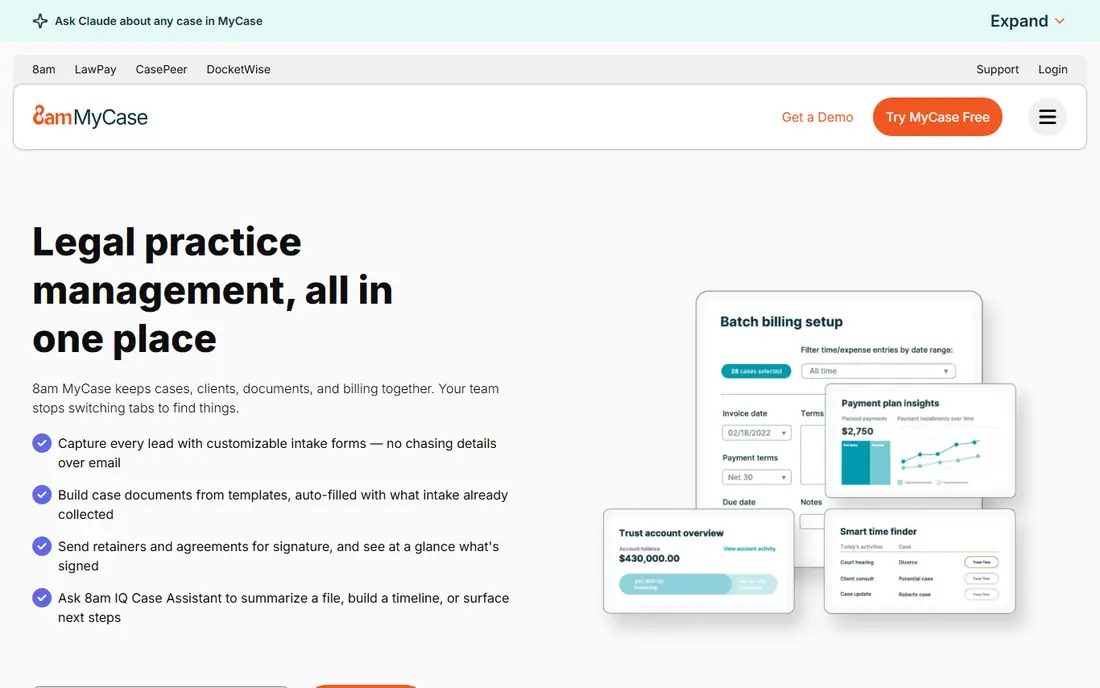
MyCase suits solo attorneys and small firms that want a clean, approachable system without a steep setup. Matters, client communication, documents, time and billing sit in one place, and the client portal lets clients share documents and pay online. That simplicity helps a small firm move off spreadsheets quickly, with less training than enterprise tools.
Customisation is thinner than Clio or Filevine, and firms with complex workflows may outgrow it. For a firm of one to five attorneys that values ease and value over deep customisation, MyCase is our pick for most small firms.
- Simple interface
- Client portal and billing included
- Good value for small firms
- Less customisation than Clio or Filevine
- Advanced CRM sits on higher tiers

PracticePanther leads for billing-intensive practices that want automation to handle routine work. Time tracking, invoicing, e-payments, unlimited e-signatures on many plans and two-way business texting reduce the need for separate subscriptions. Workflows can trigger tasks, reminders and client updates automatically, which saves office time each week.
Entry pricing is higher than Clio or MyCase, and the most useful automation sits on higher tiers. Firms that bill heavily and want communication tools built in will find the premium worthwhile, while firms with simple billing may prefer MyCase value.
- Strong automation
- Native e-payments and e-signatures
- Two-way texting
- Higher tiers cost more
- Some users report billing support friction
CosmoLex is the pick when trust accounting is the priority, because legal accounting is built into the platform rather than bolted on. Matter billing, trust ledgers and three-way reconciliation sit alongside case management, which helps firms meet compliance rules without a separate accounting tool. Small firms that hold client funds benefit most from that single-system approach.
The interface feels less modern than Clio or MyCase, and the integration list is smaller. For a firm where trust compliance drives the decision, those trade-offs are acceptable, and CosmoLex accounting depth is hard to match at this price.
- Built-in legal accounting and trust compliance
- Matter billing in one system
- Good for small firms
- Interface less modern than rivals
- Integration list smaller than Clio
Smokeball suits high-volume, document-heavy practices that lose billable time to manual time entry. Automatic time and activity capture records work as it happens, document automation speeds up standard forms, and Microsoft Office integration keeps drafting inside familiar apps. That combination helps firms that produce many documents each week.
Pricing is quoted, so budgeting needs a sales conversation, and simpler firms may find it more than they need. For a firm where documents and time capture drive revenue, Smokeball earns a trial ahead of a generalist tool.
- Automatic time capture
- Strong document automation
- Microsoft Office integration
- Pricing requires a quote conversation
- May be more than simple firms need
Filevine is built for litigation, personal injury, mass tort and immigration firms that need custom workflows, deadlines and case stages shaped to their practice. Custom fields, task automation and reporting handle complex caseloads better than generalist tools, and teams can track each case through its full lifecycle in one system.
That depth needs planning and a quoted price, so solo general practitioners will find it heavy. For a litigation firm with many active cases and specific workflow needs, Filevine customisation is the main reason to choose it over Clio or MyCase.
- Deep workflow customisation
- Strong for litigation and mass torts
- Detailed reporting
- Quote-based pricing
- Setup needs more planning than small-firm tools
Rocket Matter suits solo attorneys who want straightforward matter management, time tracking and billing without enterprise complexity. The interface is clear, the client portal covers communication and payments, and the entry price matches MyCase for a single user. It is a calm, practical choice for a solo practice.
Larger firms or firms needing deep automation, CRM or custom workflows will outgrow it sooner than Clio or PracticePanther. For a solo firm that bills by the hour and wants a simple, reliable system, Rocket Matter is a strong value pick.
- Simple billing and time tracking
- Client portal
- Low entry price
- Fewer advanced features than Clio
- Smaller ecosystem
LEAP combines matter management, document automation and legal accounting in one platform, which suits firms that want documents and billing to stay together without separate tools. Guided setup helps firms move from older systems, and the document library covers many practice areas. That breadth explains the higher entry price.
Small firms with simple needs will find LEAP expensive, and the value only shows when document and accounting depth are both used daily. For a firm that produces many standard documents and wants accounting built in, LEAP is worth comparing with CosmoLex.
- Document automation plus legal accounting
- Matter management in one system
- Guided setup
- Highest entry price here
- More than small simple firms need
Actionstep suits firms that need custom matter types, workflows and accounting shaped to their practice, without moving to an enterprise platform. Workflow builders, document assembly and billing cover a wide range of practice areas, and the system adapts to how a firm actually works rather than forcing a fixed process.
That flexibility comes with a learning curve, and setup takes longer than MyCase or Rocket Matter. Firms with standard needs should pick a simpler tool, while firms with distinct workflows will value Actionstep control.
- Custom workflows and matter types
- Strong accounting features
- Flexible setup
- Steeper learning curve
- Setup takes longer than MyCase
How we picked these
We compared official pricing pages, product documentation and public buyer guides for each platform, focusing on tools that cover matters, billing, documents and trust accounting for law firms. We kept tools that exist today, offer a trial, and serve a distinct firm size or practice need. Where pricing is quoted, we wrote See website rather than repeating a third-party figure as fact.
What to check before you choose
Start with trust accounting, since it decides the shortlist for most firms. If your firm holds client funds, confirm three-way reconciliation, trust ledgers and compliance reporting meet your state bar rules, and ask the vendor to show those reports in a trial. Then check billing: time entry, invoicing, online payments and trust-to-operating transfers must match how your firm actually bills.
Trial with real matters
Run the trial with real matters, real documents and real invoices, not just demo data. Watch how time entry, billing and client portal messages work together, since friction there costs billable hours every week.
Integrations and migration
List the tools you must keep, including accounting, email, e-signature and court filing, and confirm each integration works on your chosen tier. Ask how matter, document and billing history migrates, and keep an export of your old system until the new one is proven.
Total monthly cost
Price the full firm, including all users, higher tiers for automation, payment processing fees and any add-ons for intake or accounting. A $39 entry tier can become $100 per user once the features you need are added.
Frequently asked questions
What is the top legal practice management software for a solo attorney?
MyCase and Rocket Matter, both from $39 per user per month, are the strongest solo picks, with Clio entry tier as the alternative for a larger ecosystem. Solo firms should trial billing and client portal workflows before choosing.
What are the best legal practice management software reviews saying about Clio?
Public reviews commonly praise Clio integrations and maturity, while noting that advanced automation sits on higher tiers. That pattern matches our findings: Clio leads on ecosystem, while value and automation leaders differ by firm need.
Does legal practice management software include trust accounting?
Clio, MyCase, PracticePanther, CosmoLex, Rocket Matter, LEAP and Actionstep all include trust accounting features, though depth varies. Confirm three-way reconciliation and your state rules with the vendor before buying.
How much does legal practice management software cost?
Most firms pay $39 to $149 per user per month depending on tier, with realistic totals higher once add-ons and payment fees are included. LEAP starts higher, while Filevine and Smokeball are quoted.
What is the difference between practice management and case management?
Practice management covers the business of the firm, including billing, clients and calendars, while case management focuses on the progress of individual cases. Most tools here cover both, with Filevine leaning more toward case workflow depth.
Which platform is best for personal injury firms?
Filevine suits personal injury and mass tort firms with custom workflows and case tracking, while PracticePanther and Clio also serve many personal injury firms well. Trial workflow customisation with real case stages before deciding.
Sources we checked (9)

Online Jobs is an independent blog about careers, online work, learning new skills and the tools that help people earn. More about us.
Keep reading
All posts
n8n Alternatives
n8n alternatives compared for 2026, with Zapier, Make, Activepieces, and more, covering visual builders, code steps, self-hosting, and pricing models.

ZoomInfo Alternatives
The best ZoomInfo alternatives in 2026, compared on price, free plans, data coverage, and which tool fits small teams or large sales teams best in detail.

Workday Alternatives
We compared the best workday alternatives for HR, payroll, and global hiring, from BambooHR and Gusto to Rippling, Deel, and HiBob for growing teams in 2026.