Best Internet Service in 2026: 8 Companies Compared

How we put this together: we compare official feature and pricing pages, app store listings, privacy policies and public user reviews. Prices change, so check the provider's site before you pay.
Key takeaways
- There is no single best internet service provider for the whole US, because availability varies by address and the fastest plan at one home may not be sold at another.
- Fiber is our first choice where it is available, because upload speeds usually match download speeds, which helps video calls and large uploads.
- Cable is the most widely available fast option, but check data caps, equipment fees and the price after any promo period ends.
- 5G home internet is worth checking if fiber and cable are weak at your address, since it needs no wired line and often has simple pricing.
- Advertised speeds are not guaranteed, and wireless speeds in a home depend on the router, the device and how many people are online at once.
Quick comparison
| Name | Who it suits | Starting price | Free option | |
|---|---|---|---|---|
 Xfinity | Widest cable coverage | $19.99 per month | No | Visit |
 Spectrum | Cable without a contract focus | See website | No | Visit |
 AT&T Fiber | Symmetrical fiber speeds | $50.00 per month | No | Visit |
 Verizon Fios | Fiber in the Northeast and Mid-Atlantic | $35.00 per month | No | Visit |
 Google Fiber | Fast, simple fiber plans | $70.00 per month | No | Visit |
 T-Mobile Home Internet | 5G home internet with flat pricing | $50.00 per month | No | Visit |
 Cox | Cable with TV bundle options | $30.00 per month | No | Visit |
 Frontier Fiber | Expanding fiber with price options | $30.00 per month | No | Visit |
The best internet service
We compared US providers that cover many homes, offer a range of speeds and publish plan details online. The list below covers fiber, cable and 5G home internet, so you can compare what is actually sold at your address rather than what looks best on a national chart.
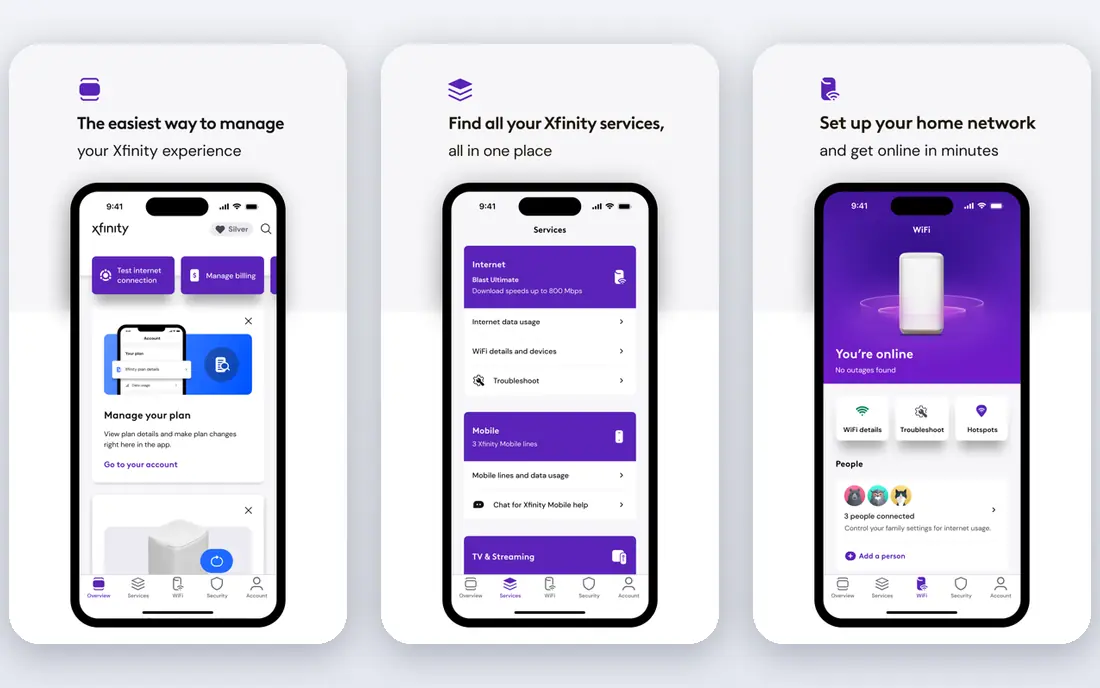
Xfinity, from Comcast, is the cable provider most US homes are likely to find available. Its plans cover basic browsing through to multi-gigabit downloads in some areas, and it offers bundles that can simplify billing if you also want TV or mobile service. For a household that needs a reliable, widely available connection, that reach is a real benefit.
The limits are the usual cable trade-offs. Upload speeds lag download speeds on many plans, which matters if you work from home with video calls or upload large files often. Some plans also have data caps, and promo prices rise after the promo period, so check the standard rate, equipment fee and cap for your address before you sign up.
- Available in many states
- Wide range of download speeds
- Bundle options with TV and mobile
- Upload speeds are often lower than download speeds on cable plans
- Data caps apply in some areas
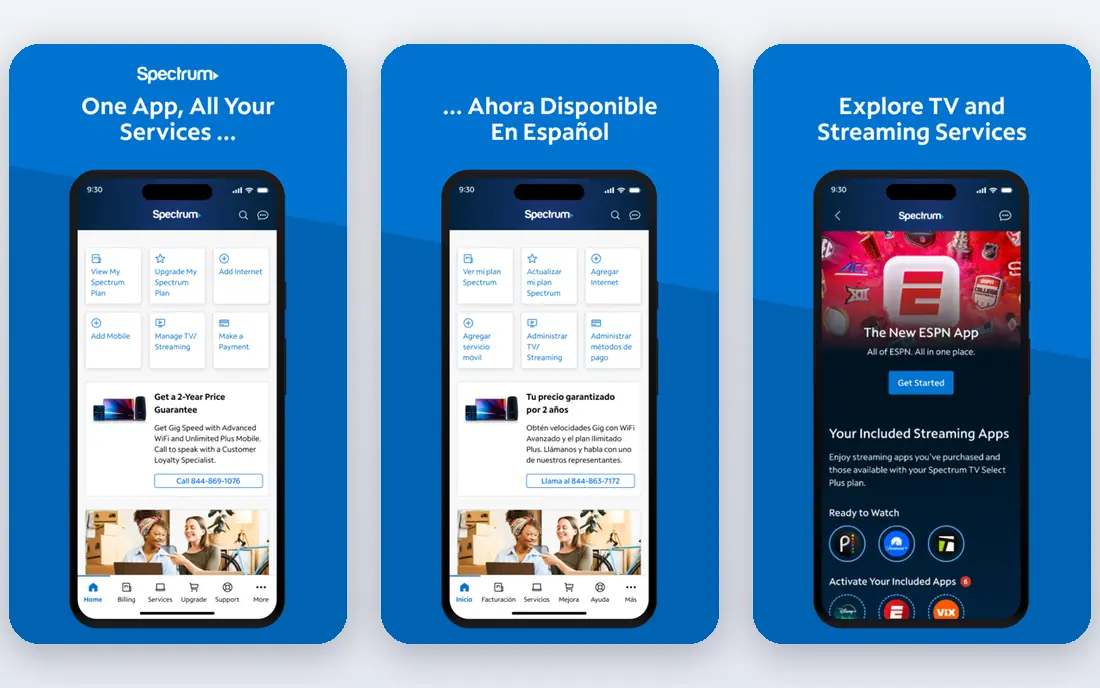
Spectrum, from Charter, is a strong cable option for households that want simple terms. The provider describes its internet plans as having no data caps and no annual contracts, which removes two common sources of surprise bills. Coverage spans many states, so it is often one of the few fast options at an address.
Pricing still needs care. Introductory rates are common, and the standard rate after a promo can be notably higher, so ask for the post-promo price in writing. Speeds also vary by area, and the top advertised speed may not be sold at every address. If Spectrum is your main cable choice, compare its standard rate with any fiber or 5G option at the same address.
- No data caps on internet plans as described by the provider
- Wide cable footprint
- No annual contract on many plans
- Standard rates can be higher after promos
- Upload speeds vary by plan and area
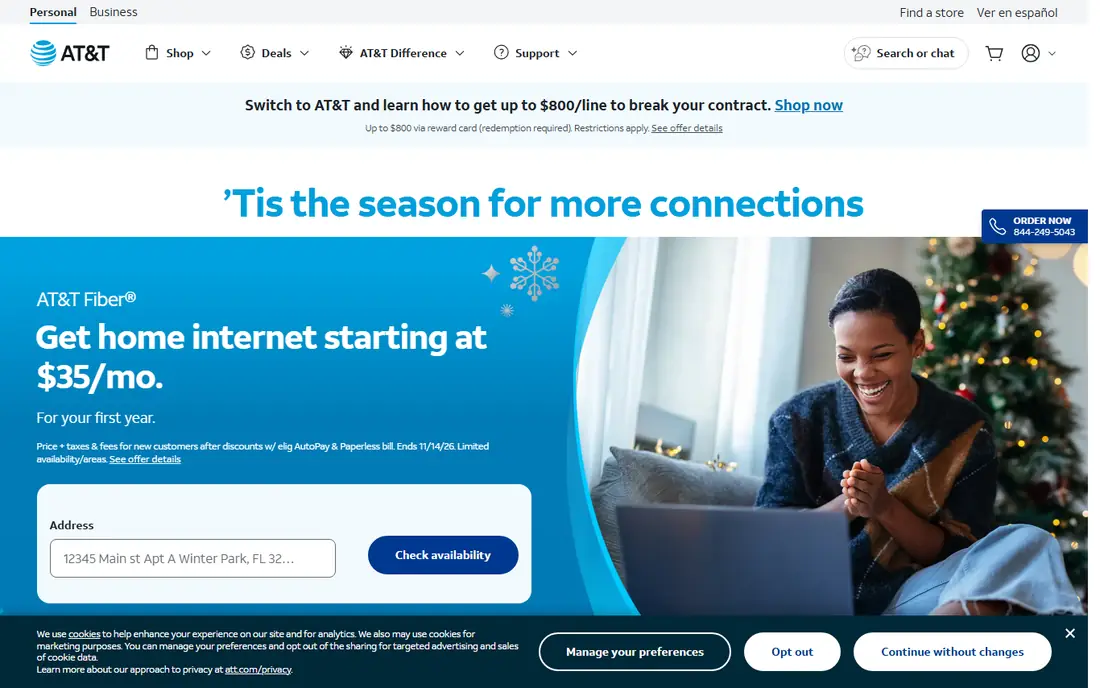
AT&T Fiber is our pick for households that can get it. Fiber plans offer the same speed up and down, which makes video calls, cloud backups and uploads feel far less constrained than on cable. The provider also describes fiber plans as having unlimited data and no annual contract, which keeps the terms simple.
The catch is coverage. AT&T still sells slower DSL-based internet in some areas, and that is a different product from AT&T Fiber. Enter your exact address on the provider site and confirm the word Fiber appears in the plan name and speed details. If only DSL is available, compare cable or 5G options before accepting a slow plan.
- Matching upload and download speeds on fiber plans
- Unlimited data on fiber plans as described by the provider
- No annual contract on fiber
- Fiber is not available at every AT&T address
- DSL plans in some areas are far slower
Verizon Fios is a fiber service with a smaller footprint than Xfinity or Spectrum, concentrated in the Northeast and Mid-Atlantic. Where it is available, it is often the best service for internet at that address, thanks to matching upload and download speeds and a straightforward fiber plan range. Households that stream, game and work from home at the same time tend to benefit most.
Outside its fiber footprint, Verizon sells 5G Home Internet instead, which is a different technology with its own speeds and availability checks. Do not assume a Verizon plan at your address is Fios. Check the address result carefully, and compare Fios with any cable fiber hybrid at the same home.
- Symmetrical fiber speeds
- Strong reputation for reliability in its footprint
- No data caps on Fios plans as described by the provider
- Limited geographic footprint
- 5G home internet is a separate product with different speeds
Google Fiber keeps its offer simple: a small number of fast fiber plans, with matching upload and download speeds and no data caps as described by the provider. That simplicity makes it easy to compare, and the top speeds suit large households, creators and people who move large files often.
Availability is the main limit. Google Fiber serves selected cities and areas within them, so many readers will not be able to buy it at all. If it is available at your address, it is usually worth pricing against cable and other fiber providers, because the simple terms can offset a higher starting price over a year.
- Simple plan range with fast speeds
- Symmetrical speeds on fiber plans
- No data caps as described by the provider
- Available in a limited number of cities
- Installation and availability depend on local build-out
T-Mobile Home Internet
Who it suits: 5G home internet with flat pricing
T-Mobile Home Internet uses 5G fixed wireless, so it can serve homes where fiber has not been built and cable is slow or costly. The gateway is designed for self-setup, and pricing is simpler than many cable promos, with the provider describing taxes and fees as included on some plans. For renters and people in areas with limited wired choice, that simplicity is appealing.
Speed is the variable to test. Real speeds depend on signal strength, distance from the tower and how busy the network is at peak times. T-Mobile offers an address check and a trial period in many cases, so test it during your normal evening use before you cancel a wired service. If the signal is strong, it can be the best service for internet in that home.
- No wired line needed
- Flat-rate pricing with taxes and fees often included as described by the provider
- Easy self-setup gateway
- Speeds vary with 5G signal and network load
- Not ideal for the heaviest gaming or upload use in weak-signal areas
Cox is a cable provider serving parts of the South, West and Midwest, with plans from basic browsing speeds to gigabit tiers in many areas. Bundles with TV and mobile can suit households that want one bill, and the provider offers a range of equipment and support options. If Cox is the main cable provider at your address, it is a solid baseline to compare against fiber or 5G.
Check the details that affect the total bill. Some Cox plans have data caps, equipment rental adds cost, and promo rates change after the promo period. If you use a lot of data for streaming, gaming and backups, ask about the cap, overage terms and the price of an unlimited data option before you choose a tier.
- Wide cable range in its states
- Bundle options with TV and mobile
- Higher-speed tiers in many areas
- Data caps apply on some plans
- Promo prices rise after the promo period
Frontier Fiber is expanding in many states, and where fiber is available it offers a competitive alternative to cable. Fiber plans give matching upload and download speeds, and the provider describes price-lock options that can help with budgeting. For homes that have lived with slow DSL or a single cable provider, a new fiber option can change the choice entirely.
As with AT&T, the address check matters more than the brand name. Some Frontier addresses still have DSL, which is far slower than fiber, so confirm the plan is a fiber plan and note the speed tier. If fiber is available, compare its standard rate and terms with cable at the same address, since promo and price-lock details differ.
- Fiber plans with matching upload and download speeds
- Price-lock options described by the provider
- Growing fiber footprint
- Some addresses still have slower DSL or older plans
- Availability varies street by street
How we picked these
We compared official provider pages, plan and pricing pages, coverage descriptions and public reviews for US home internet. We focused on providers with broad coverage, a clear fiber, cable or 5G product, and published starting prices or terms we could describe without inventing a rate. Where promo prices and standard rates differed, we noted that gap rather than presenting a promo as the long-term price.
We did not claim hands-on speed tests at reader addresses, because speeds vary by address, wiring and home network. We also did not treat a national ranking as proof for a single home. The method here is comparison of published plans and terms, plus address checks, which is the step that decides the real choice for most households.
How to choose the best internet service for your address
Start with availability, not with a national top pick. Enter your exact address on each provider site, note which technology is offered, and write down the speed tier, promo price, standard price, equipment fee, data cap and contract term. That short list is your real shortlist, and it will often contain only two or three providers.
Speed: how much do you actually need
For one or two people browsing, streaming and working from home, 100 to 300 Mbps download is usually enough. Larger households, 4K streaming on several screens, gaming and large uploads push that toward 500 Mbps or gigabit, and fiber helps most when uploads matter. Do not pay for multi-gigabit speeds if your devices, router and wiring cannot use them, and remember that Wi-Fi speeds are lower than wired speeds in most homes.
Price: look past the first year
Add equipment rental, taxes and fees where they apply, and note the standard rate after any promo. A plan that looks cheap for 12 months can cost more in year two than a slightly higher plan with a price lock. If you can buy a compatible modem or router, check whether that saves rental fees, but confirm compatibility with the provider first.
Contracts, caps and support
Check whether a contract is required, what the early exit terms are, and whether data caps or overage charges apply. If you work from home, ask about outage support and whether the provider offers a backup option. For rural homes, check satellite and fixed wireless options too, even if they are not on this list, since they may be the only service at that address.
Frequently asked questions
Which internet service is the best?
The best internet service is the fastest reliable service available at your address at a price you can accept long term. Fiber is usually best where it is sold, followed by cable and then 5G home internet in strong-signal areas. Use address checks for Xfinity, Spectrum, AT&T Fiber, Verizon Fios, Google Fiber, T-Mobile, Cox and Frontier, then compare standard rates, not just promos.
Who is the best internet service provider in the US?
No one provider wins nationally, because coverage differs by state and street. Xfinity and Spectrum cover the most homes with cable, AT&T Fiber and Verizon Fios lead on fiber where they are built, and Google Fiber leads on simple fast fiber in its cities. Judge a provider by the plan, speed and standard price at your address, plus caps and contract terms.
What are the best deals on internet service?
The best deals are usually promo prices for new customers, student or low-income programs where you qualify, and bundles that replace a separate TV or mobile bill. Check the standard rate after the promo, equipment fees and contract length, since a low first-year price can hide a higher second year. Ask the provider to confirm the total monthly bill in writing before you order.
Is fiber better than cable?
Fiber is usually better for uploads, latency and consistent speeds, because upload speeds often match download speeds. Cable can still be very fast for downloads and is available in more homes. If you mainly stream and browse, cable may be enough. If you upload large files, join many video calls or run a home server, fiber is the stronger choice where it is available.
How fast should my internet be for working from home?
For most remote work, 100 Mbps download and at least 20 Mbps upload covers video calls, file sharing and browsing, though larger households need more. Fiber helps because uploads match downloads. Test your current speed at peak times, and upgrade only if calls freeze, uploads stall or several people cannot work at once.
Why do advertised speeds say up to, and not guaranteed?
Advertised speeds describe the maximum for a wired connection under good conditions, not a promise for every device over Wi-Fi. Router placement, older devices, wiring and network load all reduce real speeds. Wired tests give the clearest check, and providers state that actual speeds vary and are not guaranteed. Use that wording as a reason to test during a trial period where one is offered.
Sources we checked (8)

Online Jobs is an independent blog about careers, online work, learning new skills and the tools that help people earn. More about us.
Keep reading
All posts
Best Phone Company
Looking for the best phone company in 2026? We compared 9 US carriers on price, coverage, data and perks so you can pick the right plan for your line.

Best Google Search Alternatives
Looking for Google search alternatives with more privacy or different results? We compare eight search engines on price, privacy, results and AI answers.
Best EV Charging App
Best ev charging app picks for US drivers in 2026, compared by station coverage, payments, trip planning, and driver reports for public charging across the US.