Best Global Payroll Services in 2026: 9 Services Compared


Broad global payroll and contractor platform · Starting price: $29 per employee per month
How we put this together: we compare official feature and pricing pages, app store listings, privacy policies and public user reviews. Prices change, so check the provider's site before you pay.
Key takeaways
- Deel and Remote offer the broadest mix of payroll, contractors, and EOR.
- Papaya Global leads for finance reporting and centralized payments.
- Rippling fits teams that want HR, IT, and payroll in one system.
- Oyster and Multiplier suit remote-first and budget-conscious EOR hiring.
- Always compare payroll and EOR prices separately, and budget employer contributions on top.
Quick comparison
| Name | Who it suits | Starting price | Free option | |
|---|---|---|---|---|
| Deel | Broad global payroll and contractor platform | $29 per employee per month | Free trial | Visit |
 Remote | Owned-entity compliance and IP protection | $29 per employee per month | Free trial | Visit |
 Papaya Global | Finance-led payroll with treasury and reporting | $12 per employee per month | Free trial | Visit |
 Oyster | Distributed-first hiring with clear EOR pricing | See website | Free trial | Visit |
 Rippling | One system for HR, IT, payroll, and finance | See website | Free trial | Visit |
 Multiplier | Lower-cost owned-entity EOR hiring | $20 per employee per month | Free trial | Visit |
 CloudPay | Enterprise payroll with treasury integration | $20 per employee per month | Free trial | Visit |
 ADP Global Payroll | Enterprise payroll for large multinationals | See website | Free trial | Visit |
 G-P | Enterprise EOR hiring at scale | See website | Free trial | Visit |
The best global payroll services
Global payroll is not one product. Some vendors calculate payroll for your own entities, some act as the legal employer through EOR, and some do both at very different prices. The nine services below cover each model, so you can match the vendor to whether you have entities, need EOR, or need both.
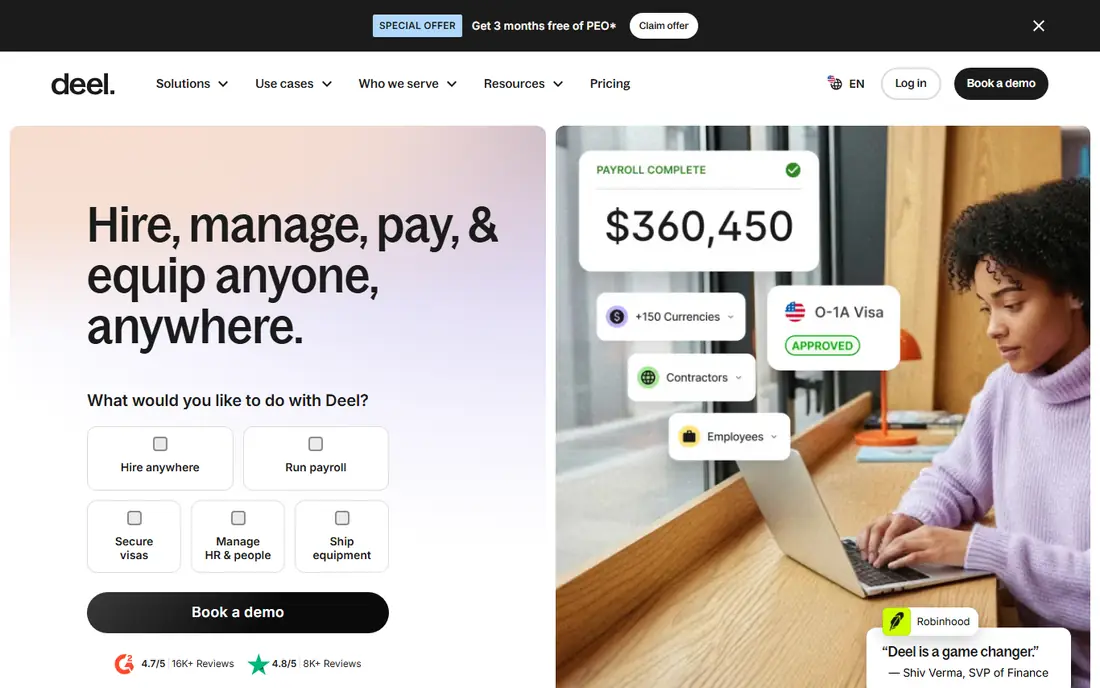
Deel is the broadest platform for teams hiring across many countries. It covers global payroll, contractors, and employer-of-record hiring in one system, with integrations for HR and finance tools. That breadth suits startups that grow country by country and do not want a new vendor each time.
The catch is price structure. Payroll pricing and EOR pricing are different products, and EOR costs far more per employee. Get a quote for your exact country mix, and budget employer contributions on top of the platform fee.
- Payroll in many countries
- Contractor and EOR options
- Strong integrations
- EOR pricing is much higher than payroll
- Setup fees can apply per entity
Remote suits compliance-first teams that want owned entities, not just partners. Its owned-entity model gives it direct control over payroll and compliance in the countries it covers, which helps with IP protection and data handling. Contractor hiring is straightforward, and payroll pricing is published.
The catch is that headline payroll pricing is not the whole bill. EOR pricing is higher, and off-cycle runs and year-end work can cost extra. Confirm the full quote for each country before you sign.
- Owned entities in many countries
- Contractor and EOR options
- Transparent payroll pricing
- EOR pricing is higher
- Some services cost extra, such as year-end processing
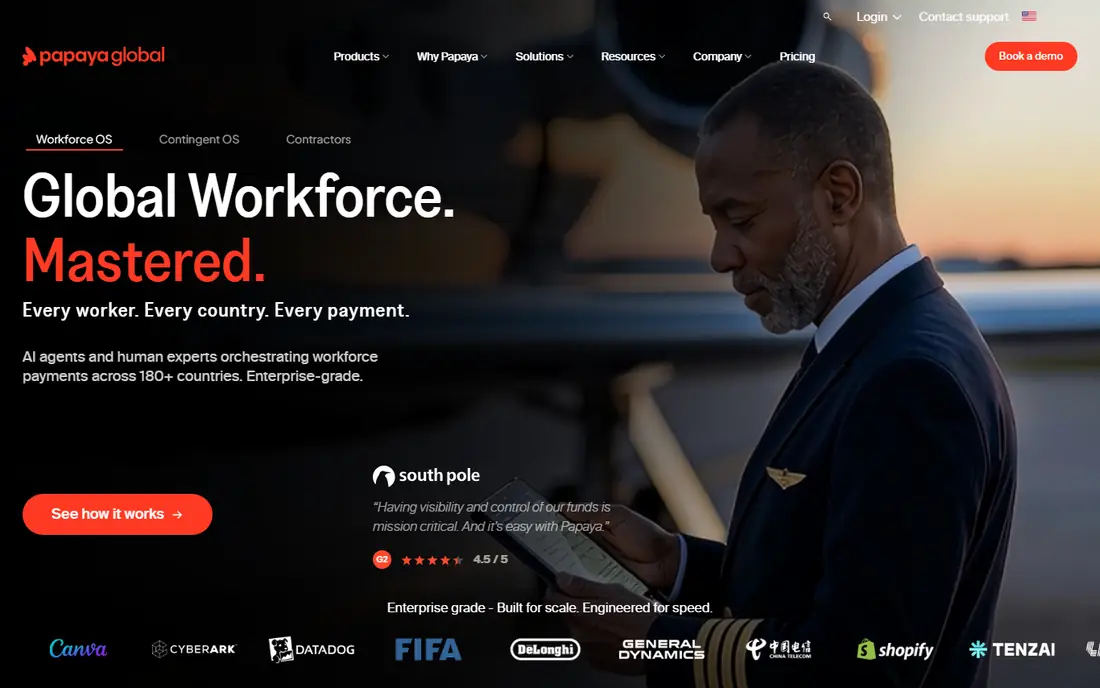
Papaya Global fits finance teams running payroll across many countries. Its centralized payments and analytics give finance a clear view of payroll costs, currencies, and compliance across countries. That reporting depth suits larger teams with complex payroll calendars.
The catch is fit. Papaya is enterprise-leaning, and some pricing needs a quote, so small teams may find simpler tools faster to buy. If reporting and treasury matter most, it earns a close look.
- Centralized payments
- Workforce analytics
- Broad country coverage
- Enterprise focus
- Some pricing is quote-based
Oyster is a good fit for remote-first teams hiring abroad for the first time. Its hiring workflow is friendly, with local experts and clear contracts, and its EOR coverage is broad. That helps lean HR teams that do not have payroll specialists in each country.
The catch is that Oyster is EOR-first. If you already have entities and only need payroll calculation, a payroll-first vendor may fit better. Compare EOR and payroll prices separately.
- EOR in many countries
- Contractor hiring
- Friendly hiring workflow
- Standalone payroll is limited
- EOR pricing is higher than payroll-only tools
Rippling suits US-headquartered teams that want one system for everything. It combines HR, IT device management, payroll, and finance, with automations that cut manual onboarding work. For a team already using Rippling for HR, adding global payroll keeps data in one place.
The catch is pricing clarity. Modular pricing means you need a demo to confirm what payroll costs for your countries. Check native payroll depth per country, since it varies.
- HR, IT, and finance in one platform
- Global payroll add-on
- Strong automations
- Modular pricing needs a demo to pin down
- Global payroll depth varies by country
Multiplier appeals to budget-conscious teams that still want owned-entity EOR. Its EOR pricing is lower than several rivals, and its owned-entity model gives direct control in the countries it covers. That mix suits mid-market teams expanding carefully.
The catch is fees. Setup, implementation, and statutory fees can sit on top of the headline rate, so ask for an all-in quote. Confirm payroll pricing separately, since it is less transparent than EOR pricing.
- Owned entities
- EOR and payroll options
- Competitive EOR pricing
- Extra fees can apply for setup and statutory items
- Payroll pricing is less transparent
CloudPay fits enterprises that run payroll through their own entities. Its owned-entity payroll and treasury integration suit large finance teams that need control over payments and reporting. It is built for scale, not for a first hire abroad.
The catch is scope. CloudPay does not offer EOR hiring, so you need your own entities. Smaller teams will find payroll-first rivals easier to buy and use.
- Payroll in many countries
- Treasury and finance integration
- Owned-entity model
- Enterprise focus
- No EOR product
- Quote-based pricing at larger scale
ADP Global Payroll
Who it suits: Enterprise payroll for large multinationals
ADP Global Payroll suits large companies with complex, long-standing payroll needs. Its GlobalView and Celergo products cover many countries through a partner network, with deep compliance experience. Enterprises already on ADP get continuity and familiar reporting.
The catch is cost and speed. Pricing is quote-based, and implementation can be a major project. Small and mid-sized teams should compare Deel, Remote, and Papaya first.
- Payroll in many countries
- Deep compliance history
- Partner network
- Quote-based pricing
- Implementation can be large and slow
G-P fits enterprises that need EOR hiring across many countries. Its EOR coverage is broad, with contractor hiring and analytics for global teams. Large companies value its compliance depth and onboarding support for new countries.
The catch is pricing. EOR pricing is quote-based, so you cannot compare it directly from a pricing page. If you only need payroll, choose a payroll-first vendor instead.
- EOR in many countries
- Contractor hiring
- Analytics
- Quote-based EOR pricing
- No standalone payroll product
How we picked these
We compared official feature pages, pricing pages, and app store listings, and we checked that each vendor homepage loads and matches the product named. We favored tools that are still offered in October 2026, that fit the topic without stretching the definition, and that publish clear pricing or a clear route to a quote. Where a price was not published on the vendor site, we wrote See website instead of guessing. We did not claim hands-on testing we did not do, and we treated public reviews as background only, not as proof of a feature.
How to choose a global payroll service
First, decide the model. If you have an entity in a country, you need payroll calculation and filing. If you do not, you need EOR, where the vendor is the legal employer. Mixing those two up is the most common and expensive mistake in this market.
Second, get a country-by-country quote. Headline rates hide setup fees, year-end fees, FX spreads, and employer social contributions, which can add a large share on top of salary. Ask for an all-in loaded cost for each country where you will hire.
Third, test reporting and support. Payroll errors affect real people, so check how fast support answers, how payroll calendars work, and whether finance gets clean reports. A pilot in one country tells you more than a sales demo.
One more check helps: ask each finalist to walk through a full payroll run for one country, from data entry to payslip to filing. Watch how errors are flagged, how corrections are made, and how long support takes to answer a real question. A smooth demo can hide a slow correction process, and payroll mistakes affect trust fast.
Frequently asked questions
What is the best global payroll service?
Deel is the broadest pick for mixed payroll, contractor, and EOR needs. Remote suits compliance-first teams, while Papaya Global suits finance-led enterprises.
What is the best global payroll software for startups?
Startups often start with Deel or Remote for published payroll pricing and broad coverage. Oyster and Multiplier are worth comparing for EOR hiring on a tighter budget.
What is the difference between global payroll and EOR?
Global payroll calculates and files pay for employees of your own entity. EOR means the vendor legally employs the worker in a country where you have no entity, and payroll comes bundled with that service.
How much does global payroll cost per employee?
Payroll-only pricing often starts around $12 to $29 per employee per month, while EOR often starts around $400 to $700 per employee per month. Employer contributions and fees sit on top.
Which global payroll platform covers the most countries?
Coverage claims vary by model, with EOR coverage often higher than native payroll coverage. Check coverage for your exact countries, not the headline total.
Sources we checked (9)

Online Jobs is an independent blog about careers, online work, learning new skills and the tools that help people earn. More about us.
Keep reading
All posts
n8n Alternatives
n8n alternatives compared for 2026, with Zapier, Make, Activepieces, and more, covering visual builders, code steps, self-hosting, and pricing models.

ZoomInfo Alternatives
The best ZoomInfo alternatives in 2026, compared on price, free plans, data coverage, and which tool fits small teams or large sales teams best in detail.

Zoom Alternatives for Webinars
Compare Zoom alternatives for webinars in 2026, from browser-based rooms to enterprise events, with prices, attendee limits, features and honest trade-offs.