Best Event Registration Software in 2026: 8 Platforms Compared

How we put this together: we compare official feature and pricing pages, app store listings, privacy policies and public user reviews. Prices change, so check the provider's site before you pay.
Key takeaways
- Eventbrite is the best choice for public ticketed events, with free publishing for free events and a built in audience.
- RegFox suits budget focused organizers, with a low flat fee per paid registrant and no upfront license cost.
- Whova and Cvent lead for conferences, with attendee apps, networking, and complex registration forms.
- Always add up service fees, payment processing, and per registrant charges before you compare headline prices.
Quick comparison
| Name | Who it suits | Starting price | Free option | |
|---|---|---|---|---|
 Eventbrite | Public ticketed events | Free | Yes | Visit |
 RegFox | Budget focused registration | See website | No | Visit |
 Whova | Conference networking | See website | No | Visit |
 Cvent | Large enterprise events | See website | No | Visit |
 Bizzabo | B2B conference marketing | See website | No | Visit |
 Splash | Brand led event pages | Free | Yes | Visit |
 Swoogo | Custom registration forms | See website | No | Visit |
 EventMobi | Association and hybrid events | See website | No | Visit |
The best event registration software
Event registration software should do more than collect names. It should handle ticket types, payment, check in, refunds, and attendee communication without forcing you into spreadsheets. The eight platforms below cover free community events, paid public events, and large conferences, with very different fee models.
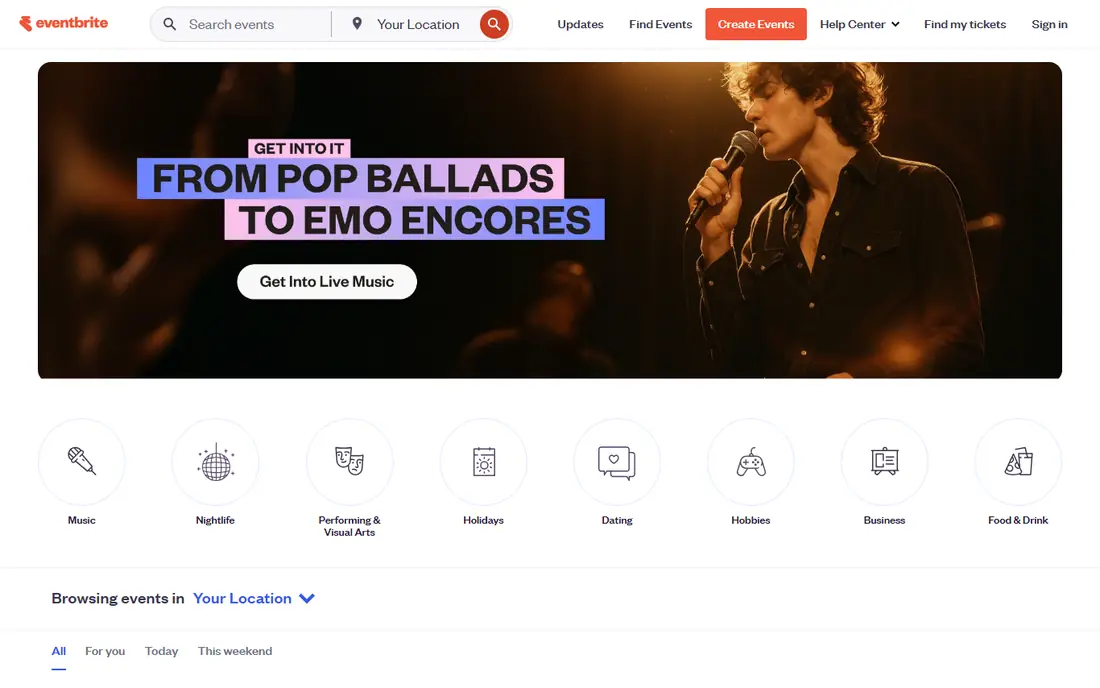
Eventbrite is the default choice for public events that sell tickets, from concerts and classes to community fundraisers. Publishing is free for free events, and paid events use a per ticket fee model that includes a service fee plus payment processing. That model means you pay nothing upfront, which suits small organizers.
The catch is the total fee per ticket, so model your ticket price with fees included before you publish. Complex conferences with multi track sessions, abstracts, and member pricing may outgrow Eventbrite. For straightforward ticketed events with a public audience, its discovery reach and simple setup are hard to beat.
- Free to publish free events
- Built in event discovery
- Simple ticket setup and mobile check in
- Fees on paid tickets add up, including service and payment processing charges
- Less suited to complex conference registration
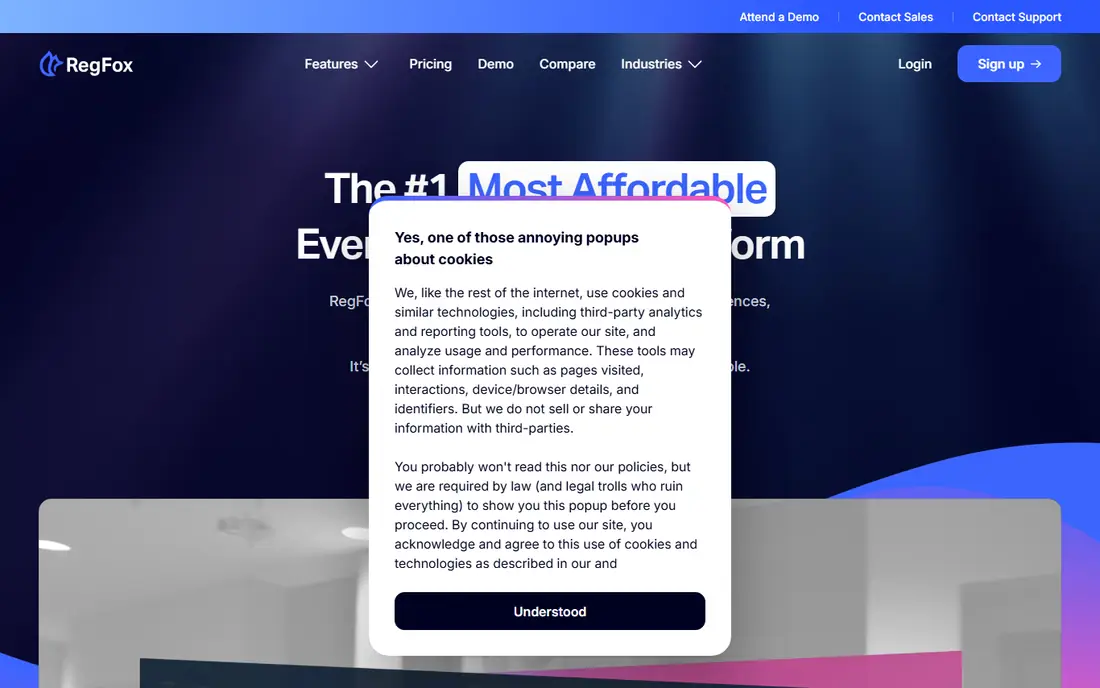
RegFox appeals to organizers who want to keep more of each registration fee. Its model charges a small flat amount plus a percentage per paid registrant, capped at a set amount, with no upfront license cost. That structure often beats percentage heavy ticket fees for higher priced registrations, such as camps, courses, and races.
The trade off is discovery. RegFox does not bring the same public marketplace traffic as Eventbrite, so you need your own promotion. If you already have an audience through email, schools, or a community, RegFox can save real money over a season of events.
- Low flat fee per paid registrant, capped per registrant
- No upfront licensing fee
- Flexible form builder
- Less of a built in public audience than Eventbrite
- Event app features are more limited
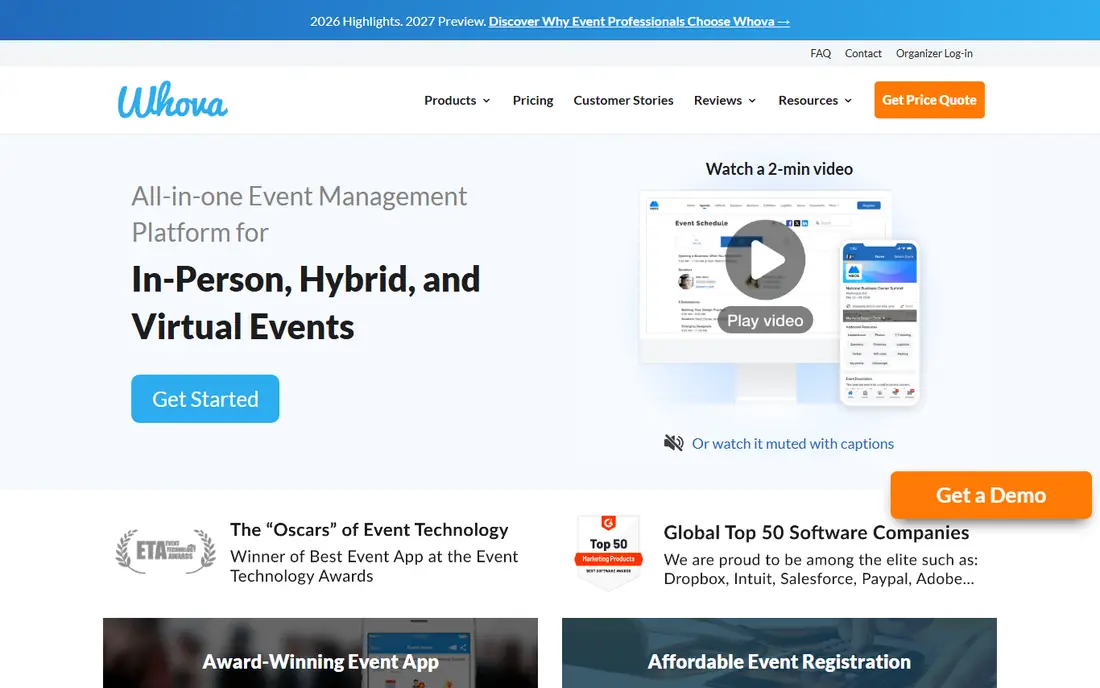
Whova is built for conferences, association meetings, and expos where attendees need agendas, networking, and session details in one app. Registration feeds directly into the attendee app, so changes to sessions and speakers reach attendees without a separate tool. That integration is the main reason conference organizers choose it.
Pricing is custom and based on event size and length, so get a quote early in your planning. For a simple ticketed show, Whova may be more than you need. For a multi day conference where networking matters, the attendee experience often justifies the quote.
- Strong attendee app with networking and agendas
- Registration plus event app in one system
- Per ticket fee model for paid events
- Pricing is custom per event
- Smaller events may find the full platform more than they need
Cvent is the enterprise standard for large conferences, meetings, and event programs with complex needs. Conditional registration paths, approval workflows, housing blocks, and detailed reporting are all part of the platform. Large teams with many events per year benefit from its scale and integrations.
The downside is cost and setup time. Custom pricing and a longer onboarding process make Cvent a poor fit for a single small event. Choose it when you run a program of events, need strict approval and reporting controls, or already use other enterprise event tools.
- Deep registration logic for complex events
- Venue sourcing and reporting tools
- Strong enterprise integrations
- Custom annual pricing can be high
- Implementation takes longer than simpler tools
Bizzabo positions itself as an event operating system for business conferences, combining registration, marketing, and attendee engagement. Branded registration pages, email tools, and lead capture help marketing teams tie event attendance to pipeline. That breadth suits B2B conferences with sponsors and sales follow up.
Small teams should check the annual cost carefully, since pricing is aimed at mid market and enterprise events. If you only need tickets and check in, a simpler tool will cost less. If event marketing and lead capture are core to your event, Bizzabo earns its place on the shortlist.
- Registration plus event marketing and attendee engagement
- Lead capture tools
- Branded event websites and apps
- Annual pricing is high for small teams
- Full value needs marketing team time
Splash is a good fit for brand led events where the registration page itself matters, such as product launches, networking nights, and corporate gatherings. Design controls let you build a page that matches your brand without a developer, and the free tier covers basic event pages. That makes it easy to test for a single event.
Complex registration, such as multi track conference logic or member pricing tiers, is lighter here than in dedicated conference tools. Use Splash when the event is about brand experience and guest list management, and use a conference platform when the program itself is complex.
- Free tier for event pages
- Strong design and branding controls
- Useful for launches and networking events
- Paid plans are quote based for larger use
- Registration logic is lighter than Cvent or Swoogo
Swoogo is known for registration forms that adapt to the attendee, showing different questions, prices, and options based on earlier answers. That flexibility helps conferences with member rates, session choices, and sponsor passes, without forcing every attendee through the same long form. Design control is also strong, so pages can match event branding closely.
The price reflects that power, with annual plans aimed at teams that run events regularly. A one off small event will usually be cheaper on Eventbrite or RegFox. For event marketers who run a calendar of branded events, Swoogo saves time on form building and reporting.
- Highly flexible registration forms with conditional logic
- Strong design control
- Built for event marketers
- Pricing is aimed at mid market teams
- Smaller organizers may find it costly
EventMobi combines registration with an event app, networking, and virtual event options, which suits associations and hybrid conferences. Templates speed up setup for recurring association meetings, and the app keeps in person and virtual attendees in one place. That breadth helps teams that run both formats.
Custom pricing means you need a quote, and the full suite may be more than a simple ticketed event needs. If your event is hybrid, or your association runs many meetings a year, the combined registration and app package can replace two separate tools.
- Registration plus event app and virtual options
- Templates for associations
- Per event or annual packages
- Pricing is custom
- Smaller events may not need the full app suite
How we picked these
We compared official pricing pages, fee disclosures, and feature lists for each platform, and we checked that each one still offers registration as a core product in October 2026. We included free and low fee options, conference platforms, and enterprise tools, so organizers at different sizes can compare total cost, not just headline price. Fees change, so confirm the current fee schedule on the vendor site before you set ticket prices.
How to choose event registration software
Start with your event type, then work out total fees, then test the attendee path from registration to check in. A tool that looks cheap on paper can cost more once fees, staff time, and attendee confusion are counted.
Model the total fee per ticket
Add service fees, payment processing, and any per registrant charge, then compare that total across platforms at your actual ticket price. A low percentage fee can still cost more than a capped flat fee on high priced tickets, and the reverse is true for low priced tickets. Publish a ticket price that covers the fee model you choose.
Test the full attendee journey
Register as a test attendee, buy a ticket, receive the confirmation, and check in with the mobile app. Look for confusing form steps, missing confirmation details, and slow check in. Attendee problems on event day cost far more staff time than a slightly higher platform fee.
Check reporting and refunds
Confirm that you can export attendee lists, track ticket types, and process refunds without contacting support for every case. For conferences, check session capacity, waitlists, and member pricing before you commit. Good reporting saves hours after the event, when sponsors and finance teams ask for numbers.
Frequently asked questions
What is the best event registration platform for conferences?
Whova and Cvent are strong conference registration platforms, with Whova leading on attendee networking and Cvent leading on complex enterprise registration. Swoogo is also strong for custom registration forms. The best conference registration software for you depends on event size, session complexity, and whether you need an attendee app.
What is the best free event registration software?
Eventbrite is the best free event registration option for free events, since publishing and registration carry no platform fee for free tickets. Splash also offers a free tier for event pages. For paid events, compare total per ticket fees rather than the free tier alone, since fees vary a lot by ticket price.
What is the best event registration app for small events?
Eventbrite suits small public events that need discovery and simple tickets, while RegFox suits small events with an existing audience that want lower per ticket fees. Test both with a real ticket price, since the cheaper option flips depending on price and volume. For internal or private events, a branded page tool such as Splash may be enough.
How much does event registration software cost?
Costs range from free for free events to custom annual contracts for enterprise platforms, with paid ticket fees typically combining a service fee and payment processing. RegFox uses a capped flat fee model, while Eventbrite and Whova use percentage plus fixed fee models. Always model total cost at your ticket price and expected volume.
What is the best online registration platform for paid events?
The best online registration platform for paid events depends on ticket price and audience. Eventbrite wins on discovery for public events, RegFox wins on fee control for higher priced registrations, and Whova wins when the event also needs a conference app. Compare total fees, refund handling, and check in tools before you choose.
Sources we checked (8)

Online Jobs is an independent blog about careers, online work, learning new skills and the tools that help people earn. More about us.
Keep reading
All posts
ZoomInfo Alternatives
The best ZoomInfo alternatives in 2026, compared on price, free plans, data coverage, and which tool fits small teams or large sales teams best in detail.

Workday Alternatives
We compared the best workday alternatives for HR, payroll, and global hiring, from BambooHR and Gusto to Rippling, Deel, and HiBob for growing teams in 2026.
Which SaaS Tools Have the Best Customer Support
Which SaaS tools have the best customer support? Compare eight popular tools on help centres, live help, response options and overall support quality.