8 Best ERP Software Systems for Small Business to Enterprise

How we put this together: we compare official feature and pricing pages, app store listings, privacy policies and public user reviews. Prices change, so check the provider's site before you pay.
Key takeaways
- Odoo is the best starting point for small and growing businesses, with modular apps you can add as needs grow, while NetSuite suits mid-market firms that need finance and operations in one cloud system.
- Microsoft Dynamics 365 Business Central is the best choice for companies already on Microsoft 365, thanks to native links with Outlook, Excel, and Power BI.
- SAP S/4HANA and Oracle Fusion Cloud ERP suit large, global enterprises with complex manufacturing, multi-entity finance, and strict compliance needs.
- Acumatica suits distributors and manufacturers with many users, since its pricing tracks usage rather than charging per user in the same way as rivals.
- ERP pricing depends on modules, user count, and implementation, so a vendor quote and an implementation estimate matter more than any list price.
Quick comparison
| Name | Who it suits | Starting price | Free option | |
|---|---|---|---|---|
 Odoo | Small and growing businesses | See website | No | Visit |
 Microsoft Dynamics 365 Business Central | Microsoft-first companies | See website | No | Visit |
 Oracle NetSuite | Mid-market finance and operations | See website | No | Visit |
 SAP S/4HANA | Large enterprise manufacturing | See website | No | Visit |
 Oracle Fusion Cloud ERP | Global enterprises | See website | No | Visit |
 Acumatica Cloud ERP | Distributors with many users | See website | No | Visit |
 Sage Intacct | Finance-led services firms | See website | No | Visit |
 ERPNext | Budget-conscious small businesses | See website | No | Visit |
The best erp software
We compared target company size, finance and inventory depth, manufacturing support, deployment options, integration with common tools, and pricing model.
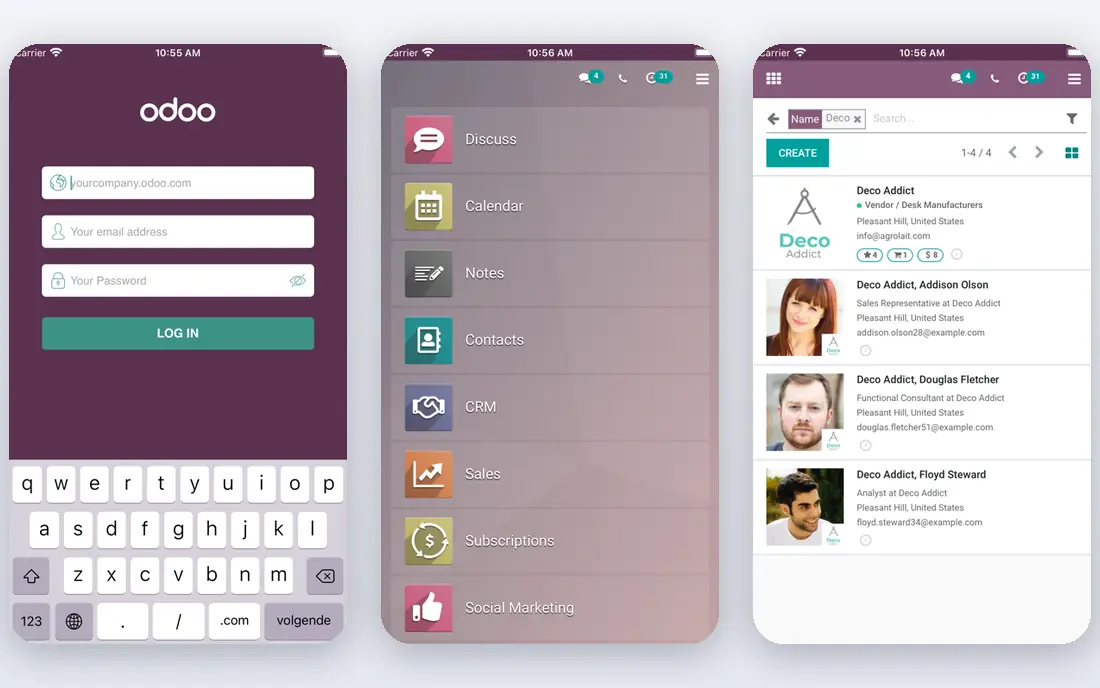
Odoo is the most flexible starting point for a small or growing business. Its system is built from modules for CRM, sales, inventory, accounting, manufacturing, and human resources, so a company can start with finance and inventory and add manufacturing or project tools later without switching platforms. The interface is modern, the app ecosystem is large, and the modular model keeps early costs lower than a full enterprise suite.
The catch is implementation discipline. A modular system still needs clean data, clear processes, and someone to own the rollout, and advanced features may need a partner or a higher tier. Odoo suits companies that want to grow into ERP gradually, rather than buy a large suite on day one and use a fraction of it.
- Modular apps for sales, inventory, accounting, and manufacturing
- You add only the modules you need
- Large app ecosystem
- Implementation and customization still need planning
- Advanced features require higher tiers or partner help
Microsoft Dynamics 365 Business Central
Who it suits: Microsoft-first companies
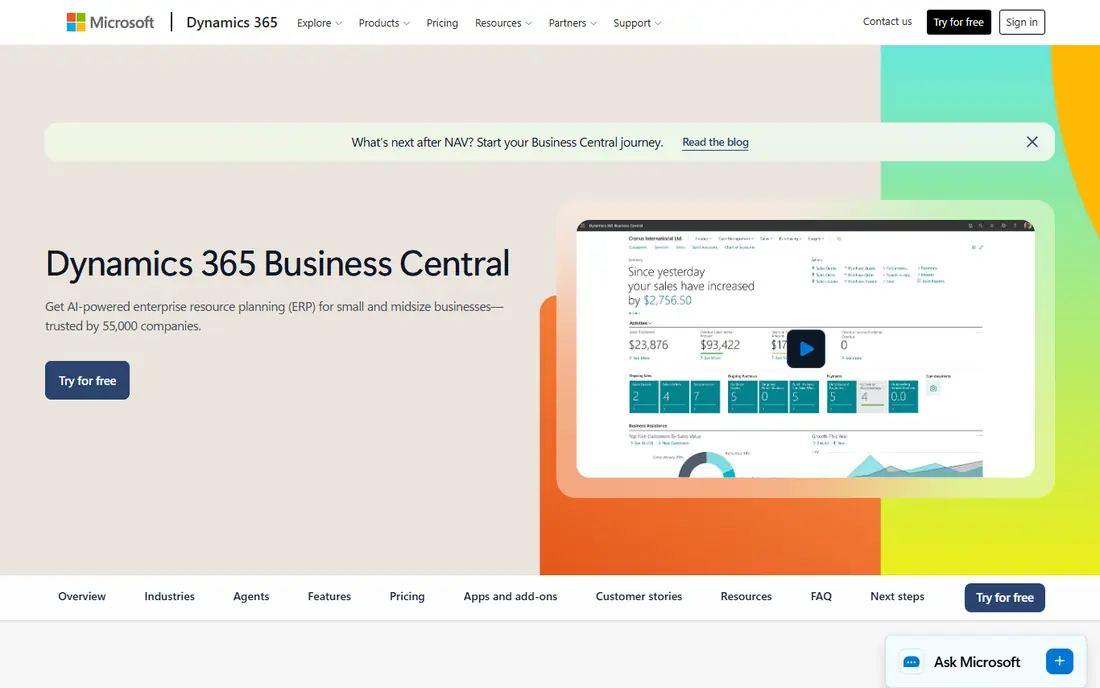
Business Central is the natural ERP choice for a company already running on Microsoft 365. It links natively with Outlook for email, Excel for reporting, Teams for collaboration, and Power BI for dashboards, so staff work inside familiar tools rather than learning a separate system. Finance, inventory, sales, and purchasing are strong, and cloud deployment keeps updates and maintenance with Microsoft.
The limits are manufacturing depth and setup cost. Advanced manufacturing features sit in the premium tier, and most rollouts run through a Microsoft partner, which adds implementation fees. Business Central suits small to mid-market firms that already pay for Microsoft 365 and want ERP that fits that stack without a rip-and-replace project.
- Native integration with Microsoft 365, Excel, Outlook, and Power BI
- Strong finance and inventory
- Cloud deployment
- Manufacturing depth needs the premium tier
- Partner-led setup adds implementation cost
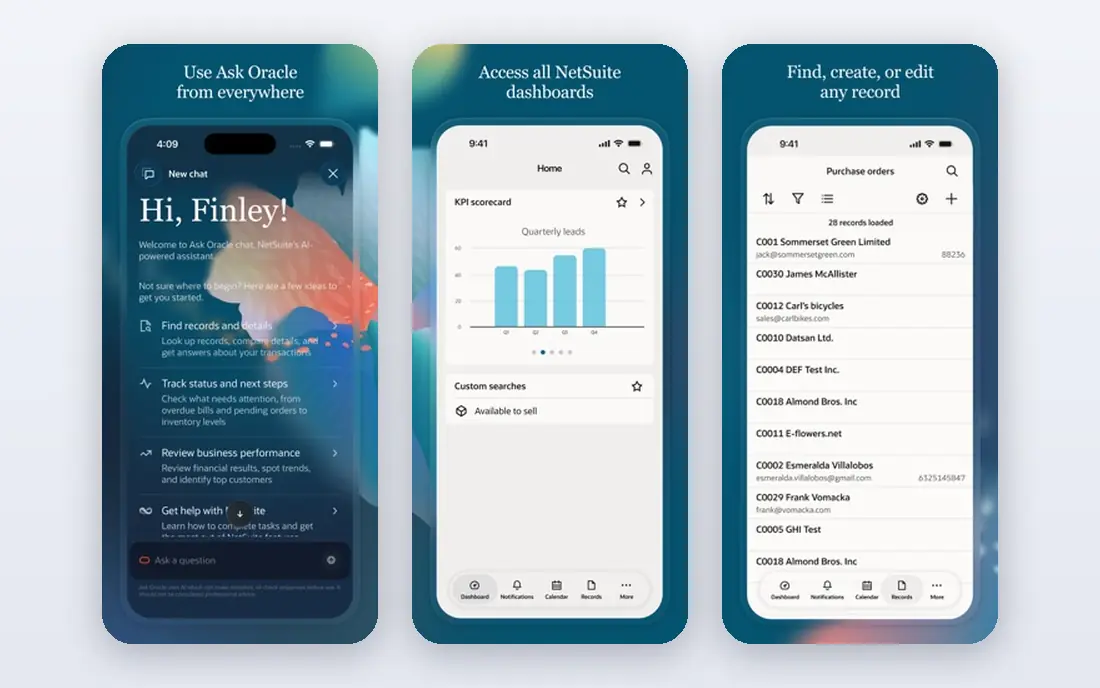
NetSuite is the best cloud ERP for mid-market firms that need finance and operations in one place. It combines accounting, inventory, order management, and CRM in a single cloud system, with strong support for multi-entity companies, multi-currency transactions, and distributed teams. Its partner ecosystem is large, and its reporting tools give finance teams a single view across subsidiaries.
The trade-off is cost growth. The base platform fee plus per-user and module fees means the bill climbs as you add seats and functions, and a complex rollout can take months. NetSuite suits growing firms that have outgrown basic accounting software and need a unified system, with a budget that covers both subscription and implementation.
- Finance, inventory, and order management in one cloud system
- Strong multi-entity and multi-currency support
- Large partner ecosystem
- Cost climbs with users and modules
- Implementation can be long for complex firms
SAP S/4HANA is the enterprise pick for large manufacturers and global firms. Its depth in production planning, supply chain, procurement, and finance is unmatched in this list, and its compliance and localization support covers many countries and tax regimes. The in-memory design handles large transaction volumes fast, which matters for firms with complex plants and global warehouses.
The cost is the honest catch. S/4HANA carries a high subscription and implementation bill, rollouts often take a year or more, and success needs experienced consultants plus strong internal ownership. It suits large enterprises with complex operations and a budget to match, not small firms that need a quick finance upgrade.
- Deep manufacturing, supply chain, and finance capabilities
- Strong global compliance
- In-memory speed for large data volumes
- High total cost
- Long implementation
- Needs experienced consultants and internal ownership
Oracle Fusion Cloud ERP is Oracle's enterprise cloud suite for large, global organizations. It unifies finance, procurement, project management, and supply chain in one cloud system, with built-in AI tools for forecasting, anomaly detection, and automated close tasks. Multi-entity, multi-currency, and compliance support suit firms operating across many countries.
The limits are price and fit. Pricing is quote-based and implementation needs a skilled partner, so small and mid-market firms will find NetSuite or Business Central a better value. Fusion Cloud ERP suits large enterprises that want a single Oracle cloud stack and can fund a full rollout.
- Unified cloud finance, procurement, and project management
- Strong AI forecasting and anomaly detection
- Global scale
- Quote-based pricing
- Implementation needs a skilled partner
- Less suited to small firms
Acumatica suits distributors, manufacturers, and project firms with many occasional users. Instead of charging per user in the same way as most rivals, Acumatica prices by resource usage, so a firm with many warehouse, field, or shop-floor users does not pay a full seat for each person who logs in rarely. Distribution, inventory, manufacturing, and project accounting are strong, and the cloud system is flexible for custom workflows.
The trade-off is pricing predictability. Usage-based pricing means the bill tracks transaction volume, so a busy season costs more, and quotes come through resellers rather than a public price list. Acumatica is best for user-heavy firms where per-user pricing would be punishing, and where transaction volume is steadier than headcount.
- Usage-based pricing rather than per-user fees
- Strong distribution, manufacturing, and project tools
- Unlimited users on many plans
- Pricing is quote-based and tracks transaction volume
- Partner-led implementation
Sage Intacct is the finance-first pick for services, software, nonprofit, and subscription businesses. Its multi-entity accounting, dimensional reporting, and revenue recognition tools suit firms that need to slice financials by department, project, or entity without spreadsheets. Audit trails and compliance controls are strong, which matters for firms with external audits or grant reporting.
The limit is operations depth. Inventory and manufacturing tools are thinner here than at NetSuite, Acumatica, or SAP, so product firms with complex warehouses should look elsewhere. Sage Intacct suits finance-led firms where accounting accuracy and reporting matter more than shop-floor control.
- Strong multi-entity finance and reporting
- Good for services, nonprofits, and subscription firms
- Solid audit and compliance tools
- Inventory and manufacturing depth is thinner than rivals
- Quote-based pricing
ERPNext closes the list as the budget pick. Its open-source core covers accounting, inventory, sales, purchasing, and basic manufacturing at a low entry cost, and firms can self-host or use a hosted plan. For a small business that needs real ERP functions without an enterprise subscription, ERPNext offers the most capability per dollar in this list.
The trade-off is ecosystem size. ERPNext has fewer partners and fewer ready-made integrations than Odoo or NetSuite, so support, customization, and training depend more on your chosen partner or internal team. ERPNext suits technically confident small firms, or firms with a trusted partner, that want low license costs and are willing to own more of the rollout.
- Open-source core with a low entry cost
- Covers accounting, inventory, sales, and manufacturing
- Self-hosting option
- Smaller partner ecosystem than Odoo or NetSuite
- Support and customization depend on the partner or internal team
How we picked these
We compared official vendor pages, pricing models, deployment options, and public reviews, and we checked that each system is still actively sold and supported. We favored systems with a clear target company size, a distinct pricing or integration strength, and coverage of finance plus at least one operations area such as inventory, manufacturing, or projects. We did not run a trial implementation, and ERP pricing varies by modules, users, and implementation scope, so every price here is listed as See website.
How to choose ERP software without a costly mistake
Start with the processes that hurt most today, such as month-end close, inventory accuracy, or order fulfillment, and shortlist systems that fix those processes first. A system that is strong in finance but weak in your warehouse will not help if inventory is the bottleneck. Ask each vendor for a demo using your own data and workflows, not a generic script, and speak to two reference customers in your industry and size range.
Budget for implementation, not just licenses
License fees are only part of the total cost. Data migration, process redesign, training, integrations, and partner consulting often exceed the first-year subscription, especially for SAP, Oracle, and NetSuite. Ask for a written implementation estimate with scope, timeline, and what is excluded, and keep a contingency for data cleanup, which is the most common cause of delays.
Plan the rollout in phases
Roll out core finance first, then add inventory, then manufacturing or projects, rather than switching everything at once. A phased rollout lets staff learn one area at a time, surfaces data problems early, and keeps the business running if one phase slips. Assign an internal owner for the project, since a vendor or partner cannot make process decisions for you.
Check integration and exit options
Confirm that the system connects cleanly with your CRM, e-commerce, payroll, and banking tools, and ask how you export your data if you leave. Cloud ERP vendors vary in data export tools and contract terms, and a system that locks your data in is a long-term risk. Get integration and export answers in writing before you sign.
Frequently asked questions
What is the best ERP software for small business?
Odoo is the best ERP software for most small businesses, thanks to its modular apps and lower entry cost. ERPNext is the best budget alternative for technically confident firms, while Business Central suits small firms already on Microsoft 365. Start with finance and inventory, and add modules as you grow.
What are the top ERP software systems for mid-market companies?
Oracle NetSuite, Microsoft Dynamics 365 Business Central, Acumatica, and Sage Intacct are the top ERP software systems for mid-market firms. NetSuite suits multi-entity finance and operations, Business Central suits Microsoft-first firms, Acumatica suits user-heavy distributors, and Sage Intacct suits finance-led services firms.
What is the best ERP software for manufacturing?
SAP S/4HANA is the best ERP software for large, complex manufacturing, while Acumatica and NetSuite suit mid-market manufacturers. Odoo covers basic manufacturing for small firms at a lower cost. Match the system to your production type, such as discrete, process, or mixed-mode, and demo with your own bills of materials.
How much does ERP software cost?
ERP cost varies by modules, user count, deployment, and implementation, so there is no single price. Small business systems can start at a low monthly fee per user, mid-market systems add a platform fee plus per-user charges, and enterprise systems are quote-based with large implementation bills. Get a vendor quote plus an implementation estimate before you budget.
Is cloud ERP better than on-premise ERP?
Cloud ERP suits most firms today, since the vendor handles updates, security patches, and infrastructure, and staff can work from anywhere. On-premise ERP suits firms with strict data control rules or deep customization needs, but it adds hardware, upgrade, and staffing costs. SAP and Business Central offer both options, while NetSuite and Fusion Cloud ERP are cloud-only.
How long does ERP implementation take?
Implementation time ranges from weeks for a small Odoo or ERPNext rollout to many months for NetSuite or Business Central, and a year or more for SAP S/4HANA at a large enterprise. Data quality, scope, and internal ownership affect the timeline more than the software itself. A phased rollout with clean data is the fastest reliable path.
Sources we checked (9)
- https://www.odoo.com
- https://www.microsoft.com/en-us/dynamics-365/products/business-central
- https://www.netsuite.com
- https://www.sap.com/products/erp/s4hana.html
- https://www.oracle.com/erp/
- https://www.acumatica.com
- https://www.sage.com/en-us/products/sage-intacct/
- https://erpnext.com
- https://boyangcs.com/best-erp-software-systems/

Online Jobs is an independent blog about careers, online work, learning new skills and the tools that help people earn. More about us.
Keep reading
All posts
DocuSign Alternatives
We compared the best DocuSign alternatives on price, free plans, templates, audit trails and ease of use, including free DocuSign alternatives for small teams.
Best Spend Management Software
Looking for the best spend management software? We compared 8 platforms on cards, approvals, travel and price to help your finance team pick the right one.
Best Recruitment Software for Direct Hire
Looking for the best recruitment software for direct hire? We compared 8 ATS tools on price, pipelines, interviews and hiring tools to pick the right one.