Best Ecommerce Platform for Small Business in 2026: 8 Tools Compared

How we put this together: we compare official feature and pricing pages, app store listings, privacy policies and public user reviews. Prices change, so check the provider's site before you pay.
Key takeaways
- The best ecommerce platform for small businesses for most owners is Shopify, because it combines easy setup, payments, shipping, and a large app ecosystem in one system.
- Best ecommerce platforms for small business differ on transaction fees, so a low monthly price can still cost more if platform fees and payment processing add several percent to every order.
- WooCommerce is the best small business ecommerce software for owners who already use WordPress and want full control over hosting, code, and data.
- Free ways to start selling exist on WooCommerce, Ecwid, Square Online, and Shift4Shop, but paid plans usually add a custom domain, more products, and lower fees.
- Design-led brands should compare Squarespace and Wix closely, while sellers with many products or B2B needs should look at BigCommerce and Webflow.
Quick comparison
| Name | Who it suits | Starting price | Free option | |
|---|---|---|---|---|
 Shopify | All-round small business stores | $39 per month | Free trial | Visit |
 WooCommerce | WordPress stores with full control | Free | Yes | Visit |
 BigCommerce | Scaling without platform fees | See website | Free trial | Visit |
 Wix | Design-led small shops | See website | No | Visit |
 Squarespace | Lifestyle brands and portfolios | See website | Free trial | Visit |
 Ecwid | Selling on an existing site | Free | Yes | Visit |
 Square Online | In-person and online selling | Free | Yes | Visit |
 Webflow | Custom design without code | $29 per month | Yes | Visit |
The best ecommerce platform for small business
We compared platforms by setup effort, design tools, product and inventory features, payments, shipping, transaction fees, and published pricing, and we gave extra weight to tools a small team can run without a developer.

Shopify remains the safest default for most small businesses. The Basic plan starts at $39 per month, with a lower annual equivalent in published comparisons, and it covers hosting, security, unlimited products, and a full checkout. Payments, shipping labels, discounts, and sales channels live in the same dashboard, so a small team can run a store without stitching tools together.
The costs to watch are transaction fees and apps. Using Shopify Payments avoids extra platform transaction fees, while third-party gateways add a percentage on top of payment processing. Apps for reviews, email, subscriptions, and search can also raise the monthly total. Even with those costs, Shopify is the easiest path from first product to first sale for most owners, and it scales well as order volume grows.
- Fast setup with hosted store
- Built-in payments, shipping, and POS
- Large app ecosystem
- Transaction fees apply with third-party gateways
- App costs can add up
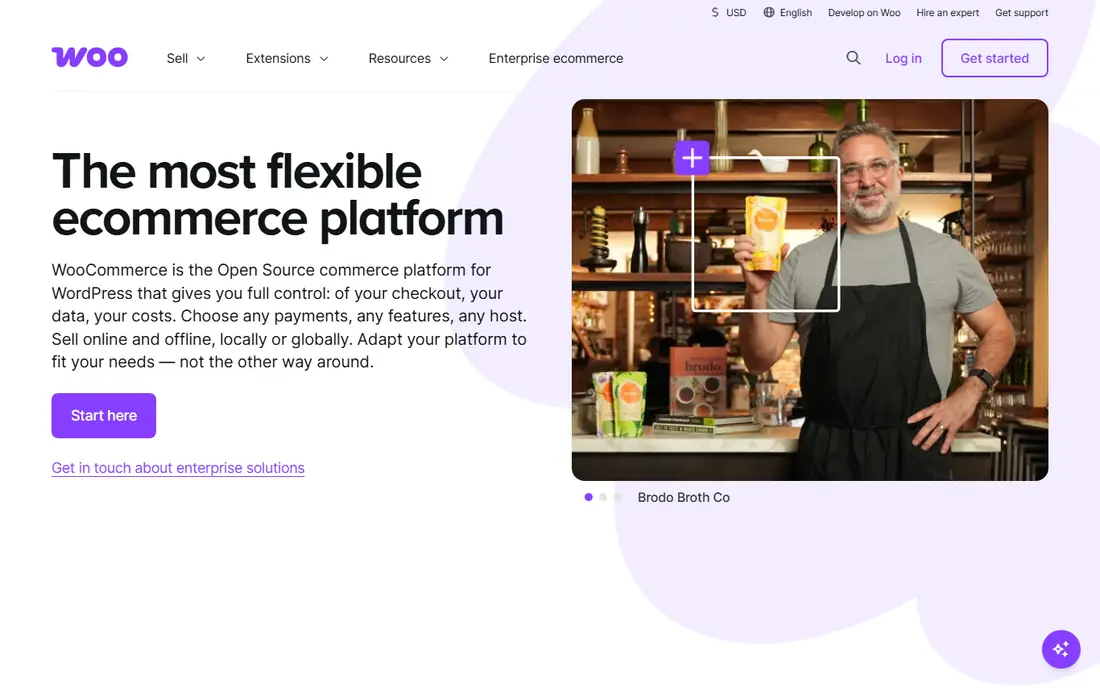
WooCommerce is the best ecommerce software platforms for small business owners who already run WordPress or want to own every part of their store. The plugin itself is free, and you pay separately for hosting, a domain, and payment processing. That structure gives full control over design, checkout, SEO setup, and data, with no platform fee on each order beyond what your payment provider charges.
Control comes with responsibility. You or your host must handle updates, backups, security, and performance, and useful extensions for shipping, subscriptions, or bookings often cost extra. For a WordPress-savvy owner, that trade-off is worth it. For an owner who wants a managed store with support handling the technical work, Shopify or Square Online will be simpler.
- Free and open-source plugin
- Full control over hosting, code, and data
- No platform transaction fees
- You manage hosting, updates, and security
- Paid extensions can add up

BigCommerce suits sellers who expect volume to grow and do not want platform fees eating into margin. Unlike Shopify, it does not charge a platform transaction fee on its plans in published comparisons, which helps high-volume sellers even when the monthly subscription looks similar. Native features for catalogs, promotions, and multi-channel selling also reduce the need for many paid apps.
Pricing clarity is weaker than Shopify, because published starting prices have varied across sources, so we list See website here. Confirm the plan price, sales limits, and payment processing rates in a quote for your expected volume. If you sell many products, sell B2B, or expect rapid growth, BigCommerce is a strong alternative to Shopify. If you want the simplest setup, Shopify still wins.
- No platform transaction fees on published plans
- Strong native features
- B2B tools included in higher tiers
- Published starting price varies by source
- Theme and app costs can add up
Wix is a good fit for a small shop that also needs a strong website, portfolio, or booking system. The visual builder is easy to learn, templates look polished, and you can add products, services, and appointments without a separate site. For a creative business, a salon, or a small brand with a modest catalog, that combination is appealing.
The limit is ecommerce depth. Inventory, shipping, and multi-channel tools are less advanced than Shopify or BigCommerce, and published ecommerce plan prices have varied, so we list See website. If your store is the main business and you expect complex shipping or many products, choose a commerce-first platform. If design and ease matter more than advanced commerce, Wix is a pleasant place to start.
- Easy visual builder
- Many templates
- Business tools for bookings and services included
- Ecommerce features are less deep than Shopify
- Published ecommerce prices vary by source
Squarespace produces some of the most polished storefronts on this list, which matters for lifestyle brands, artists, photographers, and content-led sellers. Templates are consistent, image handling is strong, and blogging, portfolios, and commerce share one system. A brand that sells fewer products but cares deeply about presentation will feel at home here.
Commerce depth is the trade-off. Squarespace commerce is solid for straightforward stores, but it trails Shopify on apps, shipping options, and advanced inventory. Lower commerce tiers can also carry transaction fees, so confirm the fee for the exact plan you choose. For a design-led store with a modest catalog, Squarespace is an excellent pick. For a large catalog or complex fulfillment, Shopify or BigCommerce will scale better.
- Polished templates
- Strong content and portfolio tools
- Built-in commerce and blogging
- Commerce features are more limited than Shopify
- Transaction fees apply on lower commerce tiers
Ecwid is different from most tools here, because it adds ecommerce to a website you already have instead of replacing it. You can embed a store on a WordPress site, a builder site, or a social page, and manage products, orders, and payments from one dashboard. The free plan lets you test selling without a monthly commitment.
Limits appear as you grow. The free plan restricts product count and features, and design control is less flexible than Shopify or Webflow. Paid plans remove those limits, but Ecwid still suits sellers who want to add commerce to an existing presence rather than rebuild a whole site. If you already have traffic on a site you like, Ecwid is the fastest way to start selling from it.
- Free plan to start
- Adds a store to an existing website or social page
- Simple product management
- Free plan limits products and features
- Design control is less than a full platform
Square Online is the natural choice for a business that already sells in person with Square. Inventory, payments, and customer data sync between the shop counter and the website, so a product sold in store updates online stock without manual work. The free plan lets a small business start selling online without a new payment provider.
Design is more templated than Squarespace or Webflow, and a custom domain and some advanced features require a paid plan. That is a fair trade for a cafe, boutique, or service business that needs one system for in-person and online sales. If online design is your main selling tool, a design-led platform may suit you better. If unified selling matters most, Square Online is hard to beat.
- Free plan to start
- Strong fit with Square POS and payments
- Inventory syncs online and in store
- Design flexibility is limited
- Paid plans needed for custom domain and advanced features
Webflow gives designers and agencies pixel-level control without writing code by hand. You can build custom layouts, animations, and product pages that look distinct from template stores, and the CMS handles catalogs and content cleanly. Ecommerce plans start at $29 per month in published comparisons, which is competitive for a design-first platform.
The learning curve is the main barrier. Webflow is a visual development tool, not a simple drag-and-drop builder, so a small business owner without design experience may need help to get started. If you value a unique storefront and have design skills or an agency, Webflow rewards that effort. If you need the fastest setup, Shopify, Wix, or Square Online will get you selling sooner.
- Precise visual design control
- Clean site structure
- CMS for product catalogs
- Learning curve is steep for beginners
- Ecommerce plan starts higher than some rivals
How we picked these
We compared official feature pages, pricing pages, app store listings, privacy policies, and public reviews for ecommerce platforms that suit small businesses. We checked setup effort, design tools, payments, shipping, inventory, and transaction fees, not just monthly price. Where published prices conflicted, we wrote See website instead of presenting a disputed figure as fact. We did not claim hands-on testing, and we treated review comments as user reports.
What to check before you choose
Add transaction fees to the monthly price
Work out fees at your expected monthly sales, not just at launch. A platform with a low subscription but a platform fee on every order can cost more than a higher subscription with no platform fee. Ask each vendor for the total cost at $10,000 in monthly sales, including payment processing.
Check the features you will use in month six
A store that starts with 20 products may soon need discounts, abandoned cart emails, multi-channel selling, and shipping rules. Check whether those features are native, paid apps, or missing. A platform that needs five paid apps for basic selling will cost more than its headline price suggests.
Test checkout on a phone before you commit
Most small business traffic comes from phones, so test product pages, checkout, and payment on a mobile device during a trial. A beautiful desktop store that feels slow or cramped on a phone will lose sales. Choose the platform whose mobile checkout feels fastest and clearest for your products.
Frequently asked questions
What is the best ecommerce platform for small businesses?
For most small businesses, Shopify is the best all-round choice, because it covers hosting, payments, shipping, and apps in one managed system. WooCommerce is better if you use WordPress and want full control, while Square Online is better if you also sell in person with Square. Shortlist three platforms and test checkout before you choose.
What is the best ecommerce platform for small business with no monthly fee?
WooCommerce, Ecwid, and Square Online all offer free ways to start, though hosting, payment processing, and paid features still cost money. WooCommerce is free as a plugin but needs hosting, while Ecwid and Square Online offer free plans with limits on products and features. A free plan is a good test, but most growing stores move to a paid plan for a custom domain and lower fees.
How do best ecommerce platforms small business lists handle transaction fees?
Good lists separate platform fees from payment processing fees. Platform fees are charged by the ecommerce platform, while payment processing fees are charged by the payment provider. Shopify charges platform fees on third-party gateways but not on Shopify Payments, while BigCommerce does not charge platform fees on published plans. Always compare the combined fee, not just one part.
Is WooCommerce better than Shopify for a small business?
WooCommerce is better if you want full ownership, WordPress integration, and no platform fees, and if you can manage hosting and updates. Shopify is better if you want fast setup, managed hosting, support, and a large app ecosystem without technical work. The right choice depends on your technical comfort and how much control you want.
What is the best small business ecommerce software for design-led brands?
Squarespace and Wix are strong for design-led brands, with polished templates and easy visual editing. Webflow offers more custom design control for users with design skills. Shopify also offers good templates, but its design system is less flexible than Webflow. Choose based on how much you value a unique look versus fast setup.
Can I switch ecommerce platforms later?
Yes, but switching takes work. You will need to move products, customers, orders, and content, set up redirects for old URLs, and reconnect payments and shipping. That is why picking the right platform first matters. If you may switch later, choose a platform that lets you export products and customer data easily.
Sources we checked (10)
- https://www.shopify.com
- https://woocommerce.com
- https://www.bigcommerce.com
- https://www.wix.com
- https://www.squarespace.com
- https://www.ecwid.com
- https://squareup.com
- https://webflow.com
- https://www.commercepundit.com/blog/affordable-e-commerce-platforms-for-small-businesses/
- https://rankite.com/blog/best-ecommerce-software

Online Jobs is an independent blog about careers, online work, learning new skills and the tools that help people earn. More about us.
Keep reading
All posts
ZoomInfo Alternatives
The best ZoomInfo alternatives in 2026, compared on price, free plans, data coverage, and which tool fits small teams or large sales teams best in detail.

Workday Alternatives
We compared the best workday alternatives for HR, payroll, and global hiring, from BambooHR and Gusto to Rippling, Deel, and HiBob for growing teams in 2026.
Which SaaS Tools Have the Best Customer Support
Which SaaS tools have the best customer support? Compare eight popular tools on help centres, live help, response options and overall support quality.