Best Data Pipeline Software in 2026: 9 Tools Compared


Managed ELT with minimal maintenance · Starting price: See website
How we put this together: we compare official feature and pricing pages, app store listings, privacy policies and public user reviews. Prices change, so check the provider's site before you pay.
Key takeaways
- Fivetran suits teams that want managed ELT with minimal maintenance, while Airbyte suits teams that want open-source control and lower entry cost.
- Apache Airflow suits teams that need to orchestrate complex workflows, not just move data from one place to another.
- Talend and Informatica suit enterprises with complex transformations, governance, and legacy systems.
- Pricing models differ sharply, from free open-source tools to usage-based MAR and volume pricing, so model your real data volume before choosing.
Quick comparison
| Name | Who it suits | Starting price | Free option | |
|---|---|---|---|---|
| Fivetran | Managed ELT with minimal maintenance | See website | Yes | Visit |
 Airbyte | Open-source data movement with cloud option | $20 per month | Yes | Visit |
 Apache Airflow | Orchestrating complex data workflows | Free | Yes | Visit |
 Talend | Enterprise integration and transformation | See website | No | Visit |
 Informatica | Enterprise data integration and governance | See website | No | Visit |
 AWS Glue | Serverless pipelines inside AWS | See website | No | Visit |
 Azure Data Factory | Pipelines inside Microsoft Azure | See website | No | Visit |
 Google Cloud Dataflow | Unified batch and streaming on GCP | See website | No | Visit |
 Hevo Data | No-code pipelines for mid-market teams | See website | Free trial | Visit |
The best data pipeline software
Data pipeline software moves data from sources such as apps, databases, and files into a warehouse or lake, and often transforms it on the way. Some tools focus on ingestion, others on orchestration, and others on full integration. We compared official product pages, pricing explanations, and connector documentation, and we focused on tools that are actively maintained and widely used in production.
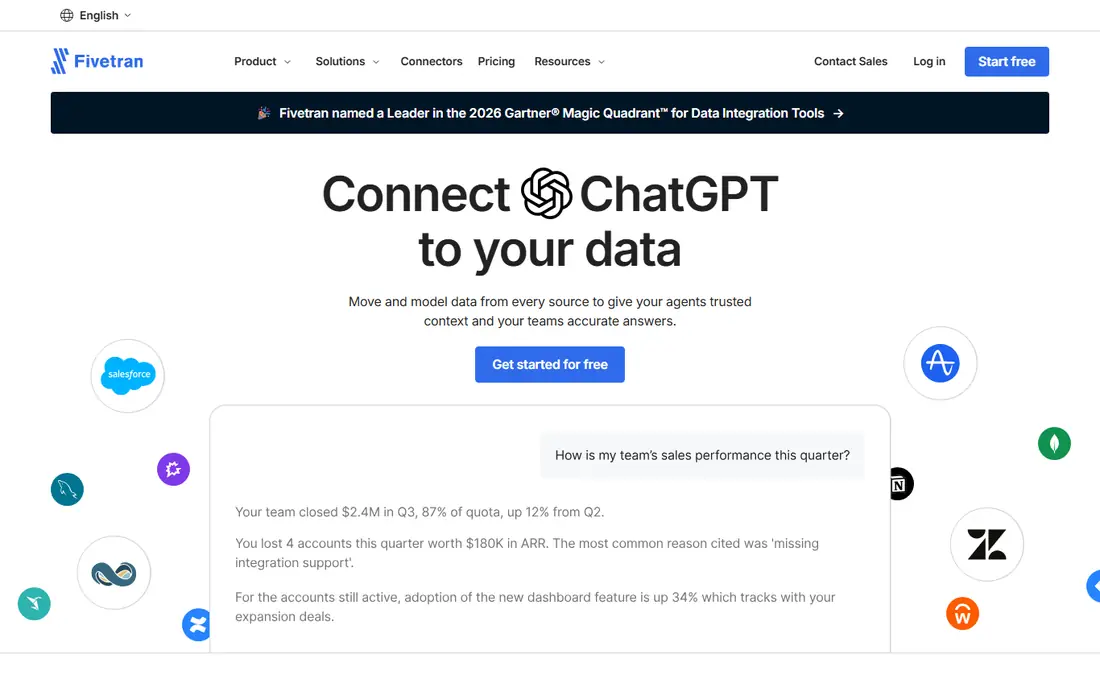
Fivetran is the low-maintenance choice for analytics teams. You connect a source, choose a destination, and Fivetran handles schema changes, incremental syncs, and reliability, with dbt transformation bundled after its merger with dbt Labs. That hands-off model saves engineering time, especially for SaaS sources that change their APIs often.
Cost is the main watch point. Pricing is based on monthly active rows, with a free plan up to 500,000 MAR in published comparisons and contract minimums on annual deals. High-churn tables can raise MAR quickly, so model your tables before committing. For teams that value reliability over control, Fivetran is a strong default.
- Hundreds of managed connectors
- Automated schema handling
- Hybrid deployment on higher plans
- Usage-based MAR pricing can grow with data volume
- Annual contract minimums apply on contracts in published comparisons
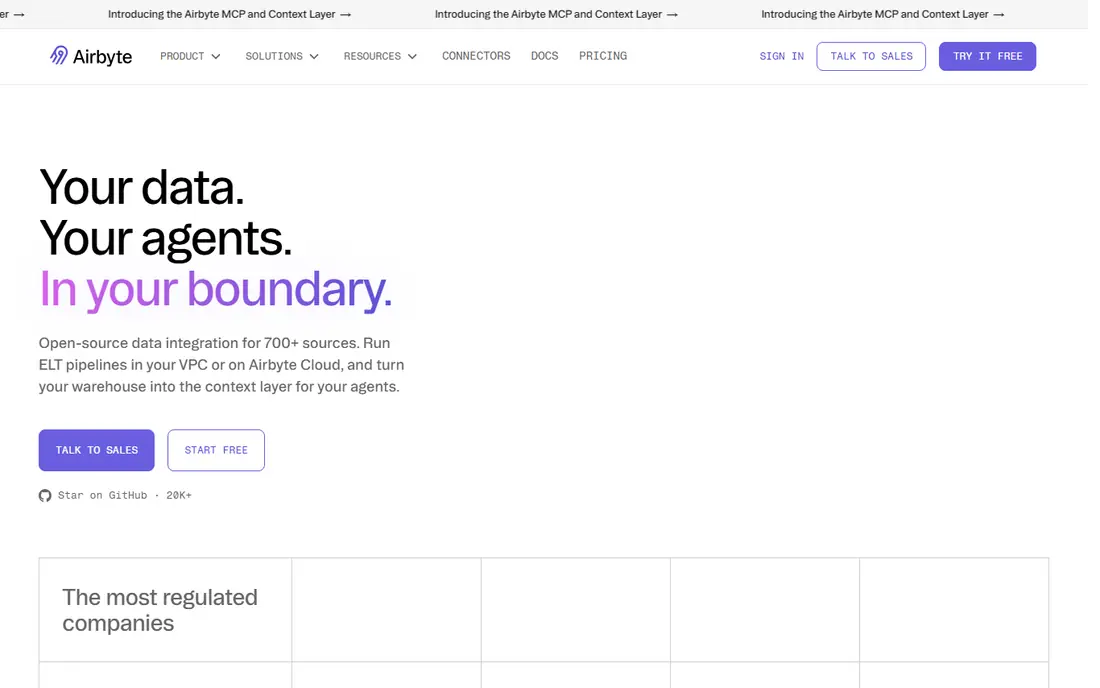
Airbyte gives teams a choice that Fivetran does not: run the open-source Core yourself for free, or use managed cloud with volume-based pricing starting at $20 per month for Standard in published comparisons. It offers hundreds of connectors, a no-code connector builder, and native integrations with dbt, Airflow, and other orchestration tools. That flexibility suits teams that want control over hosting and cost.
Self-hosting is not free in practice, since you pay for infrastructure and maintenance time. Cloud pricing also needs modelling by volume, not just by connector count. Airbyte fits best when open source, hybrid deployment, or cost control matters more than a fully managed service.
- Open-source Core for self-hosting
- Hundreds of connectors
- No charge per row on cloud volume plans
- Self-hosting needs engineering time
- Managed cloud costs rise with volume and credits
Apache Airflow is an orchestrator, not a simple connector tool. You define workflows as directed acyclic graphs, schedule them, handle dependencies, and retry failed tasks, while Airflow calls other tools to move and transform data. That makes it ideal for complex pipelines with many steps, checks, and dependencies.
Airflow does not replace Fivetran or Airbyte for ingestion, and running it well takes engineering effort, even with managed cloud versions. Teams that only need to sync a few SaaS sources to a warehouse should start with an ELT tool instead. Teams with complex, multi-step workflows will find Airflow hard to replace.
- Open-source orchestration with DAG workflows
- Huge operator library
- Strong monitoring and retries
- Not an ingestion tool on its own
- Needs engineering skill to run well
Talend, now part of Qlik, suits enterprises that need integration, transformation, and data quality in one platform. Talend Studio lets developers build complex jobs with many components, while Qlik Talend Cloud adds cloud pipelines and governance. That depth helps with legacy systems and complex business rules that simpler ELT tools struggle with.
Pricing is quote-only, with third-party reports placing Starter in a five-figure annual range, so small teams should expect an enterprise sales process. The learning curve is also steep. Talend fits when transformation complexity and governance justify the investment, not when you only need simple syncs.
- Broad connector and component library
- Strong transformation and data quality tools
- Cloud and hybrid options
- Quote-only pricing
- Studio-based work needs skilled developers
- Open Studio retired in 2024
Informatica is a long-standing enterprise integration platform, used by large organisations to integrate customer data across many regional systems with consistent quality and compliance. Its metadata, lineage, and governance tools are stronger than those in most ELT tools, which matters for regulated industries and audits.
That power brings cost and complexity. Pricing is quote-based, and implementations often need specialist skills and time. Smaller teams will find Fivetran or Airbyte faster and cheaper. Large enterprises with many systems, strict governance, and complex transformations are the natural audience.
- Deep enterprise connectors and metadata
- Strong governance and data quality
- Cloud and on-prem options
- Enterprise pricing and complexity
- Implementation can be long
AWS Glue suits teams already committed to AWS. It provides serverless ETL with Spark, data cataloguing, and integrations across S3, Redshift, Athena, and other AWS services, without managing servers. Pay-per-DPU-hour pricing fits spiky workloads, since you pay for processing time rather than idle capacity.
AWS lock-in is the drawback, and Glue is not a simple connector tool for non-AWS destinations. Teams outside AWS should look elsewhere. Inside AWS, Glue is a practical, scalable pipeline choice, especially when data already lives in S3.
- Serverless Spark-based ETL inside AWS
- Integrates with S3, Redshift, and Athena
- Pay-per-use pricing
- AWS-only
- Spark and Glue concepts need learning
- Costs depend on DPU usage
Azure Data Factory is the Microsoft equivalent of Glue: a cloud integration service for building, scheduling, and monitoring data pipelines inside Azure. It integrates well with Synapse, Databricks, SQL Database, and other Microsoft services, and its visual designer helps teams without deep coding skills build pipelines.
Pricing depends on activities, integration runtimes, and data movement, so forecasting needs care. Outside the Microsoft ecosystem, its advantage fades. For Azure shops, Data Factory is a natural, well-supported pipeline platform.
- Visual pipeline building in Azure
- Strong Microsoft ecosystem integration
- Serverless and managed options
- Azure-focused
- Complex pricing by activity and integration runtime
- Less suited outside Microsoft stack
Google Cloud Dataflow, based on Apache Beam, handles both batch and streaming pipelines in one model, which suits analytics teams with real-time needs. It integrates with BigQuery, Pub/Sub, and other Google Cloud services, and it scales automatically as data volume changes. That unified model avoids maintaining separate batch and streaming systems.
Beam has a learning curve, and costs are billed by resource use per second, so inefficient pipelines can be expensive. Dataflow fits best for GCP teams with streaming or mixed workloads. Batch-only teams may find a simpler ELT tool sufficient.
- Unified batch and streaming with Apache Beam
- Dynamic work rebalancing
- Strong GCP integration
- GCP-focused
- Beam concepts need learning
- Per-second resource billing needs monitoring
Hevo Data targets mid-market teams that want no-code pipelines without enterprise complexity. You can set up sources and destinations quickly, with automatic schema mapping and built-in transformation options. That speed helps small data teams deliver dashboards without a large engineering effort.
Connector coverage is narrower than the leaders, and pricing is tiered by events, so high-volume use needs modelling. Hevo fits when simplicity and speed matter more than the broadest connector library. Teams with unusual sources should check connector availability before committing.
- No-code pipeline setup
- Automatic schema mapping
- Real-time replication options
- Fewer connectors than Fivetran or Airbyte
- Pricing rises with event volume
How we picked these
We compared official pricing pages, connector documentation, and deployment options for tools that cover ingestion, orchestration, and enterprise integration. We included open-source, managed, and cloud-native options, and we labelled pricing models clearly, since MAR, volume, credit, and DPU pricing are not directly comparable. Where pricing was quote-based, we wrote See website rather than publishing an estimate.
What to check before you choose
Start with your sources, destinations, and volume. List every source you must sync, check connector availability, and estimate monthly active rows or event volume honestly. A tool that looks cheap at low volume can become expensive at scale, and a tool that looks expensive can save engineering time worth more than the subscription.
Orchestration, transformation, and governance
Decide whether you need ingestion only, or orchestration and transformation as well. Airflow plus an ELT tool is a common combination, while Talend or Informatica may cover all three in one platform for enterprises. Check schema handling, data quality, lineage, and security certifications for your industry, and run a pilot on your messiest source before signing a long contract.
Frequently asked questions
What is the best data pipeline software?
Fivetran is best for managed ELT with minimal maintenance, Airbyte is best for open-source control and lower entry cost, and Apache Airflow is best for orchestrating complex workflows. The best choice depends on your team size, sources, and volume.
Which data pipeline software platforms are best for beginners?
Hevo Data and Fivetran are the easiest starting points for beginners, thanks to no-code or low-code setup and managed connectors. Airbyte Cloud is also approachable, while Airflow suits more technical teams.
Is Airbyte free?
Airbyte Core, the open-source edition, is free to self-host, although you pay for your own infrastructure. Airbyte Cloud Standard starts at $20 per month in published comparisons, with volume-based credits beyond the included amount.
How does Fivetran pricing work?
Fivetran charges mainly by monthly active rows, which counts rows added or changed in a month. A free plan up to 500,000 MAR is described in published comparisons, with paid contracts subject to minimums, so check current terms for your use case.
Do I need Airflow if I use Fivetran or Airbyte?
Not always. Fivetran and Airbyte handle ingestion and syncing on their own. You need Airflow when workflows have complex dependencies, custom steps, checks, and retries across many systems, rather than simple source-to-warehouse syncs.
Sources we checked (9)

Online Jobs is an independent blog about careers, online work, learning new skills and the tools that help people earn. More about us.
Keep reading
All posts
iPhone Alternatives
Looking for iPhone alternatives in 2026? Compare 9 Android phones from Samsung, Google, OnePlus, and more, with cameras, battery life, and honest trade-offs.
Who Has the Best Home Internet Service
Find who has the best home internet service for your address, with fiber, cable, 5G, and satellite providers compared on price, speed, and coverage here.

Best Robotics Companies
Compare the best robotics companies in 2026, from humanoids to factory robots, with focus areas, deployments, and honest limits for buyers and pilots.