Best Data Management Software in 2026: 8 Platforms Compared

How we put this together: we compare official feature and pricing pages, app store listings, privacy policies and public user reviews. Prices change, so check the provider's site before you pay.
Key takeaways
- Data management covers storage, integration, quality, governance, and access, and no single tool does all five equally well.
- Snowflake and Databricks suit teams that already run analytics on a cloud warehouse or lakehouse.
- Collibra and Alation suit teams whose main problem is trust: finding data, knowing who owns it, and proving it is governed.
- Start with the data problem you can name, such as messy customer records or slow reporting, and pick the tool that fixes that first.
Quick comparison
| Name | Who it suits | Starting price | Free option | |
|---|---|---|---|---|
 Snowflake | Cloud data warehouse | See website | Free trial | Visit |
 Databricks | Lakehouse and AI workloads | See website | Free trial | Visit |
 Informatica | Enterprise integration and governance | See website | Free trial | Visit |
 Talend | Data integration and pipelines | See website | Free trial | Visit |
 Collibra | Data governance and catalog | See website | No | Visit |
 Alation | Data catalog and discovery | See website | No | Visit |
 Ataccama | Data quality and governance | See website | Free trial | Visit |
 Monte Carlo | Data observability | See website | Free trial | Visit |
The best data management software
Good data management is rarely about one purchase. It is about getting data from many systems into one trusted place, cleaning it, recording who owns it, and letting the right people use it without breaking privacy rules. The platforms below cover different parts of that job, from storage and integration to catalogs and monitoring, so the right pick depends on where your current process breaks down.
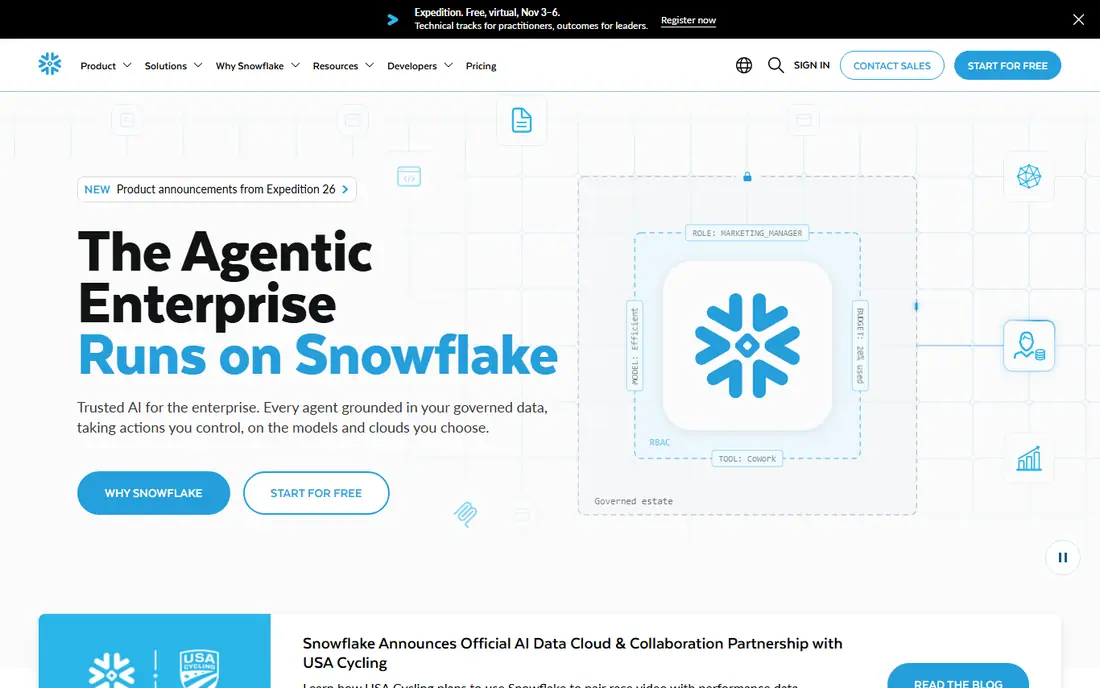
Snowflake is a cloud data warehouse that lets teams store large volumes of structured and semi-structured data and query it without managing servers. Storage and compute scale separately, so a team can keep data stored cheaply and pay for compute only when queries run. Data sharing and its marketplace also make it easier to share governed datasets with partners without copying files around.
The main risk is cost control. A badly written query or an always-on warehouse can raise the bill quickly, so teams need usage monitoring and clear ownership of warehouses. Snowflake is a strong foundation for analytics, but it does not by itself clean messy source data or document every dataset, so pair it with quality and catalog work.
- Scales storage and compute separately
- Strong sharing and marketplace features
- Broad connector support
- Costs need careful monitoring
- Governance tools require setup
- Learning curve for new teams
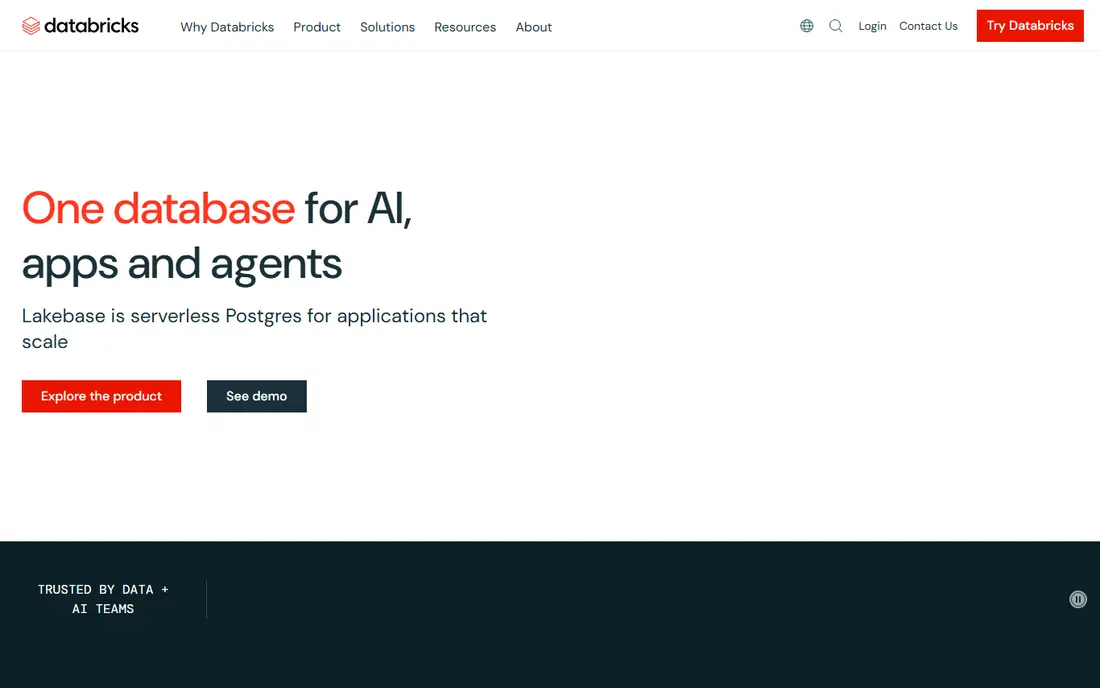
Databricks combines a data lake and a warehouse into a lakehouse, so teams can run SQL analytics, data engineering pipelines, and machine learning on shared data. Its Unity Catalog provides governance, lineage, and access control across workspaces, which helps larger teams prove who can see what. For companies building AI features on their own data, that combination is hard to match.
Databricks is not a simple plug-and-play warehouse for a small team with no data engineers. Usage-based pricing needs monitoring, and the platform rewards teams that already know Spark, SQL, or Python. If your team is small and mainly needs dashboards, a simpler warehouse or a reporting tool may be a better first step.
- Unifies data engineering, analytics, and AI
- Strong governance with Unity Catalog
- Handles large data volumes
- Needs skilled data engineers
- Pricing is usage-based and complex
- Setup takes time
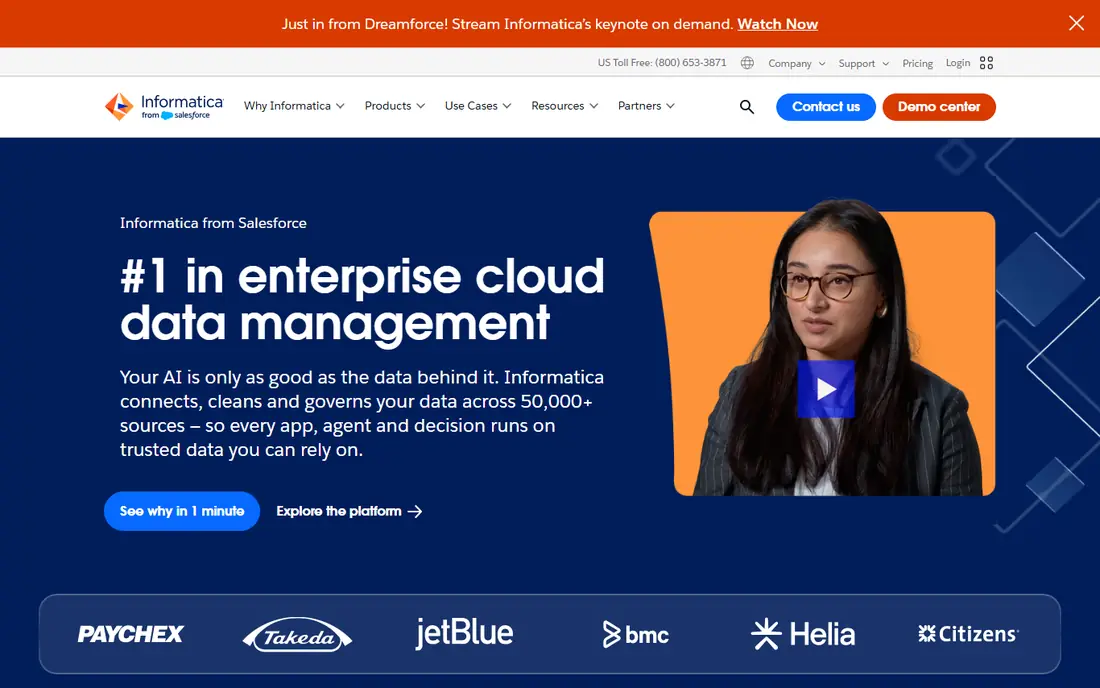
Informatica is an enterprise platform for moving, cleaning, and governing data across cloud and on-premises systems. Its integration tools connect many source systems, and its data quality and governance features help teams profile, clean, and document data before it reaches a report. For large companies with many legacy systems, that breadth matters more than a single clever feature.
The trade-off is complexity and cost. Informatica is built for enterprises, and smaller teams may find the setup, licensing, and specialist help heavier than they need. If your data problem spans dozens of systems and strict compliance rules, it earns a place on the shortlist. If you have three sources and one warehouse, a lighter integration tool will do.
- Broad integration and data quality tools
- Strong governance features
- Long enterprise track record
- Enterprise pricing and complexity
- Implementation often needs specialists
Talend focuses on building data pipelines: taking data from applications, files, and databases, transforming it, and loading it into a warehouse or another system. Its visual pipeline tools help data teams build repeatable jobs, and its quality features can profile and clean data during the move. For teams whose main pain is messy, manual data movement, Talend addresses the root cause.
Talend still needs people who understand data modelling and transformation logic, and its pricing depends on usage and edition, so check the current pricing page and get a quote for your volume. It pairs well with a warehouse such as Snowflake, since Talend moves and prepares data while the warehouse stores and queries it.
- Strong pipeline building
- Cloud and hybrid support
- Data quality features
- Pricing is not a simple starting figure
- Advanced use needs data skills
Collibra is a governance platform: it records what data you have, who owns it, what it means, and what rules apply to it. That sounds like paperwork, but it solves a real problem in larger companies, where analysts waste time asking which sales table is correct or whether a dataset can be shared. Collibra gives those answers in a catalog, with lineage that shows where data came from.
Governance tools only work if the business commits to them. If no one owns datasets or updates definitions, even the best catalog goes stale. Collibra suits regulated or larger organisations that already accept that governance is a job, not a one-time project. Smaller teams may get enough value from a lighter catalog first.
- Strong governance, catalog, and policy tools
- Clear ownership and lineage views
- Enterprise controls
- Quote-based pricing
- Needs governance commitment to deliver value
Alation is a data catalog built for discovery: analysts can search for tables, see how often they are used, read descriptions, and find the right dataset without asking around. Popularity and usage signals help new analysts trust a table that colleagues already use, and warnings can flag deprecated or sensitive data. That shortens the time from question to answer.
Like Collibra, Alation needs adoption to pay off. If analysts keep asking in chat instead of searching the catalog, the catalog will not stay current. It suits teams with several warehouses or business intelligence tools, where finding the right data is itself a bottleneck. For a single-warehouse team, a simpler catalog inside the warehouse may be enough.
- Strong search and discovery
- Usage and popularity signals
- Good for analyst teams
- Quote-based pricing
- Value depends on catalog adoption
Ataccama combines data quality, catalog, and governance, which suits teams whose main problem is trust in the data itself. Its profiling tools show where customer records are incomplete, duplicated, or inconsistent, and its quality rules can monitor those issues over time. When a report looks wrong, Ataccama helps a team find whether the source, the pipeline, or the definition caused it.
That breadth means setup and pricing are enterprise-scale, so smaller teams should trial it against a narrower quality tool first. For companies in finance, health, or other regulated areas, where bad data carries real risk, the combined quality and governance view is a genuine advantage.
- Data quality, catalog, and governance in one platform
- Strong profiling
- Good for regulated teams
- Enterprise scope can be heavy for small teams
- Pricing varies by deployment
Monte Carlo is a data observability tool: it watches pipelines, tables, and dashboards, and alerts teams when data is late, missing, or suddenly different. Think of it as monitoring for data, in the same way uptime monitoring watches a website. When a morning report is wrong, Monte Carlo helps a team find which pipeline broke, rather than guessing through every job.
Observability does not by itself clean data or govern access, so it works best alongside a warehouse and a catalog. If your team already has pipelines but learns about failures from business users, Monte Carlo can cut that embarrassment. If your data is still moved by hand in spreadsheets, fix the pipeline first.
- Monitors pipelines and data freshness
- Alerts on anomalies
- Lineage for incident triage
- Monitoring does not fix bad source data
- Pricing varies by data volume
How we picked these
We compared official product pages, documentation, and pricing pages for platforms that cover a real part of data management: storage, integration, quality, governance, catalog, or observability. We left out pure reporting tools and spreadsheet tools, since they use managed data rather than managing it. Where pricing is quote-based or usage-based, we use See website, and we avoid quoting a figure that would not match a different deployment size.
How to choose the right platform
Start by naming the failure you see most often. If reports disagree, you may need governance and a catalog. If data arrives late or broken, you may need observability or better pipelines. If analysts cannot find data, a catalog helps. If you have no central store, a warehouse or lakehouse comes first.
Governance, privacy, and access
Check who can see sensitive data, how access is approved, and whether lineage shows where a field came from. For personal data, confirm retention, deletion, and regional hosting options, and involve your privacy or security team before a purchase, not after.
Cost and skills
Usage-based platforms reward good monitoring and punish careless queries, so budget for training and cost controls, not just licences. A platform your team cannot run will cost more in consultants than a simpler tool that your team actually uses. Trial with real data and a real question, and measure time to answer, not just feature lists.
Frequently asked questions
What is the best data management platform for small businesses?
Small teams usually do best starting with a cloud warehouse or a simple catalog, rather than a full enterprise governance suite. Snowflake and Databricks suit teams with data skills, while a lighter catalog or quality tool may suit teams with fewer engineers. Pick the tool that fixes your most painful failure first, and add governance as data grows.
What are the best data management tools for analytics?
Snowflake and Databricks are the strongest foundations for analytics at scale, because they store and query large data volumes and connect to reporting tools. Talend helps move and prepare that data, while Monte Carlo monitors it once it flows. Reporting tools then sit on top, rather than replacing, this layer.
Which data management companies lead in governance?
Collibra, Alation, and Ataccama are the names most often shortlisted for governance and catalog work, with Informatica also strong in enterprise governance. The right choice depends on whether you need policy and ownership most, discovery most, or data quality most. Ask each vendor to demo with your own datasets, not a polished sample.
Is data management software worth it for a small team?
It is worth it when manual data work, conflicting reports, or compliance risk already cost time or money. A small team does not need every module at once. Start with one central store, clear ownership, and basic quality checks, and expand only when a new failure appears.
What is the difference between a data catalog and a data warehouse?
A warehouse stores and queries data, while a catalog describes it: what it is, who owns it, and whether it can be trusted. You need storage before a catalog is useful, and a catalog becomes valuable once you have enough tables that people cannot keep track by memory. Many teams use both, with the catalog pointing to the warehouse.
Sources we checked (8)

Online Jobs is an independent blog about careers, online work, learning new skills and the tools that help people earn. More about us.
Keep reading
All posts
ZoomInfo Alternatives
The best ZoomInfo alternatives in 2026, compared on price, free plans, data coverage, and which tool fits small teams or large sales teams best in detail.
Workday Alternatives
We compared the best workday alternatives for HR, payroll, and global hiring, from BambooHR and Gusto to Rippling, Deel, and HiBob for growing teams in 2026.
Which SaaS Tools Have the Best Customer Support
Which SaaS tools have the best customer support? Compare eight popular tools on help centres, live help, response options and overall support quality.