Best Corporate Travel Platforms in 2026: 8 Platforms Compared


Firms that want travel booking and expense in one system · Starting price: See website
How we put this together: we compare official feature and pricing pages, app store listings, privacy policies and public user reviews. Prices change, so check the provider's site before you pay.
Key takeaways
- Navan suits firms that want travel and expense in one system, while Perk suits firms that value booking flexibility.
- SAP Concur fits large firms with complex policy and reporting needs, especially those already using SAP tools.
- Spotnana and TravelBank suit mid-size teams that want modern booking without a heavy enterprise setup.
- Amex GBT and FCM suit large global programs that need scale, duty of care and local support.
- TripIt is a trip organiser, not a full booking platform, so pair it with a booking tool if you need policy control.
Quick comparison
| Name | Who it suits | Starting price | Free option | |
|---|---|---|---|---|
| Navan | Firms that want travel booking and expense in one system | See website | See website | Visit |
 Perk | Flexible booking for small and mid-size firms | See website | See website | Visit |
 SAP Concur | Large firms with complex policy, audit and reporting needs | See website | No | Visit |
 Spotnana | Modern, global booking for mid-size and large firms | See website | No | Visit |
 TravelBank | Travel and expense for small and mid-size firms | See website | See website | Visit |
 Amex GBT | Large global firms that need scale and duty of care | See website | No | Visit |
 FCM | Mid-size to large firms that want global reach with local service | See website | No | Visit |
 TripIt | Organising itineraries from bookings made elsewhere | See website | Yes | Visit |
The best corporate travel platforms
We looked at platforms that help firms book flights and hotels, apply travel policy, track spend and support travellers on the road. The right choice depends less on a long feature list and more on firm size, travel volume and how much control finance needs. A small team may want fast booking and simple approvals, while a large firm may need deep reporting, duty of care and integration with finance systems.
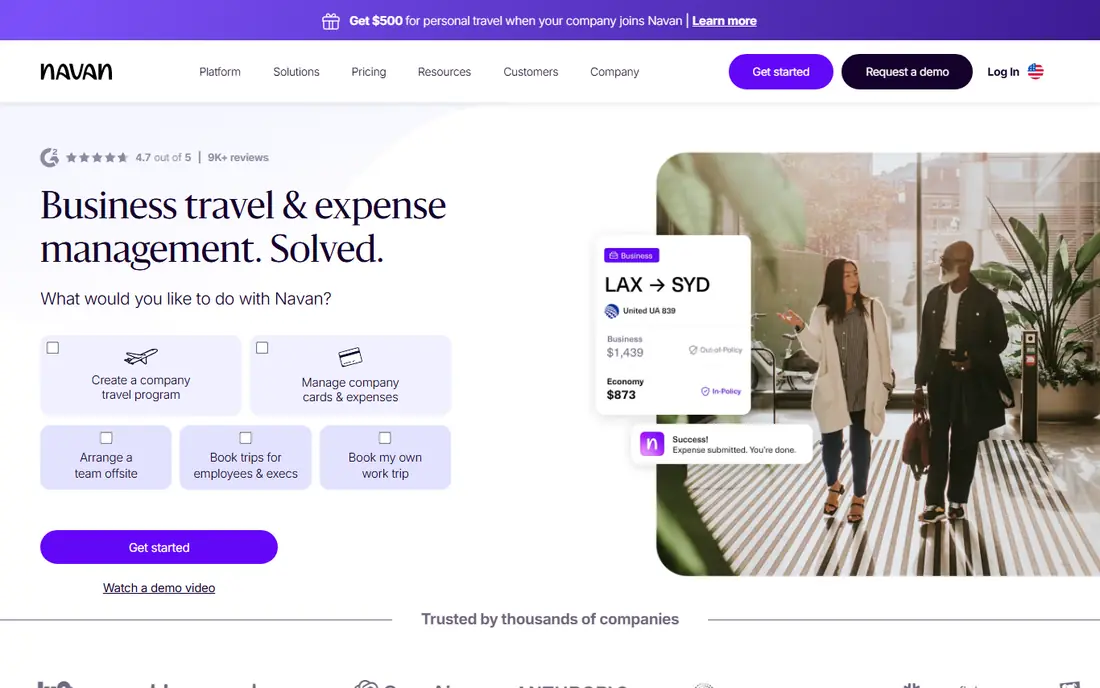
Navan brings booking, policy and expense together, so a trip booked in policy can flow into expense without re-entering the same details. Travellers book flights, hotels and cars in a consumer-style interface, while admins set policy rules that show up during booking rather than after spend has happened. That link between booking and expense is the main reason many firms consider it. The platform also covers support and reporting, which helps finance teams see total trip cost in one place. The trade-off is scale and setup. Firms with very light travel may find a simpler booking tool enough, and larger deployments will need time to set policy, approvals and finance links. For firms that want one system for travel and expense, Navan is a strong starting point for a demo.
- Combined travel and expense workflow, policy controls in booking, mobile booking, support for travellers
- Enterprise pricing needs a quote, smaller firms may not need the full expense suite
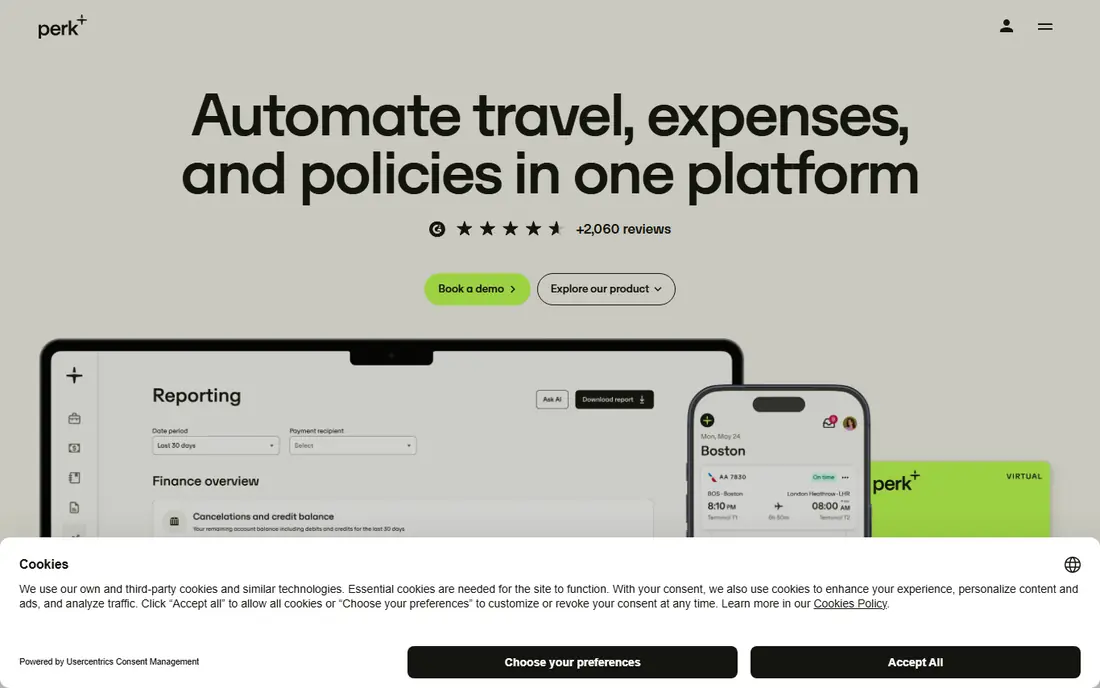
Perk, formerly TravelPerk, is built for firms that book often and need to change plans without losing the full fare. Its flexible cancellation feature is a key draw for teams with shifting meetings, and the booking interface is designed to feel close to a consumer travel site. Admins can set policy, approvals and spend visibility while travellers keep a simple booking flow. Inventory is another strength, with flights, hotels, cars and rail in many markets, which suits firms with European travel in particular. The cost model needs care at high volume, since fees per booking add up over a year. Check the current plan tiers on the vendor site and model a typical month of bookings before choosing.
- Wide travel inventory, flexible cancellation options, policy tools, VAT invoice handling
- Per-booking fees can add up at high volume, some advanced options sit on higher tiers
SAP Concur
Who it suits: Large firms with complex policy, audit and reporting needs
SAP Concur is the established enterprise choice for travel and expense. It handles complex approval chains, policy rules, expense capture and reporting in a way that suits firms with many travellers, many cost centres and strict audit needs. Integration with SAP finance tools is a clear benefit for firms already on that stack. The cost is complexity. Implementation takes planning, training and time, and travellers used to modern booking apps may find the flow less smooth. For a large firm, that trade-off can be worth it, because control and reporting matter more than a slick booking screen. Smaller firms, by contrast, may find the setup too heavy for their travel volume.
- Deep policy and expense controls, wide integrations, global reporting, audit trail
- Setup can be long, interface feels heavier than newer tools, pricing needs a quote
Spotnana positions itself as a modern travel platform with a focus on content and technology. It pulls travel options from multiple sources and presents them in a single booking flow, with policy rules and reporting for admins. The API focus also appeals to firms that want travel data to flow into other internal tools. For firms moving from an older travel tool, the modern interface can improve adoption, since travellers are less likely to book outside policy. The main question is service coverage in each market you travel to, so test support, local content and reporting for your main routes during a trial or pilot.
- Modern booking interface, broad content sources, policy and reporting tools, API focus
- Less suited to very small firms, service model varies by region and plan
TravelBank combines travel booking with expense and card tools for firms that want finance visibility without an enterprise system. Travellers book within policy, managers approve trips, and expenses link back to the trip. Budget tracking helps teams see spend against a trip budget before the trip ends. It suits finance-led small firms that want one place for travel spend, rather than separate booking and expense tools. Firms with very large global programs may need the scale and local service of a larger travel management company. For a growing firm, TravelBank offers a practical middle path.
- Combined booking and expense, budget tracking, simple approvals, card and expense links
- Less global scale than the largest platforms, feature depth varies by plan
American Express Global Business Travel, known as Amex GBT, serves large firms with travellers in many countries. Its scale brings negotiated rates, global service and duty of care tools that help firms locate and support travellers during disruption. Consolidated reporting also helps finance teams track spend across regions and suppliers. This is not a tool for a ten-person firm booking a few trips a month. The value shows at volume, where service, policy control and reporting justify the setup. Firms considering Amex GBT should compare service levels, implementation time and reporting needs with a modern platform, and choose based on travel volume and risk needs.
- Global scale, negotiated rates, duty of care tools, consolidated reporting
- Pricing needs a quote, setup suits larger programs, less suited to tiny teams
FCM, part of Flight Centre Travel Group, combines a global travel management network with local teams in many markets. That mix suits firms that want a named service contact and local knowledge, alongside central policy and reporting. It covers flights, hotels and ground travel, with support for travellers during changes and disruption. The service model is a key point to test, since local office quality can vary. Ask for references in your main markets, check response times, and confirm how policy, approvals and reporting work in practice. For firms that value human service alongside a platform, FCM is worth a shortlist place.
- Global network with local teams, travel management service, reporting and policy tools
- Pricing needs a quote, experience can vary by local office
TripIt does a different job from the other tools here. It turns booking confirmations into a single itinerary, with flight, hotel and car details in one timeline. Travellers can share trips, get alerts, and keep all plans in one app, which is useful when bookings come from several sources. It does not book travel under corporate policy or control spend by itself, so it is best as a companion tool or for small teams that book directly and just need organisation. Firms that need policy, approvals and spend control should pair TripIt thinking with a booking platform, or choose a full platform from the list above.
- Automatic itinerary building, trip sharing, alerts, simple mobile app
- Not a corporate booking platform, no policy control on its own, limited expense tools
How we picked these
We picked platforms that cover booking, policy, expense or trip organisation for business travel, and that serve different firm sizes. We included both modern platforms and established travel management firms, because the best fit for a small team is rarely the best fit for a global firm. We avoided tools that are only for personal travel, and we noted where a tool is a companion rather than a full platform. Where pricing was not confirmed from the vendor site at the time of writing, we used See website rather than publishing a figure that could be out of date. Firms should request a quote based on traveller numbers, travel volume and required integrations, since corporate travel pricing often depends on those factors.
What to look for when choosing a corporate travel platform
Start with policy and spend control. Check how policy shows up during booking, how approvals work, and how spend flows into expense and finance reports. A platform that only reports spend after booking will not prevent out-of-policy choices, while a platform that guides travellers during booking can reduce exceptions and admin work. Next, test the traveller experience and support. Book a real trip, change it, and contact support during the test, since disruption handling matters as much as the booking screen. Check inventory for your main routes, rail and hotel coverage, duty of care tools, and integrations with your finance and HR systems. A short pilot with a small group of travellers will reveal more than a sales demo alone.
Frequently asked questions
What is the best corporate travel platform?
The best corporate travel platforms depend on firm size and travel volume. Navan suits firms that want travel and expense together, Perk suits flexible booking for mid-size firms, and SAP Concur suits large firms with complex needs. Shortlist two or three platforms, run a pilot, and compare booking, policy control and reporting on real trips.
What is the best travel software for small businesses?
Small firms often benefit from a modern platform with simple policy and approvals, such as Perk or TravelBank, rather than a large enterprise system. Check the free or starter tier, per-booking fees, and whether expense tools are included. A simple setup that travellers actually use will beat a complex system that staff avoid.
Do corporate travel apps replace a travel agent?
Some platforms include agent support, while others are mainly self-service booking tools. Large firms and complex trips may still need human service for changes, group travel and disruption. Check what support is included in your plan, response times, and whether support is available in your travellers time zones.
How much do corporate travel platforms cost?
Costs vary by traveller count, booking volume, plan tier and whether expense tools are included. Some platforms offer a free starter tier, while enterprise platforms need a custom quote. Model a typical month, including booking fees and any per-user charges, and compare total cost rather than headline plan price alone.
Can these platforms enforce travel policy?
Yes, most full platforms let admins set policy rules for flights, hotels, booking lead time and spend limits, and show those rules during booking. TripIt alone does not enforce policy, since it organises bookings made elsewhere. If policy control is a priority, choose a full booking platform and test its rules during a pilot.
What is the difference between a corporate travel platform and a travel management company?
A platform is the software used to book and manage travel, while a travel management company is the service firm that may run the program, provide agents and negotiate rates. Many providers combine both, such as Amex GBT and FCM, while others focus mainly on software. Check whether your shortlist includes service, software, or both.
Sources we checked (8)

Online Jobs is an independent blog about careers, online work, learning new skills and the tools that help people earn. More about us.
Keep reading
All posts
DocuSign Alternatives
We compared the best DocuSign alternatives on price, free plans, templates, audit trails and ease of use, including free DocuSign alternatives for small teams.
Best subscription billing software
Looking for the best subscription billing software? We compare 9 platforms for billing, dunning, tax, revenue recognition, and team workflows in 2026.
Best Workforce Management Software
Looking for the best workforce management software? We compare 8 tools for scheduling, time tracking, payroll, and compliance for hourly teams and managers.