Best Concept Testing Platforms for CPG Companies in 2026: 9 Platforms Compared

How we put this together: we compare official feature and pricing pages, app store listings, privacy policies and public user reviews. Prices change, so check the provider's site before you pay.
Key takeaways
- Zappi is the strongest pick for CPG teams that test many concepts and need comparable scores across studies.
- NielsenIQ BASES suits go-or-no-go decisions where volume forecasting matters more than a quick directional read.
- Kantar Marketplace fits teams that want deep diagnostics and established norms behind a concept score.
- Qualtrics suits large companies that already run research on its platform and need statistical depth.
- Attest, Pollfish, and PickFu are better for fast, lower-cost reads, while Upsiide and Suzy help teams screen ideas quickly.
Quick comparison
| Name | Who it suits | Starting price | Free option | |
|---|---|---|---|---|
 Zappi | Benchmarked CPG concept testing | See website | No | Visit |
 NielsenIQ BASES | Volume forecasting | See website | No | Visit |
 Kantar Marketplace | Deep concept diagnostics | See website | No | Visit |
 Qualtrics | Enterprise research depth | See website | No | Visit |
 Upsiide | Fast idea screening | See website | Free trial | Visit |
 Attest | Self-serve consumer studies | See website | No | Visit |
 Pollfish | Quick mobile surveys | See website | No | Visit |
 Suzy | Always-on consumer testing | See website | No | Visit |
 PickFu | Fast side-by-side polls | See website | Free trial | Visit |
The best concept testing platforms for CPG companies
We compared platforms on CPG fit, speed, benchmarks, sample quality, and how clearly results support a launch decision.
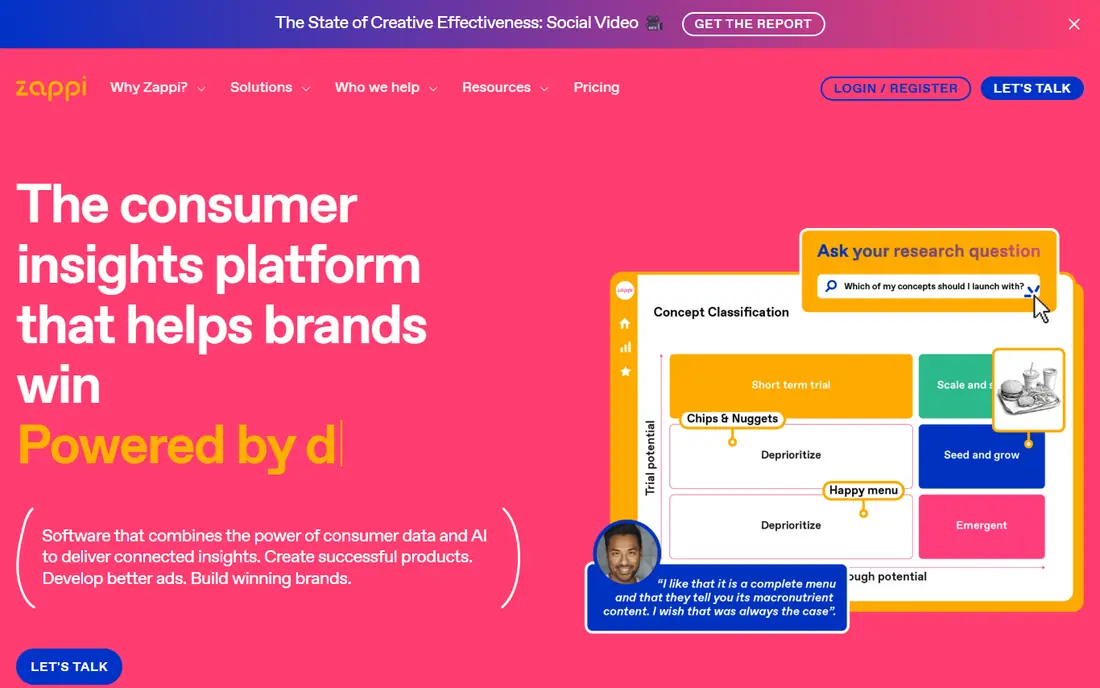
Zappi is the platform most CPG innovation teams should shortlist first, because it is built around repeatable testing with comparable scores. Concepts, packs, and ads run through standardized templates, and results come back against normative benchmarks drawn from past CPG studies. That context turns a raw score into a decision: a concept is not just liked, it is liked more or less than comparable ideas in its category. The trade-off is flexibility. Standardized workflows keep studies fast and comparable, but teams with unusual stimuli or custom methods may find them limiting. Pricing is also quote based, so budget planning needs a sales conversation. For high-volume CPG pipelines, though, speed plus benchmarks is a hard combination to beat.
- Automated concept, pack, and ad testing
- Normative benchmarks built for CPG
- Fast turnaround on established accounts
- Pricing is not published
- Standardized templates can feel rigid for bespoke studies
NielsenIQ BASES answers the question that matters most before a launch: how much will this actually sell. Its concept testing feeds into volume forecasting models built on sales, distribution, and trial data, which gives finance and supply teams numbers they can plan around. For a major launch with factory and media commitments, that forecast is worth more than a fast directional score. It is not the tool for screening twenty early ideas in a week. BASES studies take longer and cost more, and smaller brands may find the process heavy. Use it when a concept has survived screening and the decision is whether to invest at scale. At that stage, its forecasting depth is the reason to pay.
- Volume forecasting for go-or-no-go calls
- Deep CPG sales and distribution data
- Trusted by large manufacturers
- Slower and more costly than agile tools
- Overkill for early idea screening
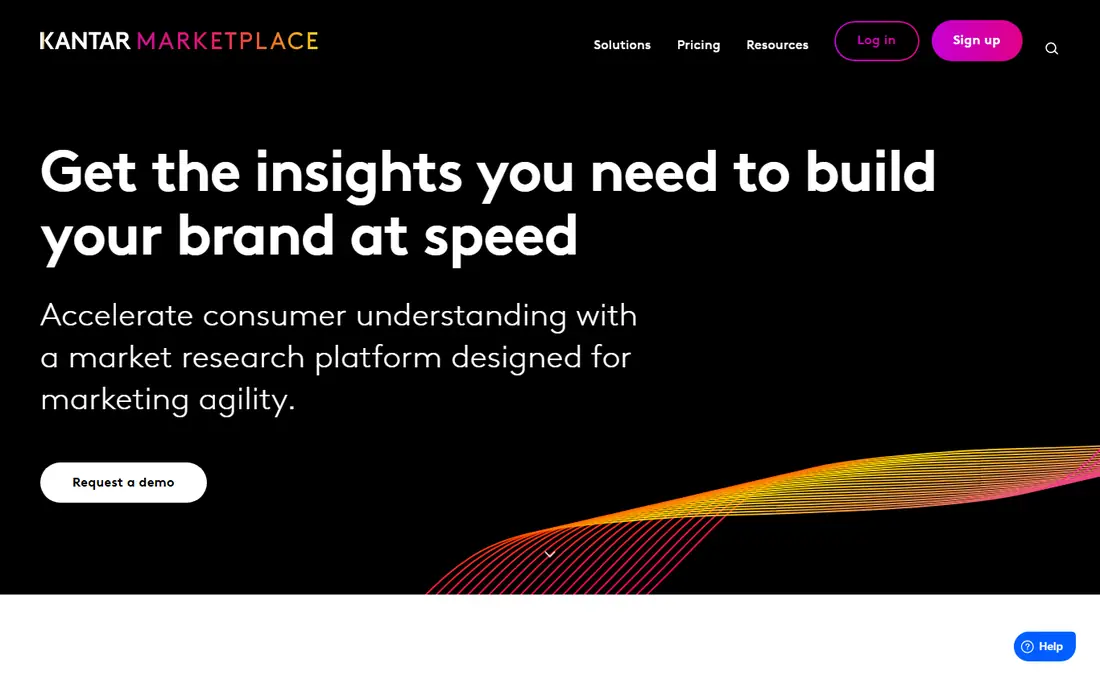
Kantar Marketplace brings research depth that agile tools sometimes skip, with diagnostics that explain why a concept works rather than only whether it scores well. Purchase intent modeling, brand equity measures, and normative benchmarks help teams defend a decision to senior leaders who want more than a single score. Global coverage also suits brands testing the same idea across markets. Speed is the honest limit. Kantar studies can take longer than a Zappi or Upsiide run, and pricing is set by agreement. Teams that need an answer this week may prefer a faster tool for screening, then use Kantar for the concepts that survive. For final validation, its depth is a real asset.
- Strong concept diagnostics and purchase intent modeling
- Established norms
- Global reach and research expertise
- Quote-based pricing
- Turnaround can be slower than agile platforms
Qualtrics is less a CPG concept tool and more a research platform that can run excellent concept studies, and that distinction matters. Teams with research expertise get advanced logic, monadic and sequential designs, conjoint analysis, and statistical tools that go beyond a standard concept score. Results can also connect to brand and customer data already held in Qualtrics. Occasional testers will find it heavy. The platform assumes research skill, onboarding takes time, and pricing is enterprise level. Companies that already run Qualtrics for customer experience work get the best value, since concept testing becomes one more use of a system they own. Standalone CPG teams should compare Zappi first.
- Advanced survey logic and statistics
- Conjoint and trade-off analysis
- Connects to wider customer experience data
- Expensive and complex for occasional testing
- Needs research skill to use well
Upsiide suits the earliest stage of CPG innovation, when a team has many ideas and needs to kill weak ones fast. Its mobile-first surveys and market share simulation help teams rank concepts and see which ones might win shelf space, without running a full validation study on each. That speed keeps pipelines moving and saves expensive testing for survivors. It is a screening tool first, not a final validation or forecasting platform. Teams should plan a second stage with Zappi, Kantar, or BASES for the ideas that pass. Used in that role, Upsiide is efficient and easy to adopt, and the trial makes it simple to judge fit on real concepts.
- Mobile-first idea screening
- Market share simulation for concepts
- Quick results for early-stage ideas
- Less depth for final validation
- Smaller teams may still need a second tool for forecasting
Attest gives CPG teams a self-serve way to run consumer studies without waiting on an agency or a heavy enterprise setup. Teams can target audiences across many markets, field a concept study quickly, and read results in clear dashboards. That control suits insight teams that test often and want to iterate on wording, packs, or claims themselves. The limit is benchmarking. Attest does not offer the same deep CPG normative database as Zappi or Kantar, so scores need careful interpretation against your own past studies. Teams with research skill will get strong value from it. Teams that want a benchmarked verdict with little design work should look at Zappi instead.
- Self-serve studies across many markets
- Fast setup for consumer audiences
- Clear dashboards
- Less CPG-specific benchmarking than Zappi
- Quality depends on study design
Pollfish is the quick-read option on this list, built around mobile surveys that reach respondents fast. For a CPG team that needs a directional answer on a claim, a pack idea, or a flavor direction, Pollfish can return results far faster than a full research program. That speed makes it useful for early checks and for teams without a large research budget. Complex diagnostics are not its strength, and niche audiences need careful screening to keep sample quality high. Treat Pollfish results as directional rather than final, and validate winning concepts on a deeper platform before committing launch spending. Used honestly, it is a useful first filter.
- Fast mobile-first surveys
- Broad respondent reach
- Good for quick directional reads
- Less suited to complex concept diagnostics
- Sample quality needs care for niche audiences
Suzy is built for teams that test continuously rather than once a quarter, with an always-on audience that supports repeated concept checks. That model suits CPG teams refining a concept over several rounds, since each round can build on the last without recruiting from scratch. Qualitative and quantitative feedback sit together, which helps teams understand both scores and reasons. One-off testers get less value, because the platform's strength is the ongoing audience and workflow. Pricing is also set by agreement, so small brands should check costs early. For innovation teams with a steady pipeline, Suzy's always-on approach can shorten the gap between idea and decision.
- Always-on consumer audience for repeated testing
- Fast qualitative and quantitative feedback
- Good for iterative concepts
- Pricing is quote based
- Best value comes with regular use rather than one-off studies
PickFu is the simplest tool here, and that simplicity is its point. Teams can run a side-by-side poll on two names, claims, or pack directions and get an answer in hours, with written explanations from respondents. For early creative choices, that speed beats a formal study that arrives after the decision has moved on. It is not a replacement for concept validation. Samples are small and the method suits early reads, not launch forecasts. Use PickFu to settle a close call between two directions, then validate the winner on Zappi, Kantar, or BASES. At that job, it is fast, cheap, and genuinely useful.
- Very fast side-by-side polls
- Simple setup
- Useful for names, claims, and pack directions
- Not a full concept validation platform
- Small samples suit early reads only
How we picked these
We compared official feature pages, pricing pages, help documentation, privacy policies, and public reviews, and we favored platforms with real CPG use, clear methods, and active support. We weighed benchmark quality, speed, sample reach, and whether results support a launch decision, not just a preference score. Prices are listed as See website where vendors price by agreement, so confirm current terms and per-study costs before budgeting.
How to run concept testing that leads to a decision
A good platform cannot save a vague study, so design the test around the decision you need to make.
Start with the decision, not the survey
Write down what you will do if the concept scores high, middling, or low, before you field anything. If a low score would not stop the launch, the study is theater, not research. Clear decision rules also help you pick the right tool: screening needs speed, while a launch call needs forecasting.
Test the concept people will actually see
Use realistic packs, claims, and prices, not polished internal slides that flatter the idea. Include a price point where possible, since a concept without a price tells you little about purchase intent. Also test against a known benchmark or a current product, so the score has context.
Read the reasons, not just the score
A percentile or purchase intent figure tells you where a concept lands, not what to fix. Read open responses, diagnostic ratings, and subgroup differences to find the claim, flavor, or pack detail holding the idea back. The best teams run a second round on a fixed concept rather than launching a flawed one.
Frequently asked questions
What is concept testing for CPG companies?
Concept testing shows a product idea, pack, or claim to target consumers and measures appeal, purchase intent, and reasons to buy or reject it. CPG companies use it to screen ideas, improve concepts, and decide whether to invest in a launch. Good testing happens before factory, packaging, and media spending lock a company into a weak idea.
Which concept testing platform is best for CPG?
Zappi is our pick for most CPG teams, thanks to its automated testing and CPG benchmarks. NielsenIQ BASES is best when a volume forecast is needed for a launch decision, and Kantar Marketplace suits teams that want deep diagnostics. The right pick depends on whether you are screening ideas or making a final launch call.
How much does concept testing cost?
Costs vary widely by platform and study size. Agile polls can cost far less than a full forecasting study, and most enterprise platforms price by agreement rather than publishing a rate. Ask each vendor for a per-study price for your sample size and markets, and confirm what benchmarks and reporting are included.
How fast can I get concept test results?
Fast platforms like PickFu and Pollfish can return early reads in hours, while automated CPG platforms like Zappi often return results in days once a study is scoped. Deeper validation and forecasting studies from Kantar or NielsenIQ BASES take longer, often weeks. Match speed to the decision: screening can be fast, but a launch call deserves more time.
What is the difference between concept testing and product testing?
Concept testing measures reactions to an idea, description, pack, or claim before the product is finished. Product testing, often called home-use testing, puts a real product in people's hands and measures use, taste, and repeat intent. CPG teams usually run concept testing first, then product testing on the ideas that survive.
Do I need a benchmark to interpret concept scores?
A benchmark helps a great deal, because a raw score alone does not say whether an idea is strong for its category. Platforms like Zappi and Kantar compare scores with past CPG studies, which gives context for a go-or-no-go call. Without a benchmark, compare against your own past concepts and a current competitor product.
Sources we checked (9)

Online Jobs is an independent blog about careers, online work, learning new skills and the tools that help people earn. More about us.
Keep reading
All posts
Workday Alternatives
We compared the best workday alternatives for HR, payroll, and global hiring, from BambooHR and Gusto to Rippling, Deel, and HiBob for growing teams in 2026.
Which SaaS Tools Have the Best Customer Support
Which SaaS tools have the best customer support? Compare eight popular tools on help centres, live help, response options and overall support quality.
Top AI Helpdesk Software
Searching for top AI helpdesk software in 2026? We compared 8 AI helpdesks on automation, pricing, channels and ease of setup for small and growing teams.