Best Community Platforms in 2026: 9 Platforms Compared

How we put this together: we compare official feature and pricing pages, app store listings, privacy policies and public user reviews. Prices change, so check the provider's site before you pay.
Key takeaways
- The best community platform depends on whether you run a paid membership, a free forum, or a chat-first group, so define that before comparing prices.
- Circle and Mighty Networks are the strongest all-round choices for paid creator communities, with courses, events, and member payments in one place.
- Discourse is the best choice for a searchable, long-lived forum, especially if you want open-source control and self-hosting.
- Discord is free and excellent for real-time chat, but it is weaker for charging members, searching old discussions, and owning your data.
- Transaction fees matter as much as monthly fees: a low monthly price with a percentage cut can cost more once membership grows.
Quick comparison
| Name | Who it suits | Starting price | Free option | |
|---|---|---|---|---|
 Circle | Paid creator communities | $89 per month | Free trial | Visit |
 Mighty Networks | Courses plus community | $79 per month | Free trial | Visit |
 Discourse | Searchable forums | $100 per month | Yes | Visit |
 Discord | Free real-time chat | Free | Yes | Visit |
 Skool | Simple coaching communities | $99 per month | No | Visit |
 Heartbeat | Modern chat and courses | $49 per month | Free trial | Visit |
 Bettermode | Branded support communities | See website | Free trial | Visit |
 Hivebrite | Associations and alumni | See website | No | Visit |
 Facebook Groups | Free reach and discovery | Free | Yes | Visit |
The best community platforms
A community platform is where your members talk, learn, and show up repeatedly, so the choice shapes behaviour more than any single feature list. Some platforms suit fast chat, others suit slow, searchable discussion, and others suit paid courses with a community wrapped around them. The nine below cover those different jobs.
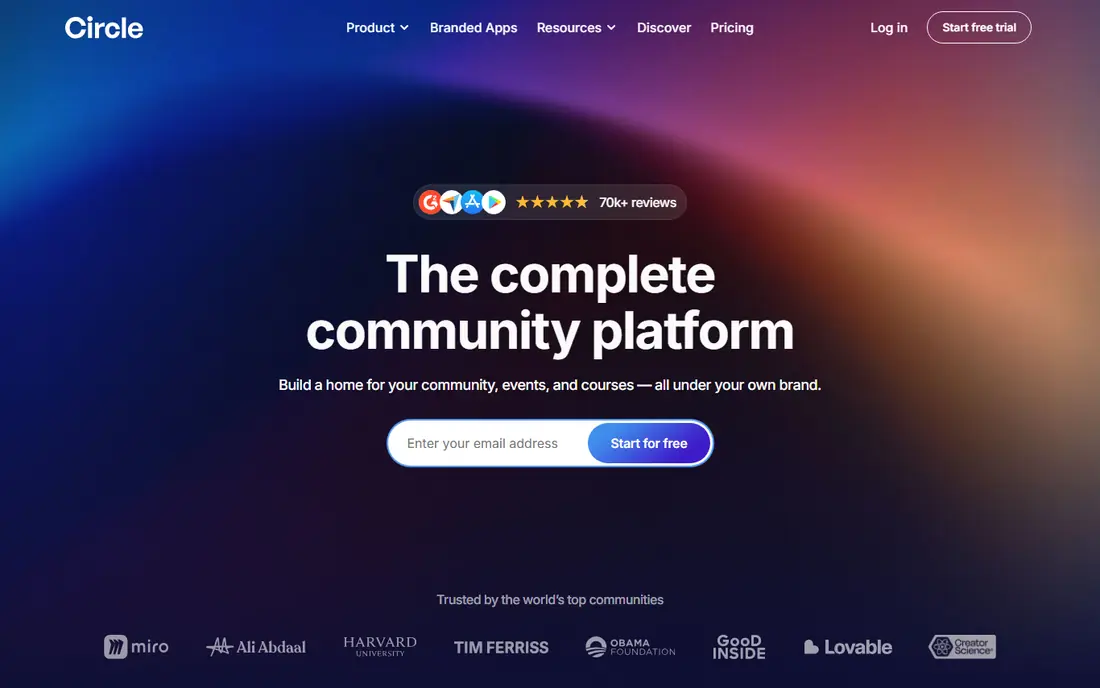
Circle is our pick for most paid creator communities. It brings discussion spaces, courses, live events, and member payments into one polished place, so members do not have to jump between a forum, a course site, and a payment tool. Automations can welcome new members, award badges, and surface active discussions, which helps a small team run a community that feels alive without constant manual work.
The pricing needs a close read. The Professional plan starts at $89 per month on annual billing, with a transaction fee on lower plans, and higher tiers at $199 and $419 per month add capacity and features. If you plan to sell a lot through Circle, compare the fee-inclusive cost against a platform with no transaction fee. For most creators, though, the member experience and breadth of tools justify the starting price.
- Spaces for discussion, courses, live streams, and events
- Automation and member analytics
- Clean, modern member experience
- Transaction fees on lower plans
- Branded mobile apps and some email features sit on higher tiers
- Member limits vary by plan
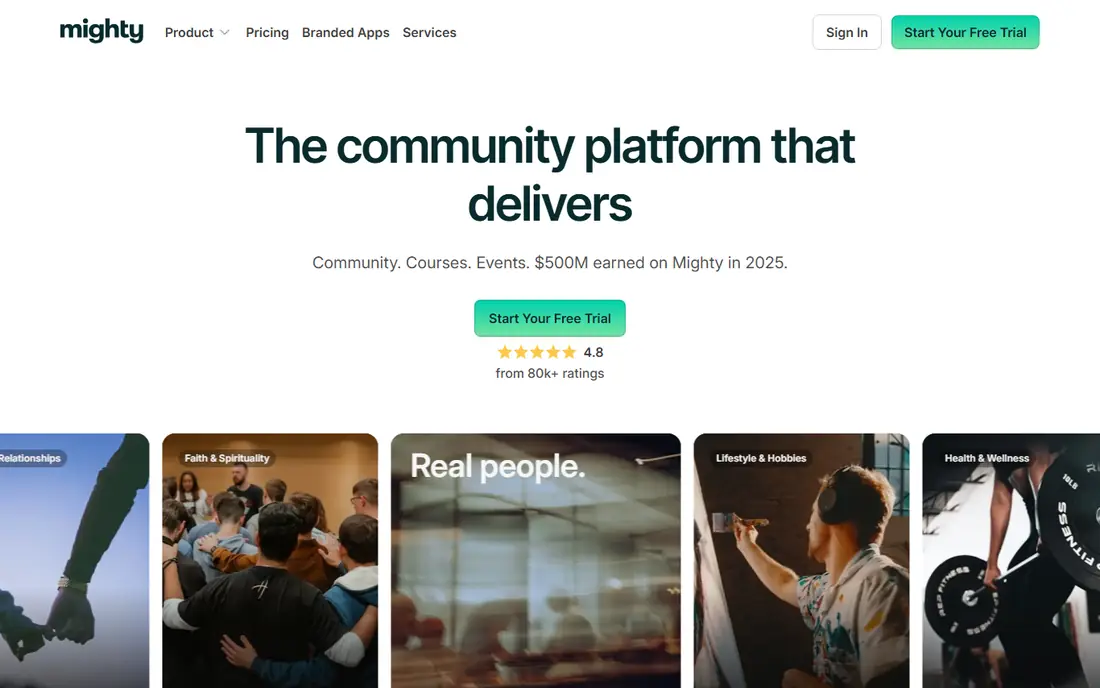
Mighty Networks is the strongest rival to Circle, and it wins for communities built around structured programs. Cohort courses, challenges, live streams, and events sit naturally beside discussion spaces, so a coach or educator can run a timed program without bolting on a separate course platform. Members get a strong mobile experience, which matters when most engagement happens on a phone.
Pricing starts at $79 per month on annual billing for the Launch plan, with higher tiers at $179 and $354 per month, and transaction fees that fall as you move up. Fully branded mobile apps sit on Mighty Pro, which is quoted separately, so budget for that if your own app in the app stores is a requirement rather than a nice extra.
- Unlimited members and spaces on paid plans
- Strong native mobile apps
- Cohort courses, events, and challenges built in
- Transaction fees on lower plans
- Design flexibility is less open than Discourse
- Branded apps need the higher Pro tier
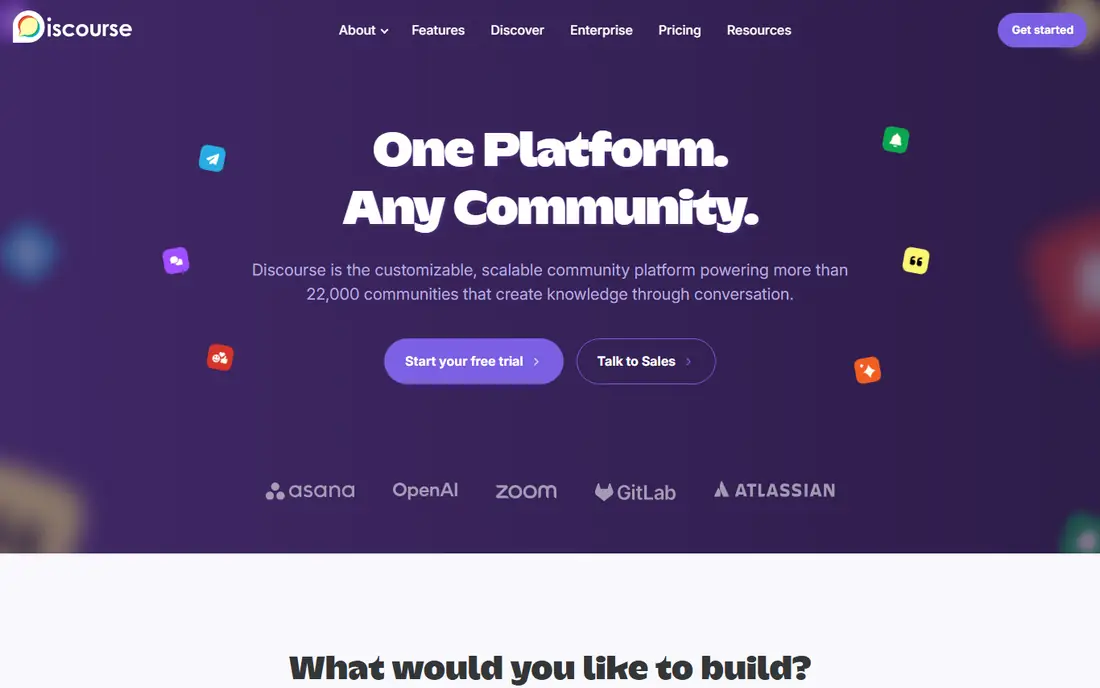
Discourse is the best choice when you want discussions that stay findable for years. Unlike chat apps where a good answer scrolls away in a day, Discourse threads are searchable, categorised, and easy to link to, which makes it ideal for support communities, product forums, and knowledge bases. Trust levels reward helpful members with more abilities over time, and moderation tools are mature.
The hosted Standard plan starts at $100 per month, while self-hosting the open-source code is free apart from your own server costs and time. Self-hosting is genuinely viable, but it needs updates, backups, and spam management, so a non-technical team should usually choose hosted. If your community lives on quick chat rather than considered replies, Discord or Heartbeat may fit better.
- Open source and self-hostable
- Excellent search and long-form discussion
- Trust levels and moderation tools
- Hosted plans start at $100 per month
- Less suited to real-time chat
- Self-hosting needs technical upkeep
Discord is free, familiar, and excellent for real-time conversation. Servers can hold text channels, voice rooms, and video, and roles and bots let you organise members and automate routine moderation. For gaming groups, study groups, and fan communities, it is often the place members already are, which removes the hardest part of launching a community: getting people to show up.
The limits appear when a community becomes a business. Charging members, exporting member data, and searching two years of conversation are all weaker here than on Circle, Mighty Networks, or Discourse. Nitro, at around $9.99 per month for users who want it, adds perks but does not fix those structural limits. Use Discord for free, chat-first communities, and choose a paid platform when membership revenue matters.
- Free for core use
- Voice, video, and text in one place
- Bots, roles, and huge existing audience
- Weak for paid memberships and data ownership
- Old discussions are hard to search
- Moderation at scale takes real work
Skool wins on simplicity. A community, a classroom for courses, and a calendar sit in one clean view, and the flat $99 per month pricing makes budgeting easy for a coach or small creator. There is little to configure, which means you can launch in a day rather than spending a week choosing layouts and integrations.
Simplicity is also the limit. Customisation is modest, analytics are basic compared with Circle, and larger communities with complex permissions may outgrow it. There is no free plan, so try the platform properly during any trial period and check that your members like the single-feed layout before you move an existing community onto it.
- Very simple setup
- Community, classroom, and calendar in one view
- Flat monthly pricing
- Limited customisation
- No free plan
- Less suited to large, complex communities
Heartbeat is a newer community platform that blends chat-style discussion with courses and events, and it starts at $49 per month for the Build plan. That lower entry price makes it attractive for a creator who wants a modern feel without paying $79 to $99 per month from day one. The interface feels closer to a chat app than a forum, which suits members who prefer short, frequent messages.
Watch the member caps. The Build plan stops at a set member count, after which you move to the Grow plan at $149 per month, so a fast-growing community can face a price jump sooner than expected. Transaction fees also apply on lower plans. Check the current cap and fee for the plan you would actually be on in six months, not just the plan you start on.
- Chat-first feel with courses and events
- Lower starting price than Circle or Mighty Networks
- Clean modern interface
- Member caps on lower plans
- Transaction fees
- Smaller integration ecosystem than older platforms
Bettermode, formerly Tribe, suits brands that want a community embedded in their own website rather than a standalone creator hub. Spaces are built from flexible widgets, so a support community, a feedback board, and a discussion forum can share one branded home. That makes it a good fit for software companies and product teams that want community to support retention and support deflection.
Pricing is the reason to get a quote early. Published plans have started well above creator-platform prices, and the feature set you need may sit on a higher tier. For a small creator community, Circle or Mighty Networks will usually be cheaper and faster to launch. For a brand community tied to a product, Bettermode's flexibility can justify the cost.
- Flexible, widget-based spaces
- Strong for customer support and feedback communities
- Good customisation
- Pricing is higher than creator platforms for small teams
- Setup takes more thought
- Some features need higher tiers
Hivebrite is designed for associations, alumni networks, and professional communities rather than individual creators. Member directories, event management, groups, and admin controls suit organisations that need structure, privacy controls, and reporting across chapters or cohorts. It is a serious platform for a community that is also an institution.
That focus comes with a higher price. Published core plans have started around $895 per month on annual billing, with higher tiers above that, so it is not a sensible choice for a small creator community. If you run an association or alumni network with a budget to match, Hivebrite's admin depth is worth a demo. If not, start elsewhere and revisit it when membership revenue supports it.
- Built for associations, alumni, and professional networks
- Member directory and event tools
- Strong admin controls
- High starting price for small communities
- No free trial on some plans
- Quoted pricing for larger configurations
Facebook Groups remain the easiest free way to gather people, because your audience already has an account and gets notifications. For a hobby group, a local club, or a free audience around a topic, that reach is hard to beat, and setup takes minutes. Many paid communities also keep a free Facebook Group as a discovery outpost that feeds their main platform.
The limits are structural. You do not own the member list or the data, the algorithm decides how many members actually see each post, and monetisation tools are thin compared with Circle or Mighty Networks. Treat Facebook Groups as a front door, not a home base, and move paying members to a platform you control when the community becomes a business.
- Free
- Huge existing audience
- Members already have accounts and notifications
- No data ownership
- Algorithm controls what members see
- No real monetisation tools
How we picked these
We compared official pricing pages, feature pages, and public platform documentation, favouring platforms that are actively maintained and genuinely used for communities in 2026. We included free, creator, forum, and association options so readers can compare across budgets, rather than listing only the platforms with the largest marketing budgets. We did not claim hands-on testing, and we used See website where pricing was quoted or had changed recently.
Choosing the right community platform
Start with the member behaviour you want. If you want fast, daily chat, choose Discord or Heartbeat. If you want searchable, long-lived answers, choose Discourse. If you want paid memberships with courses and events, choose Circle or Mighty Networks. If you want an association directory, choose Hivebrite. A platform that fights your members' natural behaviour will feel empty even with good features, while a platform that matches it will grow with less effort.
Fees, migration, and ownership
Compare total cost, not just the monthly fee. Add transaction fees, branded app costs, and any payment processing, then model the total at your expected member count in six months. Also check export options before you launch: can you export member emails, posts, and content if you leave. A platform that locks your data in will cost you far more in a migration than a slightly higher monthly fee on a platform that lets you leave.
Moderation and member experience
Moderation is a feature, not an afterthought. Check role-based permissions, automated spam controls, reporting flows, and whether moderators can work from mobile. A community that grows without moderation tools will either burn out its moderators or lose good members to noise. Test the member journey too: joining, finding the right space, posting a first message, and getting a notification should all feel obvious on a phone.
Frequently asked questions
What is the best online community platform?
For most paid creator communities, Circle is the strongest all-round choice, with Mighty Networks close behind for course-led programs. For a free forum, Discourse is best, and for free chat, Discord is best. The right answer depends on whether you charge members, run courses, or just want conversation.
What is the best community app for creators?
Circle and Mighty Networks lead for creators, because both combine community, courses, events, and payments. Skool is simpler and cheaper to run for a coach with one program, while Heartbeat offers a modern chat-first alternative at a lower starting price. Try the member experience on a phone before you commit.
Can I build a community for free?
Yes. Discord is free for core chat, Discourse is free if you self-host it, and Facebook Groups are free. The trade-off is control: free platforms give you less ownership of data, weaker monetisation, and less say over how members see your content. Paid platforms earn their fee when membership revenue or support savings matter.
What is the difference between Circle and Mighty Networks?
Circle offers a cleaner all-in-one toolkit with stronger automation and a broader feature set, while Mighty Networks offers stronger native mobile apps and structured cohort programs. Both start around $79 to $89 per month on annual billing and charge transaction fees on lower plans, so compare the member experience and course tools rather than price alone.
Should I build my community on Facebook Groups?
Facebook Groups work well as a free discovery channel, but they are a weak home base for a paid community. You do not own the data, the algorithm limits reach, and monetisation is limited. Use Facebook to find members, then move paying members to a platform you control.
How do I move an existing community to a new platform?
Tell members early, explain what improves for them, and migrate in stages rather than switching overnight. Export member lists and key content where the old platform allows it, set up the new spaces before you invite people, and keep the old space open for a transition period so nobody gets lost in the move.
Sources we checked (9)

Online Jobs is an independent blog about careers, online work, learning new skills and the tools that help people earn. More about us.
Keep reading
All posts
n8n Alternatives
n8n alternatives compared for 2026, with Zapier, Make, Activepieces, and more, covering visual builders, code steps, self-hosting, and pricing models.

ZoomInfo Alternatives
The best ZoomInfo alternatives in 2026, compared on price, free plans, data coverage, and which tool fits small teams or large sales teams best in detail.

Workday Alternatives
We compared the best workday alternatives for HR, payroll, and global hiring, from BambooHR and Gusto to Rippling, Deel, and HiBob for growing teams in 2026.