9 Best Card Grading Service Picks for Collectors

How we put this together: we compare official feature and pricing pages, app store listings, privacy policies and public user reviews. Prices change, so check the provider's site before you pay.
Key takeaways
- PSA is our first pick for resale recognition, especially for vintage and high-demand cards, while CGC offers a lower entry cost for many modern cards.
- SGC suits sports card collectors who want a clean label and a simpler service, and Beckett suits collectors who want subgrades on the label.
- TAG and newer graders suit collectors who want machine-assisted grading and modern slabs, but resale recognition is still building for newer firms.
- Grading tiers change often, with some low tiers paused at times, so check the company pricing page before you send any cards.
Quick comparison
| Name | Who it suits | Starting price | Free option | |
|---|---|---|---|---|
 PSA | resale recognition | See website | No | Visit |
 Beckett Grading Services | subgrades and thick cards | See website | No | Visit |
 CGC Cards | lower cost modern grading | See website | No | Visit |
 SGC | sports cards and clean labels | See website | No | Visit |
 TAG | machine-assisted grading | See website | No | Visit |
 HGA | modern slabs and labels | See website | No | Visit |
 ISA Grading | budget grading | See website | No | Visit |
 Degree Grading | flat rate grading | See website | No | Visit |
 Ace Grading | UK collectors | See website | No | Visit |
The best card grading service
We compared grading companies on recognition, label detail, cost, turnaround estimates, and card types covered. The best card grading company for you depends on if you plan to sell, keep, or display the card, and on the sport or game involved.
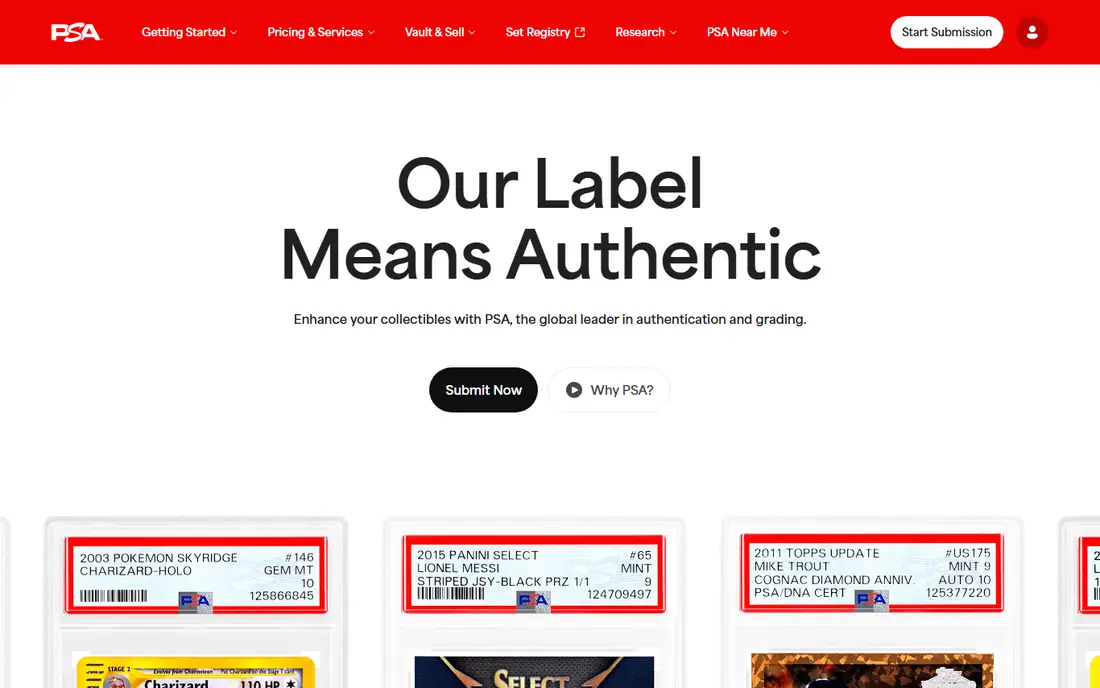
PSA, short for Professional Sports Authenticator, is the grading company most buyers recognise first. A high PSA grade often helps a card sell faster and for more than the same card in a lesser-known slab, especially for vintage sports cards and popular trading cards. Its population reports also help buyers check how rare a grade is.
The catch is cost and wait. Open tiers have cost more in recent periods, and lower tiers have been paused at times, so the cheapest published tier may not be open when you check. Always check the PSA services page, declared value limits, and estimated turnaround before you submit.
- Widest buyer recognition
- Large population reports
- Strong for vintage and high-demand cards
- Higher fees on open tiers at times
- Long waits on some tiers
- Low tiers are sometimes paused
Beckett, known as BGS, is the pick for collectors who want detail on the label. Subgrades show how a card scored on centering, corners, edges, and surface, which helps buyers judge a card beyond the main grade. It is also popular for thick modern cards with patches and autographs, where that detail matters.
Fees and tier availability change, and lower tiers have been paused at times, so check the Beckett grading page for the tiers actually open. If you want subgrades and you collect modern thick cards, Beckett is a strong choice despite the higher open-tier cost.
- Subgrades for centering, corners, edges, and surface
- Strong for thick patch and autograph cards
- Respected Black Label grade
- Higher fees on open tiers at times
- Base tiers are sometimes paused
- Turnaround varies by tier
CGC Cards is a practical choice for modern trading cards, including Pokemon and other TCG cards, where a lower entry fee matters. Bulk tiers can bring the per-card cost down for larger submissions, though they need a minimum card count and longer estimated waits. Economy tiers suit single cards that are not urgent.
Resale recognition for CGC varies by card type, so check recent sales for your specific set before you choose CGC over PSA. For a personal collection or for modern cards where cost matters, CGC offers a sensible balance of price and professional slabbing.
- Lower entry tiers for many cards
- Bulk options for larger submissions
- Clear labels
- Resale recognition varies by card type
- Bulk tiers need many cards and longer waits
SGC is a long-standing grader with a clean black-and-white label style that many sports collectors like. It suits vintage and modern sports cards, and its service tiers are easy to follow. Collectors who display cards often prefer the simple SGC look in a collection.
Fees have changed over time, so check the current SGC pricing page before you submit. If you collect sports cards and want a respected slab without subgrade detail, SGC is a solid and simple choice.
- Clean and simple labels
- Popular for sports cards
- Straightforward service tiers
- Fees have risen in recent periods
- Less TCG focus than CGC or PSA
TAG, short for Technical Authentication and Grading, uses machine-assisted imaging to grade cards and provides detailed reports on card condition. That approach appeals to collectors who want consistent measurement and a modern digital record alongside the slab. Its slabs and labels have a distinct modern look.
As a newer grader, TAG resale recognition is still building compared with PSA and Beckett, so check recent sales for your card type. If you value grading detail and modern presentation, and you are not in a rush to sell, TAG is worth considering.
- Machine-assisted grading process
- Detailed digital reports
- Modern slab design
- Newer firm with building resale recognition
- Tier availability changes
HGA, or Hybrid Grading Approach, is a newer grader known for modern slab styles and label designs. It appeals to collectors who display cards and want a fresh look, and it covers many modern trading cards. Its reports give a clear view of how a card scored.
Resale recognition is smaller than the major firms, so a card graded by HGA may sell for less than the same grade from PSA in some markets. If you grade for a personal collection or for display, HGA offers style and value. If resale is the main goal, compare recent sales first.
- Modern label designs
- Popular for Pokemon and modern cards
- Clear grading reports
- Smaller resale market than PSA
- Turnaround and tiers vary
ISA Grading is a budget option for collectors who want a professional slab without paying major-firm fees. It suits personal collections, lower-value cards, and collectors who want protection and a grade for display. Submission is simple, and costs are often lower than PSA or Beckett open tiers.
The trade-off is market recognition. An ISA grade may not carry the same resale weight as PSA, Beckett, CGC, or SGC. If you plan to sell a high-value card, a major grader is usually safer. If you grade for your own collection, ISA is a practical low-cost choice.
- Lower cost options
- Simple submission process
- Suits personal collections
- Lower resale recognition than major firms
- Smaller population data
Degree Grading offers a flat rate approach that some collectors find easier to budget than value-based tiers. It prints subgrades on labels, which helps buyers see centering, corners, and surface detail. That mix of flat pricing and detail appeals to modern card collectors.
As a newer firm, its resale market is still building, so check sales for your card type before submitting high-value cards. For personal collections and for cards where flat pricing helps, Degree Grading is a clear and simple option.
- Flat rate per card
- Subgrades on labels
- No membership needed to start in many cases
- Newer firm
- Resale recognition still building
Ace Grading is a UK-based grader that suits UK collectors who want to avoid sending cards abroad. It offers modern slabs and a local submission path, which can save shipping time and cost for UK-based collections. It covers many trading card types popular in the UK market.
Global resale recognition is smaller than PSA or Beckett, so international buyers may pay less for an Ace slab. If you collect in the UK and grade for display or a personal collection, Ace is convenient. If you plan to sell globally, compare it with a major grader first.
- UK-based service for UK collectors
- Modern slabs
- Avoids some international shipping for UK submitters
- Smaller global resale market
- Less recognition outside the UK
How we picked these
We checked official grading pages, service tiers, and pricing pages for each company, and we read public reviews and sales discussions about recognition and turnaround. We favoured firms with clear service tiers, published estimates, and coverage for sports or trading cards. We did not claim hands-on grading, and where a price could not be confirmed on the company site, we wrote See website rather than guess, since tiers pause and change often.
How to choose a card grading company
Start with your goal. If you plan to sell, pick the grader buyers trust most for your card type, which is often PSA for vintage and high-demand cards. If you plan to keep or display, a lower-cost grader may give you the same protection and look for less money. Check declared value limits, since higher-value cards need higher tiers.
Cost, wait, and card prep
Budget for grading fees plus shipping both ways and insurance, since those costs add to the per-card fee. Check estimated turnaround, which is an estimate and not a guarantee, and check if your tier is actually open. Clean and inspect cards carefully, use proper card savers and team bags, and photograph cards before you send them.
Baseball, Pokemon, and trading cards
For baseball card grading, PSA and SGC have deep sports recognition, while Beckett suits modern thick cards with subgrades. For Pokemon and other TCG cards, PSA, CGC, and Beckett all have strong followings, with CGC often offering lower entry costs. For a mixed collection, grading the highest-value cards with a major firm and lower-value cards with a budget firm can balance cost and resale value.
Frequently asked questions
What card grading company is the best?
PSA is the best-known grader for resale recognition in many markets, especially for vintage and high-demand cards. Beckett suits collectors who want subgrades, CGC suits modern cards at lower cost, and SGC suits sports cards with clean labels. The best company depends on your card type and if you plan to sell or keep it.
Which card grading company is the best for baseball cards?
PSA and SGC are strong picks for baseball card grading, with PSA leading for resale recognition and SGC offering a clean sports label. Beckett is also popular for modern baseball cards, especially thick patch and autograph cards where subgrades help buyers. Check recent sales for your specific set and year before you choose.
What is the best card grading service for Pokemon cards?
PSA, CGC, and Beckett are all popular for Pokemon cards. PSA often leads for resale, CGC often offers lower entry costs, and Beckett offers subgrades. For a personal Pokemon collection, a lower-cost grader can also work well. Compare fees, turnaround, and recent sales for your set.
How much does card grading cost?
Cost depends on the company, tier, declared value, and card count, and low tiers are sometimes paused. Major firms often charge more on open tiers than on paused low tiers, while budget firms charge less. Always check the company pricing page for open tiers, shipping, and insurance before you submit.
How long does card grading take?
Turnaround varies by company and tier, from faster express tiers to bulk tiers that can take many weeks. Published estimates are not guarantees, and backlogs can extend waits. Choose a tier that matches your patience and your selling plans, and do not submit a card you need to sell urgently on a slow tier.
Should I grade a card or keep it raw?
Grade a card if a high grade would add clear value, if you want authentication and protection, or if you plan to display it in a slab. Keep a card raw if grading fees would exceed the likely value gain, or if you enjoy handling and viewing the card unslabbed. Pre-check centering, corners, edges, and surface before you pay for grading.
Sources we checked (9)

Online Jobs is an independent blog about careers, online work, learning new skills and the tools that help people earn. More about us.
Keep reading
All posts
Zoom Alternatives
Zoom alternatives compared for 2026: Google Meet, Microsoft Teams, Webex, Jitsi and more for free calls, large meetings and webinars for teams and classrooms.

Workday Alternatives
We compared the best workday alternatives for HR, payroll, and global hiring, from BambooHR and Gusto to Rippling, Deel, and HiBob for growing teams in 2026.

WordPress Alternatives
WordPress alternatives guide: we compare 8 platforms for builders, designers, stores, and publishers to leave WordPress without losing your full site content.