Best API Management Platforms in 2026: 9 Platforms Compared

How we put this together: we compare official feature and pricing pages, app store listings, privacy policies and public user reviews. Prices change, so check the provider's site before you pay.
Key takeaways
- Kong, Tyk, Gravitee and WSO2 suit teams that want an open-source gateway core with a paid management layer on top.
- Apigee, MuleSoft and IBM API Connect are enterprise plays with deep governance, and they need a sales conversation and a longer rollout.
- AWS API Gateway and Azure API Management win inside their own clouds, where usage billing and native integration beat a standalone gateway.
- Postman is not a gateway, but it is the best starting point for API design, testing and documentation before traffic management matters.
Quick comparison
| Name | Who it suits | Starting price | Free option | |
|---|---|---|---|---|
 Kong | High-performance gateway teams | See website | Yes | Visit |
 Apigee | Google Cloud API programs at scale | See website | Free trial | Visit |
 MuleSoft Anypoint | Enterprises unifying integration and APIs | See website | Free trial | Visit |
 AWS API Gateway | AWS-native serverless APIs | Pay per request | Free tier | Visit |
 Azure API Management | Azure-first enterprises | See website | Free trial | Visit |
 Postman | API design, testing and docs | $14 per user per month | Yes | Visit |
 Tyk | Lightweight programmable gateway | See website | Yes | Visit |
 Gravitee | Event-native API management | See website | Yes | Visit |
 WSO2 API Manager | Open-source full lifecycle | See website | Yes | Visit |
The best api management platforms
An API management platform covers more than routing traffic. It adds authentication, rate limits, developer portals, versioning, analytics and monetisation around a gateway, so teams can publish APIs safely and partners can use them without constant support. The right platform depends on cloud, scale and governance needs.

Kong suits teams that need a fast, plugin-rich gateway without enterprise integration pricing. The open-source gateway handles routing, authentication and rate limiting, while Konnect adds management, analytics and developer portal features for teams that need them. Plugin support covers common needs from auth to traffic control, and hybrid deployment keeps data planes where you need them.
The trade is assembly. The free gateway is powerful, but a polished portal and enterprise governance sit in paid tiers, so budget for that layer if you publish public APIs. For microservices and multi-cloud teams, Kong remains the most flexible gateway-first pick.
- Open-source gateway core
- Rich plugin system
- Strong multi-cloud and hybrid support
- Full management layer is paid
- Portal setup needs configuration
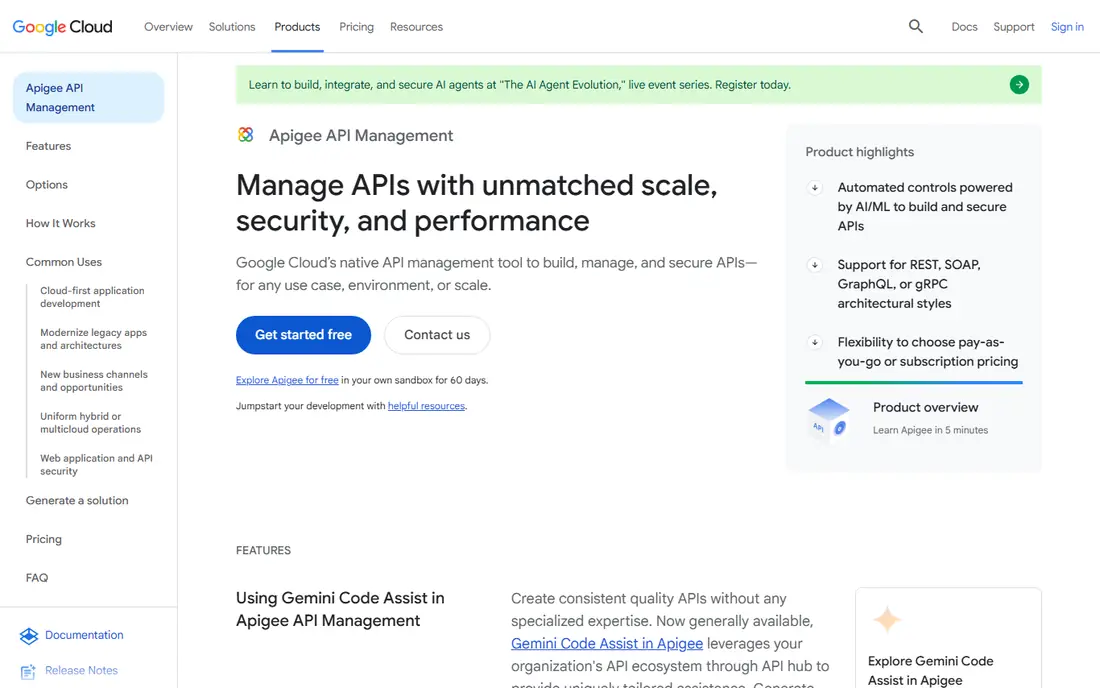
Apigee is Google Cloud API management for enterprises that run large API programs with strict governance. Analytics, security policies, traffic management and developer portals cover the full lifecycle, and integration with Google Cloud services suits teams already on that platform. It handles high-volume programs with detailed controls over who can call what.
Smaller teams will find it heavy and expensive, and pricing is largely quoted or pay-as-you-go by environment. Choose Apigee when you already run Google Cloud at scale and need enterprise governance, not when you need a quick gateway for one service.
- Advanced analytics and security policies
- Strong governance
- Google Cloud fit
- Enterprise pricing and complexity
- Hybrid setup needs planning
MuleSoft Anypoint pairs API management with integration, so an enterprise can connect legacy systems, SaaS apps and APIs in one platform. Its connector library and API-led design approach suit large organisations with many systems to join up, and governance tools cover design, publishing and monitoring. For a company standardising on Salesforce and MuleSoft, the fit is natural.
Cost and time are the barriers. Pricing is custom, projects often run for months, and small teams get little value from the breadth. Pick MuleSoft when integration is the main problem and API management is part of that larger programme.
- Unified integration and API management
- Strong connectors
- Enterprise support
- Custom pricing
- Long implementation for large programs
AWS API Gateway is the default for teams already on AWS, especially serverless APIs backed by Lambda. You pay per request rather than per seat, it scales without managing servers, and it ties directly to AWS auth, logging and monitoring. For a startup or an AWS shop shipping internal or public APIs, that simplicity is hard to beat.
It is a gateway more than a full management suite, so a polished developer portal, monetisation and advanced governance often need extra services or tools. Teams that need those features should compare it with Kong or Apigee before committing to AWS alone.
- Pay-per-request pricing
- Native Lambda and AWS integration
- Scales automatically
- Portal and governance need extra tooling
- Costs rise with traffic volume
Azure API Management suits enterprises already on Microsoft Azure, with a built-in developer portal, policy controls and integration with Azure identity and monitoring. Tiered plans cover development through production, and a consumption option helps smaller workloads avoid a large fixed bill. Self-hosted gateway support extends it to on-premise backends.
Pricing varies by tier and region, so compare the tier that matches your traffic and portal needs, not just the cheapest tier. For Azure shops, the native fit usually beats a standalone gateway on total effort, even if the gateway alone looks cheaper.
- Built-in developer portal
- Azure integration
- Consumption and tiered options
- Self-hosted gateway adds complexity
- Pricing tiers need careful comparison
Postman is the best API management tool for the design and testing stage, even though it does not route production traffic. Teams design, mock, test, document and monitor APIs in the tool developers already know, and collections keep collaboration simple. The free plan covers individuals and small teams, with paid tiers adding collaboration and governance.
Do not buy Postman expecting gateway features. Pair it with Kong, AWS or Azure for production traffic, and use Postman for the workflow that happens before an API ships. That pairing is common and works well.
- Standard tool for design and testing
- Collaboration and docs
- Free plan for small teams
- Not a production gateway
- Traffic management needs a separate platform
Tyk suits developers who want a lightweight, programmable gateway they can run themselves. The open-source gateway covers routing, auth and rate limits, while paid tiers add a dashboard, portal and analytics. Its policy model is flexible, and it runs well in containers and Kubernetes, which suits platform teams.
The community and plugin range are smaller than Kong, and full management features need a paid plan. For a team that values a small footprint and code-first control, Tyk is a strong alternative to Kong.
- Open-source gateway
- Programmable policies
- Self-serve portal in paid tiers
- Enterprise features are paid
- Smaller community than Kong
Gravitee covers REST, event and streaming APIs in one platform, which sets it apart from gateway-only tools. The open-source edition includes a portal, and paid tiers add governance, analytics and support for larger programs. Teams building event-driven systems, with Kafka or similar streams alongside REST APIs, get a single place to manage both.
Quoted enterprise pricing makes budgeting harder, and event API concepts take time to learn. For teams whose future includes streaming as well as REST, Gravitee is worth a trial ahead of a REST-only gateway.
- Open-source edition
- Event and streaming API support
- Built-in portal
- Enterprise tiers are quoted
- Event features need learning time
WSO2 API Manager offers a complete open-source lifecycle, from design and publishing to gateway, portal and analytics, under an Apache licence. Regulated and hybrid teams value the ability to self-host the whole stack and control data residency. The portal is included, not an add-on, which helps teams publish APIs without extra tooling.
Running it well needs platform skill, and most large deployments add paid support. For an organisation that wants open-source control with full lifecycle features, WSO2 remains one of the most complete options available.
- Complete open-source lifecycle
- Portal included
- Strong for regulated and hybrid use
- Setup and tuning need skill
- Paid support often needed at scale
How we picked these
We compared official product pages, documentation and pricing pages for each platform, plus public comparisons from platform teams. We kept tools that manage APIs at production scale or, for Postman, cover the design and testing workflow that precedes production. Where pricing is quoted or usage-based, we wrote See website or pay per request rather than inventing a flat monthly figure.
What to check before you choose
Start with where your APIs run and who consumes them. A cloud-native team gains most from its own cloud gateway, while a multi-cloud team gains most from a portable gateway like Kong or Tyk. A public API programme needs a portal, monetisation and governance, while an internal microservices mesh mainly needs routing, auth and observability.
Traffic and pricing model
Compare per-request, per-service and per-seat models at your expected traffic, not at demo volume. A cheap gateway can become expensive at high request counts, and a quoted enterprise platform can be cheaper per request at very high scale.
Security and governance
Confirm authentication methods, rate limiting, key management, audit logs and policy controls match your security rules. For regulated APIs, check data residency and compliance documentation before a trial, not after.
Developer experience
Trial the portal from a partner developer point of view. Clear docs, working examples and easy key creation reduce support load more than any gateway feature, and a portal that developers avoid will not drive adoption.
Frequently asked questions
What is the best API management platform for a small team?
Kong open-source, Tyk open-source, AWS API Gateway or Azure consumption tiers suit small teams, depending on cloud. Postman covers design and testing, while Zuplo-style managed options suit teams that want minimal setup, though they sit outside this list.
What is the best API management tool for enterprises?
Apigee, MuleSoft Anypoint and IBM-style enterprise platforms lead for governance at scale, with Kong and WSO2 as strong multi-cloud alternatives. The best enterprise pick follows your existing cloud and integration stack.
Is there a best API management software option that is free?
Yes, Kong, Tyk, Gravitee and WSO2 all offer open-source gateways or editions for free, with paid management layers. Postman also offers a free plan for design and testing, though it is not a gateway.
What is the difference between an API gateway and API management?
A gateway routes, authenticates and rate-limits live traffic. API management adds the lifecycle around it: design, portal, versioning, governance, analytics and monetisation. Most teams need both, even if they buy them from different vendors.
Which platform is best for AWS users?
AWS API Gateway is the natural pick for AWS-native APIs, with pay-per-request pricing and Lambda integration. Teams that also run other clouds may still choose Kong for portability.
How much does API management cost?
Open-source gateways cost nothing for the gateway layer, managed entry points start low, and enterprise platforms are quoted and can reach six figures a year. Model cost at your traffic and user count before choosing.
Sources we checked (9)
- https://konghq.com/pricing
- https://cloud.google.com/apigee/pricing
- https://www.mulesoft.com/platform/api-management
- https://aws.amazon.com/api-gateway/pricing/
- https://azure.microsoft.com/en-us/products/api-management
- https://www.postman.com/pricing/
- https://tyk.io/pricing/
- https://www.gravitee.io/pricing
- https://wso2.com/api-manager/

Online Jobs is an independent blog about careers, online work, learning new skills and the tools that help people earn. More about us.
Keep reading
All posts
n8n Alternatives
n8n alternatives compared for 2026, with Zapier, Make, Activepieces, and more, covering visual builders, code steps, self-hosting, and pricing models.

ZoomInfo Alternatives
The best ZoomInfo alternatives in 2026, compared on price, free plans, data coverage, and which tool fits small teams or large sales teams best in detail.
Workday Alternatives
We compared the best workday alternatives for HR, payroll, and global hiring, from BambooHR and Gusto to Rippling, Deel, and HiBob for growing teams in 2026.