Best AI Visibility Tools for B2B Companies in 2026: 9 Tools Compared

How we put this together: we compare official feature and pricing pages, app store listings, privacy policies and public user reviews. Prices change, so check the provider's site before you pay.
Key takeaways
- AI visibility tools track how often your brand shows up in answers from ChatGPT, Perplexity, Gemini, and similar systems, which is different from classic search rankings.
- Otterly.AI and Rankscale are the lowest cost entry points on this list, while AthenaHQ, Goodie, and Brandlight are built for larger teams with bigger budgets.
- Treat every visibility score as a trend, not an exact measurement, since no vendor can see the full set of answers a model gives to real users.
- B2B teams should check which tools track the prompts their buyers actually ask, not just how many engines appear on a marketing page.
- Start with a short trial and a small prompt set tied to your product category before signing a yearly contract.
Quick comparison
| Name | Who it suits | Starting price | Free option | |
|---|---|---|---|---|
 Otterly.AI | Small B2B teams starting out | $29 per month | Free trial | Visit |
 Peec AI | Mid-market teams tracking several markets | See website | Free trial | Visit |
 Profound | Enterprise brands with strict security needs | See website | No | Visit |
 Brandlight | Large companies managing several brands | See website | No | Visit |
 AthenaHQ | Teams that want a free tier to test first | $295 per month | Yes | Visit |
 Goodie | Brands that want tracking tied to fixes | $399 per month | Free trial | Visit |
 Rankscale | Startups that want low monthly cost | See website | Free trial | Visit |
 SE Ranking | SEO teams adding AI tracking to an existing suite | $52 per month | Free trial | Visit |
 Semrush AI Visibility Toolkit | Teams already using Semrush | See website | Free trial | Visit |
The best AI visibility tools for B2B companies
These tools answer one plain question for a B2B team: when a buyer asks an AI system about your category, does your company get named, cited, or skipped. The picks below mix low cost starters with enterprise platforms, and we compared official pricing pages, feature pages, and public documentation to build the list.
Otterly.AI is the easiest first step for a small B2B company that wants to know whether AI answers mention it at all. The entry plan is priced at $29 per month, which makes it realistic for a team that is still deciding whether this category deserves a budget line. It tracks brand mentions across the main AI answer engines and presents the results in a dashboard that does not need a data team to read.
The honest catch is depth. Otterly.AI covers the basics well, but a larger company that needs sentiment analysis, detailed citation mapping, or enterprise controls will outgrow it. For a first quarter of tracking, though, it gives a small team a clear picture of where it stands and which topics need stronger content.
- Low entry price
- Simple tracking across major AI answers
- Unlimited workspaces on higher plans
- Shallower analysis than enterprise tools
- Fewer engines than some rivals
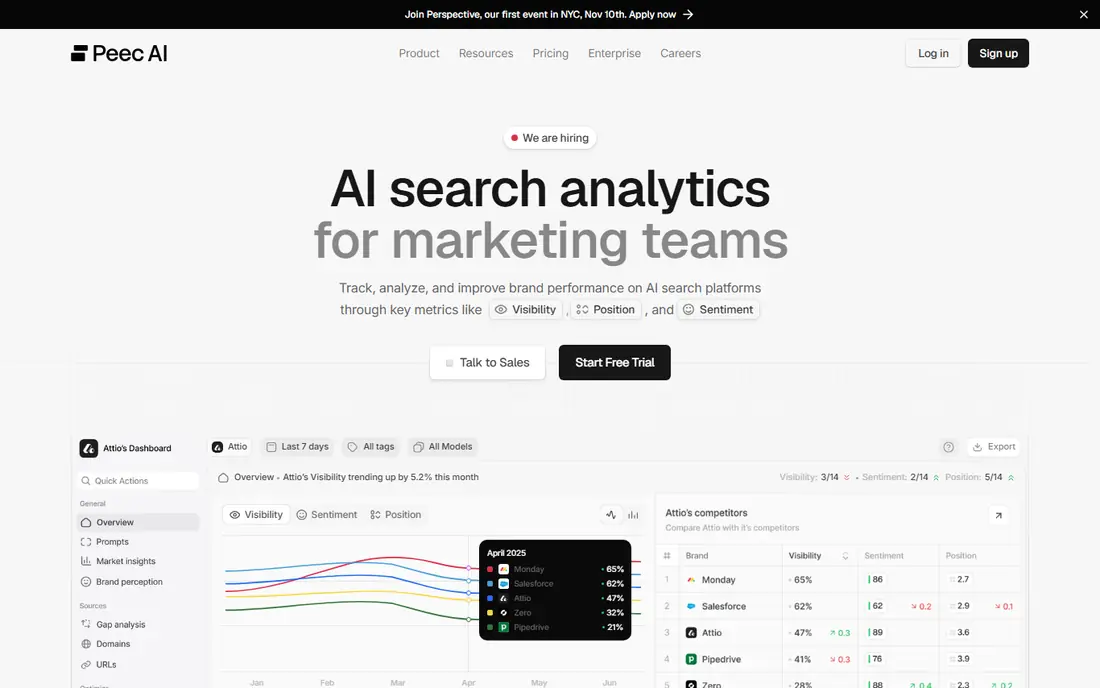
Peec AI is based in Berlin and built around prompts rather than keywords, which suits B2B teams that sell into more than one country. You define the questions buyers ask, and the tool reports how often your brand and your competitors appear in the answers, along with the sources cited. That prompt-first view makes it easier to connect a visibility gap to a specific content page that needs work.
The downside is pricing clarity. Published entry prices for Peec AI have varied across comparison pages, so we list it as See website and suggest confirming the current plan before budgeting. Teams that need multi-region tracking and shared seats will find the structure sensible, but a solo marketer may find cheaper options cover the same ground.
- Multi-market tracking
- Prompt-focused reporting
- Unlimited seats on published plans
- Entry price has moved over time, so check the current page
- No free tier
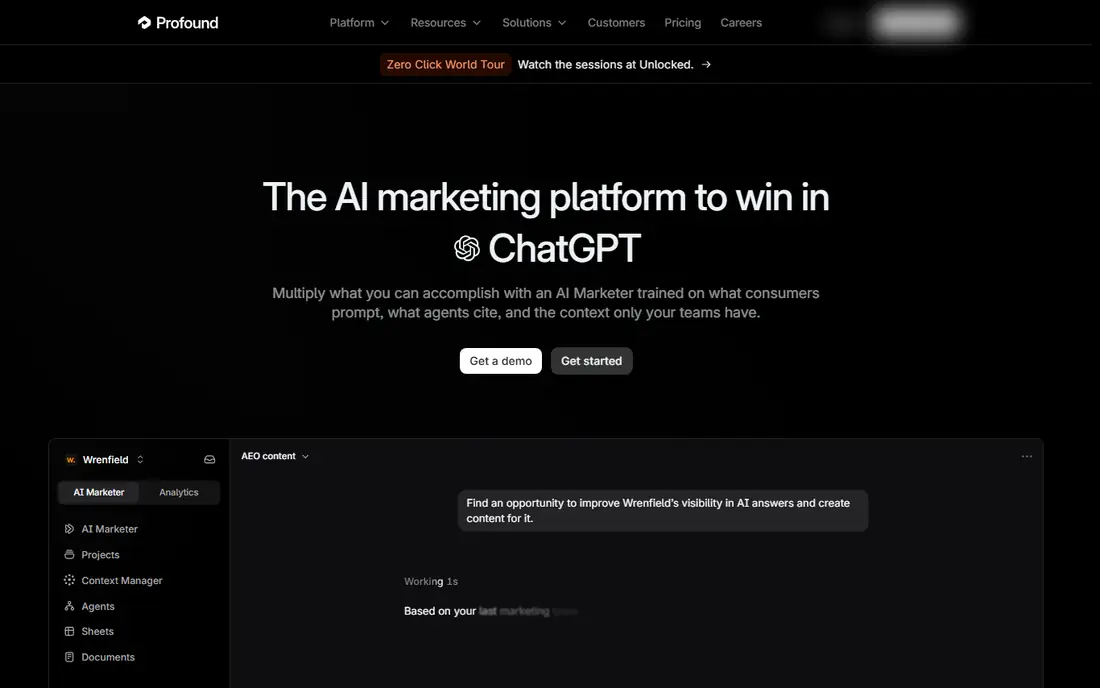
Profound is the name that comes up most often in enterprise conversations about AI visibility, and the product backs that up with detailed citation data. It shows which pages AI systems cite when they answer category questions, and it adds conversation demand data that reveals what buyers actually ask. For a large B2B brand, that combination turns a vague visibility score into a concrete list of pages to improve.
The catch is cost and access. Profound offers a short trial, but brand pricing beyond that is custom, so a small company cannot simply sign up and start. Security reviews and enterprise controls are a genuine strength here, but they also signal who the product is really built for. If your team is large and AI search is already a board-level topic, Profound belongs on the shortlist.
- Deep citation and conversation data
- Strong enterprise controls
- Wide engine coverage on enterprise plans
- No published brand price after the trial
- Overkill for small teams
Brandlight positions itself as a partner for very large companies rather than a self-serve tracker, and that shows in how it works. It tracks brand mentions across AI answers and adds sentiment and narrative analysis, so a team can see not just whether it is mentioned but how it is described. For a company managing several brands or business units, that shared view matters more than a low monthly fee.
The trade-off is obvious. Pricing is quote-only, there is no free tier, and a small or mid-market B2B team will likely find the sales process heavy for what it needs. Brandlight makes sense when the buyer is a large enterprise that wants analysis and follow-through, not just a dashboard.
- Built for multi-brand enterprises
- Sentiment and narrative analysis
- Execution support
- Quote-only pricing
- Not suited to small budgets
AthenaHQ stands out because it lets a team start free, which is rare in this category. The free Essential plan gives a cautious B2B marketer a way to see real data before asking for budget, and the paid Starter plan is listed at $295 per month. Its dashboards lean toward business intelligence, with audit logs and structured reporting that suit larger marketing and communications teams.
The catch is the jump from free to paid. A team that likes the free tier may find $295 per month a steep next step, especially if it only tracks a handful of prompts. AthenaHQ is best for teams that already know they will track AI visibility seriously and want reporting that fits an enterprise workflow.
- Free Essential plan to start
- Business intelligence style dashboards
- Audit logs on higher plans
- Paid plans start high
- Smaller teams may not need the dashboard depth
Goodie tries to solve the most common complaint about visibility tools, which is that they report a problem without saying what to do about it. Its Explorer plan is listed at $399 per month, and it pairs mention tracking with optimization actions, so a team gets a list of content and citation fixes alongside the scores. For a B2B company with content resources ready to act, that link between measurement and work is valuable.
The price is the honest barrier. At $399 per month, Goodie costs far more than the entry-level trackers, and a team that only wants a monthly visibility check will not use half of what it pays for. Pick Goodie when you have people ready to act on the recommendations each week.
- Tracking linked to recommended actions
- Clear entry plan
- Useful for teams that want next steps
- High entry price
- Less attractive for teams that only want monitoring
Rankscale appeals to startups and SEO teams that want AI visibility data without an enterprise contract. Its entry pricing has been listed at a low monthly level in recent comparisons, and the credit-based model lets a small team scale checks up or down. For a B2B startup watching cash closely, that flexibility matters more than a long feature list.
The downside is that Rankscale is a tracker first and an analysis platform second. It will show where you appear, but it will not give the same depth of narrative or citation analysis as the enterprise tools on this list. That is a fair trade at this price, and it makes Rankscale a sensible first paid tool.
- Low monthly entry cost
- Credit-based flexibility
- Useful for SEO teams moving into AI tracking
- Pricing has shifted across plan names
- Smaller feature set than enterprise tools
SE Ranking is a good pick for a B2B team that already does SEO and wants AI visibility without buying a second platform. Its Essential plan is listed at $52 per month billed annually, with a 14-day trial, and it adds AI Overviews tracking to rank tracking, site audits, and backlink data. That keeps all search reporting in one place, which smaller marketing teams usually prefer.
The catch is focus. SE Ranking is an SEO suite with AI features, not a dedicated AI visibility platform, so its prompt analysis and citation detail will be thinner than Profound or Brandlight. If your main need is classic SEO with an AI layer on top, that trade is worth it. If AI answers are your main channel, pick a dedicated tool instead.
- AI Overviews tracking inside a full SEO suite
- Familiar workflow for SEO teams
- 14-day trial
- AI tracking is an add-on to a broader tool
- Not a dedicated AI visibility platform
Semrush AI Visibility Toolkit
Who it suits: Teams already using Semrush
Semrush built its AI Visibility Toolkit for the many B2B teams that already run their SEO in Semrush. It connects AI mention data to the keyword, content, and competitor data those teams already use, which makes reporting easier and avoids a second login. For a team with an existing Semrush subscription, adding the toolkit is a smaller step than adopting a new vendor.
The honest weakness is that the toolkit is priced as an add-on, and its value drops sharply if you do not already use Semrush. A team starting from scratch will usually get more dedicated AI tracking for the same money elsewhere. Choose this one when Semrush is already part of your daily workflow.
- Ties AI visibility to existing SEO data
- Large keyword and content database
- Familiar reporting
- Priced as an add-on per user
- Standalone value is lower for non-Semrush users
How we picked these
We compared official feature pages, pricing pages, and public documentation for tools that track brand visibility in AI answers, and we kept only tools that are live and clearly aimed at business users. We favored a mix of low cost starters and enterprise platforms, and we checked that each tool tracks real AI answer engines rather than just repackaging classic search rankings. Where published prices conflicted across sources, we used See website rather than printing a figure we could not confirm from the vendor.
What to check before you buy
Start with your prompt list, not the vendor demo. Write down the 20 to 50 questions your buyers actually ask about your category, your competitors, and your use cases, then ask each vendor how many of those prompts each plan covers and how often it checks them. A tool that tracks 500 generic prompts is less useful than one that tracks your 30 real buyer questions every day.
Next, check engine coverage against your buyers. Most B2B buyers will meet your brand through ChatGPT, Google AI Overviews or AI Mode, Perplexity, and Gemini, so confirm those are included at the tier you plan to buy, not only on the top plan. Ask how the tool handles citations, since a mention without a cited source is weaker than a mention that links to your site. Also ask about seats, exports, and whether historical data survives if you downgrade.
Budgeting honestly
Price these tools by prompt volume, not by the headline monthly fee. A low entry plan that covers only a few prompts can cost more per useful insight than a mid-tier plan that covers your full prompt set. Run a trial with your real prompt list, export the first month of data, and check whether your team actually acted on it. If nobody opened the report twice, the cheapest plan is still too expensive.
Reading the scores with care
AI answers change with phrasing, location, and time, so a single week of data can mislead. Look at trends over four to six weeks, compare yourself with two or three direct competitors, and pair any visibility drop with a check of the pages being cited. A score that falls while your cited pages improve may reflect a model change rather than a content failure, and that distinction keeps a team from rewriting good pages for no reason.
Frequently asked questions
What is an AI visibility tool?
An AI visibility tool tracks how often your brand appears in answers from AI systems such as ChatGPT, Perplexity, and Gemini, and which sources those answers cite. It differs from classic rank tracking because AI answers are generated per question rather than pulled from a fixed results page.
How much should a B2B company pay for AI visibility tracking?
A small team can start around $29 per month, while mid-market and enterprise plans commonly run from a few hundred dollars per month to custom annual contracts. The right budget depends on how many prompts, engines, and markets you need to track, so price by prompt volume rather than by the headline fee.
Which AI engines should a B2B tool track?
At minimum, look for ChatGPT, Google AI Overviews or AI Mode, Perplexity, and Gemini, since those cover most B2B buyer research. If your buyers are in specific regions, also check that the tool can track answers from those locations rather than only from US-based checks.
Can AI visibility scores be trusted as exact measurements?
No, and vendors that present them as exact should be treated with care. AI answers vary by wording and timing, so use the scores as directional trends, compare them with competitors over several weeks, and check the cited sources behind any large change.
Do we still need classic SEO if we buy an AI visibility tool?
Yes. AI systems cite web pages, so the content, structure, and authority that support classic SEO also support AI visibility. The best use of these tools is to find which of your pages get cited and which topics need stronger, clearer content.
Sources we checked (10)

Online Jobs is an independent blog about careers, online work, learning new skills and the tools that help people earn. More about us.
Keep reading
All posts
n8n Alternatives
n8n alternatives compared for 2026, with Zapier, Make, Activepieces, and more, covering visual builders, code steps, self-hosting, and pricing models.

ZoomInfo Alternatives
The best ZoomInfo alternatives in 2026, compared on price, free plans, data coverage, and which tool fits small teams or large sales teams best in detail.

Workday Alternatives
We compared the best workday alternatives for HR, payroll, and global hiring, from BambooHR and Gusto to Rippling, Deel, and HiBob for growing teams in 2026.