Best AI Tools for Restaurants in 2026: 10 Products Compared

How we put this together: we compare official feature and pricing pages, app store listings, privacy policies and public user reviews. Prices change, so check the provider's site before you pay.
Key takeaways
- Toast and Square are the best starting points for many restaurants, since AI features sit on top of the point of sale data the business already collects.
- SevenRooms and OpenTable lead for reservations and guest data, while Popmenu and Owner.com lead for direct ordering and marketing.
- 7shifts and Restaurant365 help with labour and food cost, which are often larger costs than marketing for a busy restaurant.
- Voice AI from Slang.ai and Popmenu helps recover missed calls, but it needs careful setup so guests still reach a person when needed.
Quick comparison
| Name | Who it suits | Starting price | Free option | |
|---|---|---|---|---|
 Toast | POS plus AI marketing | See website | No | Visit |
 Square for Restaurants | POS plus AI insights | See website | No | Visit |
 SevenRooms | Guest experience and CRM | See website | No | Visit |
 OpenTable | Reservations and guest management | See website | No | Visit |
 Popmenu | Website, ordering and phone AI | See website | No | Visit |
 Owner.com | Direct ordering and growth | See website | No | Visit |
 7shifts | Labour scheduling | Free | Yes | Visit |
 Restaurant365 | Back of house and food cost | See website | No | Visit |
 Slang.ai | Phone AI for restaurants | See website | No | Visit |
 MarginEdge | Invoice and food cost automation | See website | No | Visit |
The best AI tools for restaurants
Restaurant AI is not one product. It covers reservations, phone calls, marketing, scheduling, inventory and review replies, and each area has different leaders. The tools below are grouped by the job they do best, so a restaurant can pick the one that fixes its biggest cost or leak first, rather than buying a bundle it will not use.
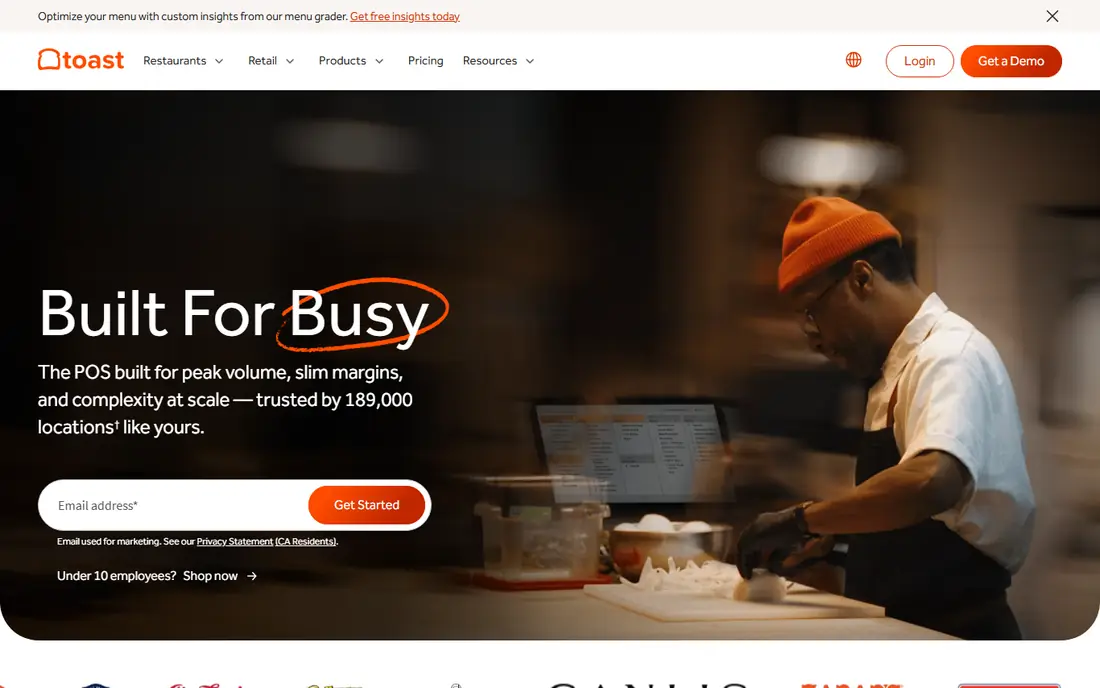
Toast is a point of sale system built for restaurants, with an AI marketing assistant that helps create email, SMS and social campaigns from menu and sales data. Because marketing sits on the same data as orders, campaigns can target past guests and popular items rather than guessing. Toast also covers payments, handheld ordering and kitchen displays, which makes it a full operations base for many restaurants.
Cost depends on hardware, plan and payment processing, so a quote needs a real conversation about covers, locations and needs. Toast is also strongest in the US market. For a restaurant that wants one system for till, payments and marketing, Toast is a practical first choice. Start with the marketing feature that fixes your biggest gap, such as repeat visits, rather than turning on every AI tool at once.
- Point of sale plus marketing in one system
- AI marketing assistant for email and SMS
- Strong restaurant focus
- Pricing depends on hardware and plan
- US focused
Square for Restaurants gives small restaurants a point of sale that is quick to set up, with AI features that summarise sales, organise items and surface insights from the business. That helps an owner who does not have time to dig through reports each week. Square also handles payments, online ordering and hardware in one account, which keeps the vendor list short.
Larger multi unit groups may need deeper inventory, labour and reporting tools than Square offers on its own, and may pair it with a back of house system. For a single site or a small group, Square is a good balance of simplicity and power. Check which restaurant features are included on the plan you choose, since some advanced tools are not on the entry tier.
- Easy setup for small restaurants
- AI insights on sales and items
- Broad hardware and payments
- Advanced restaurant features sit on higher plans
- Less deep for large multi unit groups
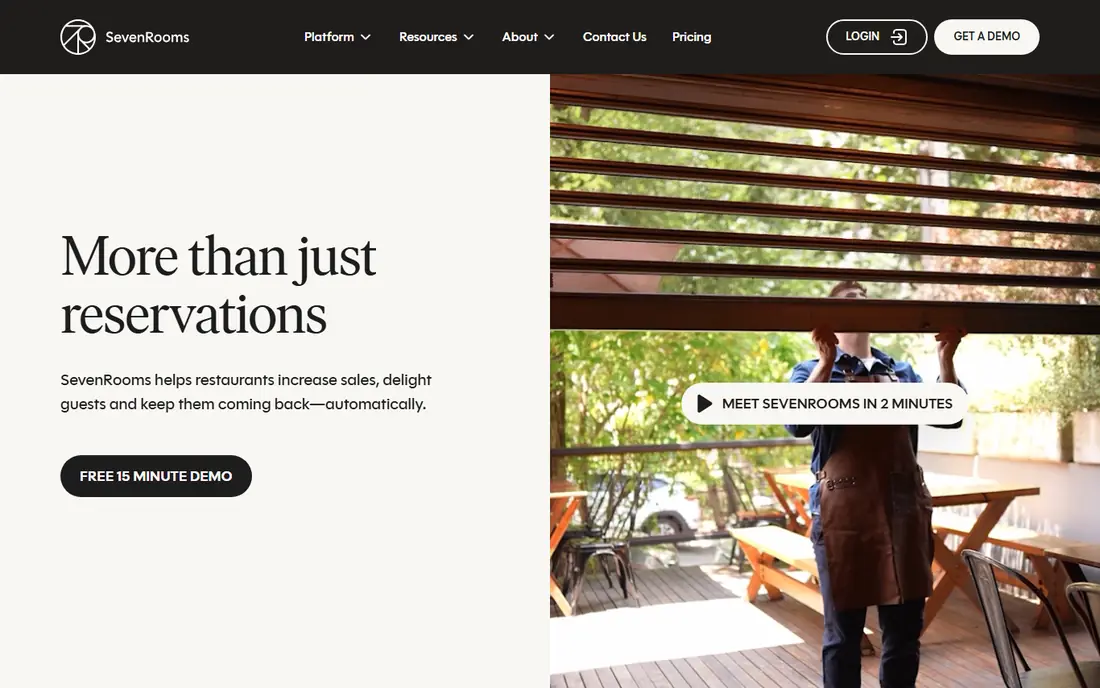
SevenRooms builds a guest profile from reservations, visits and feedback, then uses that data for marketing automation and personalised offers. A restaurant can see who its regulars are, who has not visited in a while, and which guests prefer certain tables or occasions. That guest knowledge helps fill tables on slow nights without discounting to everyone.
Pricing is by quote and depends on covers and locations, so small cafes may find it costly. SevenRooms also fits full service restaurants better than fast food counters. For a restaurant that relies on repeat guests and special occasions, the CRM view is its main value, and it pairs well with a point of sale system for order history.
- Guest profiles and marketing automation
- Reservation and waitlist tools
- Feedback and repeat visit data
- Pricing by quote
- Best for full service restaurants
OpenTable is best known for reservations, and that discovery network still matters. Diners search OpenTable for a table, which can bring new guests who would not find a restaurant website on their own. Table management, guest notes and reporting help the front of house run service smoothly, and voice AI integrations can handle some booking calls.
Per cover fees mean costs rise with volume, so a busy restaurant should model the monthly total, not only the subscription. OpenTable is less of a full marketing suite than SevenRooms, though it covers the reservation job well. For a full service restaurant that wants discovery plus reliable booking tools, OpenTable remains a strong choice.
- Large diner discovery network
- Table management
- Guest data and voice AI integrations
- Per cover pricing can add up
- Less of a marketing suite than SevenRooms
Popmenu bundles a restaurant website, interactive menus, online ordering, AI phone answering, reservations and marketing campaigns. Its AI marketing builds content from the actual menu and events, which keeps messages tied to what the restaurant really serves. AI phone answering can take bookings and answer common questions when staff are busy on the floor.
Adopting Popmenu means replacing the website and ordering flow, which is a bigger change than adding a single app. AI written marketing also needs a person to check facts and tone before it goes out. Popmenu suits independents that want fewer vendors and one login for their online presence. Skip it if you are happy with your current website and only need one specific tool.
- Website plus ordering in one product
- AI phone answering
- Marketing from menu and events
- Replaces website and ordering flow
- AI copy still needs human checking
Owner.com describes itself as a growth system for independent restaurants, bundling a website, local search tools, direct online ordering, loyalty and email and SMS marketing. The aim is to move orders off commission heavy delivery apps and onto the restaurant's own channel, where margins are better and guest data stays with the restaurant.
Switching ordering systems takes work, including menu setup, staff training and telling regulars where to order. Pricing also depends on the plan chosen, so a quote should cover ordering fees as well as subscription cost. For a restaurant that loses a large share of orders to delivery apps, Owner.com can pay for itself through direct orders, provided guests are guided to the new channel.
- Direct online ordering to reduce delivery commissions
- Website and local search tools
- Loyalty and marketing
- Pricing depends on plan
- Replacing ordering flow takes effort
7shifts helps restaurants schedule staff, track labour costs and communicate with the team in one app. Managers can build rotas, staff can swap shifts and confirm availability, and labour cost can be checked against sales. Forecasting tools help match staffing to expected demand, which matters when labour is one of the largest costs in a restaurant.
Food cost, inventory and recipe costing need a separate tool, so 7shifts is not a full back of house system. The free plan covers a single location with basic features, which lets a small restaurant test it before paying. For a restaurant with ten or more staff, 7shifts is often the first AI related tool that pays for itself through better scheduling.
- Scheduling plus labour forecasting
- Free plan for one location
- Team communication tools
- AI forecasting is basic on lower plans
- Food cost needs another tool
Restaurant365 is a back of house system for restaurant groups, covering accounting, inventory, scheduling and reporting. It helps track actual versus theoretical food cost, manage recipes and purchasing, and compare locations in one dashboard. That view is valuable once a business grows beyond one site and spreadsheets stop working.
Pricing and implementation are heavier than a single purpose app, so Restaurant365 suits multi unit groups rather than a single cafe. Setup needs clean data on recipes, suppliers and menus, and the team needs time to learn the system. For a growing group that needs control over food cost and labour across sites, it is a strong investment.
- Accounting, inventory and scheduling in one system
- Recipe costing
- Multi location reporting
- Higher price than single purpose tools
- Implementation takes time
Slang.ai provides voice AI that answers restaurant phone calls, takes reservations, answers common questions and handles orders where supported. Missed calls are a real leak for restaurants, since a guest who cannot get through often orders elsewhere. Voice AI can answer every call, even during a busy service or after hours, and pass complex requests to staff.
Setup matters. Menus, hours, booking rules and handover to a person must be configured well, or guests will get frustrated. Pricing is by quote, so a restaurant should test call quality with its own menu and peak hour scenarios before committing. For a busy restaurant that misses many calls, Slang.ai can recover revenue that a simple voicemail never would.
- Answers calls and takes bookings
- Recovers missed phone orders
- Works outside opening hours
- Pricing by quote
- Needs careful setup for complex requests
MarginEdge automates the work of processing supplier invoices and tracking food cost, pulling invoice data into inventory and accounting systems. That saves back office time and gives a clearer view of what ingredients actually cost, which helps menu pricing and purchasing decisions. It integrates with point of sale and accounting tools used by many restaurants.
A single small restaurant may find the cost harder to justify than a multi unit group, where invoice volume is high. MarginEdge is best when invoice processing takes hours each week and food cost is hard to track. Pair it with a scheduling tool such as 7shifts to cover both sides of prime cost: labour and food.
- Automates invoice processing
- Tracks food cost and inventory
- Integrates with POS and accounting
- Best value at three or more units
- Single site cost needs careful review
How we picked these
We compared tools that are live in October 2026 and used by real restaurants, not only marketed as AI products. We weighed whether the AI feature solves a measurable problem, such as missed calls, labour cost, food cost or repeat visits, and whether the tool integrates with the point of sale or reservation system a restaurant already uses. Tools that only added a chat window to an existing product without joining data sources were marked down.
We also considered restaurant size. A tool that suits a 20 site group may be poor value for a single cafe, and a tool built for a cafe may not scale to a group. That is why this list mixes point of sale systems, guest platforms, scheduling tools and voice AI, rather than ranking one type of product against another.
How to choose an AI tool for your restaurant
Start with your biggest leak, not with the most talked about tool. If labour cost is high, test 7shifts. If food cost is unclear, test MarginEdge or Restaurant365. If phones go unanswered, test Slang.ai or Popmenu phone answering. If direct orders are low, test Owner.com or Popmenu. Pick one tool, run it for a full month in one location, and track a hard number such as labour as a share of sales, food cost percentage, or hours saved per week.
Involve staff early, since a tool that front of house or kitchen staff distrust will not be used well. Check data connections before you buy, especially point of sale, reservations and accounting links. Finally, keep what pays and cancel what does not. A restaurant margin leaves little room for subscriptions that only look modern.
Frequently asked questions
What is the best AI software for restaurants?
There is no single winner, because the best tool depends on your biggest cost. For reservations and regulars, SevenRooms or OpenTable lead. For direct ordering, Owner.com and Popmenu lead. For labour, 7shifts leads, and for food cost, MarginEdge and Restaurant365 lead. Start with the area that loses the most money.
Can AI answer restaurant phone calls well?
Voice AI from Slang.ai and Popmenu can answer common calls, take bookings and handle simple orders, even during busy service. It works best when menus, hours and booking rules are set up well, and when complex calls can still reach a person. Test it with real peak hour calls before you rely on it fully.
Is Toast or Square better for a small restaurant?
Square is often simpler and faster to set up for a very small restaurant, while Toast offers deeper restaurant features and marketing tools for a busier full service site. Both cover payments and ordering, so compare hardware, plan features and processing costs for your actual covers and menu complexity.
How much do AI tools for restaurants cost?
Costs range from free for a basic 7shifts plan to several hundred dollars per month per location for back of house and guest platforms, with voice AI and enterprise systems priced by quote. Add point of sale hardware and payment fees to the subscription when you compare totals, and test one tool at a time.
Do AI tools replace restaurant staff?
No, the useful tools remove repetitive work such as scheduling admin, invoice entry and answering the same phone questions, so staff can focus on food and guest service. Restaurants that involve staff early and keep a person available for complex guests get better results than those that try to automate every interaction.
What is the best AI tool for restaurant marketing?
Popmenu and Owner.com lead for marketing tied to direct ordering, while Toast AI Marketing Assistant and SevenRooms lead for email, SMS and guest campaigns. The best choice depends on whether you need a new website and ordering flow, or marketing on top of a system you already use. Check AI copy before it goes out in all cases.
Sources we checked (10)

Online Jobs is an independent blog about careers, online work, learning new skills and the tools that help people earn. More about us.
Keep reading
All posts
eBay Alternatives
Looking for ebay alternatives? We compared 9 marketplaces for sellers on fees, buyer reach, categories and ease of listing, to help you sell with confidence.

ZoomInfo Alternatives
The best ZoomInfo alternatives in 2026, compared on price, free plans, data coverage, and which tool fits small teams or large sales teams best in detail.

Zoom Alternatives
Zoom alternatives compared for 2026: Google Meet, Microsoft Teams, Webex, Jitsi and more for free calls, large meetings and webinars for teams and classrooms.