Best AI Tool for HR Teams in 2026: 8 Tools Compared


Teams that want HR, IT and payroll on one record · Starting price: $8 per user per month
How we put this together: we compare official feature and pricing pages, app store listings, privacy policies and public user reviews. Prices change, so check the provider's site before you pay.
Key takeaways
- The best AI tool for HR teams depends on the job: Rippling and BambooHR cover everyday HR work, Lattice leads on performance, and Paradox handles high-volume hiring.
- Prices run from free for Deel HR up to 200 employees to quote-only enterprise deals at Workday and HiBob, with Rippling from $8 per user per month in between.
- AI features worth paying for are drafting, summarising and answering policy questions from your own HR data, not generic chat pasted onto a dashboard.
- Keep a human in the loop on hiring and pay decisions: AI should draft and suggest, while people approve, especially where bias rules apply.
Quick comparison
| Name | Who it suits | Starting price | Free option | |
|---|---|---|---|---|
| Rippling | Teams that want HR, IT and payroll on one record | $8 per user per month | No | Visit |
 BambooHR | Small and midsize HR teams that want simplicity | $10 per employee per month | Free trial | Visit |
 Gusto | US small businesses that need payroll first | $49 per month | No | Visit |
 Deel | Global and remote teams hiring across borders | Free | Yes | Visit |
 Lattice | Performance reviews, goals and engagement | $10 per seat per month | No | Visit |
 HiBob | Mid-market people teams that value culture and analytics | See website | No | Visit |
 Workday | Large enterprises running HR and finance together | See website | No | Visit |
 Paradox | High-volume hiring in retail, hospitality and healthcare | $1,000 per month | No | Visit |
The best AI tools for HR teams in 2026
AI in HR software now does real work: it drafts review feedback, answers policy questions, screens candidates and flags payroll errors before payday. The eight tools below all ship AI features in October 2026, but they aim at different HR jobs, so we judged each one on what its AI actually does and what the platform costs.
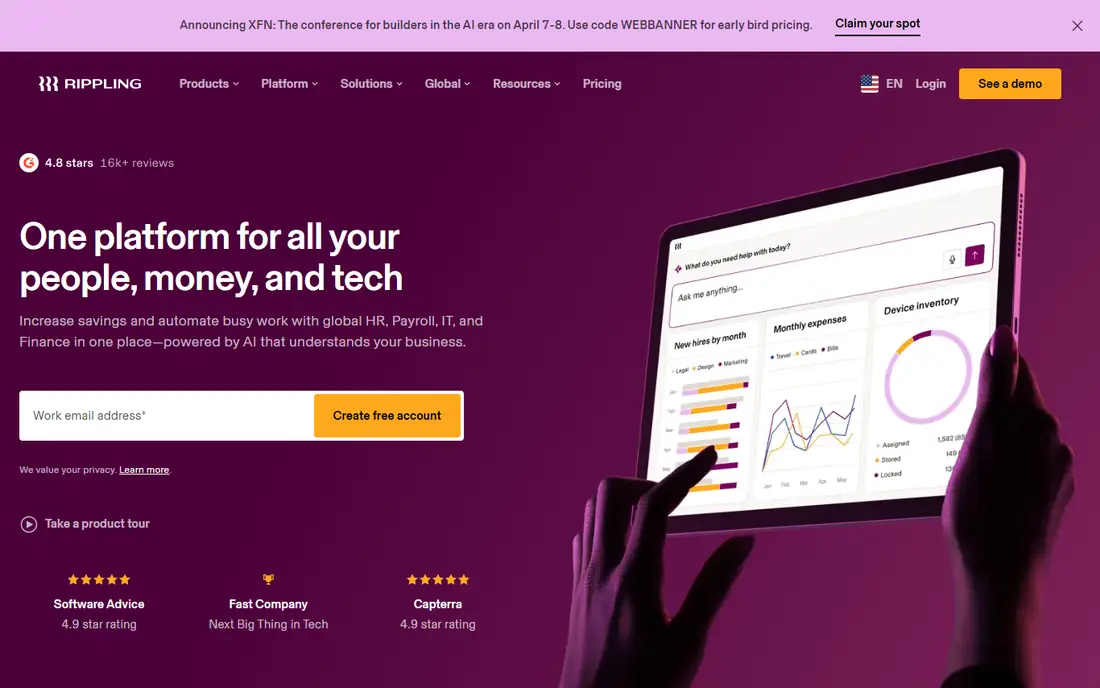
Rippling is the strongest all-round pick when an HR team also owns IT and payroll. Every app shares one employee record, so a new hire triggers payroll setup, app access and device ordering from a single workflow, and Rippling AI can answer questions and take action using that shared context rather than guessing from a single module. Reporting joins workforce and finance data, which helps HR teams show headcount costs without exporting to a spreadsheet.
Pricing starts with the Unity platform from $8 per user per month plus a monthly base fee, and each module adds its own charge: US payroll from $8 per employee per month and benefits administration from $6. That modular model is flexible, but buyers regularly land at $35 to $65 per employee per month once several modules are switched on, so get a full quote before comparing Rippling to a flat-priced rival.
- One employee record feeds HR, payroll, IT and spend
- Rippling AI answers questions and acts across modules
- 650 integrations with common business apps
- Modules are priced separately, so totals climb fast
- No free plan, only demos and quotes
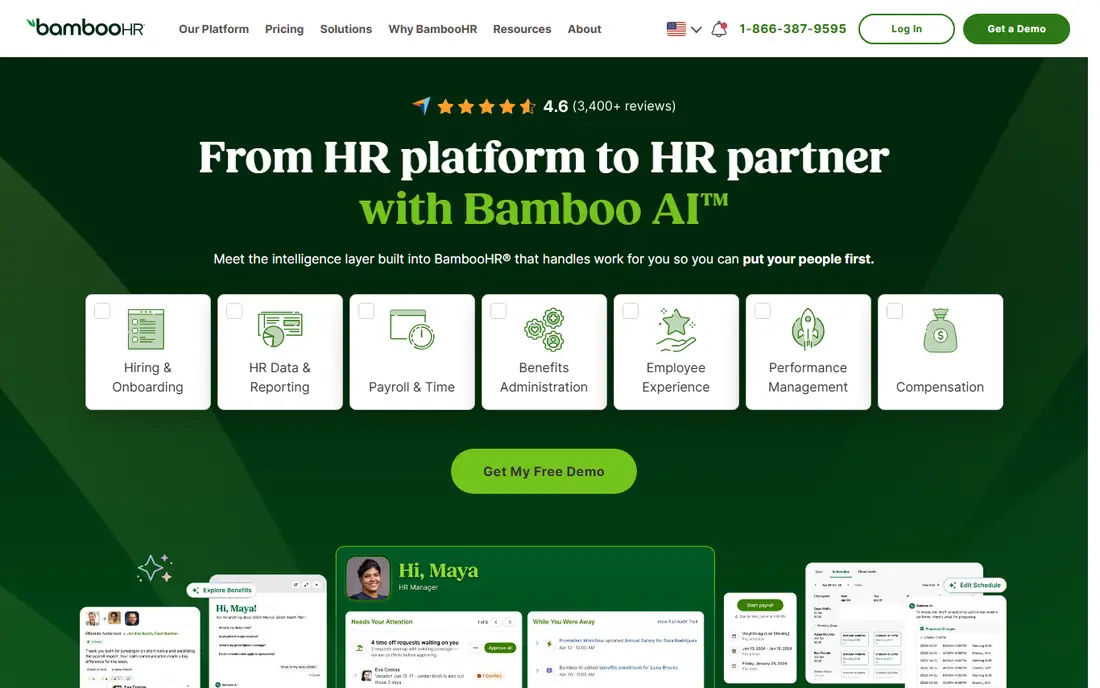
BambooHR suits HR teams of one or a few people who need records, hiring, onboarding, time off and performance in one calm system. Bamboo AI sits across the platform: on Core it answers questions about HR data such as time off and holidays, on Pro it also covers policies, handbooks and benefits, and on Elite it adds benchmarking questions and scenario forecasting. That tiered AI is worth checking, since the assistant you get depends on the plan you buy.
Core costs $10 per employee per month for companies with 26 or more employees (published tiles round the $10.25 rate), while teams of 25 or fewer pay a flat rate from $250 per month. A seven-day free trial is available with no credit card required, though trial accounts cannot hold live employee data. Payroll, benefits administration and time tracking are quote-only add-ons, so budget beyond the base rate.
- Bamboo AI answers HR data, policy and benefits questions
- Clean interface that small HR teams learn fast
- Payroll, benefits and time tracking as add-ons
- Payroll and benefits cost extra on every plan
- Implementation fees are quoted separately and not published
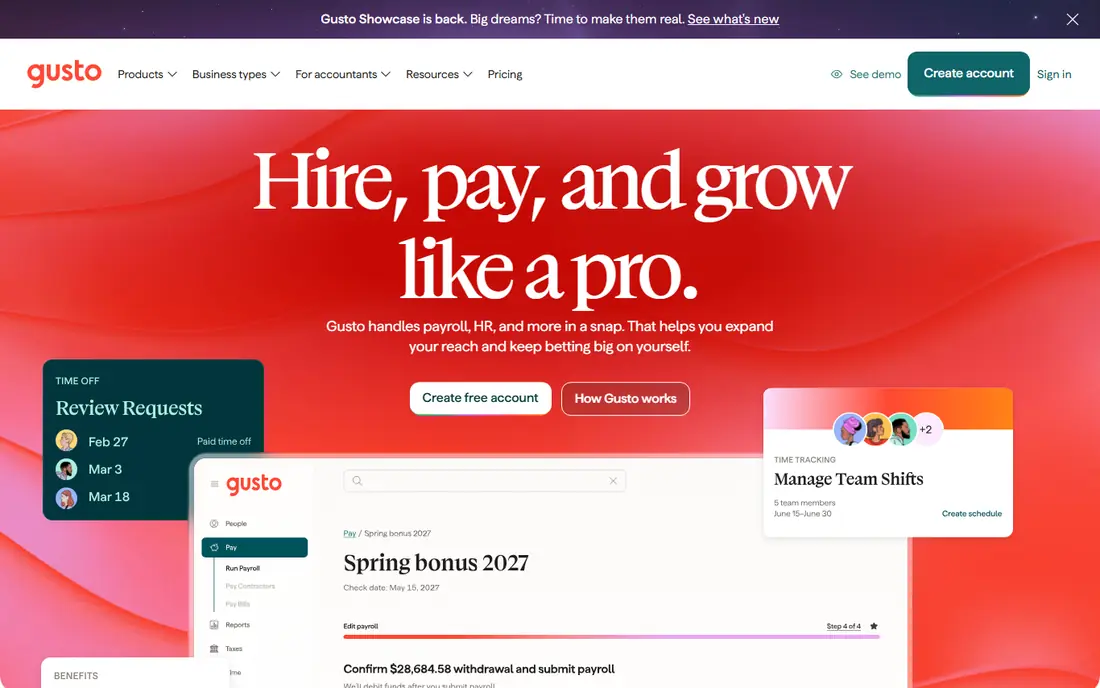
Gusto is the payroll-first pick for US small businesses, and its AI story is more modest than the rest of this list. The platform automates tax filing in all 50 states, runs unlimited payrolls and uses AutoPilot to run payroll on schedule, and it offers AI-assisted help for HR questions, but it does not pitch a full AI agent layer like Rippling or Workday. For a small team whose main pain is payday accuracy, that automation matters more than a chatbot.
Simple costs $49 per month plus $6 per person, covering single-state payroll, while Plus at $80 per month plus $12 per person adds multi-state payroll, time tracking and fuller HR tools. There is no free plan or free trial for payroll plans, and billing runs month to month with no contract. International hiring is limited to contractor payments in 120-plus countries, so global employers should look at Deel or Rippling instead.
- Full-service US payroll with automatic tax filing
- Month-to-month billing with no long-term contract
- Simple setup that small teams finish quickly
- AI features are lighter than rivals here
- Payroll covers US employees only, not international staff
Deel is the only genuinely free option here, and that makes it the default starting point for distributed teams. Deel HR is free for up to 200 employees and covers employee records, org charts, onboarding, time-off tracking and document management, with a built-in AI assistant that answers common HR and payroll questions. Above 200 employees the HRIS costs $5 per employee per month.
The business model is clear: the free HRIS leads into paid services, with contractor management from $49 per contractor per month, global payroll from $29 per employee per month and employer-of-record hiring from $599 per employee per month. For a team hiring in several countries, Deel's compliance templates and local payroll handling are the real value, and the AI assistant is a bonus on top. Purely domestic US teams may still prefer Gusto for payroll depth.
- Core HRIS free for up to 200 employees
- Built-in AI assistant for HR and payroll questions
- EOR and global payroll cover 150-plus countries
- Free tier funnels teams toward paid global services
- US payroll is newer and less proven than Gusto
Lattice is the performance specialist on this list, and its AI is aimed squarely at managers. The AI Agent, included with all base products, answers policy and career questions, drafts review feedback from the same feedback and goal data managers already use, and surfaces insights for 1:1s. Reviews, goals and OKRs, engagement surveys, compensation and growth plans read as one flow rather than separate tools.
Pricing is modular: Performance costs $10 per seat per month, Goals and OKRs $8, Engagement $4, and the popular Foundations bundle combining Performance and Goals costs $13, with Compensation and Grow as add-ons at $6 and $4. Every contract bills yearly with a $4,000 minimum, so small teams pay the floor rather than the headline rate. Lattice pairs well with a separate HRIS such as Workday, BambooHR or Rippling rather than replacing one.
- AI Agent included with every base product
- AI-drafted reviews grounded in feedback and goal data
- Strong calibration, succession and compensation tools
- $4,000 minimum annual agreement rules out tiny teams
- No HRIS, recruiting or time-tracking layer
HiBob, known as Bob, is built for growing mid-market companies that treat culture as part of the HR system, not an add-on. Bob AI generates reviews, job descriptions and internal communications, answers employee questions in natural language through Bob Companion, and powers pay insights and survey analysis. The social feed, shoutouts, clubs and anonymous Your Voice channel make engagement a daily habit, which is the feature rivals struggle to copy.
Pricing is quote-only, with third-party estimates putting common setups at $16 to $25 per employee per month plus an implementation fee of roughly 10 to 20 percent of the first-year contract. Native payroll covers the US and UK only, with other countries handled through partner integrations. For a 50 to 500-person company that wants one polished people platform, HiBob is a strong shortlist pick, but get the implementation fee in writing before signing.
- Bob AI generates reviews, job descriptions and communications
- People analytics with 150-plus metrics and 35-plus dashboards
- Workforce planning with scenario modelling
- Quote-only pricing with implementation fees
- Custom reporting depth disappoints some larger teams
Workday is the enterprise end of this list, and its AI brand is Illuminate, covering conversational search, agents for recruiting and workforce planning, and the Sana assistant that orchestrates agents behind the scenes. Embedded AI such as resume parsing, anomaly detection and talent recommendations comes with standard modules, while standalone agents and premium AI skills are separate purchases, some metered through Flex Credits. For a large employer, the draw is one system where HR, payroll, finance and planning share the same employee data.
Workday publishes no price list, so budgeting starts with a sales process: third-party benchmarks put core HCM list rates around $20 to $40 per employee per month before negotiated discounts, with premium AI adding further cost. Implementation commonly runs into six figures for midsize deployments. Small companies should not start here; Workday fits employers with hundreds or thousands of staff and the budget to match.
- Illuminate AI agents across HR, finance and IT
- Skills Cloud maps workforce skills to roles
- One record for HR, payroll, talent and planning
- No public price list at all
- Implementation is a major project, not a quick switch
Paradox is the only tool here built for one job: hiring at volume. Its assistant Olivia chats with candidates by text, checks qualifications, answers questions and books interviews across recruiter calendars without human touch on each step. Employers hiring thousands of hourly workers a year use it to cut time-to-hire sharply, and it now operates as part of Workday after an acquisition that closed on 1 October 2025.
Pricing is not published by Paradox itself, but its listing shows a starting price around $1,000 per month with no free trial, and mid-size deployments are reported at $30,000 to $95,000 a year. One honest caveat: a security lapse in June 2025 exposed real applicant data, so buyers should ask hard questions about data controls before rollout. For smaller teams, a simpler scheduling tool or an ATS with built-in automation will cost far less.
- Olivia screens candidates and books interviews by text
- Works in 100-plus languages around the clock
- Integrates with Workday, SAP SuccessFactors and major ATS tools
- Enterprise pricing rules out small teams
- A June 2025 security lapse exposed real applicant data
How we picked these
We compared official feature pages, pricing pages, product documentation and public reviews for AI tools aimed at HR teams, and we kept only products that are sold and supported in October 2026. Each tool had to offer AI features that do real HR work, such as drafting, answering questions from HR data, screening or scheduling, rather than a generic chatbot badge.
Prices come from the vendor's own pricing page wherever we could verify them, and we marked pricing as See website where the vendor sells by quote or publishes no list. We also weighed whether the AI covers the whole HR job or just one slice, how tight free plans and trial terms are, and whether the vendor is open about limits, since an AI tool that hides its pricing usually hides its implementation cost too.
How to choose an AI tool for HR teams
Match the tool to the HR job
Start from the work that eats the most time. If it is records, onboarding and payroll, Rippling, BambooHR or Gusto fit best. If reviews and goals are the pain, Lattice leads. If hiring volume is the bottleneck, Paradox is the specialist. If the team spans many countries, Deel solves the compliance problem first and the AI second. Buying a general platform for a specialist problem wastes money in both directions.
Test the AI on your own data
Ask every vendor to demo on your policies, your review forms and your job descriptions, not on polished sample data. Check whether answers cite the right policy, whether review drafts sound like your managers, and whether screening questions respect your hiring rules. An AI that sounds fluent on demo data and vague on yours will not save time once it goes live.
Keep humans on hiring and pay decisions
AI should draft, summarise and suggest, while people approve. That matters most in screening, where biased or opaque filters can break employment law, and in compensation, where a wrong band affects real pay. Set a rule before rollout: no candidate is rejected and no pay offer is set by AI alone, and keep an audit trail of every AI-assisted decision.
Frequently asked questions
What is the best AI tool for HR teams?
There is no single winner, because HR teams buy for different jobs. Rippling is the best all-round platform for teams that want HR, IT and payroll together, BambooHR suits smaller HR teams that value simplicity, and Lattice leads on performance management. Deel is the best free starting point for global teams, while Workday fits large enterprises and Paradox fits high-volume hiring.
Which AI tools help HR professionals most with hiring?
Paradox leads for high-volume hiring, since Olivia screens candidates and books interviews by text around the clock in 100-plus languages. For professional hiring, Lattice and HiBob help with job descriptions and review drafting, while BambooHR's applicant tracking covers sourcing through onboarding for smaller teams. Whichever tool you pick, keep a human reviewing screening outcomes, since automated filters can carry bias.
Is there a free AI tool for HR teams?
Deel HR is free for up to 200 employees and includes a built-in AI assistant for HR and payroll questions, which makes it the strongest free option here. BambooHR offers a seven-day free trial but no free plan, and Rippling, Gusto, Lattice, HiBob, Workday and Paradox offer demos or quotes rather than free tiers. Free plans always have limits, so check headcount caps before building processes on them.
How much does AI HR software cost?
Prices vary widely. Deel HR is free up to 200 employees, Gusto Simple costs $49 per month plus $6 per person, and Rippling starts from $8 per user per month before modules. BambooHR Core costs $10 per employee per month, Lattice Performance costs $10 per seat per month with a $4,000 yearly minimum, and Workday and HiBob are quote-only. Paradox starts around $1,000 per month. Always price the modules and implementation fees, not just the headline rate.
Can AI make hiring decisions on its own?
No, and it should not. AI tools in this list screen, rank, draft and schedule, but final hiring decisions need human judgment, both for quality and for legal compliance. Automated screening can reproduce bias from past hiring data, and several regions now require transparency about AI use in hiring. Use AI to widen the pipeline and cut admin, then let recruiters and hiring managers decide.
Sources we checked (8)

Online Jobs is an independent blog about careers, online work, learning new skills and the tools that help people earn. More about us.
Keep reading
All posts
Best AI Recruitment Platforms
Searching for the best AI recruitment platforms? We compare 8 AI hiring tools for sourcing, screening, interviews, pricing, compliance, and applicant tracking.
Zoom Alternatives
Zoom alternatives compared for 2026: Google Meet, Microsoft Teams, Webex, Jitsi and more for free calls, large meetings and webinars for teams and classrooms.

Workday Alternatives
We compared the best workday alternatives for HR, payroll, and global hiring, from BambooHR and Gusto to Rippling, Deel, and HiBob for growing teams in 2026.