Best ADP Alternatives in 2026: 8 Tools Compared

How we put this together: we compare official feature and pricing pages, app store listings, privacy policies and public user reviews. Prices change, so check the provider's site before you pay.
Key takeaways
- Gusto and OnPay suit small US teams that want clear payroll pricing and simple setup.
- Rippling, Workday, and Paylocity suit larger or growing teams that need HR, payroll, and IT in one system.
- Paychex suits mid-market teams that want a dedicated service rep and strong compliance support.
- Deel suits teams hiring across many countries, while BambooHR suits teams that need core HR more than full payroll depth.
Quick comparison
| Name | Who it suits | Starting price | Free option | |
|---|---|---|---|---|
 Gusto | Small-team US payroll | See website | Free trial | Visit |
 Rippling | Unified HR, payroll, and IT | See website | No | Visit |
 Paychex | Mid-market payroll service | See website | No | Visit |
 Workday | Enterprise HCM | See website | No | Visit |
 BambooHR | Core HR for growing teams | See website | Free trial | Visit |
 Deel | Global hiring and payroll | See website | No | Visit |
 Paylocity | Mid-market HCM | See website | No | Visit |
 OnPay | Flat-rate US payroll | See website | Free trial | Visit |
The best adp alternatives
ADP covers a huge range, from small business payroll to enterprise human capital management, so no single alternative replaces every ADP product. We picked alternatives by team size, location, and need, from simple US payroll to global hiring, and noted where each one fits best. Payroll and benefits rules vary by country and state, so treat this guide as a starting shortlist, not as tax or legal advice.
The products below cover the main reasons teams look beyond ADP: simpler pricing, a cleaner interface, stronger global hiring, or a better fit for a specific team size.
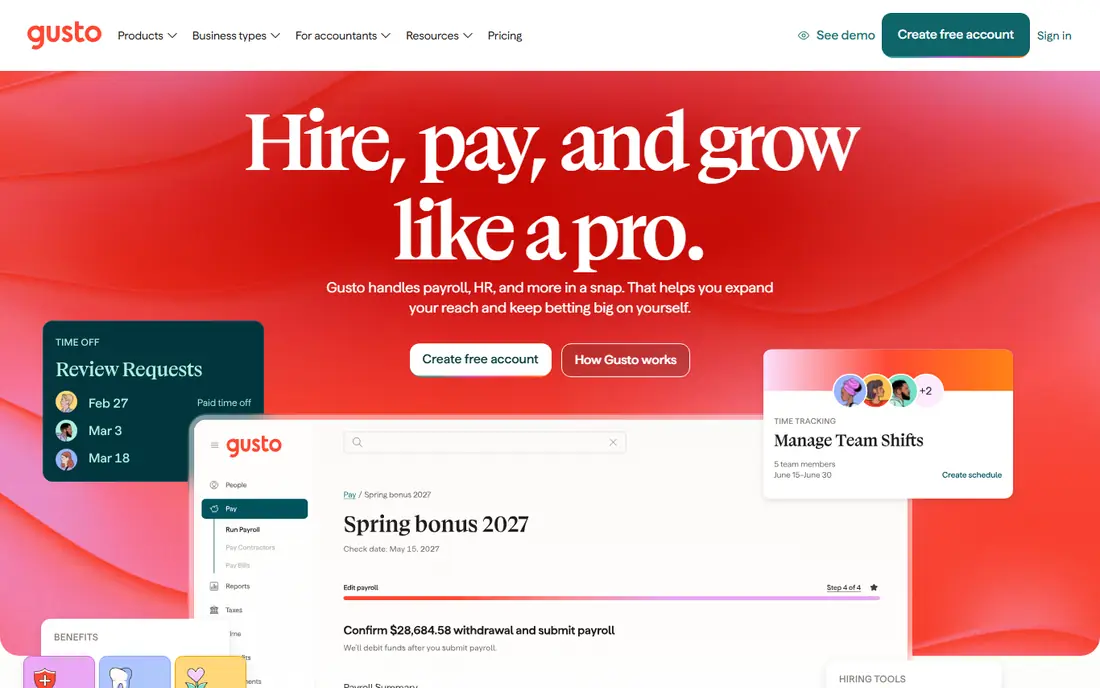
Gusto is the first alternative most small US teams should trial. Payroll, tax filings, benefits administration, and onboarding sit in a clean interface that founders and office managers can run without a payroll specialist. Pricing follows a base fee plus a per-person fee, which makes monthly costs easy to forecast for a stable team. That transparency is a common reason teams leave larger, quote-based providers. Gusto fits teams under a few hundred people best, and its full payroll strength centres on the US. International contractors are supported through a separate path, but companies hiring employees in many countries will need a global provider as well. For a US small business that wants payroll done correctly without enterprise complexity, Gusto is a strong, approachable replacement.
- Clear payroll and benefits workflow for small US teams
- Transparent base plus per-person pricing structure
- Good onboarding and self-service
- US-focused for full payroll, with contractors abroad as a separate path
- Larger enterprise HCM depth is limited
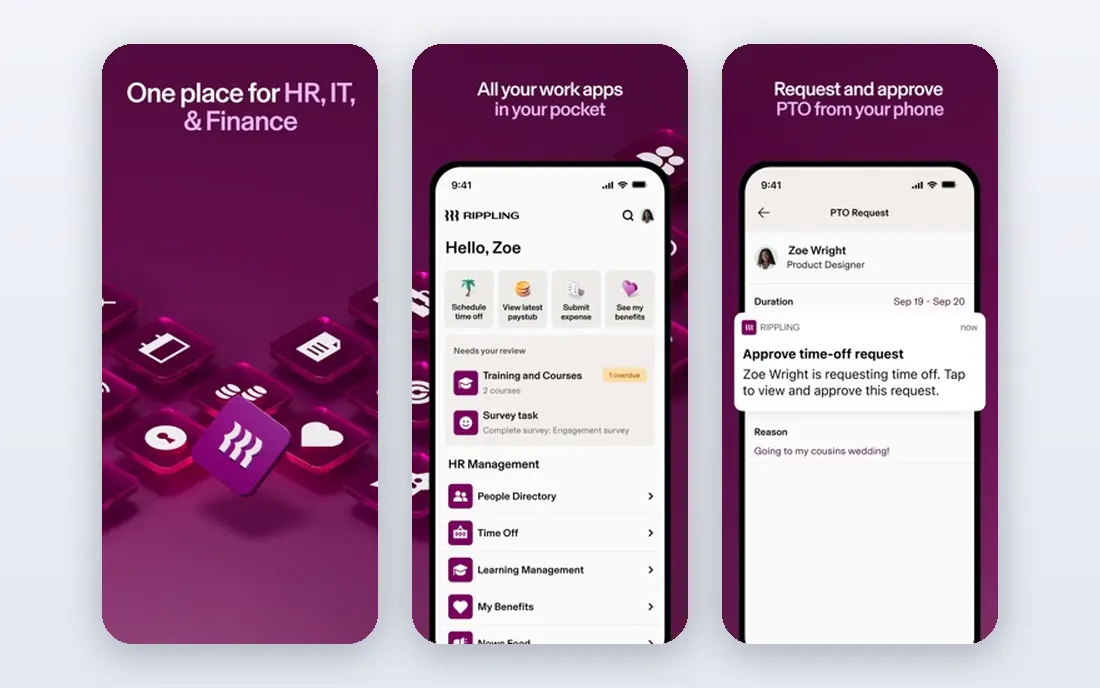
Rippling appeals to fast-growing companies that are tired of HR, IT, and payroll living in separate systems. When a hire starts, Rippling can provision accounts, devices, payroll, and benefits from one workflow, and when someone leaves, it can revoke access in the same way. That unity saves time for operations teams and reduces the access mistakes that happen when systems drift apart. Modular pricing is the watch point. Rippling charges by module and per person, so a team that adds HR, IT, spend, and global features will pay more than the headline starting figure suggests. Get a quote for your exact module mix, and trial the workflows that matter most, such as onboarding and offboarding, before committing. For tech-forward teams that value automation, Rippling is a powerful ADP alternative.
- Unifies HR, payroll, IT, and spend in one system
- Strong automation and integrations
- Global hiring through add-on services
- Pricing is modular, so total cost depends on chosen modules
- Setup and configuration take care for larger teams
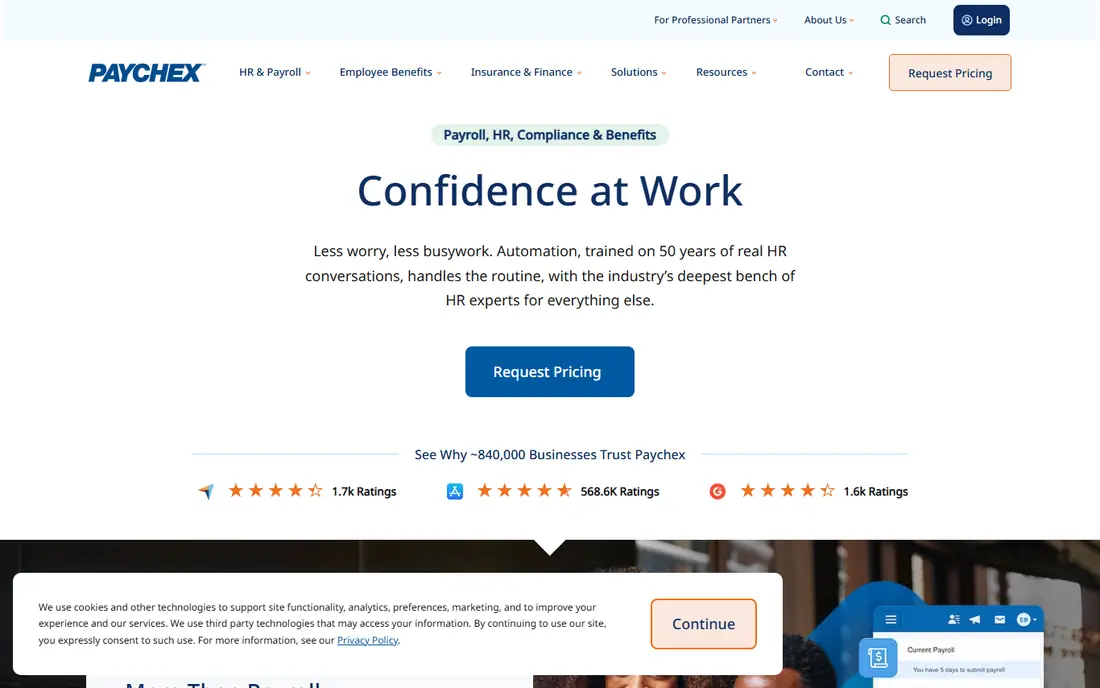
Paychex suits mid-market teams that want a service relationship, not just software. A dedicated representative, payroll expertise, and compliance support help companies in regulated industries or with multi-state payroll, where a missed filing carries real cost. Paychex Flex covers payroll, HR, benefits, and time, while PEO options add pooled benefits and HR support for teams that want more outsourcing. The trade is transparency and modern feel. Pricing is custom, so comparing Paychex with Gusto or Rippling requires quotes and careful scope matching. Some users also find the setup heavier than newer tools. If your team values a named contact and a long-established payroll bureau over self-service speed, Paychex is a credible ADP alternative in the same weight class.
- Established payroll bureau with dedicated support options
- Strong compliance and tax handling
- PEO options for benefits
- Pricing is quote-based, so comparison takes sales calls
- Interface and onboarding can feel heavier than newer rivals
Workday is the enterprise pick. It combines human capital management, payroll, talent, and workforce planning in one system built for large, complex organisations. Finance and HR teams can share data, model headcount, and report consistently across countries and business units, which matters when a company outgrows a patchwork of payroll and HR tools. For a small or mid-sized team, Workday is almost certainly too much. Implementation takes time and expertise, pricing is enterprise-level, and the system rewards dedicated administrators. The value appears at scale, when governance, audit, and planning matter as much as running payroll itself. If your organisation has more than a thousand employees or complex global HCM needs, Workday belongs on the shortlist. Otherwise, a smaller alternative will serve you better.
- Enterprise-grade HCM, payroll, and workforce planning
- Strong analytics and reporting
- Global enterprise support
- Cost and implementation suit large organisations
- Overkill for small and mid-sized teams
BambooHR suits teams whose main problem is people management, not payroll complexity alone. It organises employee records, onboarding, time off, performance notes, and basic reporting in a clean system that HR teams and managers actually use. Employee self-service reduces admin questions, and the interface stays approachable as a team grows from dozens to hundreds of people. Payroll is the caveat. BambooHR offers payroll in some plans and regions, but teams with complex multi-state payroll, global hiring, or deep benefits needs should check coverage carefully and may need a separate payroll provider. For a growing team that needs core HR first, with payroll as a secondary need, BambooHR is a friendly ADP alternative that prioritises people operations over enterprise depth.
- Clean core HR, onboarding, and time off
- Good reporting for people teams
- Employee self-service is strong
- Payroll depth varies by plan and region
- Larger enterprise features are lighter than Workday or Rippling
Deel is the pick for distributed hiring. It acts as an employer of record in many countries, manages contractors, handles local compliance and payroll, and gives a central view of a global team. That matters for companies hiring engineers, sales staff, or support staff across borders, where setting up a local entity in each country would be slow and costly. For a US-only team, Deel adds little over Gusto or OnPay, and its pricing depends on whether you hire employees, contractors, or both, and in which countries. Get country-specific quotes for your actual hiring plan, and check benefits and tax handling for each location. For global teams, though, Deel is one of the clearest ADP alternatives, because global payroll and compliance are its core job, not an add-on.
- Employer of record and global payroll across many countries
- Contractor management and compliance support
- Central dashboard for distributed teams
- Pricing varies by hiring model and country
- US-only small teams gain little from global depth
Paylocity targets mid-market companies that want a modern HCM platform without enterprise weight. Payroll, core HR, time, benefits, and engagement tools sit together, with analytics and self-service features that help managers and employees handle routine tasks. That breadth suits companies growing from small-team tools into a more complete system, especially where employee experience matters. Pricing requires a quote, so budget comparison takes more work than with transparently priced rivals. Implementation also needs care, because a mid-market HCM touches payroll, benefits, and time data that must migrate cleanly. If your team is outgrowing a simple payroll tool but is not ready for Workday, Paylocity is a strong middle step with a modern interface and broad HCM coverage.
- Modern HCM for mid-market teams
- Payroll, HR, engagement, and analytics in one platform
- Strong employee self-service
- Pricing is quote-based
- Implementation and configuration need planning for larger teams
OnPay suits small US employers who want predictable payroll costs. Its flat pricing model, with a base fee plus a per-person fee, makes monthly budgeting simple, and unlimited payroll runs help businesses with variable schedules, such as restaurants, clinics, and seasonal teams. Core HR tools cover onboarding and time off without turning payroll into a large HCM project. OnPay is US-focused, so global hiring teams will need another provider for employees abroad. It also lacks the deep HCM, IT, and analytics depth of Rippling or Workday, which is fine for its target audience but worth noting for fast-growing teams. For a small US business that wants payroll done well at a clear price, OnPay is a straightforward ADP alternative that deserves a trial alongside Gusto.
- Flat, predictable pricing for US payroll
- Unlimited payroll runs on many plans
- Simple HR tools included
- US-focused
- Fewer enterprise HCM and global features than larger rivals
How we picked these
We compared official feature pages, pricing pages, and product documentation for payroll and HR providers that serve as ADP replacements across team sizes. We favoured products that are actively maintained, that state their payroll and HR scope clearly, and that cover a distinct need, from small US payroll to enterprise HCM to global hiring. Where pricing is quote-based or could not be confirmed from the vendor site at the time of writing, we listed it as See website. We did not claim hands-on testing, and we noted regional limits because payroll and benefits rules differ by country.
How to choose the right option
Start with location and team size
Location decides the shortlist faster than features do. A US-only team of twenty has different needs from a global team of five hundred, and no single tool serves both equally well. Filter first by where you hire and how many people you employ, then compare features within that shortlist.
Price the full payroll year, not the first month
Payroll costs include base fees, per-person fees, benefits administration, tax filings, and add-ons for time, hiring, or global services. Model a full year at your current headcount and at your expected headcount, and ask vendors to quote the same scope. A cheap base fee with costly add-ons can beat a higher all-in price on paper and lose in practice.
Plan migration before you sign
Payroll migration touches pay history, tax records, benefits, and time data. Ask each vendor for a migration plan, timeline, and support contact, and run parallel payroll for at least one cycle where possible. A smooth migration matters more than a slightly better interface, because payroll errors affect trust immediately.
Frequently asked questions
What are the best alternatives to ADP for small businesses?
Gusto and OnPay are the strongest small-business picks for US payroll, because both offer clear pricing and simple setup. BambooHR suits small teams that need core HR first, while Rippling suits small teams planning fast growth. Trial two options with your real pay schedule before choosing.
Is there an ADP alternative with transparent pricing?
Yes, Gusto and OnPay publish a base plus per-person pricing structure, which makes forecasting easier. Paychex, Workday, Paylocity, and many enterprise providers use quote-based pricing, so you will need a sales conversation to compare them fairly. Always ask for the total monthly cost at your headcount, including add-ons.
Which ADP alternative is best for global hiring?
Deel is the best fit for hiring employees and contractors across many countries, because employer of record and global payroll are its core services. Rippling also supports global hiring through add-on services. For a US-only team, a global tool adds cost without benefit, so choose global depth only when you actually hire abroad.
Can I switch from ADP without disrupting payroll?
Yes, with planning. Choose a migration date that avoids year-end or benefits renewal if possible, gather pay and tax history early, and run parallel payroll for at least one cycle. Ask the new vendor for a written migration plan and a support contact, and tell employees what will change in pay slips and self-service access.
Do ADP alternatives handle tax filings?
Most full-service payroll providers, including Gusto, Paychex, Rippling, and OnPay, handle federal and state tax filings for the regions they serve. Coverage varies by state and country, so confirm filing support for every location where you have employees. For complex multi-state or global tax needs, get that confirmation in writing before signing.
Sources we checked (8)

Online Jobs is an independent blog about careers, online work, learning new skills and the tools that help people earn. More about us.
Keep reading
All posts
Best AI Tool for HR Teams
We compared the best AI tools for HR teams in 2026, from Rippling and BambooHR to Lattice, Deel and Workday, on price, AI features and hiring help today.
Best AI Recruitment Platforms
Searching for the best AI recruitment platforms? We compare 8 AI hiring tools for sourcing, screening, interviews, pricing, compliance, and applicant tracking.

n8n Alternatives
n8n alternatives compared for 2026, with Zapier, Make, Activepieces, and more, covering visual builders, code steps, self-hosting, and pricing models.