Best AI Recruitment Platforms in 2026: 8 Compared

How we put this together: we compare official feature and pricing pages, app store listings, privacy policies and public user reviews. Prices change, so check the provider's site before you pay.
Key takeaways
- Workable and Manatal suit small and mid-size teams that want an AI applicant tracking system with a published starting price.
- Paradox and HireVue suit high-volume and enterprise hiring, with conversational screening and video assessment at scale.
- Juicebox and Fetcher suit sourcing-led teams that need to find passive candidates without manual Boolean search.
- Many enterprise platforms quote by sales call, so budget for implementation, add-ons, and per-seat or headcount pricing.
Quick comparison
| Name | Who it suits | Starting price | Free option | |
|---|---|---|---|---|
 Workable | All-in-one AI applicant tracking | $299 per month | Free trial | Visit |
 Manatal | Budget AI applicant tracking | $15 per month | Free trial | Visit |
 Paradox | High-volume conversational hiring | See website | No | Visit |
 HireVue | Enterprise video interviews | See website | No | Visit |
 Juicebox | AI sourcing search | $99 per month | Free trial | Visit |
 Fetcher | Automated outbound sourcing | See website | Free trial | Visit |
 Greenhouse | Structured enterprise hiring | See website | No | Visit |
 Zoho Recruit | Small business AI recruiting | $25 per month | Free trial | Visit |
The best AI recruitment platforms
We compared official feature pages, pricing pages, integration pages, privacy policies, and public reviews to find the best AI recruitment platforms for different hiring teams. The best AI recruitment software is not the one with the most AI labels. It is the one that automates your bottleneck, whether that is sourcing, screening, scheduling, or interview scoring, while keeping a human in charge of final decisions.
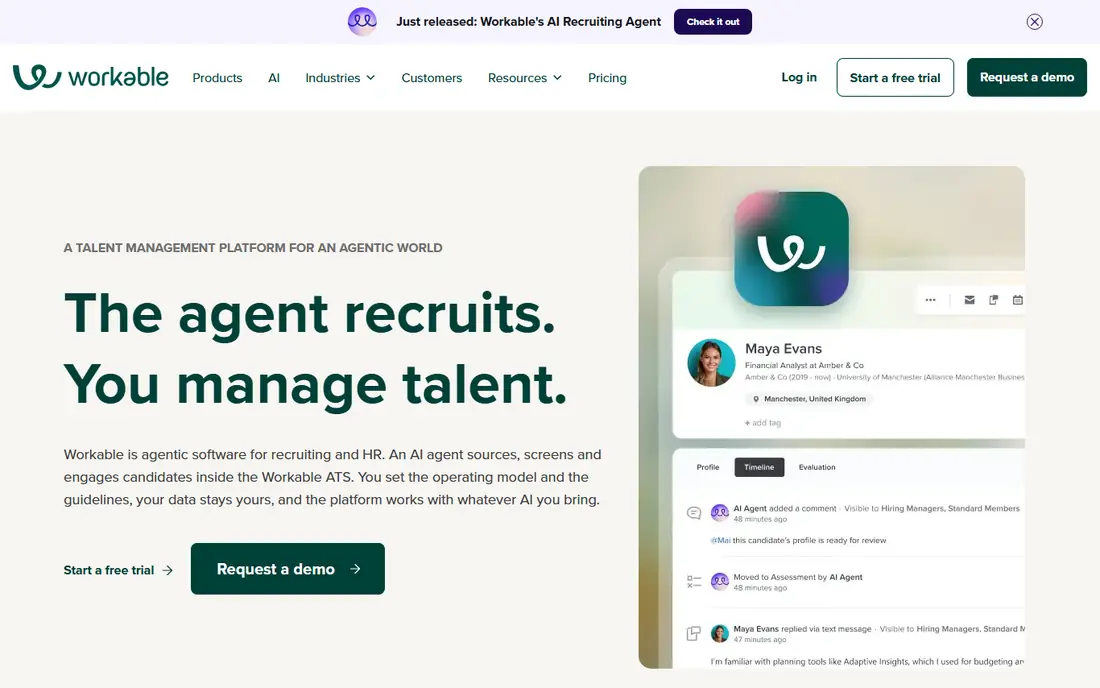
Workable fits small and mid-size companies that want hiring and core HR in one place. It posts jobs to many boards, tracks applicants, schedules interviews, and offers an AI agent for intake, sourcing, and screening. A 15-day trial allows a team to run a real vacancy before committing. The honest catch is pricing structure. The entry price covers a small headcount band, and the price rises with employee count rather than hiring volume. Texting, video interviews, and assessments are add-ons on the Standard plan, so check the full cost for the features you will actually use.
- Full applicant tracking
- AI agent for intake and screening
- Job board distribution
- Price scales with headcount
- AI agent uses credits
- Some features are add-ons
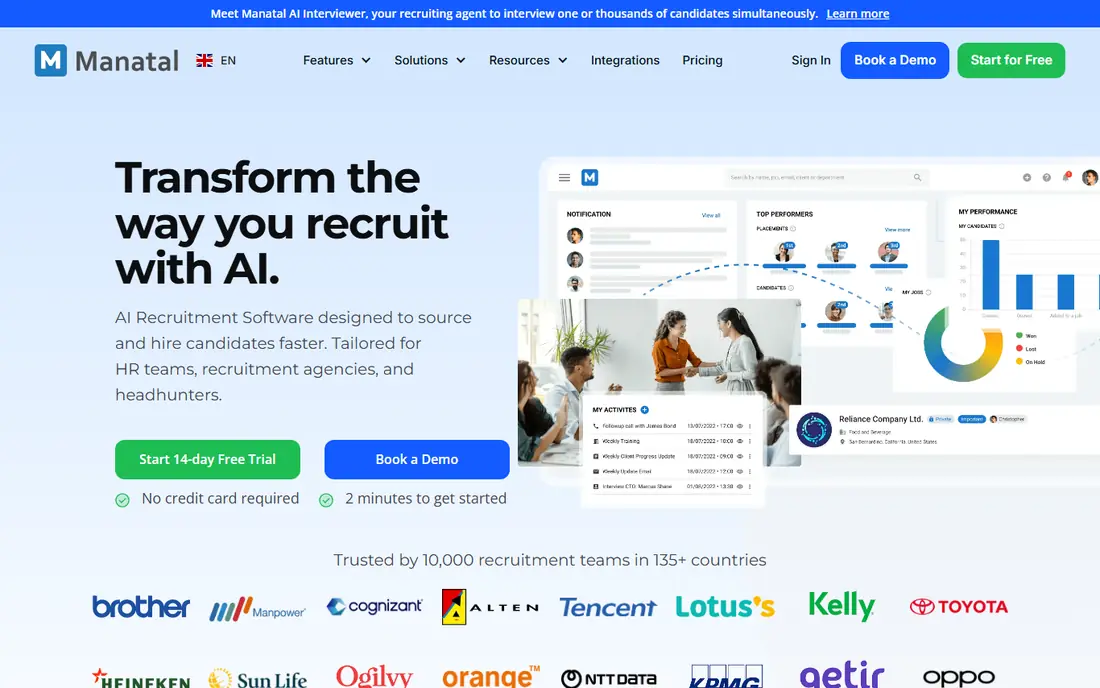
Manatal fits agencies and small teams that want AI matching without an enterprise contract. It combines applicant tracking with a recruitment CRM, social profile enrichment, and AI candidate recommendations. The per-user price makes it easy to start with one or two recruiters and add seats later. The trade-off is depth. Workflow stages and field layouts offer less flexibility than Greenhouse or enterprise tools, and some AI features sit on higher plans. For a small team that needs clean pipelines and fast sourcing, that simplicity is a benefit rather than a flaw.
- Low per-user price
- AI matching
- Candidate enrichment and CRM features
- Less configurability than enterprise systems
- AI interview tools are add-ons
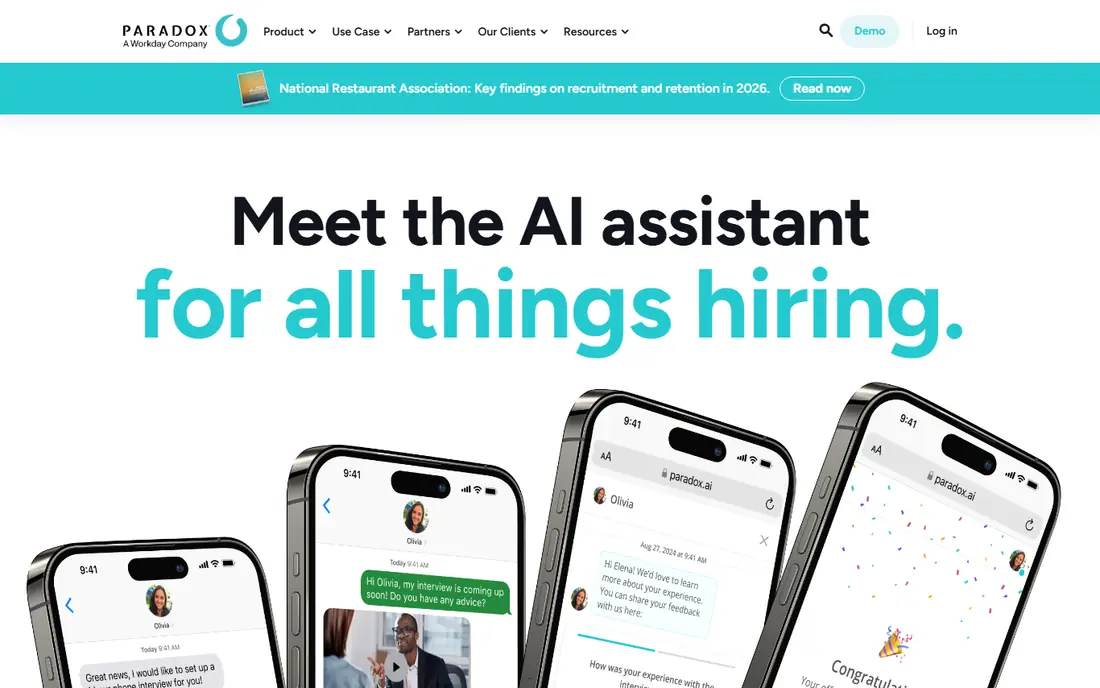
Paradox fits high-volume hourly and frontline hiring, where speed matters more than long recruiter calls. Its assistant, Olivia, screens candidates by chat and SMS, answers questions, and books interviews around recruiter calendars. That 24-hour availability helps retail, hospitality, healthcare, and logistics teams with many locations. The catch is cost and rollout. Paradox publishes no price on its own site, and third-party listings suggest a higher starting point than small-team tools. Workday acquired Paradox in 2025, so Workday customers gain a natural integration path, while smaller teams should expect a sales-led process.
- Conversational screening by chat and SMS
- Automated scheduling
- Many languages
- No published price
- Implementation suits larger employers
- No free trial in most listings
HireVue fits enterprises screening thousands of applicants with structured video interviews and assessments. Recruiters can use preset questions, scoring guides, and game-based assessments to compare candidates on the same criteria. Integrations with major HR systems help large teams keep data in one place. The honest limit is access for small teams. HireVue is quote-only, with enterprise pricing and a longer sales process, so it is not a quick self-serve trial. Teams that hire in volume and need consistent, auditable screening will value that structure, while small teams should look at Workable or Manatal first.
- Video interviews and assessments
- Structured scoring
- Enterprise integrations
- Quote-only pricing
- Enterprise focus
- Scheduling can be an add-on at entry tiers
Juicebox fits recruiters who spend too long on Boolean search and want plain-language sourcing. Its PeopleGPT search lets recruiters describe a role in words and receive matching profiles, with workflows that can run sourcing steps on their behalf. That suits technical and niche roles where LinkedIn alone feels thin. The trade-off is scope. Juicebox finds candidates, but it does not replace an applicant tracking system for pipelines, interviews, and offers. Pair it with Workable, Greenhouse, or Manatal when you need both sourcing and tracking, and check credit and agent costs before scaling.
- Natural language sourcing search
- Large profile database
- Agentic sourcing workflows
- Sourcing only, not full applicant tracking
- Extra agents cost more
Fetcher fits small teams that want passive candidate outreach without hiring a sourcer. It finds candidates, matches them to a role, and runs email campaigns on a schedule, so recruiters receive replies instead of starting every search from zero. That hands-off model suits teams with steady but not enterprise hiring. The catch is control. Automated outreach still needs human review of messages, targeting, and replies, or it can feel generic to candidates. Check plan limits on leads and campaigns, because pricing varies by volume and by whether you choose a managed or self-serve tier.
- Automated candidate outreach
- Email drip campaigns
- Matching to role requirements
- Pricing varies by plan and volume
- Outreach needs human review
Greenhouse fits mid-size and enterprise teams that want structured, consistent hiring at scale. It offers interview kits, scorecards, structured workflows, and a large integration marketplace, which helps teams compare candidates fairly and keep hiring data clean. That structure also supports compliance and reporting. The honest trade-off is price and setup. Greenhouse publishes no starting price, and onboarding can add cost, so small teams may find Workable or Manatal faster and cheaper. For teams hiring across many roles and interviewers, that structure is often worth the sales process.
- Structured interview workflows
- Large integration marketplace
- Strong reporting
- Quote-only pricing
- Onboarding can be a paid add-on
- More tool than small teams need
Zoho Recruit fits small businesses already using Zoho, or teams that want a low-cost AI recruiting tool with applicant tracking. It offers job posting, candidate pipelines, AI matching, and integrations with Zoho CRM and other Zoho apps. The per-recruiter price keeps costs predictable for small teams. The catch is AI depth. Zoho Recruit covers matching and automation well for its price, but it does not match Paradox for conversational screening or HireVue for video assessment. Choose it when you need an affordable all-round recruiter, and add a specialist when one hiring stage becomes a bottleneck.
- Low per-recruiter price
- AI matching
- Zoho system integrations
- AI depth is lighter than specialist tools
- Interface feels busy to some users
How we picked these
We compared official feature pages, pricing pages, integration pages, and privacy policies, then checked public reviews for screening quality, scheduling, and ease of use. We gave weight to published pricing, sourcing quality, screening and scheduling automation, ATS integration, and compliance features such as bias audit information. We did not claim hands-on testing, and we treated quote-only pricing as a real cost in time and negotiation, not as a neutral detail.
How to choose an AI recruitment platform
Start with one bottleneck. If sourcing is slow, shortlist Juicebox or Fetcher. If screening and scheduling consume recruiter time, shortlist Paradox or Workable. If interview consistency is the problem, shortlist HireVue or Greenhouse. Buying a full platform for one bottleneck often adds cost without fixing the real delay.
Check compliance and human oversight early
Ask how AI scores are explained, whether recruiters can override them, and what audit or adverse-impact reporting the vendor provides. In some regions, AI hiring tools face audit, consent, and disclosure rules, so involve HR and legal before rolling a tool out to candidates.
Run a pilot on a real role
Use a trial or pilot on one live vacancy and measure time to shortlist, candidate response rate, and recruiter hours saved. A demo with sample data hides integration gaps, data quality issues, and candidate experience problems that only a real role reveals.
Frequently asked questions
What is the best AI recruitment platform for small businesses?
Workable and Manatal suit small businesses, with Workable offering an all-in-one system and Manatal offering a lower per-user price. Zoho Recruit also suits small teams, especially those already using Zoho apps.
What are the best AI hiring platforms for high-volume hiring?
Paradox suits high-volume hourly hiring through conversational screening and scheduling, while HireVue suits enterprise video screening at scale. Both are quote-led, so budget for a sales process and implementation time.
What is the best AI tool for recruiters focused on sourcing?
Juicebox suits natural-language sourcing search, while Fetcher suits automated outbound outreach. Choose Juicebox when you want to search and control sourcing yourself, and Fetcher when you want outreach to run with less daily input.
Do AI recruitment tools replace recruiters?
No, they automate parts of sourcing, screening, and scheduling, but final hiring decisions should stay with humans. Recruiters still need to review scores, check context, talk to candidates, and make judgement calls that a model cannot make alone.
How much do AI recruitment platforms cost?
Prices range from $15 per user per month at Manatal to $299 per month at Workable for small headcount bands, with enterprise tools quoted by sales. Check headcount bands, seat counts, credit use, add-ons, and implementation fees before comparing headline prices.
Are AI hiring tools fair and legal?
They can be used lawfully when vendors provide bias audit information, consent flows, and human oversight, and when employers follow local rules. Ask vendors for adverse-impact reporting and disclosure options, and check rules that apply in your hiring locations.
Sources we checked (8)

Online Jobs is an independent blog about careers, online work, learning new skills and the tools that help people earn. More about us.
Keep reading
All posts
Zoom Alternatives
Zoom alternatives compared for 2026: Google Meet, Microsoft Teams, Webex, Jitsi and more for free calls, large meetings and webinars for teams and classrooms.
Top Rated Poster Maker Software
Top rated poster maker software compared for 2026: Canva, Adobe Express, VistaCreate, PosterMyWall and more for events, sales and classrooms for US users.
Surfshark Alternatives
Looking for Surfshark alternatives? We compare 8 VPN services on price, privacy, streaming, and device limits to help you find a VPN that fits your needs.