Best AI SEO Tools for SEO Teams in 2026: 9 Tools Compared


Live content scoring for teams · Starting price: $49 per month
How we put this together: we compare official feature and pricing pages, app store listings, privacy policies and public user reviews. Prices change, so check the provider's site before you pay.
Key takeaways
- Surfer and Frase cover the daily brief-to-draft workflow for most SEO teams.
- Clearscope suits larger editorial teams where unlimited seats change the cost maths.
- MarketMuse fits topic planning across a whole site, not single-page fixes.
- NeuronWriter and Content Harmony give smaller teams a lower-cost route to scoring and briefs.
- Semrush and Ahrefs add AI features to suites teams may already pay for, so check overlap before buying a separate tool.
Quick comparison
| Name | Who it suits | Starting price | Free option | |
|---|---|---|---|---|
| Surfer SEO | Live content scoring for teams | $49 per month | Free trial | Visit |
 Frase | Research to draft in one workspace | $49 per month | Free trial | Visit |
 Clearscope | Shared editorial scoring | $129 per month | No | Visit |
 MarketMuse | Site-wide topic planning | See website | Yes | Visit |
 NeuronWriter | Low-cost scoring and briefs | $19 per month | Free trial | Visit |
 Content Harmony | Briefs priced by volume | $50 per month | Free trial | Visit |
 Scalenut | Clusters, drafting and optimisation | See website | Free trial | Visit |
 Semrush | Suite with AI search tracking | $139 per month | Free trial | Visit |
 Ahrefs | Suite with AI content help | $129 per month | Yes | Visit |
The best AI SEO tools for SEO teams
AI SEO tools for teams differ from solo writing apps. They must share briefs, keep scoring consistent across writers, track many pages at once, and show whether published work moves in search and in AI answers. The tools below are judged on that team job, not on single-article flair.

Surfer is the default pick for teams that publish often and need one scoring standard. Writers open a brief, see terms, headings and length guidance from top pages, and watch the score move as they edit. Editors can then review against the same score instead of trading vague feedback about length or keywords. The billing detail matters for planning. Lower plans use annual document credits, so a team that publishes in bursts must plan the year, not just the month. Check document counts, tracked pages and AI features before you sign, and test the editor with two writers on the same brief.
- Live editor score while writers draft
- SERP analysis and audit tools
- Content planner for clusters
- Annual credits on lower plans reset yearly, not monthly
- AI writing and tracking features sit on higher tiers or add-ons
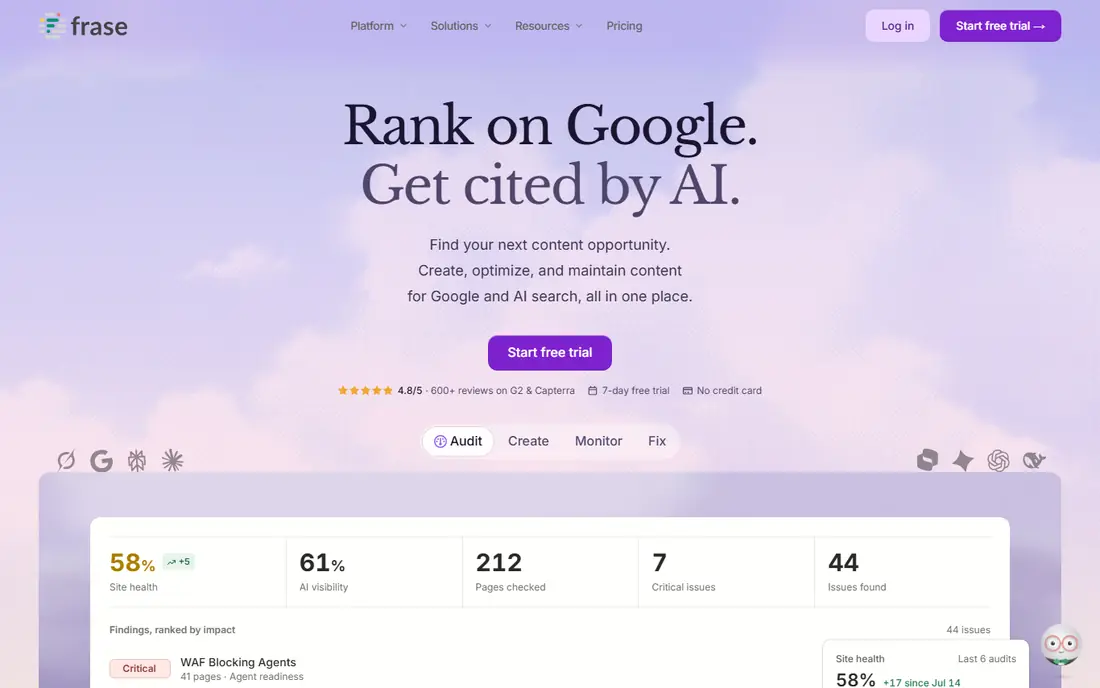
Frase suits teams that lose time moving between research docs, briefs and editors. Research a query, build a brief from top pages, draft inside the same workspace, and score the result without exporting to another tool. That single flow helps small teams ship more pages with fewer handoffs. Starter limits are the main check. One seat, one site and a capped article count suit a solo writer or a small site, while a team with several writers will need a higher tier. Trial the full flow on a real topic, including publishing, before you judge the price.
- Fast SERP research and brief building
- Draft and optimisation in one flow
- AI visibility tracking on some plans
- Article and audit limits on the starter plan are tight for busy teams
- White-label reporting is limited to higher tiers
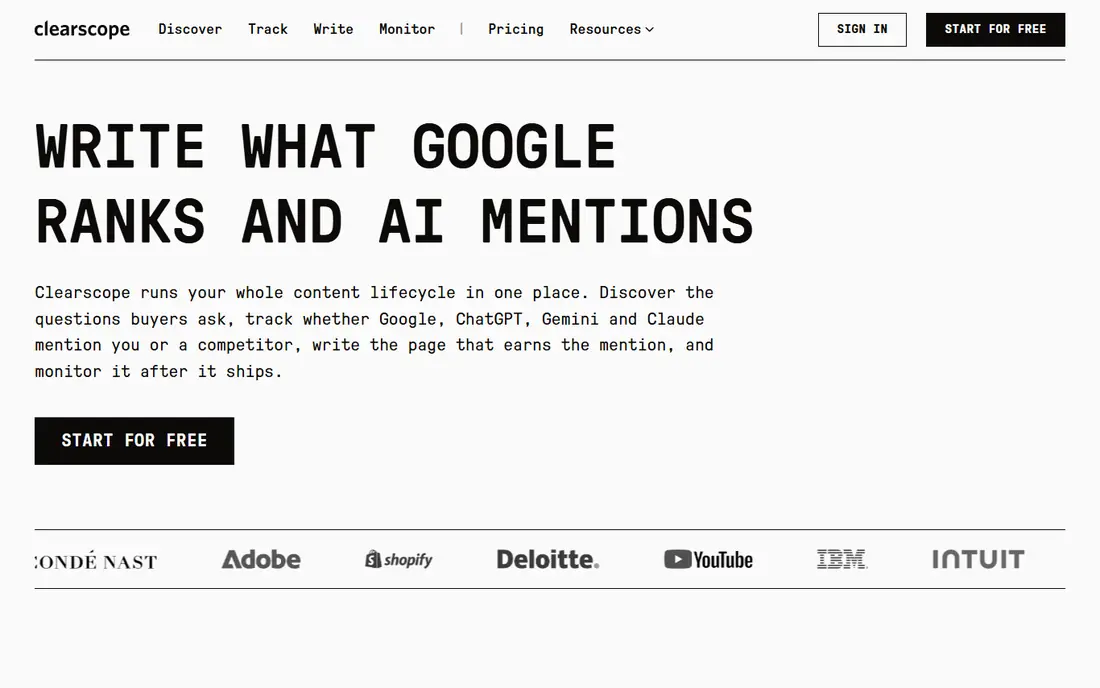
Clearscope is built for editorial teams where many people touch the same content. Unlimited seats mean a team of ten editors does not pay per head, which changes the comparison against per-seat tools. The editor itself is simple, with term suggestions drawn from top-performing pages and a clear relevance score. The price only makes sense if the team actually shares the workspace. A solo writer pays a premium for seats they will not use, and draft limits still cap monthly output. For a newsroom-style team, though, the shared standard can cut revision rounds and keep tone consistent.
- Clean editor that writers learn fast
- Unlimited users and projects on every plan
- Consistent term guidance
- Highest entry price in this list
- Draft and page limits still apply despite unlimited seats
MarketMuse answers a strategy question that page scorers do not. Instead of asking how to improve one article, it models which topics a site covers well, where gaps sit, and which clusters will build authority over time. That view helps a team plan a quarter of content rather than reacting to single keywords. The cost and learning curve mean it fits larger teams with a big library. Small teams may get more value from a page scorer and a spreadsheet plan. Use the free limited queries first, and ask sales for a clear price tied to your site size before you commit.
- Topic modelling across a whole domain
- Content inventory and gap analysis
- Useful for large site strategy
- Paid tiers are demo-gated, so pricing needs a sales conversation
- Interface and method take time to learn
NeuronWriter is the value pick for teams that need scoring without a large monthly bill. Bronze plans cover a useful number of analyses and projects, and the tool handles non-English content well, which matters for teams publishing in several languages. Writers still get term guidance and a content score, just in a plainer workspace. Expect some rough edges in navigation and reporting. If your team needs polished client dashboards or deep integrations, a higher-priced tool may save time. If the main job is scoring drafts on a budget, NeuronWriter covers it.
- Low entry price for scoring and briefs
- Good support for many languages
- Content planner and internal linking help
- Interface feels less polished than Surfer or Clearscope
- Integrations are fewer
Content Harmony focuses on the brief, which is often where team content fails. A good brief gives the writer the search intent, headings, questions, terms and competitor notes in one place, so editors spend less time fixing drafts that missed the point. Unlimited users help larger teams share that standard. The model suits teams that produce a known number of briefs each month. If volume swings widely, check the cost at your peak month, not your average. Pair it with your normal editor, since many teams still draft in docs or a CMS after the brief is done.
- Structured briefs that writers can follow without guesswork
- Unlimited users
- Keyword and SERP data in the brief
- Priced by workflow volume, so heavy months cost more
- Drafting happens outside the brief tool for many teams
Scalenut tries to cover the full content pipeline, from cluster planning to drafting and optimisation, with monitoring after publication. Teams that want one vendor for that pipeline will like the joined-up flow, especially when AI search visibility is part of the brief. The traffic view also helps editors see which pages need refreshes. That breadth is also the risk. No single feature here is as deep as a specialist scorer or a full suite, and pricing pages should be read carefully before purchase. Trial it on a full cluster, not a single article, to see whether the workflow holds up at team volume.
- Keyword clusters, drafting and optimisation in one suite
- AI search monitoring on some plans
- Traffic analysis for published pages
- Plan names and prices have changed often, so verify the current page
- Breadth can dilute depth in any single feature
Semrush is worth shortlisting when a team already uses it for research. Adding AI search tracking and a content toolkit to an existing suite can be cheaper than buying a separate AI tool, and the data stays in one account. Teams can track classic rankings and AI prompt visibility side by side for the same pages. Check exactly which AI features are included in your plan. Some sit in add-ons or higher tiers, and the headline suite price does not always include them. Map your current Semrush use first, then price only the missing AI gap.
- Keyword, audit and rank tools plus AI visibility tracking
- Content toolkit for briefs and optimisation
- Large team ecosystem
- AI features may sit in separate bundles
- Extra users add cost
- Learning curve for new team members
Ahrefs fits teams that start content from data, not from a blank page. Keyword difficulty, competitor top pages and link data help a team pick topics with a real chance to rank, and the AI content helper can shape a draft around that research. That data-first start suits SEO-led teams more than brand-led editorial teams. It does not replace a brief or scoring editor for most teams. Use Ahrefs to choose and validate topics, then pair it with Surfer, Frase or Clearscope for the writing standard. That pairing keeps research and editing each in the tool built for the job.
- Strong keyword and backlink data behind content work
- AI content helper for drafts
- Free Webmaster Tools for own sites
- Content helper limits and pricing differ by market
- Not a full editorial workflow on its own
How we picked these
We compared official feature pages, pricing pages, app store listings, privacy policies and public reviews for AI SEO tools live in October 2026. We favoured tools with team features such as shared workspaces, seat models, brief sharing and reporting, over solo apps with a team label but no shared workflow. We did not run hands-on ranking tests, and we do not claim that a higher content score guarantees a ranking. Prices change often, so check the vendor pricing page before you buy. Document, draft and credit limits differ by plan, and annual billing can change the monthly rate shown here.
Running AI SEO tools as a team
Set one scoring standard
Pick one scorer for the team and use it for every draft. Mixed scores from different tools confuse writers and make editor feedback hard to compare. Document the target score range, and note that it is guidance for coverage, not a quality grade on its own.
Keep human review in the loop
AI drafts and scores still need fact checks, brand checks and product checks. Assign an editor to verify claims, links and prices before publication, and keep a short checklist for medical, financial or legal topics. Speed gains disappear if a published error needs a correction.
Track more than rankings
Classic rank tracking plus AI visibility tracking gives a fuller picture in 2026. Record which prompts and engines mention your pages, and compare that with clicks from Search Console. A page can appear in AI answers without earning a click, so plan content for both outcomes.
Review limits each quarter
Document caps, seat counts and credit resets change with team size and publishing pace. Review usage each quarter, and move tiers before a busy period, not during it. A plan that fit a team of three may fail a team of eight in the same year.
Frequently asked questions
What is the best AI SEO tool for a small SEO team?
Frase or Surfer usually fits a small team best, because both cover research, briefs and scoring in one workspace. Frase wins on research-to-draft speed, while Surfer wins on live scoring. Pick the workflow your writers will actually use each week.
Do AI content scores guarantee higher rankings?
No. A score measures coverage against top pages, not authority, links, page speed or user satisfaction. Use scores to shape drafts, then check rankings, clicks and conversions after publication. A well-scored page with weak facts or a poor user experience will still underperform.
How do teams handle AI search visibility?
Track prompts that relate to your core topics, note which engines cite your pages, and compare that data with Search Console clicks. Update pages that AI answers cite but users do not click, and add clear facts, tables and definitions that answer engines can quote accurately.
Is Clearscope worth the higher price?
For a larger editorial team, yes, because unlimited seats can make the per-person cost lower than per-seat rivals. For a solo writer or a team of two, the entry price is hard to justify. Work out the cost per active editor, not just the headline monthly price.
Should we buy a separate AI tool if we already use Semrush or Ahrefs?
Not always. Check what AI features your current suite plan already includes, and price only the gap. A separate scorer makes sense when your team needs a shared writing standard that the suite does not provide, or when brief volume justifies a specialist tool.
How much AI-generated text should a team publish?
Use AI for research, outlines and first drafts, then edit for accuracy, voice and original insight. Publish work that adds facts, examples or analysis a reader cannot get from a generic summary. That human layer is what keeps content useful as AI answers grow more common.
Sources we checked (9)

Online Jobs is an independent blog about careers, online work, learning new skills and the tools that help people earn. More about us.
Keep reading
All posts
ZoomInfo Alternatives
The best ZoomInfo alternatives in 2026, compared on price, free plans, data coverage, and which tool fits small teams or large sales teams best in detail.
Workday Alternatives
We compared the best workday alternatives for HR, payroll, and global hiring, from BambooHR and Gusto to Rippling, Deel, and HiBob for growing teams in 2026.
Which SaaS Tools Have the Best Customer Support
Which SaaS tools have the best customer support? Compare eight popular tools on help centres, live help, response options and overall support quality.