Best AI Security Platforms in 2026: 8 Tools Compared


Enterprises wanting end-to-end AI security on one platform · Starting price: See website
How we put this together: we compare official feature and pricing pages, app store listings, privacy policies and public user reviews. Prices change, so check the provider's site before you pay.
Key takeaways
- Most enterprise AI security platforms are sold by quote, not by published price, so budget comparisons need a sales conversation and a scoped pilot.
- Runtime guardrails from Lakera Guard and Prisma AIRS stop prompt injection and data leakage live, while red teaming tools like Mindgard and garak prove whether those defenses actually work.
- Model scanning from HiddenLayer and posture management from Wiz cover the supply chain and cloud layers that guardrails alone cannot see.
- Agent security from Zenity matters once employees build copilots and autonomous agents, because the risk moves from prompts to the actions an agent takes.
- Two genuinely free starting points exist: Lakera Guard has a free developer tier, and garak is open source under Apache 2.0.
Quick comparison
| Name | Who it suits | Starting price | Free option | |
|---|---|---|---|---|
| Prisma AIRS | Enterprises wanting end-to-end AI security on one platform | See website | See website | Visit |
 HiddenLayer | Teams protecting proprietary models and AI supply chains | See website | See website | Visit |
 Lakera Guard | Developers needing fast runtime prompt defense | Free | Yes | Visit |
 Cisco AI Defense | Cisco shops wanting network-layer AI guardrails | See website | See website | Visit |
 Wiz AI-SPM | Cloud teams needing AI posture across multi-cloud estates | See website | See website | Visit |
 Zenity | Organizations securing agents and copilots at scale | See website | See website | Visit |
 Mindgard | Security teams wanting automated AI red teaming | Free | Yes | Visit |
 garak | Engineers wanting a free open-source LLM vulnerability scan | Free | Yes | Visit |
The best AI security platforms for every team
Prisma AIRS
Who it suits: Enterprises wanting end-to-end AI security on one platform
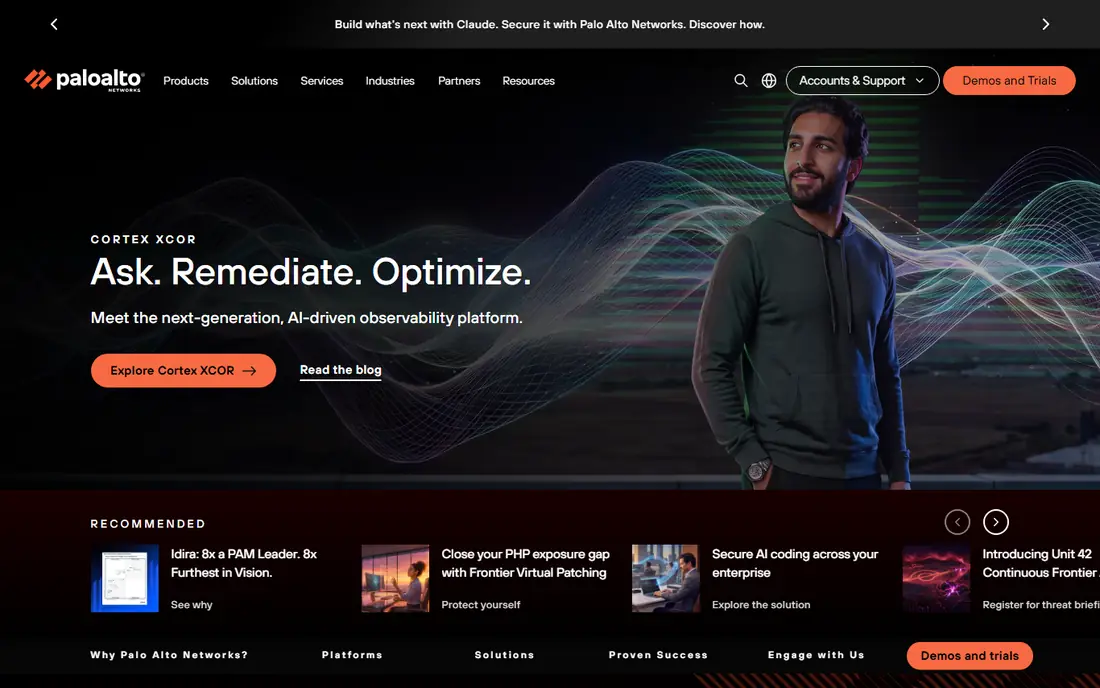
Prisma AIRS is Palo Alto Networks' unified AI security platform, built in part from its acquisition of Protect AI, which closed in July 2025. It covers AI security posture management, runtime security, AI agent security, model security and red teaming, so one platform can discover AI apps, models and agents, scan models for tampering and malicious code, block prompt injection and data exposure at runtime, and simulate attacks before deployment.
The trade-off is complexity. Pricing is enterprise and credit-based, using a bring-your-own-licensing model funded with Software NGFW credits, with runtime API usage measured in monthly token quotas, so there is no simple public price to compare. Deployment can require onboarding cloud accounts, assigning permissions and deploying intercept components. For a large enterprise already standardized on Palo Alto Networks, Prisma AIRS is the natural consolidation choice. For a smaller team, the platform weight and procurement effort may exceed the risk it addresses.
- Covers posture, runtime, agents, models and red teaming in one platform
- Strong network and API enforcement
- Built on Protect AI technology
- Pricing is credit-based and complex
- Deployment needs Palo Alto infrastructure and onboarding
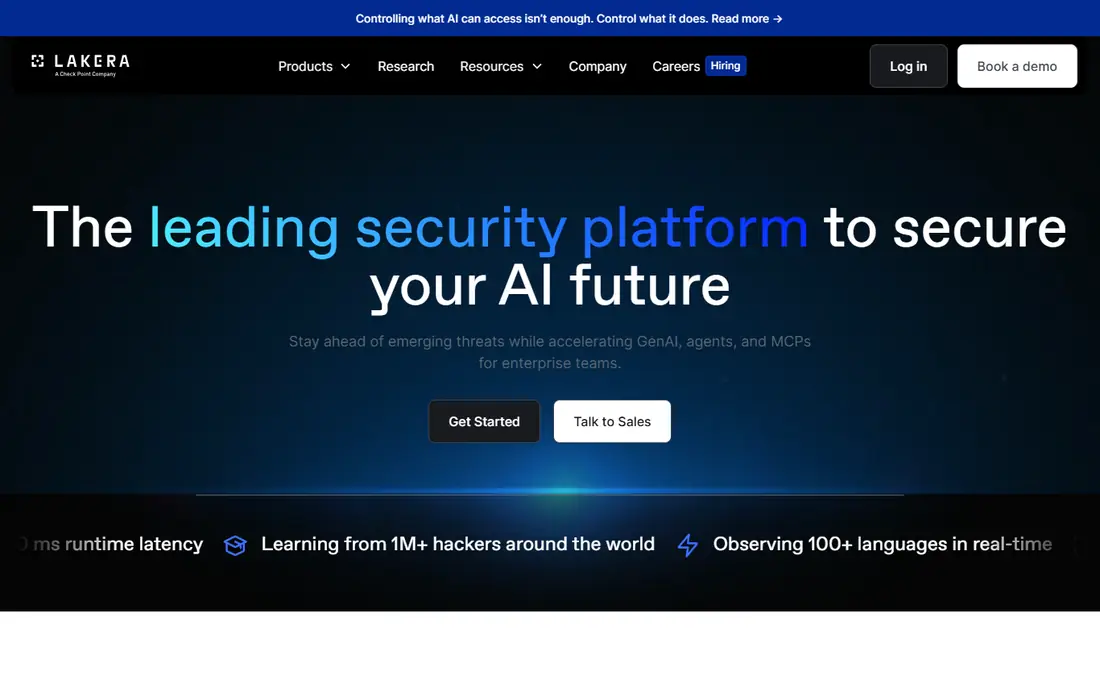
Lakera Guard is the most developer-friendly runtime defense on this list. A single API call screens a prompt or response for prompt injection, jailbreaks, data leakage and content violations, and returns a flagged verdict your code can act on. The vendor reports sub-50 ms latency and coverage of more than 100 languages, with detection informed by Gandalf, its public prompt-injection game, which has collected attack data from more than a million players. That makes Lakera Guard easy to wire into a public-facing chat app in an afternoon.
Lakera is now part of Check Point, which completed its acquisition in November 2025 and made Zurich its global AI security research center. Two honest limits apply: Lakera Guard tells you a message looks like an attack, and your code decides what to do, so it is a detector rather than a policy engine; and on the hosted service, prompts are sent to Lakera, which some regulated teams will want to assess. For teams whose main risk is prompt injection in a live app, it is the fastest place to start.
- Free developer tier
- Sub-50 ms latency
- Single API call to screen prompts and outputs
- Enterprise production pricing is quoted, not published
- A detection API, not a full policy engine
Cisco AI Defense
Who it suits: Cisco shops wanting network-layer AI guardrails
Cisco AI Defense secures AI applications through three functions: discover AI assets across distributed cloud environments, detect vulnerabilities through supply chain scanning and algorithmic testing, and protect runtime applications with guardrails updated from Cisco threat intelligence. Its validation tests models against more than 200 threat subcategories, then generates model-specific guardrails for issues such as prompt injection, data privacy exposure and safety violations, with findings mapped to MITRE ATLAS, the OWASP Top 10 for LLMs and the NIST AI Risk Management Framework.
The platform also extends to agentic AI and the Model Context Protocol, scanning MCP servers for compromised assets, enforcing runtime protections across MCP requests and responses, and detecting agent-specific threats such as memory poisoning, tool misuse and privilege escalation. Pricing is custom and typically bundled into a broader Cisco Security Cloud contract, so buyers should expect a platform conversation rather than a standalone price. For organizations already running Cisco networking and security, the network-layer enforcement is a real advantage.
- Discover, detect and protect across the AI lifecycle
- Algorithmic red teaming across 200+ threat subcategories
- Network-layer enforcement
- Pricing is quoted, not published
- Strongest fit inside Cisco environments
Wiz AI-SPM, the AI security posture management module of the Wiz cloud platform, inventories AI assets across AWS, Azure, Google Cloud and other clouds without agents, using API-based scanning. It connects AI models, applications and data to the wider Wiz Security Graph, which correlates misconfigurations, vulnerabilities, over-permissioned identities and exposed workloads into attack paths, so teams fix the handful of toxic combinations that form real risk rather than thousands of disconnected alerts. Wiz Code and the runtime sensor extend that view into pipelines and production workloads.
Wiz does not publish standard pricing, and evaluation starts with the Wiz team rather than a self-serve signup. Third-party procurement data puts entry coverage for around 100 workloads near $24,000 a year, with larger enterprise contracts running well above $100,000, though those figures are marketplace estimates, not a vendor rate card. For cloud teams that already use Wiz for posture management, AI-SPM is a natural extension. For teams that only need AI guardrails, it is broader and pricier than necessary.
- Agentless multi-cloud scanning
- Security graph links AI risks to cloud attack paths
- Fast time to value
- No published pricing and no self-serve signup
- Premium-tier contracts at scale
Zenity focuses on the layer other AI security tools miss: what an agent does after the model responds. Its platform discovers agents and copilots built on Microsoft Power Platform, Salesforce, ServiceNow and custom environments, maps what each agent can reach, and watches which tools it calls, which files it touches and where it sends data. Policy controls then decide what agents may do, steering them toward appropriate actions and stopping harmful ones before they land, with threats mapped to OWASP and MITRE ATLAS guidance.
That action-level view matters because over-permissioned agents built by business users have become a real gap: a copilot with broad access can exfiltrate data or trigger workflows that no prompt filter would catch. None of the agent security vendors publishes list pricing, and Zenity is sold through enterprise quotes based on agents monitored and deployment scale. Buyers should run a scoped proof of concept against a real slice of production agents, since this category is new enough that live behavior reveals more than any comparison table.
- Discovery, policy, identity and runtime defense for agents
- Strong fit for Microsoft, Salesforce and ServiceNow estates
- No published pricing
- Agent security is a newer category, so pilots matter more than spec sheets
Mindgard is an automated AI red teaming platform that maps the AI attack surface, then attacks it the way an adversary would. Agent-native reconnaissance profiles models, agents, tools and behaviors before attack execution, and adaptive attack agents test for prompt injection, jailbreaks, model extraction and agent misuse, validating which weaknesses are actually exploitable rather than theoretical. Findings come with evidence, attacker context and remediation guidance, mapped to the OWASP LLM Top 10, MITRE ATLAS, the NIST AI Risk Management Framework and EU AI Act requirements.
The platform deploys through APIs, CI/CD pipelines or Burp Suite, and the vendor reports that assessments drop from weeks to hours, with more than 150 publicly disclosed vulnerabilities feeding its knowledge base. A free community tier with up to 10,000 requests a month lets teams test the platform before committing, while enterprise pricing is custom. For security teams that need proof their defenses work, Mindgard is a strong pick.
- Automated adversarial testing with attacker-style reconnaissance
- Free community tier
- Findings mapped to OWASP, MITRE ATLAS and NIST
- Enterprise pricing is custom
- Security-focused output may need a second tool for engineering evaluation workflows
garak, NVIDIA's Generative AI Red-teaming and Assessment Kit, is the open-source baseline for LLM vulnerability scanning. It probes a model for hallucination, data leakage, prompt injection, misinformation, toxicity, jailbreaks and other weaknesses, combining static, dynamic and adaptive probes, and reports a failure rate for each probe family. Comparisons list around 100 attack vectors with up to 20,000 prompts per run, and the tool supports Hugging Face models, OpenAI, Replicate, Cohere, Groq, AWS Bedrock, local ggml models and anything reachable over REST.
Installation is a pip install, and a scan is a single command with a target type and model name, which makes garak easy to add to a release gate. The trade-off is that everything else is on you: there is no hosted dashboard, no managed support and no remediation workflow, so teams must configure, operate and interpret results themselves. As a free first step, or as a complement to a paid red teaming platform, garak is hard to beat.
- Free under Apache 2.0
- Around 100 attack vectors with tens of thousands of prompts per run
- Broad model support
- Command-line only, so teams must run and interpret it themselves
- No hosted dashboard or managed support
How we picked these
We compared official feature pages, product documentation, pricing pages and public reviews for the leading AI security platforms, and we kept only products that are live and supported in October 2026. Protect AI was not listed separately because Palo Alto Networks folded it into Prisma AIRS, and tools that only govern employee AI usage were left out, since they answer a different question from securing the AI apps you build.
We weighted coverage across the AI lifecycle: runtime defense, model and supply chain scanning, posture management, agent security and red teaming. That is why the list mixes broad enterprise platforms with focused tools: no single product covers every layer equally well, and most buyers will combine a runtime guardrail with a red teaming tool, plus posture or model scanning where their estate demands it.
What to check before you choose
Start from your AI estate, not the vendor pitch
Inventory what you actually run first: public chatbots, internal copilots, autonomous agents, third-party models and cloud AI workloads. A single internal chatbot may only need a guardrail API, while a company with agents touching production systems needs agent security and red teaming too.
Run a pilot in shadow mode
No independent benchmark compares prompt-injection detection rates across the enterprise vendors, so vendor-reported percentages should not decide a purchase. Run shortlisted tools in shadow mode against real traffic, measure false positives and latency, and check whether flagged items match attacks your team actually cares about.
Price the whole contract, not the headline
Most enterprise platforms here are quote-based, and costs scale with agents monitored, models scanned, workloads covered and token usage. Ask for the full fee schedule, including runtime API quotas, add-on modules and support tiers, and confirm whether the quote bundles into a wider platform contract.
Plan for agents and MCP now
Agent-specific threats such as tool misuse, memory poisoning and privilege escalation are already in vendor roadmaps, and MCP connections widen the attack surface further.
Frequently asked questions
What is the best AI security platform?
There is no single winner, because the layers differ. Prisma AIRS is the broadest enterprise platform, Lakera Guard is the fastest runtime defense to deploy, HiddenLayer leads on model and supply chain security, and Mindgard leads on automated red teaming. The best choice depends on whether your main risk is live attacks, poisoned models, shadow agents or untested defenses.
What is the difference between AI guardrails and AI red teaming?
Guardrails and firewalls apply policies to prompts, responses or agent actions at runtime, blocking attacks as they happen. Red teaming tests whether those controls actually work by attacking the system in advance, then reporting which defenses held and which failed. Guardrails without red teaming leave you guessing, and red teaming without guardrails leaves findings with no live protection.
Do I need an AI security platform if I only use one internal chatbot?
Probably not yet. A single low-risk internal tool may be covered by a free guardrail tier or an open-source scanner like garak. These platforms earn their cost when you run multiple AI features, autonomous agents or third-party models across teams, where one point of enforcement and monitoring saves more effort than it costs.
How much do AI security platforms cost?
Most enterprise platforms are quote-based, with contracts shaped by agents monitored, models scanned, workloads covered and usage volume. Entry cloud contracts for tools like Wiz are reported near $24,000 a year for small estates, while large enterprise deals run far higher. Lakera Guard, Mindgard and garak offer free entry points, so small teams can start without a sales conversation.
What is AI security posture management?
AI security posture management inventories AI apps, models, agents and data across your estate, then assesses their risks and misconfigurations in one view. Wiz AI-SPM and the posture modules in Prisma AIRS and HiddenLayer do this, linking AI risks to cloud attack paths so teams prioritize fixes that actually reduce exposure.
What is prompt injection, and why does it matter?
Prompt injection is an attack where crafted input tricks a model or agent into ignoring its instructions, leaking data or taking unwanted actions. It holds the top spot in the OWASP Top 10 for LLM Applications, and runtime guardrails remain the main defense, since traditional web security tools cannot see inside model conversations.
Sources we checked (11)
- https://www.paloaltonetworks.com/
- https://hiddenlayer.com/
- https://www.lakera.ai/
- https://www.cisco.com/
- https://www.wiz.io/
- https://www.zenity.io/
- https://mindgard.ai/
- https://github.com/NVIDIA/garak
- https://securityboulevard.com/2026/06/top-8-ai-app-security-software-in-2026/
- https://www.cisco.com/c/en/us/products/collateral/security/ai-defense/ai-defense-ds.html
- https://mindgard.ai/automated-ai-red-teaming

Online Jobs is an independent blog about careers, online work, learning new skills and the tools that help people earn. More about us.
Keep reading
All posts
DocuSign Alternatives
We compared the best DocuSign alternatives on price, free plans, templates, audit trails and ease of use, including free DocuSign alternatives for small teams.
Best Spend Management Software
Looking for the best spend management software? We compared 8 platforms on cards, approvals, travel and price to help your finance team pick the right one.
Best Recruitment Software for Direct Hire
Looking for the best recruitment software for direct hire? We compared 8 ATS tools on price, pipelines, interviews and hiring tools to pick the right one.